
EASN 2025: New operational concepts in air transport
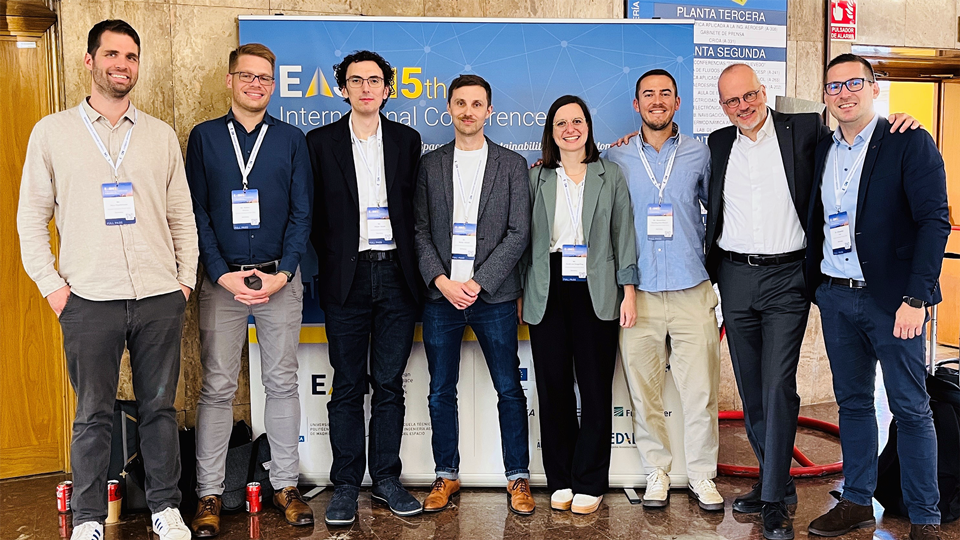

In October 2025, the 15th EASN International Conference took place in Madrid. Organised by the European Aeronautics Science Network (EASN) and the Universidad Politécnica de Madrid, the conference brought together academia, industry, and policymakers to discuss current developments and future perspectives in European aeronautics and space. The DLR Institute of Air Transport presented in-depth analyses and practical concepts that provide key impulses for the continued development of climate-compatible aviation.
Optimised flight trajectories and emission modelling with pyTOM and GRIDcast
A major focus of the DLR contributions lay in optimising flight trajectories and modelling and assessing future aviation emissions. Two in-house tools were presented that support the analysis of sustainable air transport scenarios:
The Python-based optimisation tool pyTOM enables simulation and optimisation of aircraft trajectories in complex traffic situations with multiple objectives such as climate impact, operating costs, and time1. The tool allows large-scale traffic scenarios to be calculated and analysed efficiently, providing insight into the effects of different operational strategies on climate and efficiency.
The simulation tool GRIDcast serves as a model-based estimator for global emission distributions2. It integrates technological, operational, and market developments to explore potential transformation pathways for air transport. Within minutes, the tool generates global 3D emission inventories based on user-defined scenarios, considering factors such as regional growth rates and the introduction of sustainable propulsion technologies.
EU strategy for non-CO2 effects in aviation
Since January 2025, airlines have been required to monitor and report the non-CO2 emissions of their flights under the EU Non-CO2 MRV (Monitoring, Reporting and Verification) framework. By December 2027, the European Commission may propose the inclusion of non-CO2 effects in the EU ETS. In their presentation3, the DLR team outlined the opportunities, challenges, and risks of these developments.
Mitigating non-CO2 effects offers high climate potential at comparatively low cost and could accelerate operational and technological improvements through policy measures. This presents a valuable opportunity to reduce the climate impact of aviation and contribute to the goals of the Paris Agreement.
At the same time, integrating non-CO2 effects remains challenging: uncertainties in weather, climate metrics, and models must be taken into account; proven CO2 measures must be balanced against less certain non-CO2 ones; and policy design must avoid unintended incentives or carbon leakage when applied regionally. As non-CO2 effect calculations are complex and model-based, a gradual implementation is advisable to build trust and engage stakeholders.
Energy efficiency through cooperative flight concepts
In a study on aerodynamic formation flight (Wake Energy Retrieval), researchers examined the practical feasibility of this concept4. In formation flight, following aircraft utilise the wake energy of leading aircraft to reduce their own fuel consumption. The study identified operational uncertainties in flight planning and quantified their impact on the success rate of formation missions.
By developing targeted strategies to manage these uncertainties, the researchers aim to improve the operational feasibility of formation flight. The study demonstrated that measures such as flexible departure delays can significantly increase the success rate of formation pairings. Further research on enhanced coordination between air traffic control, ground operations, and airlines could unlock additional efficiency potential.
Air quality at european airports under stricter EU limits
During the poster session, the institute presented an analysis of air quality trends at European airports in light of the revised EU Air Quality Directive, which will introduce significantly stricter limits for pollutants such as nitrogen dioxide (NO2) from 2030 onwards5. Based on DLR traffic scenarios and emission data, the study examined how many airports currently – and in the future – might exceed the new NO2 thresholds. The findings show that around 15 per cent of European airports currently exceed the forthcoming annual average NO2 limit of 20 µg/m3. Depending on the scenario, this share could vary between six and over 20 per cent by 2050 – depending on technological progress and the uptake of sustainable fuels.
1 M. Mendiguchía Meuser, T. Ehlers, A. Lau, B. Lührs, R. Grunau, R. Kanitz “pyTOM: A python-based Multicriterial Optimization Framework for Aircraft Trajectories in large Traffic Scenarios”, presentation at the 15th EASN International Conference 2025, Madrid, Spain.
2 R. Grunau, M. Niklaß, B. Lührs “Efficient modeling of aircraft emission inventories for technology impact assessment in future markets”, presentation at the 15th EASN International Conference 2025, Madrid, Spain.
3 M. Niklaß, Z. Zengerling, K. Kölker, M. Mendiguchia Meuser, T. Ehlers, A. Lau, R. Eichinger, K. Dahlmann, S. Matthes, V. Grewe, F. Yin, A. Stefanidi, T. Roetger, F. Crova “Integrating climate policies into air transport operations: Challenges, Risks, and Impacts”, presentation at the 15th EASN International Conference 2025, Madrid, Spain.
4 M. Swaid, V. Gollnick “Strategic Fuel Planning for Aerodynamic Formation Flight: Quantifying Delay Flexibility for Rendezvous Success”, presentation at the 15th EASN International Conference 2025, Madrid, Spain.
5 N. Flüthmann, M. Gelhausen, A. Leipold, H. Pabst, S. Chatterjee “Air Traffic Scenarios and Emission Development in Context of the revised EU Air Quality Standards”, poster at the 15th EASN International Conference 2025, Madrid, Spain.