
ICAS 2026: Emissions, flight trajectories and innovative air transport concepts

- Global emissions: Analysis of global air transport and the impact of geopolitical conflicts on flight routes and emissions
- Optimised flight trajectories: New approaches to modelling, climate-impact optimisation and flight route planning
- New air transport concepts: Challenges of Advanced Air Mobility and efficient fleet planning for Urban Air Mobility
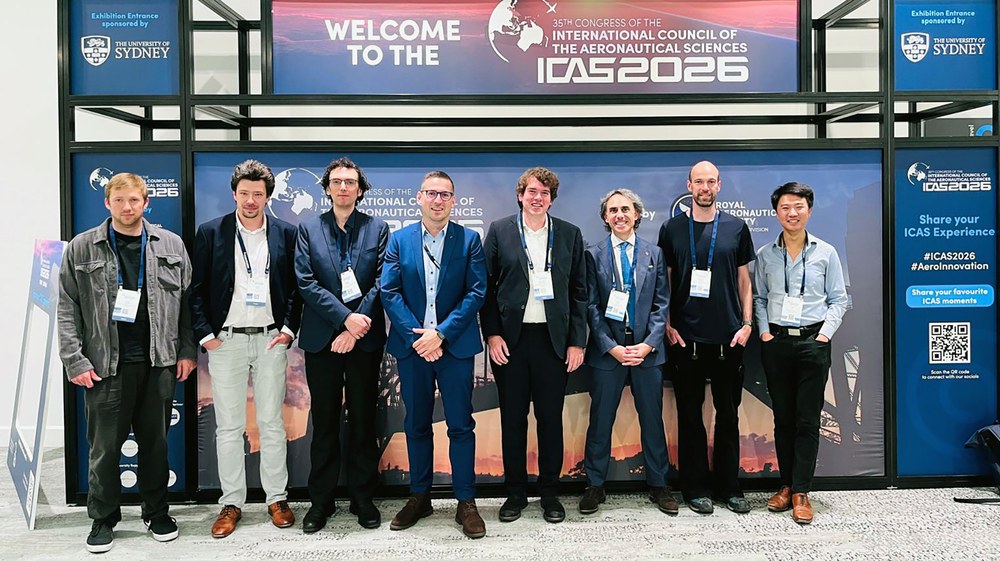
The International Council of the Aeronautical Sciences (ICAS) Congress brings together experts from academia and industry in the international aerospace sector every two years. The focus is on current developments and challenges in aviation, including environmental and sustainability topics, new aircraft and propulsion concepts, and the future operation of air transport systems. The 35th edition took place from 13 to 18 September 2026 at the International Convention & Exhibition Centre in Sydney. With its contributions, the DLR Institute of Air Transport brought current research on various aspects of the air transport system and future flight operations into the scientific exchange.
Global air transport emissions in 2023
The emissions monitor presented for 2023 provides a detailed overview of global air transport emissions based on actual flight trajectories across different air transport segments. For this purpose, ADS-B flight data were combined with information on flight plans, aircraft performance and meteorological conditions. This makes it possible to capture not only scheduled passenger services but also segments such as cargo and general aviation flights.
The inventory covers 40.2 million flights. For 2023, it records, among other figures, global kerosene consumption of 244.3 million tonnes and 771 million tonnes of CO₂ emissions from global air transport. The analysis also shows how geopolitical conflicts and restricted airspace affect flight routes: in particular, restrictions on airspace between Europe and Asia led to significant detours in some cases in 2023. The emissions monitor therefore also provides a basis for investigating the effects of changes in airspace structures and geopolitical conditions on air transport.1
Modelling flight trajectories for business aviation
Another study, conducted in collaboration with Rolls-Royce Germany, focused on modelling flight trajectories in business aviation. As less complete flight and performance data are often available for business aircraft than for commercial air transport, the study examines different modelling approaches depending on the available data. The model developed at DLR enables business aviation trajectories to be calculated at different levels of accuracy. The method was validated using real-world measurement data and demonstrated sufficient accuracy for applications such as climate-impact analyses, life-cycle assessments and the modelling of air traffic flows. However, uncertainties – for example due to missing information on actual take-off weight or gaps in ADS-B flight profiles – affect the accuracy of the calculated mission parameters.2
Planning climate-optimised and safe flight trajectories
Another study by the DLR Institute of Air Transport, the DLR Institute of Flight Guidance and the DLR Institute of Atmospheric Physics addressed the question of how climate-optimised flight trajectories can be safely integrated into air traffic. Optimising individual flight routes can help to reduce the climate impact of aviation, particularly non-CO2 effects. At the same time, aircraft must maintain sufficient separation from one another for safety reasons.
The method presented therefore combines trajectory optimisation with subsequent conflict resolution. Using the pyTOM trajectory optimiser and the NDMap deconfliction tool, the researchers investigated to what extent climate-optimised flight routes can be implemented without conflicts and how much of the original climate mitigation potential can be retained. The results show that reducing climate impact is possible while maintaining the required safety distances.3
Adaptive flight routes for atmospheric measurements
Intelligent trajectory planning can benefit not only climate-compatible aircraft operations. Another study demonstrates how unmanned aircraft can be specifically deployed for atmospheric measurements. As part of the MEASURE project, a Remotely Piloted Aircraft System (RPAS) was developed together with the German Meteorological Service (DWD) and enviscope GmbH to measure particulate matter and radioactive substances in contaminated airspace – for example, to enable effective measurements of volcanic ash.
For this purpose, DLR developed three-dimensional adaptive trajectory optimisation. The flight route is planned based on spatial data and adjusted during the flight as soon as new measurement data become available. During a flight campaign in Andøya, Norway, in 2025, the complete data chain was demonstrated: the optimised flight routes were flown while measurement data were collected. Based on these data, new flight routes were subsequently calculated and flown by the operator. The work therefore demonstrates an approach to flexible, data-based flight planning for efficient atmospheric surveying with an RPAS under changing atmospheric conditions.4
Opportunities and challenges of Advanced Air Mobility
An international review study, in which the DLR Institute of Air Transport also participated, examined the current state of Advanced Air Mobility (AAM). The study compares the state of AAM development worldwide and examines the technical, regulatory, economic and societal conditions required for the successful integration of new aircraft.
The analysis shows that the framework conditions still differ significantly between countries and regions. Different regulatory approaches, high development and infrastructure costs, operational safety issues and the integration of highly automated systems present key challenges. For further development, the study identifies internationally harmonised regulation, digital and performance-based airspace concepts, and robust solutions for safety, infrastructure and public acceptance as particularly important.5
Booking lead times affect fleet requirements for Urban Air Mobility
The planning of future Urban Air Mobility networks was also addressed in a contribution from the institute. The study examined how the time between booking a flight and its actual departure affects the fleet size required and the operation of a UAM network. To this end, an existing mission assignment and fleet planning model was extended to include a rolling planning horizon.
The results for the potential network examined in Hamburg show that increasing the possible booking lead time from 60 to 120 minutes could reduce the required fleet size by up to 17 per cent, while energy demand in this scenario increases by only around three per cent. At the same time, longer booking lead times reduce passenger flexibility. A lead time of between 90 and 120 minutes could provide a balance between operational efficiency and user flexibility.6
Further links
1 Clococeanu, M., Weder, C. M., Bruder, H., Zengerling, Z. L. "Global Emission Monitor for 2023", 35th Congress of the International Council of the Aeronautical Sciences – ICAS 2026, Sydney, Australia.
2 Zengerling, Z. L., Lau, A., Clococeanu, M., Kanitz, R., Schwengler, J., Vogel, A., Abu-Taa, K. "Flight Mission Modeling with Varying Baseline Data: Application in Business Aviation", 35th Congress of the International Council of the Aeronautical Sciences – ICAS 2026, Sydney, Australia.
3 Ehlers, T., Lau, A., Mendiguchia Meuser, M., Kuenz, A., Dietmüller, S., Matthes, S. "Joint Trajectory Optimization and Deconfliction for Climate Impact Mitigation", 35th Congress of the International Council of the Aeronautical Sciences – ICAS 2026, Sydney, Australia.
4 Buchtal, K. A., Lau, A. "Three-Dimensional Adaptive Trajectory Optimization for RPAS-Based Atmospheric Measurements", 35th Congress of the International Council of the Aeronautical Sciences – ICAS 2026, Sydney, Australia.
5 Kramar, V., Asmer, L., Schuchardt, B., Badea, A., Teutsch, J., Vreeken, J., Sunil, E., Gungen, B., Kok, J., Murça, M. C. R., Borshchova, I., Keillor, J., Pinjala, L., Hebbar, A., Madhuranath, G., Manindrakumar, D. M., Yokoyama, N., Park, H. U., Kopardekar, P. H. "Advanced Air Mobility: The Current State of Development and the Challenges", 35th Congress of the International Council of the Aeronautical Sciences – ICAS 2026, Sydney, Australia.
6 Swaid, M. "Impact of Booking Lead Times on Fleet and Infrastructure in Urban Air Mobility", 35th Congress of the International Council of the Aeronautical Sciences – ICAS 2026, Sydney, Australia.