
Innovative air mobility: A guest research stay
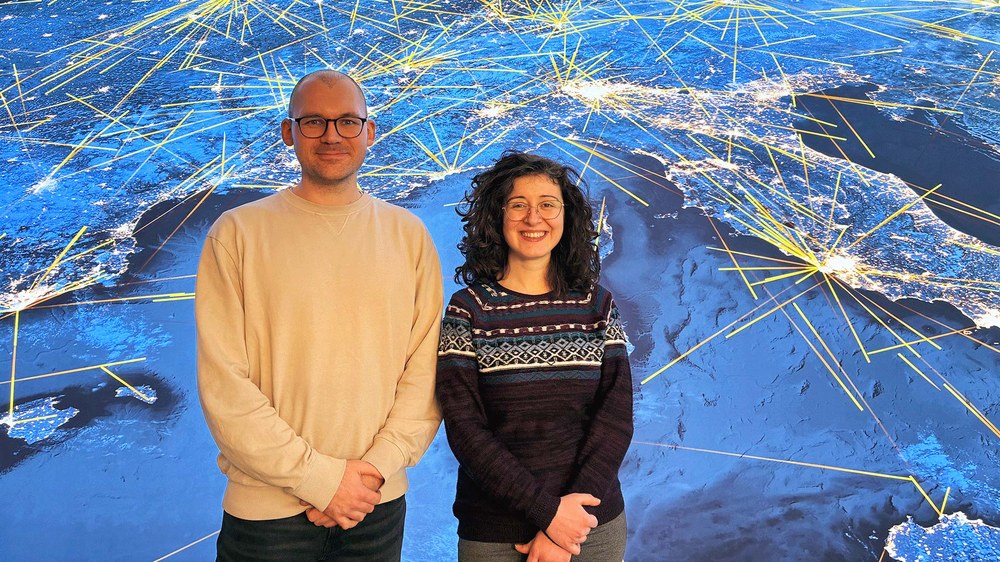

- Bridging aviation and transport engineering across universities and research centres
- Comparing regional infrastructures in Italy and Germany to improve demand modelling
- Strengthening future mobility through international collaboration
Innovative Air Mobility (IAM) — including urban and regional air transport using new aircraft concepts — is expected to play a growing role in future mobility systems. Understanding how passengers might choose such services, and how these choices interact with existing ground transport, is essential for infrastructure planning, system integration and policy design.
Today, we speak with Valeria Cosenza, a PhD researcher at the University of Naples Federico II, who recently completed a guest research stay at the DLR Institute of Air Transport. She shares her background, her motivation for coming to the German Aerospace Center (DLR) and her key takeaways from the collaboration.
DLR Institute of Air Transport: Could you briefly introduce yourself and your research background?
Valeria: “My name is Valeria Cosenza, and I am a PhD student at the University of Naples Federico II, Department of Civil, Building and Environmental Engineering. My research focuses on transportation engineering, and the topic is demand modelling for IAM, combining methods from transportation and aviation engineering. My doctoral work is co-funded through a national programme by the Italian Aerospace Research Centre (CIRA), under joint academic and research supervision. The main goal is to understand how IAM might compete with traditional transport modes from the user’s perspective.”
What motivated your research stay at the DLR Institute of Air Transport?
“I was encouraged to apply because of the international reputation of DLR and its strong expertise in air transport research. Due to the long-lasting cooperation between CIRA and DLR, the DLR Institute of Air Transport was identified as the ideal place to further develop my work, especially in areas related to passenger behaviour and system modelling.”
How does your work on passenger choice models for urban air mobility connect to the research being carried out here?
“My research connects closely with the institute’s work on transport demand, accessibility and system integration. I joined a research group working on topics related to Innovative Air Mobility and passenger choice modelling. Although my academic background is traditionally more focused on ground transport, many of the core questions — such as user behaviour, accessibility and competition between modes — overlap with air transport research.”
What topics are you working on together, and how do your areas of expertise complement each other?
“While at DLR, I have collaborated closely with colleagues from both DLR and CIRA on a joint research project that brings together the University of Naples Federico II, CIRA, and DLR. It focuses on developing a demand model for IAM based on discrete choice theory and study-area zoning methodology developed in collaboration with CIRA, analysing competition between IAM and conventional transport modes. During my stay, I worked closely with Dr. Jan Pertz from the DLR Institute of Air Transport on a mode choice model to estimate how many users choose different ground transport options — such as private car, bus or taxi — to access and leave vertiports, where IAM becomes the main travel mode. These results can be applied to a wide range of analyses, including:
- Assessing the potential impact of IAM on ground traffic congestion
- Supporting studies on optimal vertiport location and planning
We are currently comparing two case studies, one in Italy and one in Germany, to better understand how different infrastructures and spatial layouts influence demand and system performance.”
Do regional differences influence your perspectives or assumptions in your research?
“Yes, absolutely. My research accounts for behavioural heterogeneity, as transport choices depend on users’ preferences and decision-making processes. In our joint work, we are comparing two regions — one in southern Italy and one in northern Germany. Here, the main differences we investigate are not user behaviour itself, but rather the structure of terrestrial transport networks and assumptions about future vertiport locations. These contextual factors play a major role in shaping IAM demand and system design.”
What aspects of your stay have been most valuable so far?
“At first, I was sceptical about the need to be physically present and thought that collaboration could be managed entirely online. I was wrong. The most valuable aspect has been the opportunity to work side by side with colleagues on a daily basis. The exchange of ideas, spontaneous discussions and joint problem-solving simply cannot be replicated through online meetings alone.”
What do you see as the main benefits of this international collaboration in your field?
“The development of Innovative Air Mobility requires coordinated efforts across institutions with complementary expertise, diverse geographical perspectives and shared research capacity. Indeed, CIRA and DLR, as EREA (European Research Establishments in Aeronautics) institutions, are already collaborating on IAM topics, for example in a dedicated working group in the International Forum for Aviation Research (IFAR). This international collaboration strengthens scientific quality and ensures that potential IAM solutions are robust, adaptable and relevant across different contexts. It also lays the foundation for long-term partnerships between the University of Naples Federico II, the Italian Aerospace Research Centre, and DLR, supporting the international advancement of future air transport systems.”
What are the main things you have gained from your stay — scientifically and personally?
“Scientifically, I will return home with the experience of having worked closely with new colleagues and experts in their respective fields, discussing their projects, methods and future plans — an opportunity that would not have been possible without being physically present. On a personal level, I had the chance to live in Hamburg, a city I had never imagined myself in before. It has been a wonderful experience, and I am already encouraging friends and colleagues to visit.”
Do you have any advice for other researchers considering an international research stay?
“My main advice would be to clearly define the goals and scope of the collaboration before the stay begins. At the same time, I would say: explore the city, try the local food, meet people and enjoy the experience. A research stay is not only about research — it is also about personal growth and cultural exchange.”