Home
>
Research & Transfer>
Projects & Missions>
DEkoS – optimising the design and operation of complex systems
DEkoS – optimising the design and operation of complex systems
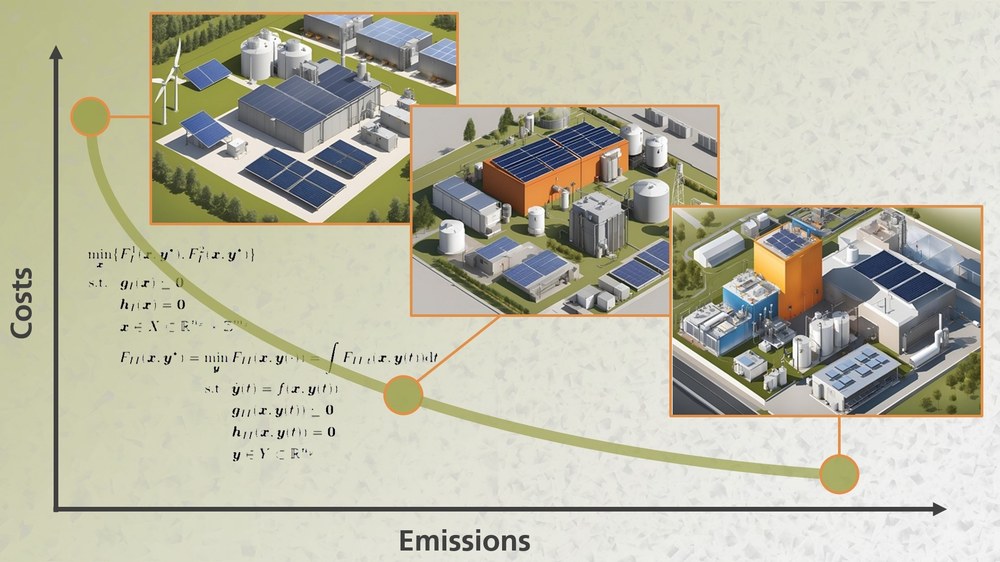

Integrated optimisation of the design and operation of hybrid energy conversion systems
This graphical representation highlights the integrated design and operational optimisation of hybrid energy conversion systems. This approach considers both economic and ecological criteria, framing the challenge as a multi-objective optimisation problem.
Credit:
Working together for a sustainable energy future – the DEkoS project
How can energy be provided in a way that is more reliable, affordable and environmentally compatible? The German Aerospace Center (Deutsches Zentrum für Luft- und Raumfahrt; DLR) is tackling this very question through the DEkoS research project – optimising the design and operation of complex systems.
Two DLR institutes – the Institute of Low-Carbon Industrial Processes and the Institute of Solar Research – are collaborating to develop pioneering solutions for the industrial energy supply.
Green industrial processes
One of the main priorities of the DEkoS project is to develop digital technologies that make industrial processes more climate compatible. The DLR Institute of Low-Carbon Industrial Processes is researching high-temperature heat pumps capable of providing industrial process heat using renewable energy sources. Meanwhile, the DLR Institute of Solar Research is concentrating on hybrid solar power plants. By combining solar energy with other energy sources, these plants can supply electricity even when the Sun is not shining – a crucial requirement for a stable, baseload-capable energy supply.
Modern energy technology, however, is highly complex. The plants comprise numerous components, including energy generators, storage units, converters and consumers, all interconnected in various configurations. These hybrid systems must be meticulously designed and operated to minimise both costs and emissions.
Mastering complexity
When planning such systems, two closely related questions must be addressed:
- Design optimisation: Which components are required and what are their optimal dimensions?
- Operational optimisation: How can the operation of the plant be most effectively controlled based on the chosen components?
The questions are deeply interconnected. The optimal design of a plant invariably affects its ideal operational strategy, making holistic optimisation a particularly complex challenge.
A tool for the future
To address these challenges, DLR researchers involved in the DEkoS project are developing a flexible software tool to facilitate the optimisation of the design and operation of energy conversion systems.
The DEkoS project aims to:
- Develop a software tool capable of simultaneously optimising both the planning and operation of energy conversion systems.
- Further advance modelling techniques to realistically represent various energy-related components.
- Create an optimisation algorithm that accounts for the complex interdependencies between design and operation.
- Demonstrate the tool's flexibility and reliability, both within the institutes' own research projects and in collaboration with external partners.
Why DEkoS is important
Through DEkoS, the participating DLR institutes are making a significant contribution to the transformation of the energy system. The tool being developed not only facilitates the increased use of renewable energy sources but also identifies ways to make the industrial energy supply more efficient and climate compatible.
DEkoS project – optimising the design and operation of complex systems
- Duration: 1 January 2022 to 31 December 2024
- Leading institute: Institute of Low-Carbon Industrial Processes
- Project type: Core funding
- Funding body: DLR Energy Programme Directorate
Participating DLR institutes and facilities