2023 theme: Aircraft for restoring internet connectivity in disaster-hit areas
First place in the DLR Design Challenge – 'The Sentinel System'
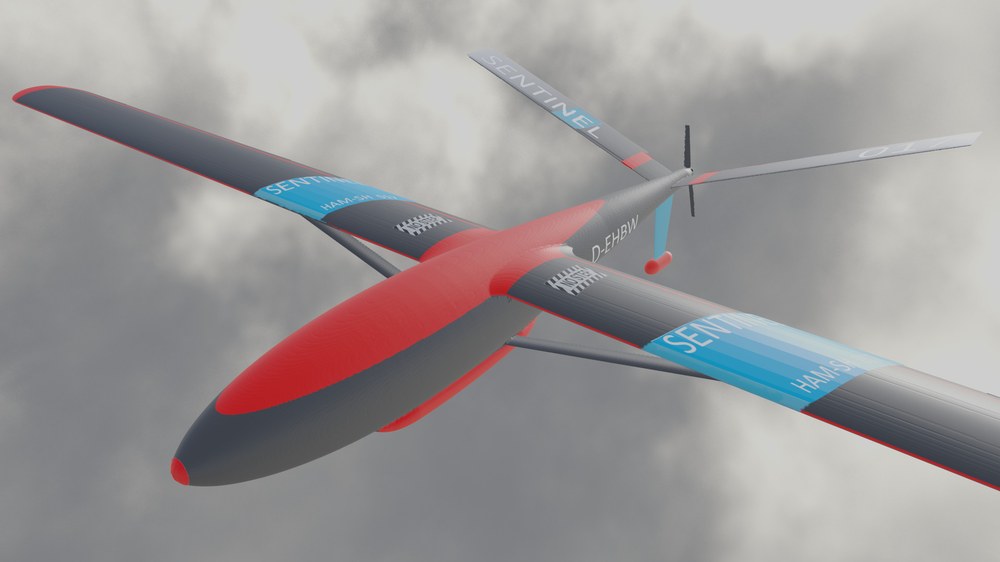
'The Sentinel System' concept from the team at DHBW Ravensburg relies on proven technology and a high-aspect-ratio wing to enable flight durations of up to 50 hours.
Image: 1/2, Credit:
DHBW Ravensburg/The Sentinel System
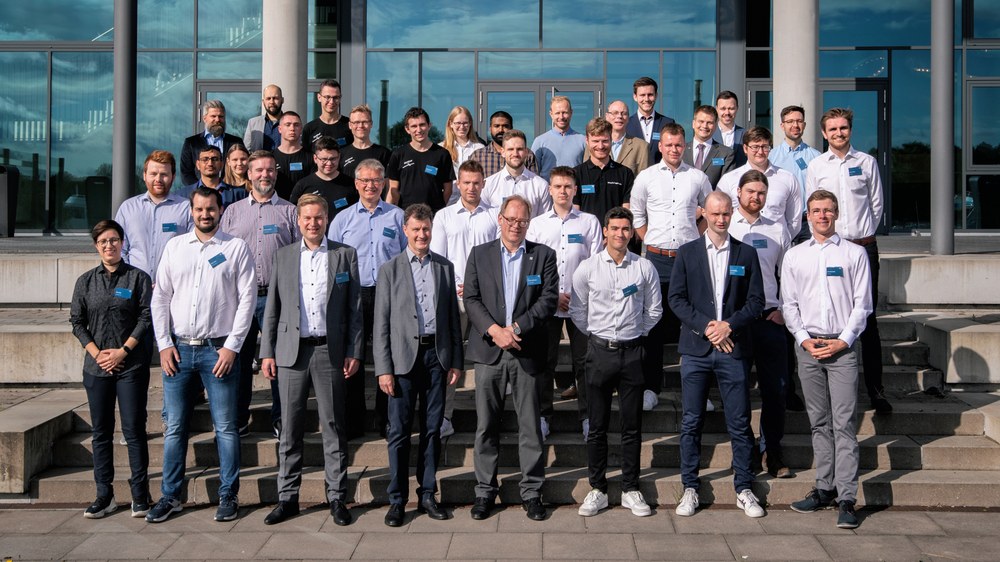
The DLR jury together with student teams during the DLR Design Challenge 2023
On 8 August 2023, the final event of the seventh DLR Design Challenge took place at DLR's ZAL TechCenter in Hamburg-Finkenwerder, including the award ceremony and presentation of prizes.
The task of the DLR Design Challenge 2023 was to design an airborne system to re-establish internet connectivity.
Twenty-five students from five teams competed.
The team at DHBW Ravensburg impressed the DLR jury with their 'The Sentinel System' concept, taking first place.
The goal of the DLR Design Challenge 2023 was to develop an aircraft capable of restoring internet connectivity in disaster-hit areas. The concepts were required to enable both reliable communication and Earth observation, with a particular focus on efficient, continuous operation and rapid deployment.
Five teams presented their designs in 2023
The annual DLR Design Challenge took place for the seventh consecutive year. Following the kick-off event in mid-March 2023 at DLR's site in Braunschweig, students had approximately four months to work on their designs. The closing event took place in early August at the DLR site in Hamburg, at the ZAL Tech Center.
Following the DLR Design Challenge 2023, the three top-ranked teams presented their concepts at the German Aerospace Congress (DLRK 2023) in Stuttgart. The winning team also presented its design at the European Aeronautics Science Network International Conference (EASN 2023) in Salerno.
"The DLR Design Challenge demonstrates how innovation can emerge from different approaches, variety and diversity," said Anke Kaysser-Pyzalla, Chair of the DLR Executive Board, at the final of the 2023 student competition. "The results are surprising, featuring a mix of different aerodynamic concepts and propulsion systems for aircraft that could take on high-altitude platform missions in the very near future. All teams have taken on a major challenge alongside their studies. Today, teams may have been placed differently, but everyone involved has won – because they have all used their expertise to contribute to the mobility of the future and to develop solutions for the current societal challenges of our time."
Markus Fischer, DLR Executive Board Member for Aeronautics, adds: "Once again this year, the participating teams have brought a high level of innovation and creativity to the task. That in itself is a great success. This year's theme was also very well chosen: to design an aircraft that provides internet connectivity in the event of a crisis. On the one hand, it is a highly topical issue; on the other, the submitted designs also demonstrate the great interest shown by the students."
Aircraft design entries: an overview
First place: 'The Sentinel System' by the Ravensburg University of Cooperative Education (DHBW) in Baden-Württemberg
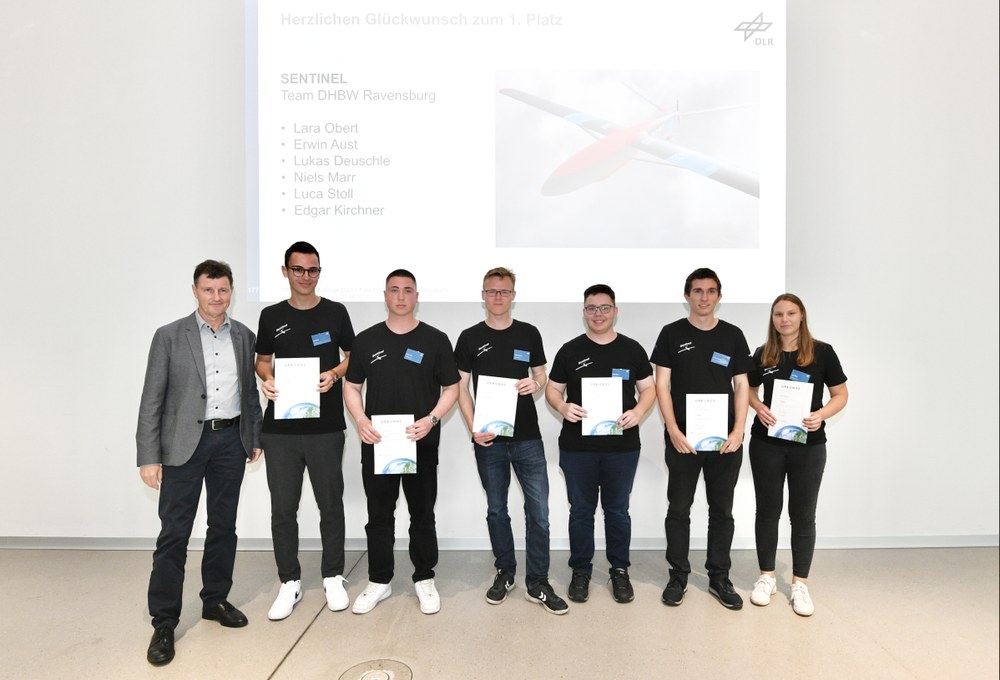
The winning team from DHBW Ravensburg at the DLR Design Challenge 2023
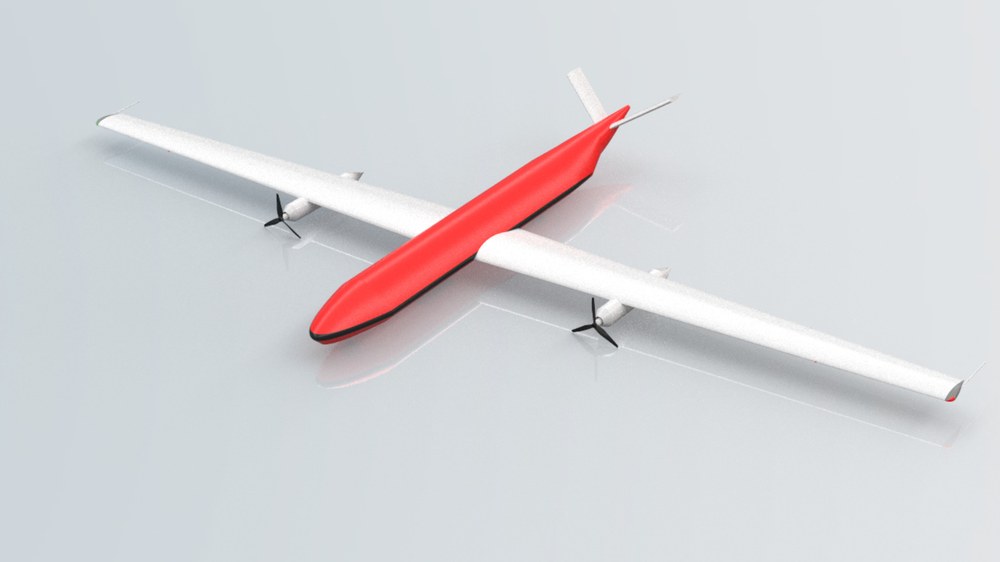
The Sentinel System concept from the DHBW relies on proven technology and a high-aspect-ratio wing to enable flight durations of up to 50 hours. The aircraft is powered by a 78-kilowatt piston engine, which provides the required power for a pusher propeller at the rear. As part of the design, particular attention was paid to the navigation of the autonomously operated aircraft. Through the consistent application of purpose-derived design principles, the aircraft is capable of operating even in adverse weather conditions.
Video: The Sentinel System concept from the DHBW Ravensburg team
Your consent to the storage of data ('cookies') is required for the playback of this video on Youtube.com. You can view and change your current data storage settings at any time under privacy.
Video: The Sentinel System concept from the DHBW Ravensburg team
Credit:
DHBW Ravensburg/The Sentinel System
Second place: 'PERSEUS' by the University of Stuttgart
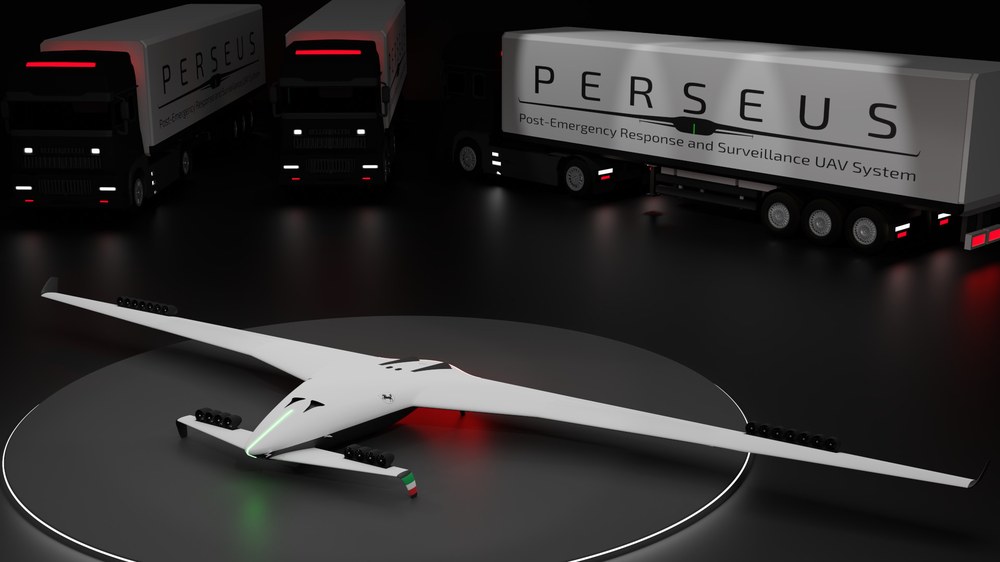
The PERSEUS concept by the University of Stuttgart
Credit:
University of Stuttgart/PERSEUS
The concept submitted by the University of Stuttgart, PERSEUS (Post-Emergency Response and Surveillance UAV System), is an uncrewed blended-wing-body design with canards. The configuration features a hybrid propulsion system comprising hydrogen fuel cells, batteries and supercapacitors, ensuring the system's sustainable operation. It is powered by 22 electric ducted fans mounted on the control surfaces. Combined with the operational concept that uses a foldable lorry container as a launch platform, PERSEUS can take off and land vertically directly from the platform, making the system independent of the availability of a suitable runway.
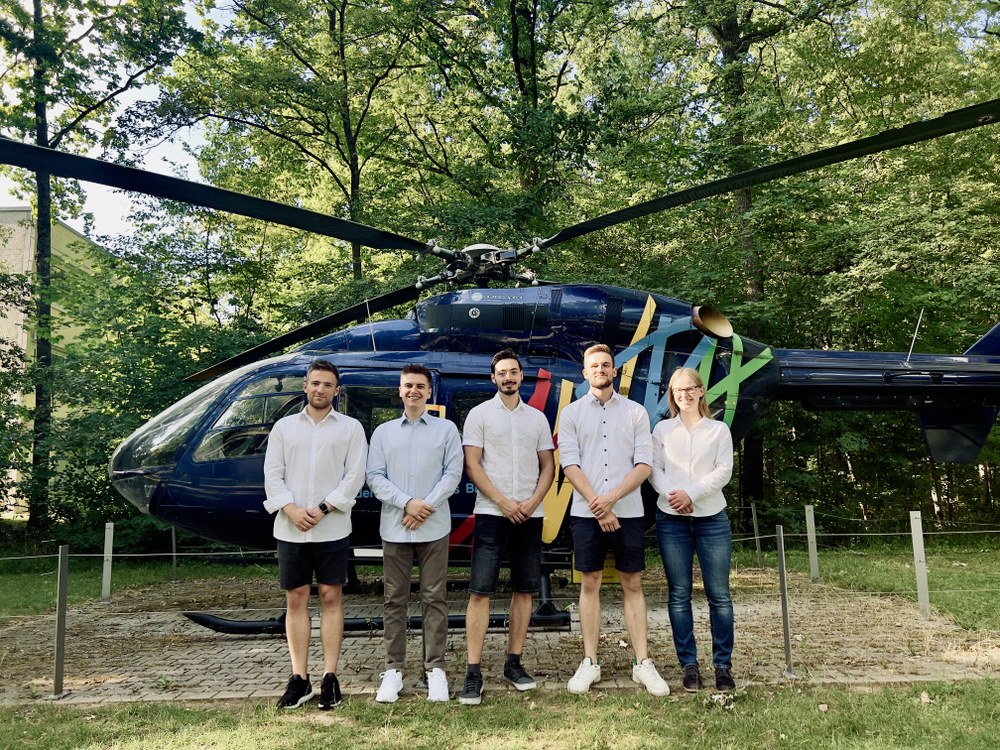
University of Stuttgart team
From the left: Tobias Reischl, Christian Mayer, Lukas Müller, Alexander Hennemann and Hellen Kimmel (missing: Abishek Anil).
Credit:
Universität Stuttgart/PERSEUS
Third place: 'HEIKE' by RWTH Aachen University
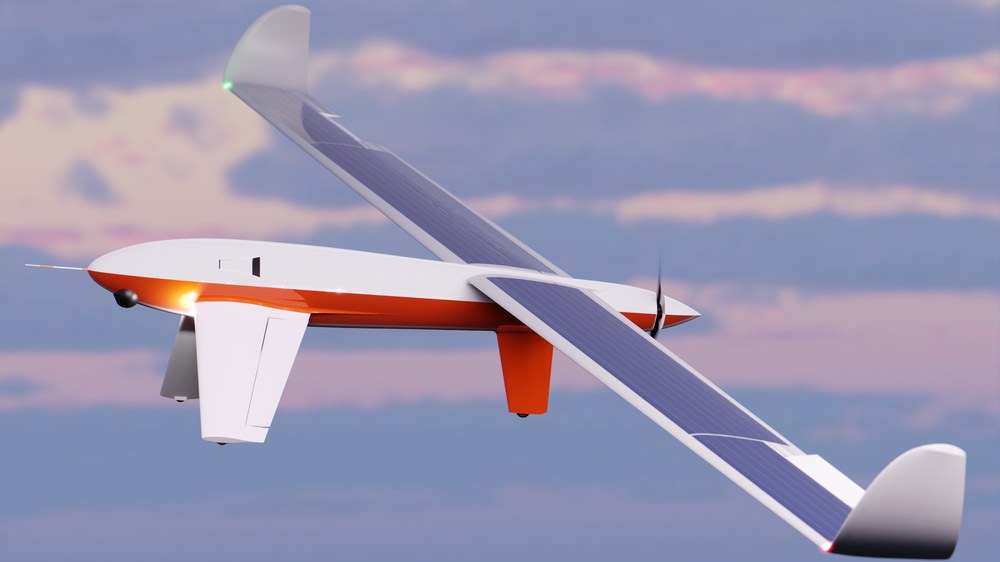
The HEIKE concept by RWTH Aachen University
Credit:
RWTH Aachen/HEIKE
The High-flying, Efficient and Intelligent Crisis Communication Unit (HEIKE) from RWTH Aachen University is a next-generation solar-powered aircraft, featuring a canard configuration with landing gear integrated into the inverted V-tail. The high-wing design prevents the solar cells on the main wing from being shaded. These charge the battery, which has a capacity of 56 kilowatt-hours, during the day. When there is a surplus of energy during the day, HEIKE can leave its operational altitude of 20 kilometres and climb to 25 kilometres in order to store solar energy as potential energy. This is then released at night during gliding flight with the propeller retracted, to enable continuous operation of the aircraft. HEIKE achieves the high aerodynamic efficiency required for this manoeuvre through morphing flaps and a large wingspan of 40 metres. Gust loads are to be actively reduced with the aid of lidar. For operational flexibility, HEIKE can be dismantled and transported in a 40-foot container.
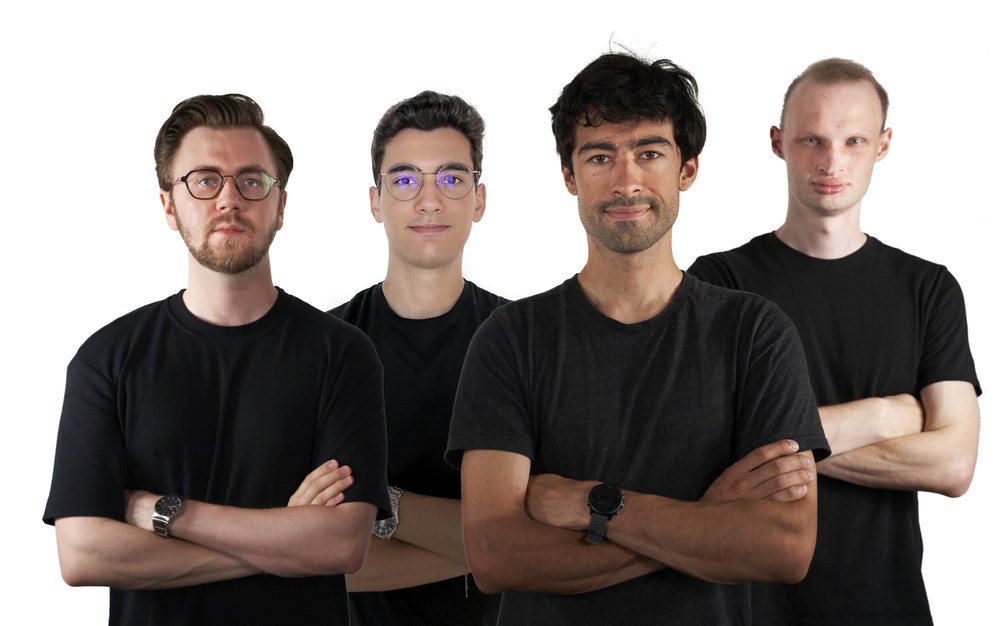
RWTH Aachen team
From the left: Johannes Götz, Sami Zoghlami, Sebastian Dominik and Lars Neveling.
Credit:
RWTH Aachen/HEIKE
Fourth place: 'AirLive' by Dresden University of Technology
The AirLive concept by Dresden University of Technology
Credit:
TU Dresden/AirLive
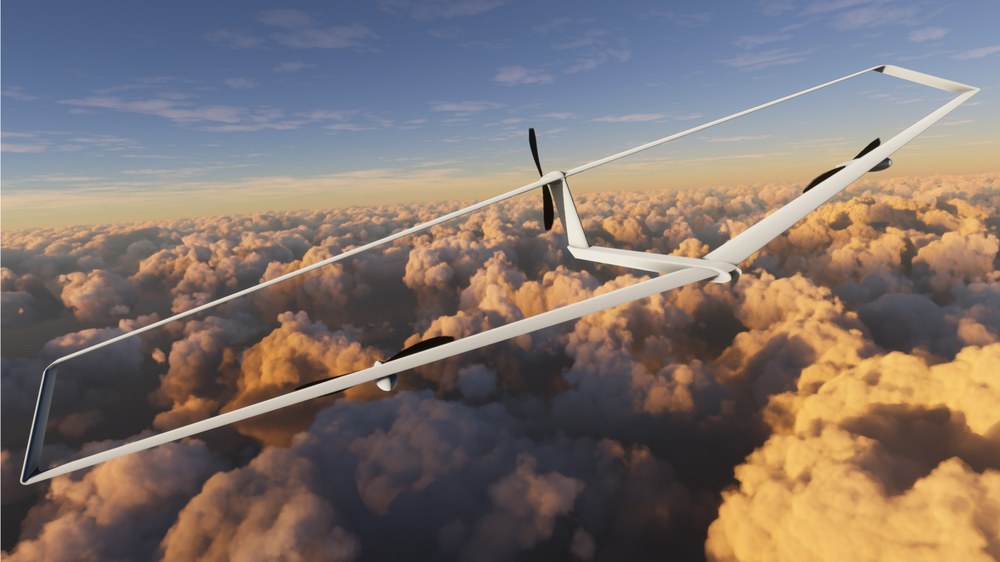
The Air Located Internet Vehicle for Emergencies (AirLive), developed by Dresden University of Technology, achieves high aerodynamic efficiency when flying at high altitudes thanks to its box-wing configuration. The tanks, installed as wing spars, supply gaseous hydrogen to the fuel cell, which in turn powers electric motors. These motors drive three propellers which, following a winch launch to reduce the take-off distance, bring the aircraft to its operating altitude of 20 kilometres. To maintain ground clearance, the wing propellers are stopped during take-off and landing.
AirLive can be adapted to mission requirements thanks to its modular design. While the main part of the mission runs completely autonomously, with aircraft communicating with one another, take-off and landing are carried out remotely by a pilot.
Fifth place: 'Prometheus' by Trier University of Applied Sciences
The Prometheus concept by Trier University of Applied Sciences
Credit:
Trier University of Applied Sciences/Prometheus
The concept submitted by Trier University of Applied Sciences, Prometheus, is an uncrewed system with a conventional kite configuration. The system features an electric propulsion system consisting of batteries and a solar film mounted on the wings. Propulsion is generated by two propellers mounted on the wing. In addition to the wing, this concept generates lift via the fuselage, which has been specifically designed as a lifting body.