
DLR launches cross-sectoral Future Fuels project for interdisciplinary research into synthetic fuels
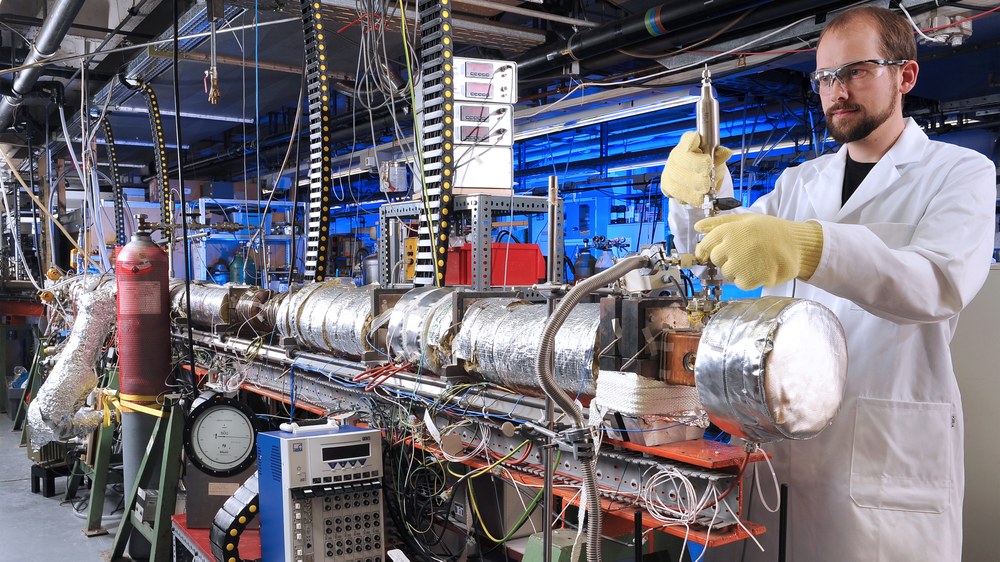


- DLR’s cross-sectoral Future Fuels project is dedicated to research into synthetic fuels.
- These 'future fuels' are sources of energy with high potential to support the sustainable transformation of the energy and mobility sector.
- The main challenge lies in producing them in as climate-neutral, efficient and cost-effective a way as possible, while also keeping the resulting pollutants to a minimum.
- Focus: Aeronautics, space, energy, transport, climate change, energy storage, sector coupling, future fuels
Synthetic fuels are crucial for realising the energy transition. They make it possible to store energy easily, flexibly, efficiently and sustainably. They also make effective fuels for future mobility concepts, as they can be used for road vehicles, trains, ships, aircraft and rockets. The challenge lies in producing them in a climate-neutral way and ensuring that their chemical properties result in the generation of significantly fewer, perhaps as low as zero, pollutants such as soot particles and nitrogen oxides. Eleven institutes at the German Aerospace Center (Deutsches Zentrum für Luft- und Raumfahrt; DLR) are conducting research into the development and application of synthetic fuels in the interdisciplinary 'Future Fuels' DLR project. This cross-sectoral project will run for four years and receive almost 13 million euros in funding from DLR’s central resources.
Driving the energy revolution and reducing pollutant and carbon dioxide emissions
"Through its 'Future Fuels' cross-sectoral project, DLR is helping to solve two major challenges facing society: developing a sustainable, safe and economical energy supply for Germany as part of the energy transition, and reducing the climate impact of Germany by lowering pollutant and carbon dioxide emissions," says Chair of the DLR Executive Board, Pascale Ehrenfreund.
Carbon and hydrogen are the basic building blocks of all fuels. In principle, they are widely available on Earth in the form of water and air. These resources are subject to chemical processes and electrical energy to produce liquid hydrocarbons that serve as the starting point for 'future fuels' that are then customised according to their specific application. "Synthetic fuels have a dual advantage: they can be integrated relatively easily into our existing energy and mobility infrastructure, and they can largely be produced from renewable resources," says Manfred Aigner, who is coordinating the cross-sectoral project. "The nice thing about future fuels is that we can then optimise them for their specific purpose," adds project lead Uwe Riedel.
An integrated, interdisciplinary approach
The 'Future Fuels' project is broken down into five sub-projects. The DLR researchers are investigating how to produce synthetic fuels using solar energy and electrolysis (Solar Fuels) and developing concepts for the reconversion of these fuels. They are working on fuels with emissions optimised for use in transport and aviation (designer fuels) and advanced ‘green propellants’ for spaceflight that could replace the highly toxic hydrazine. Another sub-project oversees systems analysis and technology assessments that examine the research into future fuels from a holistic perspective and take into account factors such as cost-effectiveness, efficiency, security of supply and social acceptance.