Germany invests 5.4 billion euros in the future of European space


ESA - S. Corvaja
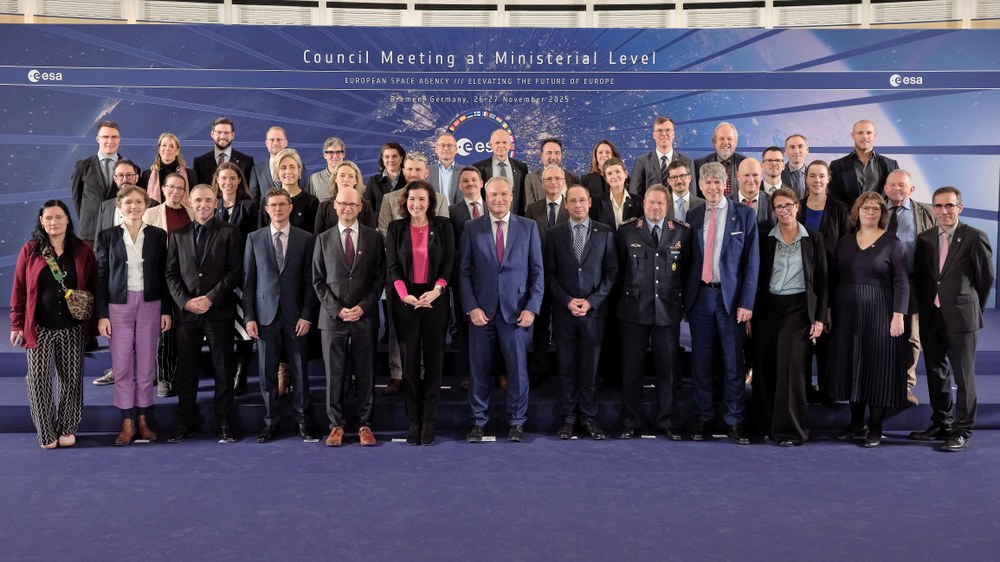
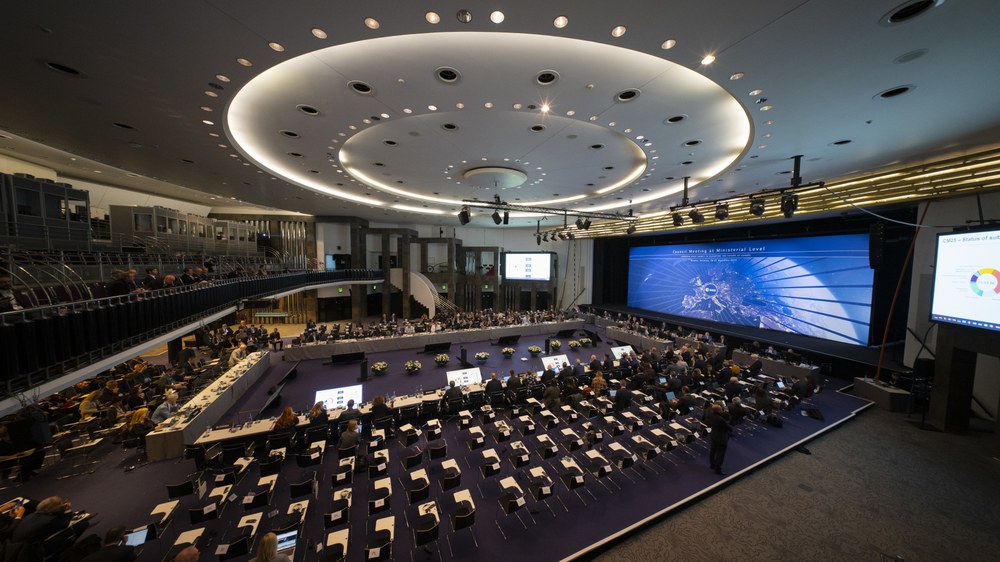
- Three years after the last ESA Council meeting at Ministerial level in Paris, the 23 Member States of the European Space Agency met in Bremen on 26 and 27 November 2025.
- Member States are allocating approximately 22.1 billion euros for space programmes over the coming years.
- ESA announced that a German ESA astronaut will be the first European to fly around the Moon.
- Germany is contributing approximately 5.4 billion euros (valued at current economic conditions) to ESA programmes. Calculated under ESA’s mixed 2025 economic conditions, Germany's subscription amounts to approximately 5.1 billion euros.
- Germany remains ESA's largest contributor, with approximately 23 percent.
- The German Space Agency at DLR prepared Germany's positions and coordinated them with the Federal Government.
- Focus: Space, space policy, international cooperation
On 26 and 27 November 2025, ministers and government representatives from the 23 Member States of the European Space Agency (ESA) met in Bremen, Germany, to determine the future of European space activities. Germany is contributing approximately 5.4 billion euros (valued at current economic conditions) to ESA programmes. Calculated by ESA under mixed economic conditions for 2025, Germany's subscription amounts to approximately 5.1 billion euros. At 23 percent of the total subscription of approximately 22 billion euros, Germany is ESA's largest contributor, ahead of France and Italy (each at approximately 16 percent). In addition, ESA Director General Josef Aschbacher announced that a German ESA astronaut will be the first European to fly around the Moon.
Germany is providing approximately 1.3 billion euros for ESA's 'mandatory programmes', which include the General Budget, the Space Science programme for exploring the Universe with space telescopes and probes, as well as the European Spaceport in Kourou.
Approximately 3.8 billion euros of Germany's contribution is allocated to 'optional programmes'. Germany is investing:
- 863 million euros for increased competition in launcher development and ensuring European access to space
- 885 million euros for human and robotic exploration of the Moon and near-Earth orbits
- Approximately 873 million euros for modern climate and environmental monitoring satellites
- Approximately 320 million euros for satellite communications to ensure the secure transmission of large data volumes
- More than 300 million euros for highly accurate satellite navigation for future mobility and safeguarding the financial and energy sectors
- Approximately 218 million euros for defence against threats from space such as asteroids and solar storms
- 120 million euros (valued at current economic conditions) for the development of state-of-the-art space technologies
- Approximately 59 million euros to strengthen the competitiveness of the entire European space sector
The German Federal Ministry of Defence is contributing approximately 292 million euros (2025 economic conditions) to ESA, supporting in particular launch vehicle development for future launch capacity and activities in space safety and security.
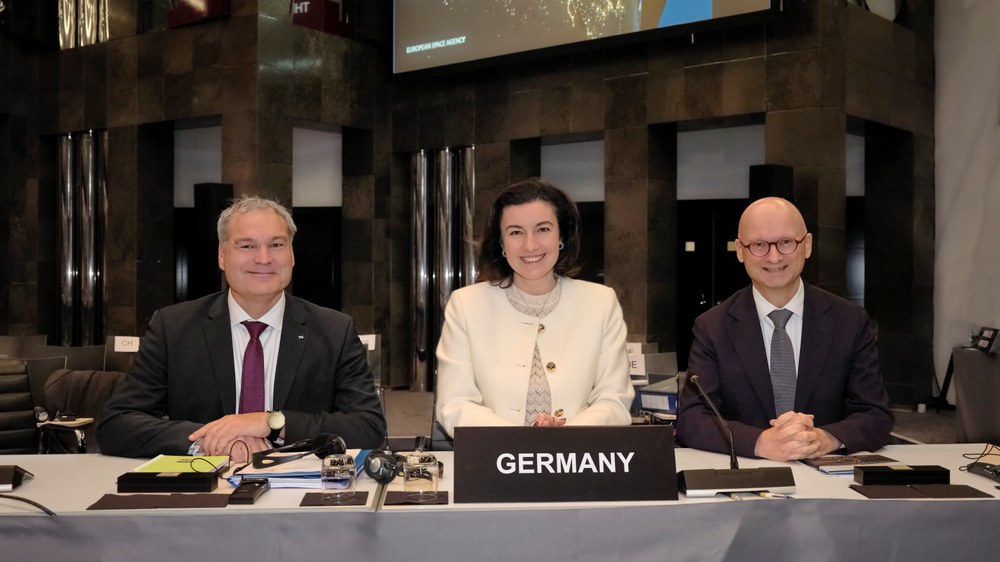
The German delegation was led by Dorothee Bär, Federal Minister of Research, Technology and Space (BMFTR), and Marcus Pleyer, State Secretary responsible for Space at the BMFTR. They were supported by representatives from their ministry, the Federal Ministry of Transport and the Federal Ministry of Defence, as well as Walther Pelzer, Member of the DLR Executive Board and Director General of the German Space Agency at the German Aerospace Center (Deutsches Zentrum für Luft- und Raumfahrt, DLR), who, together with his team in Bonn, prepared the German positions and coordinated them with the Federal Government. The Council meeting at Ministerial level is ESA's highest political decision-making body and convenes on average every three years to determine the programmatic and financial framework for ESA activities.
"Yesterday, we launched Germany's future in space. Germany is ESA's largest contributing Member State, and we are providing 5.4 billion euros from the federal budget. I am truly proud that we have managed to significantly increase our contribution, and I would also like to thank the Federal Ministry of Defence, which is contributing to the German ESA subscription for the first time," says Dorothee Bär, Federal Minister of Research, Technology and Space. "Especially in the current challenging budgetary situation, this sends a clear signal: space is an investment in our future. Germany and Europe are major players in space, and through this significant German commitment – both financially and through the programmes we've signed up to – we are substantially strengthening ESA, which is now also undergoing a paradigm shift towards competitive, user- and application-oriented approaches. In this way, we are ensuring sovereignty in space and creating competitiveness and added value in the German economy – in space and beyond. Germany and Europe are a force to be reckoned with in spaceflight. At this ESA Council meeting at Ministerial level, we have succeeded in securing some impressive programmes – and all of us in Europe will benefit."
"With this Council meeting at Ministerial level, we have reached an important milestone", emphasises Walther Pelzer, Member of the DLR Executive Board and Director General of the German Space Agency at DLR. "Over the past three years, ESA Member States – with Germany as the chair – have driven forward the transformation of ESA into a modern space agency, better positioned for increased competition and commercialisation in space, particularly in terms of launchers. The European Launcher Challenge marks the beginning of a competitive future in the launch vehicle sector. I am also particularly delighted to announce that, at the conclusion of this conference, it has just been publicly announced that, due to Germany's long-standing commitment to exploration, the first European astronaut to fly to and orbit the Moon will be German."
Germany chair of ESA Council at Ministerial level for three years – promoting competition and a strong ESA
Germany has chaired the ESA Council at Ministerial level since November 2022, and has now handed over to Italy. Over these three years, Germany has promoted a strong ESA – both internally and externally – including through cooperation with the European Union. The 2023 Space Summit in Seville marked a crucial shift towards competitive, service-based and commercial approaches to spaceflight, with a primary – but not exclusive – focus on space transport. The 2024 ESA–EU Space Council in Brussels provided impetus for European space programmes in both organisations, emphasising greater user orientation and reducing bureaucracy through more flexible programme management. In doing so, Germany continues to support the established division of tasks between ESA and the EU.
Germany's multifaceted commitment
With Germany as a cornerstone, Europe will shape the future of international spaceflight – whether through venturing to the Moon or observing Earth – making important contributions to everything from climate protection to environmental monitoring. Germany is a global leader in optical technologies, which are now also being supported for satellite navigation in order to be used in the second generation of the Galileo European satellite navigation system. This will further increase the accuracy of position and time determination – indispensable not only for automotive navigation but also for international payment transactions and the stability of power grids. Germany is also committed to supporting young talent at ESA and, through the German Space Agency at DLR, will establish a trainee programme for university graduates to be launched in 2026. It will promote and develop the skills of young German talent in the space sector and build up skilled workers for the future. For up to two years, graduates with a Master's degree can gain experience as German Graduate Trainees (GGT) at ESA in fields such as Earth observation, exploration and satellite communications, as well as space law, industrial policy and others.
Germany's key investments in detail
Science
The Science Programme is a mandatory programme and forms the backbone of ESA, making a significant contribution to building and maintaining Europe's role in international space research. It finances research satellites, their launch and operation, while scientific instruments are developed by Member States. Germany is the largest contributor to this programme with 21.39 percent, representing a total contribution of approximately 824 million euros (at current economic conditions) over five years. The LISA (Laser Interferometer Space Antenna) mission is a focus, which will be conducted with significant German participation. From 2035, LISA will detect low-frequency gravitational waves from space and investigate the properties of their sources with great accuracy. Gravitational waves are oscillations in space-time caused by rapid temporal changes in the spatial distribution of very large masses, for example by the merger of two black holes. The German contribution to LISA consists of providing the central phasemeter as payload from Germany’s National Space Programme, as well as the industrial leadership of the mission.
Launch systems
Europe's access to space is set to become more cost-efficient and competitive through commercial launchers. This is the core objective of the European Launcher Challenge (ELC), which was initiated at the 2023 Space Summit in Seville and adopted at this Council meeting at Ministerial level. The challenge supports European companies in the development of launch vehicles and subsequently purchases their launch services, with the public sector acting solely as a customer. This paradigm shift is crucial for maintaining Europe's technological and competitive edge in global spaceflight. Two German companies are among the five selected participants.
Germany is contributing approximately 363 million euros to the ELC and an additional 159 million euros to stabilising the production and ongoing operations of Ariane 6, maintaining Europe's current access to space.
Increasing Europe's resilience also means giving equal consideration to commercial European launch service providers for ESA missions, as well as to their access to the European Spaceport in Kourou. Added to this are the prospective commissioning and use of further European spaceports in continental Europe. These aspects are enshrined in the political resolution 'Space as a means of strengthening Europe's future' and in the resolution on the spaceport in Kourou.
Exploration
The current changes within NASA pose challenges for future European programmes exploring near-Earth space, the Moon and Mars – but the Council meeting at Ministerial level was successful in finding solutions. All human and robotic exploration activities are being consolidated under the European Exploration Envelope Programme (E3P), to which Germany is contributing 825 million euros. This programme brings together European research and technology programme for the use of low Earth orbit including the exploration of the Moon and Mars. Sub-programmes include the operation of the International Space Station (ISS) in low Earth orbit (LEO) and preparation of the LEO Cargo Return Service. Germany is supporting lunar activities, particularly through the Argonaut European lander and leadership of a robotic mission on its first mission. The European Service Module – the supply capsule for the US Orion spacecraft for the Artemis missions – will continue to shape Europe's role in crewed lunar exploration.
In addition, ESA's Human and Robotic Exploration directorate, with approximately 250 employees, will be gradually relocated from ESA's ESTEC site in Noordwijk, the Netherlands, to the DLR site in Cologne.
Earth observation
Germany has so far held the leading position in Earth observation in Europe and is at the forefront of this field – which is vital for governmental, commercial and scientific applications, as well as climate protection, thanks to innovative scientific developments and applications.
FutureEO is Europe's joint science and technology programme for Earth observation. It carries out missions that, for example, improve weather forecasting and enable environmental monitoring, including studying ocean currents and collecting data on the water cycle between the ocean and the atmosphere. Germany is contributing approximately 564 million euros to this programme.
A further 282 million euros of German funding is going to the world-leading Copernicus programme, which includes the development and construction of the second generation of Sentinel-2 and Sentinel-3 satellites.
Germany is also contributing 10 million euros to the InCubed-3 (Investing in Industrial Innovation) programme. The aim is to enable the commercialisation and marketing of innovative European Earth observation activities, thereby establishing a globally competitive market ecosystem in Europe. The programme has so far enabled German start-ups to develop prototypes and so enter into long-term partnerships, ensuring sustained, ongoing market access.
Satellite communications
Germany is the global market leader in optical and quantum communications. Under the Artes 4.0 framework programme, innovative technologies and products are supported for the global commercial market and secure communications applications for public authorities. The consistent technology support of recent years will also be implemented in the future through the 'Optical and Quantum Communications – Scylight' programme. The strategic programme line 4S 'Space Systems for Safety and Security' will support the quantum internet for secure communications. Comprehensive broadband coverage via 5G, and ultimately 6G, will be realised through the 'Space for 5G/6G and Sustainable Connectivity' strategic programme line. Germany is contributing approximately 320 million euros to these programmes.
Satellite navigation
ESA aims to develop new technologies across the entire satellite navigation value chain and boost the global competitiveness of European companies. Navigation-based services represent a dynamic and growing business area, and investments in these technologies have demonstrated significant economic impact. Germany leads the FutureNAV programme with approximately 266 million euros, including preparations for a Low Earth Orbit Positioning, Navigation and Timing System (LEO-PNT). The OpSTAR mission will implement an in-orbit demonstrator for optical links between satellites, consisting of two satellites in medium Earth orbit (MEO), to be built by 2028 and launched subsequently.
Germany is also strongly involved in supporting development activities for future demonstrators in the field of quantum and AI, with 35 million euros.
Space safety
The Space Safety framework programme comprises activities for the sustainable use of space and protection against threats in and from space. The flagship missions are RISE, RAMSES and Vigil, with significant German involvement.
The RISE mission will demonstrate a rendezvous manoeuvre between two satellites. The RAMSES mission aims to study the near-Earth asteroid 99942 Apophis before, during and after its very close Earth flyby on 13 April 2029. The Vigil mission is intended to enable the continuous observation of the Sun and space weather from 2031.
Germany is contributing approximately 218 million euros to this programme.
Technology development
Germany continues to strengthen ESA's General Support Technology Programme (GSTP), which develops promising concepts and approaches into complete space applications. These may be individual devices, instruments, systems or entire satellites. Companies in ESA Member States can apply for corresponding contracts, thereby expanding existing competencies and creating new abilities to improve the competitiveness of European industry and increase Europe's independence in critical technologies. Germany is contributing approximately 120 million euros to this programme.
Germany is also investing in the new area of 'Resilience and Security' to strengthen Europe's technological independence. The Electrical, Electronic and Electromechanical (EEE) components programme for maintaining European independence is also being reinforced, enabling these essential components to be developed in Europe and establishing a more independent European supply chain.
Commercialisation in the space sector
The ACCESS programme aims to accelerate the commercialisation and competitiveness of the European space sector, including through applications in non-space areas and building interfaces with external investors. It combines the promotion of commercial and integrated satellite-based applications with support for technology transfer and start-ups. The Scale-Up element supports start-ups from their founding (BIC) through the accelerator phase to start-up financing (Market Place). The BASS element develops new business areas for space data applications. Germany is contributing approximately 59 million euros to this programme.