Better understanding our atmosphere – the new SOVA-S Earth observation mission
May 29, 2026 | Green light for DLR research
Better understanding our atmosphere – the new SOVA-S Earth observation mission
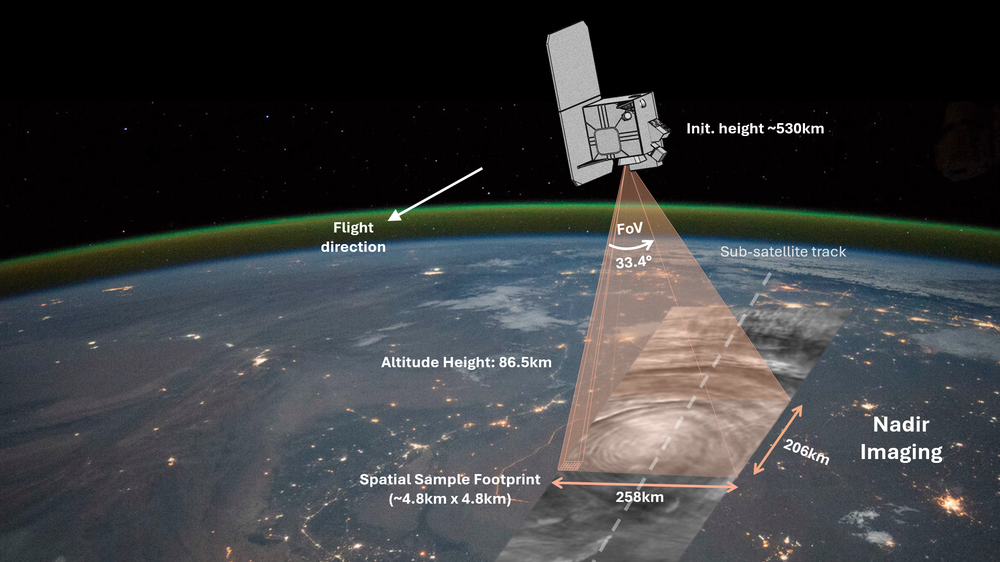
SOVA-S mission – measurement geometry
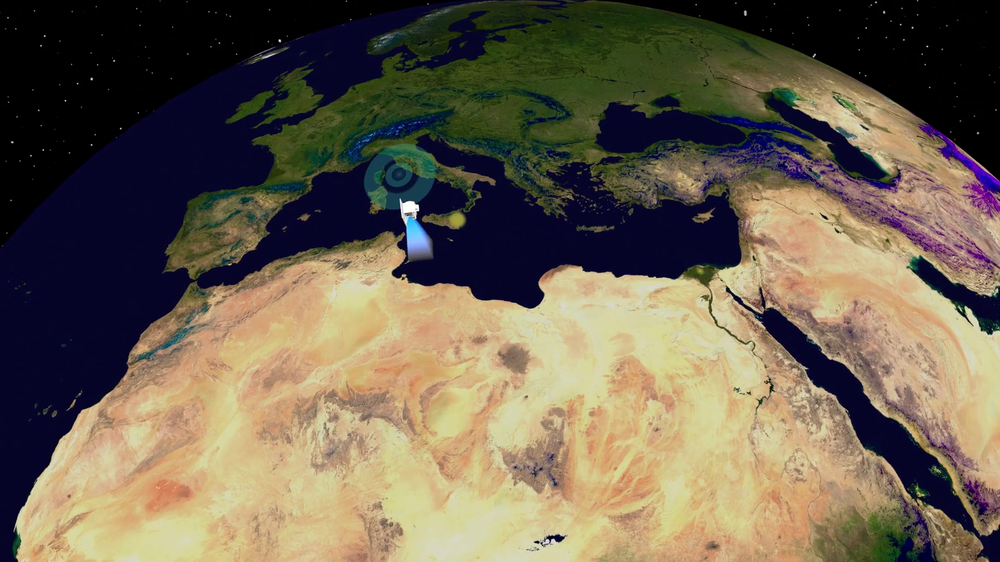
The new SOVA-S (Satellite Observation of Waves in the Atmosphere – Scout) Earth observation mission will detect gravity waves globally for the first time from 2030. To achieve this, the small satellite will orbit Earth at an altitude of approximately 600 kilometres in a Sun-synchronous polar orbit, ensuring the entire globe is covered. On board is a high-resolution infrared camera pointing towards the nadir – the point on Earth's surface directly below the satellite. The camera will measure the intensity of airglow and thereby detect gravity waves. Airglow is the natural luminescence of excited hydroxyl (OH) molecules at altitudes of approximately 80 to 100 kilometres.
Image: 1/3, Credit:
OHBCzechSpace
Atmospheric airglow
Earth is surrounded by various layers that emit their own light – a phenomenon known as airglow. The brightest emission comes from excited hydroxyl molecules, a compound of oxygen and hydrogen (OH). OH airglow is visible here in yellow and spans an altitude range of approximately 80 to 100 kilometres. The graphic also shows light emissions from excited oxygen atoms at the edge of space (green) and at altitudes of 200 to 300 kilometres (red).
Image: 2/3, Credit:
NASA
Gravity waves in the sky
Gravity waves are wave-like flows that are commonly generated in the lower layers of the atmosphere. They form when air masses pass over mountain ranges or at the transition between water and land. Strong cyclones, active volcanoes and convection in the intertropical convergence zone can also produce gravity waves.
Under the scientific leadership of DLR, the new SOVA-S Earth observation mission will measure atmospheric gravity waves on a global scale for the first time.
SOVA-S has been selected by the European Space Agency (ESA) as a new Scout mission, developed using the New Space approach.
Gravity waves play an important role in atmospheric and climate processes, but have so far been insufficiently considered in models.
Focus: Space, Earth observation, small satellites
The German Aerospace Center (Deutsches Zentrum für Luft- und Raumfahrt; DLR) is taking on the scientific leadership of the new SOVA-S (Satellite Observation of Waves in the Atmosphere – Scout) Earth observation mission. With SOVA-S, the European Space Agency (ESA) is expanding its Scout programme, which is based on small satellites and developed using innovative New Space approaches. The new mission aims to improve our understanding of the flow processes in our atmosphere and to capture gravity waves on a global scale – waves that have so far been inadequately accounted for in atmospheric and climate models.
Atmospheric gravity waves are wave-like flows with wavelengths of sometimes just a few kilometres and periods of up to several hours. They typically form in the lower layers of the atmosphere, for example when air flows over mountain ranges. These waves allow energy and momentum to be transported very efficiently over long distances within the atmosphere. Where these waves break, they significantly alter the energy balance and dynamics of the atmosphere, affecting weather and climate processes and, among other things, degrading the signal quality of satellite-based navigation systems. Gravity waves can also be generated by volcanic activity, earthquakes, tsunamis and intense cyclones, meaning they can provide insights into these events themselves.
Airglow at the edge of space
The new SOVA-S Scout mission will observe these processes globally and at high spatial resolution for the first time. The satellite will study the important transition zone between the lower and upper atmosphere – an altitude range of 80 to 100 kilometres which lies at the edge of space and plays a key role in understanding the dynamic coupling of atmospheric layers.
SOVA-S combines a compact, cost-efficient satellite design with high-resolution infrared remote sensing. At its heart is a near-infrared camera that measures the intensity of 'airglow' – the natural luminescence of hydroxyl molecules, a compound of oxygen and hydrogen (OH), which occurs at altitudes of roughly 80 to 100 kilometres. When gravity waves pass through this luminescent layer, they alter its brightness. This airglow acts like a contrast agent in the atmosphere, making even the smallest flow patterns visible.
The SOVA-S satellite detects gravity waves by measuring the intensity of airglow. As gravity waves pass through this luminescent layer of the atmosphere, they alter its brightness. In the infrared camera's measurements, this appears as stripe-like patterns, which allow researchers to draw conclusions about the strength of the gravity waves, their wavelengths and the directions in which they propagate.
SOVA-S mission – global measurement of gravity waves
Your consent to the storage of data ('cookies') is required for the playback of this video on Quickchannel.com. You can view and change your current data storage settings at any time under privacy.
SOVA-S mission – global measurement of gravity waves
The SOVA-S satellite detects gravity waves by measuring the intensity of airglow. As gravity waves pass through this luminescent layer of the atmosphere, they alter its brightness. In the infrared camera's measurements, this appears as stripe-like patterns, which allow researchers to draw conclusions about the strength of the gravity waves, their wavelengths and the directions in which they propagate.
Credit:
DLR
Many years of expertise
DLR's Earth Observation Center (EOC) has been active in this research field for many years, measuring airglow in collaboration with other institutions using ground-based and airborne infrared sensors at various locations around the world. As the scientific lead for SOVA-S, the EOC brings its extensive expertise in atmospheric remote sensing, data analysis and modelling. Researchers based in Oberpfaffenhofen will also play a central role in the scientific analysis, utilisation and international dissemination of the mission data. The mission is being developed in close collaboration with ESA and an industrial consortium led by OHB Czechspace.
The launch of SOVA-S is planned for 2030 as part of the Scout series. The small satellite is set to operate in a Sun-synchronous orbit at an altitude of approximately 600 kilometres for between two and five years, creating a unique dataset for a wide range of research and application areas.
The Scout family of small satellites delivers highly valuable scientific insights by either miniaturising existing space technologies or demonstrating new observation techniques – with the overarching goal of doing all of this swiftly. In line with the 'New Space' approach, the satellite missions follow an extremely agile and cost-efficient development process.
The Scout missions are part of FutureEO, ESA's scientific Earth observation programme. Germany is the programme's largest contributor, with funding coordinated by the German Space Agency at DLR on behalf of the Federal Ministry of Research, Technology and Space (BMFTR).