April 1, 2026 | First results of NEOFUELS/VOLCAN measurement flights published in 'Nature' scientific journal
Contrails – beyond soot
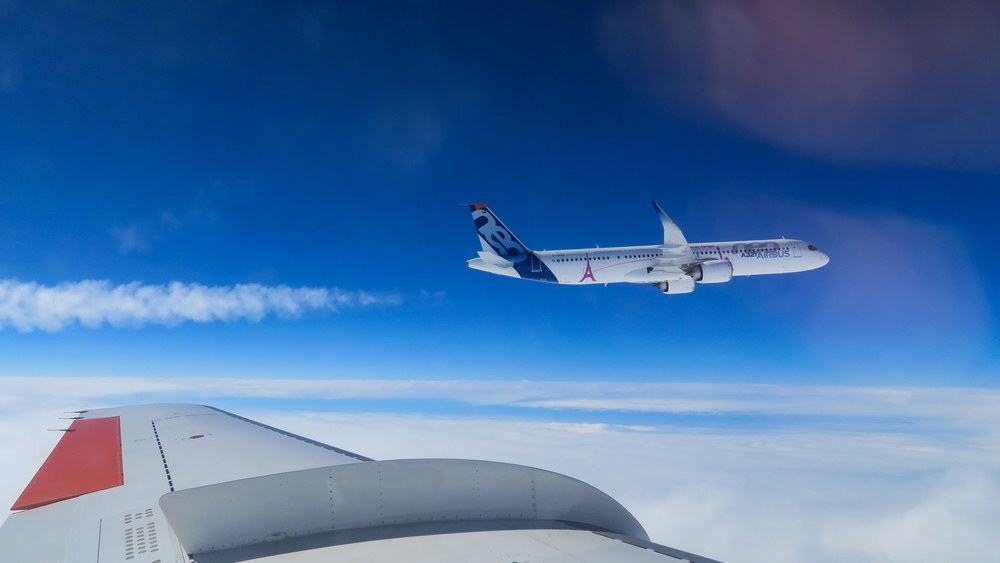
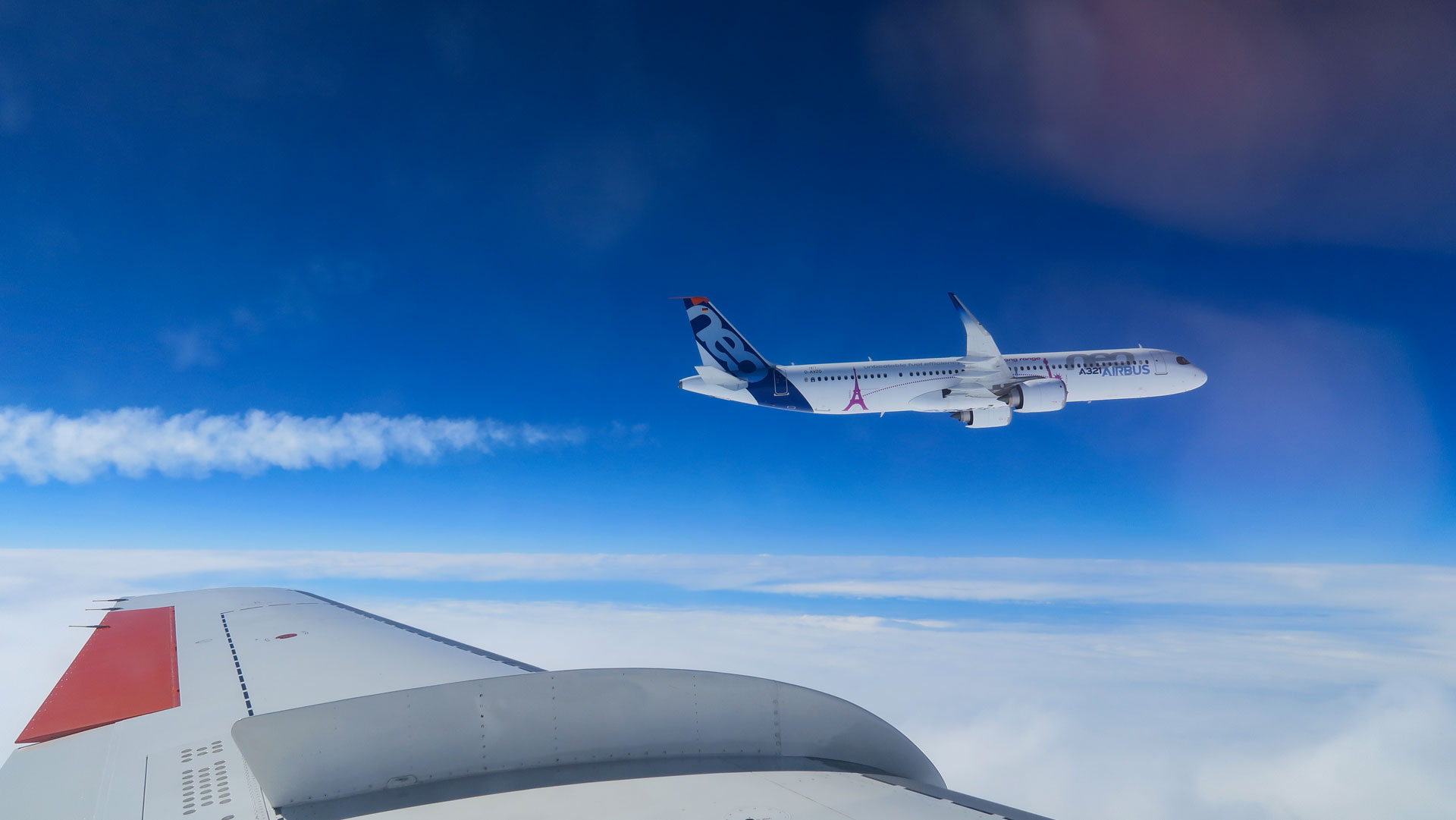
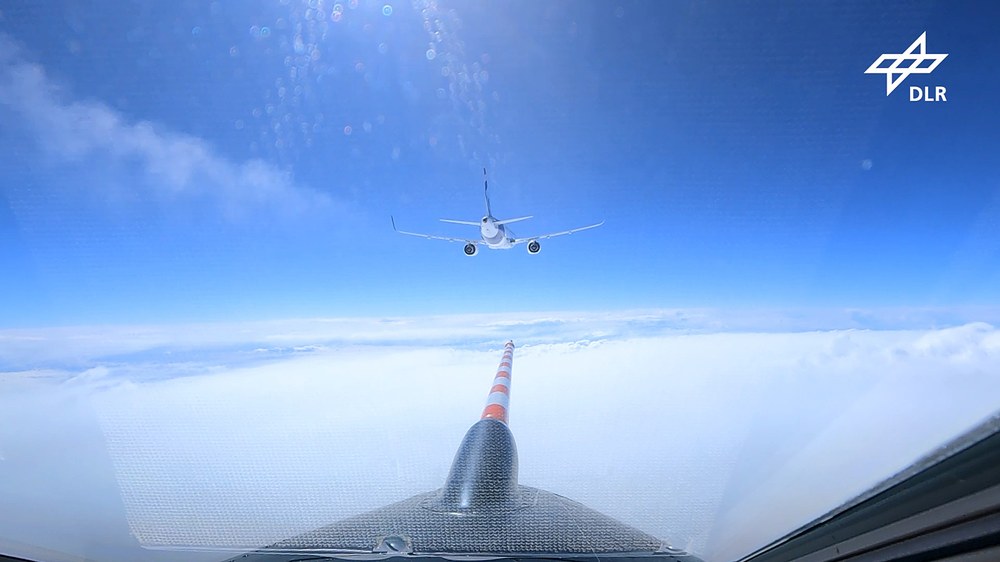
View of the Airbus A321neo from the DLR Falcon 20E
This image shows DLR's Falcon 20E research aircraft and the Airbus A321neo during joint flight tests to investigate emissions from lean-burn engines. The measurement flights took place as part of the NEOFUELS/VOLCAN project in spring 2023.
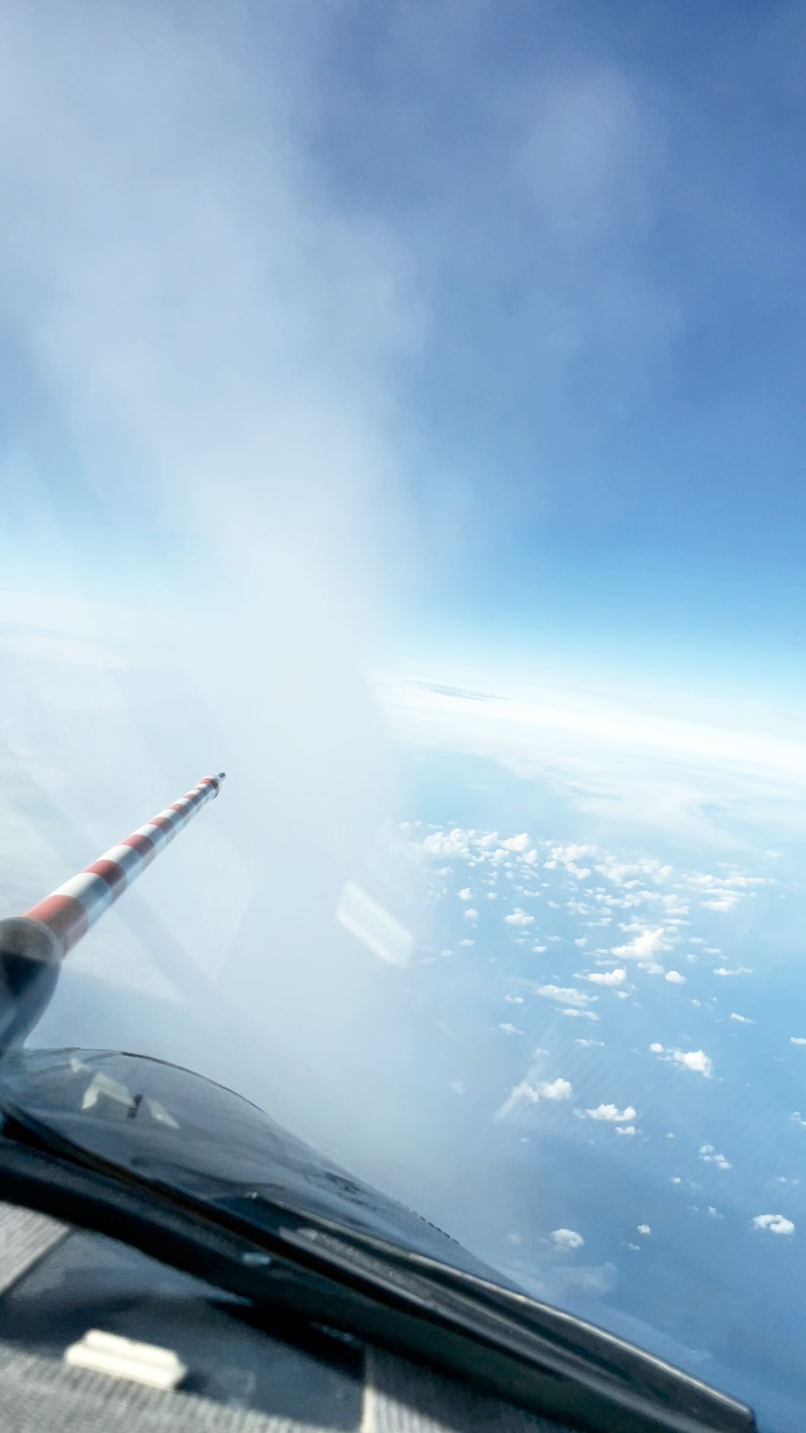
Falcon 20E in contrail measurement flight with an Airbus A321neo
The view from the cockpit shows DLR’s Falcon 20E research aircraft measuring the contrails of the Airbus A321neo flying ahead. On the left side of the image, the nose mast of the Falcon 20E for wind measurements is visible.
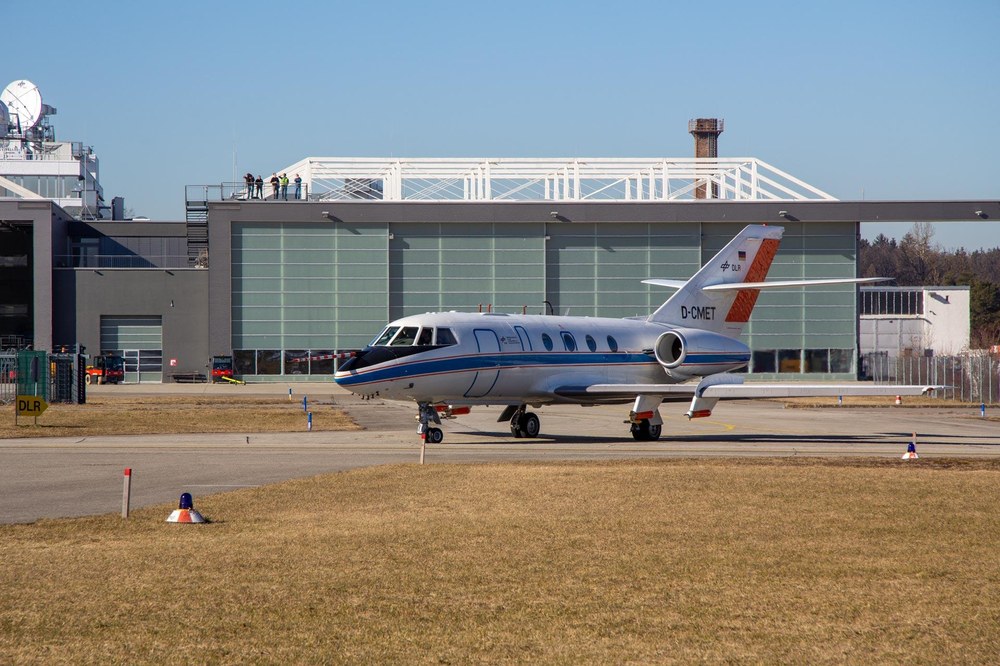
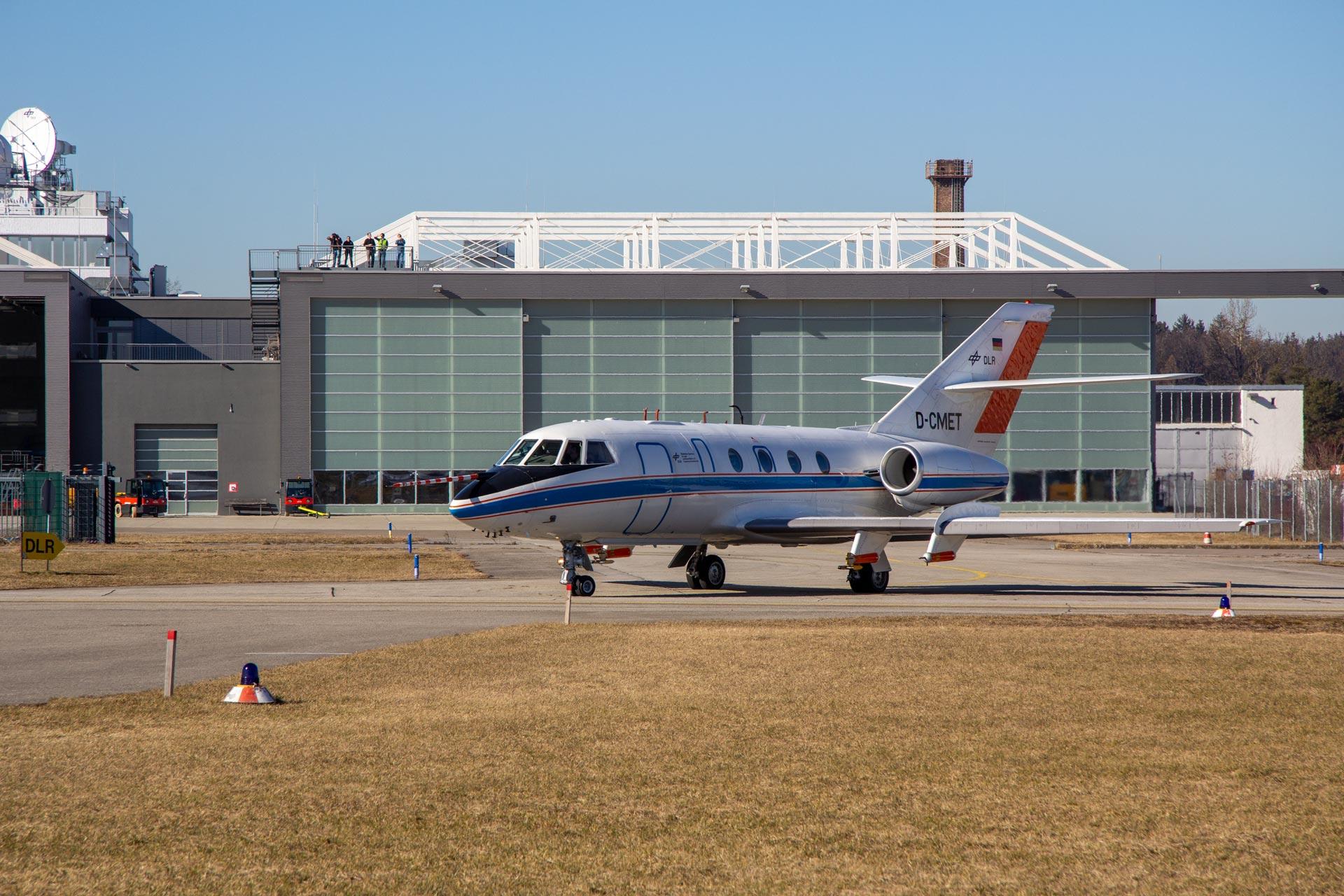
The Falcon 20E takes off on a research flight from Oberpfaffenhofen, Germany
DLR’s Falcon 20E research aircraft is based at the Oberpfaffenhofen site in Germany. The DLR Flight Experiments facility has operated the aircraft for approximately 50 years, primarily for atmospheric research. International research teams measure trace gases and aerosols directly on board and collect air samples for subsequent laboratory analysis. The twin-jet aircraft is based on a business jet from the French company Dassault and can fly at altitudes up to 12,800 metres.
Soot emissions alone cannot explain the formation of contrails, as recent atmospheric research findings show. With extremely low-sulphur fuels, volatile organic compounds and lubricating oil vapours become increasingly important for the formation of new particles.
These new findings challenge the previous understanding of contrail formation and have been published in the scientific journal Nature.
Focus: Aviation, climate-compatible flight
Latest findings in atmospheric research show that less soot does not automatically mean fewer contrail ice crystals. Instead, small volatile particles play a crucial role in contrail formation at low soot emission levels. This has been demonstrated in measurement flights conducted by the German Aerospace Center (Deutsches Zentrum für Luft- und Raumfahrt, DLR) in collaboration with Airbus and CFM International in spring 2023. The findings of the research team have now been published in the journal Nature: "Substantial aircraft contrail formation at low soot emission levels".
"Thanks to close collaboration between industry and research, we succeeded in carrying out complex measurement flights and obtaining a unique dataset. The data and insights gained from this are helping to improve both engine and climate models – paving the way for a competitive and climate-compatible future for aviation", says Markus Fischer, DLR Divisional Board Member for Aeronautics.
"Such test campaigns are crucial to improve the understanding and modelling of contrails as a function of the various drivers, and to inform our future technological and operational mitigation choices. This is another example of excellent collaboration between research centres and industry which is key to progressing quickly on this complex topic", says Mark Bentall, Airbus Head of R&T Programme.
Understanding contrail formation
Contrail cirrus clouds are a large contributor to aviation's climate impact. These ice clouds form at cruising altitude when hot exhaust gases meet very cold, humid air. Particles from engine exhaust then act as nuclei for ice crystals. Until now, soot particles were thought to control ice crystal numbers in contrails. The new findings mark important progress in contrail formation theory and help to shape the future development of engines and fuel composition.
Modern lean-burn engines significantly reduce soot emissions, as ground tests have shown. This might have suggested that fewer ice crystals would form, thus reducing their climate impact. However, contrails from lean-burn engines had, until now, never been measured in flight. To address this knowledge gap, researchers from DLR and Johannes Gutenberg University Mainz (JGU) joined forces with Airbus, CFM International and modelling teams from the University at Albany and French research institute ONERA (Office national d’Etudes et de Recherches Aérospatiales). As part of the NEOFUELS/VOLCAN measurement campaign, they conducted the first measurement flights of emissions from a lean-burn engine and the resulting contrails. During chase flights behind an Airbus A321neo fitted with CFM LEAP-1A engines, the DLR Falcon 20E research aircraft measured the exhaust gases and particles under cruise flight conditions. The study also investigated the previously unknown roles of fuel sulphur, organic matter and lubrication oils for contrail formation in the low-soot regime.
During chase flights behind an Airbus A321neo fitted with lean-burn engines, DLR’s Falcon 20E research aircraft analysed its exhaust gases and the resulting contrails. The findings from the NEOFUELS/VOLCAN project provide new insights into how modern engines and fuel compositions can be optimised to be more climate compatible.
Video: Detecting emissions and contrails in flight – the NEOFUELS/VOLCAN project
Your consent to the storage of data ('cookies') is required for the playback of this video on Quickchannel.com. You can view and change your current data storage settings at any time under privacy.
Video: Detecting emissions and contrails in flight – the NEOFUELS/VOLCAN project
During chase flights behind an Airbus A321neo fitted with lean-burn engines, DLR’s Falcon 20E research aircraft analysed its exhaust gases and the resulting contrails. The findings from the NEOFUELS/VOLCAN project provide new insights into how modern engines and fuel compositions can be optimised to be more climate compatible.
High-speed chase manoeuvres were carried out at an altitude of ten kilometres over restricted airspace above the Mediterranean and the Atlantic. In fifteen flights, the Falcon 20E repeatedly sampled the exhaust plume of the passenger aircraft at distances of 40 to 250 metres. The Falcon also intercepted the fully developed contrails of the A321neo several kilometres downstream. Modified engine control settings by CFM International enabled defined lean- and rich-burn operation, allowing researchers to compare emissions and contrail properties at different soot emission levels. The engines were also operated with test fuels containing varying levels of sulphur and aromatics. The DLR Flight Experiments facility has operated the Falcon 20E for 30 years – its decades of experience were essential for the demanding deployment in this challenging research mission.
Results from flight measurements
The results show that for this engine type, lean-burn engine operations reduced soot emissions by three orders of magnitude compared to rich-burn conditions. Contrail ice crystal numbers remained high, far exceeding the number of measured soot particles. This indicates that soot alone cannot explain contrail formation under low-soot conditions typical of lean-burn engines. Instead, in these tests, researchers observed large numbers of liquid volatile particles forming in the cooling exhaust plume, with concentrations comparable to the measured number of contrail ice crystals.
"The defining moment came when the initial data revealed no soot – but plenty of contrail ice crystals", says Christiane Voigt, scientific lead of the project at DLR and JGU. "It immediately became clear that advancing our understanding of contrail formation will be essential for shaping the technological future of aviation."
New findings for climate models
Fuels with lower sulphur content reduced the number of contrail ice crystals, and microphysical simulations by the University at Albany and ONERA successfully reproduced the trends from the observations. The results also show that for ultra-low-sulphur fuels and at low soot emission levels, volatile organic compounds and lubrication oil vapours become increasingly important for new particle formation.
These findings extend the classical theory of contrail formation by introducing additional pathways involving volatile sulphate, organic and lubrication oil particles. Because most contrail climate models do not yet include ice formation on liquid particles, they may underestimate the climate impact from contrails. Incorporating these processes will be essential for improving projections of aviation’s climate impact.
"The results of the measurement campaign are impressive proof of the excellent collaboration between JGU, DLR, and the two companies Airbus and CFM International," says Stefan Müller-Stach, Vice President for Research and Academic Careers at University Mainz. "They also provide a great foundation for our researchers to continue contributing to the development of sustainable aviation and thereby making a difference in climate protection."
Technologies for climate-compatible aviation
Future mitigation strategies could consider fuel composition alongside combustion design and oil venting architectures. Current emission standards regulate gases and non-volatile particles. The new findings indicate that minimising volatile particles can also be an important pathway to reduce the climate impact of contrails. Although fuel sulphur content is limited to a maximum of 0.3 percent by mass – while typical levels today are approximately 0.046 percent – further reductions may be needed to significantly limit contrail ice formation. Optimising lubrication oil venting systems could provide an additional engineering lever for engine developers.