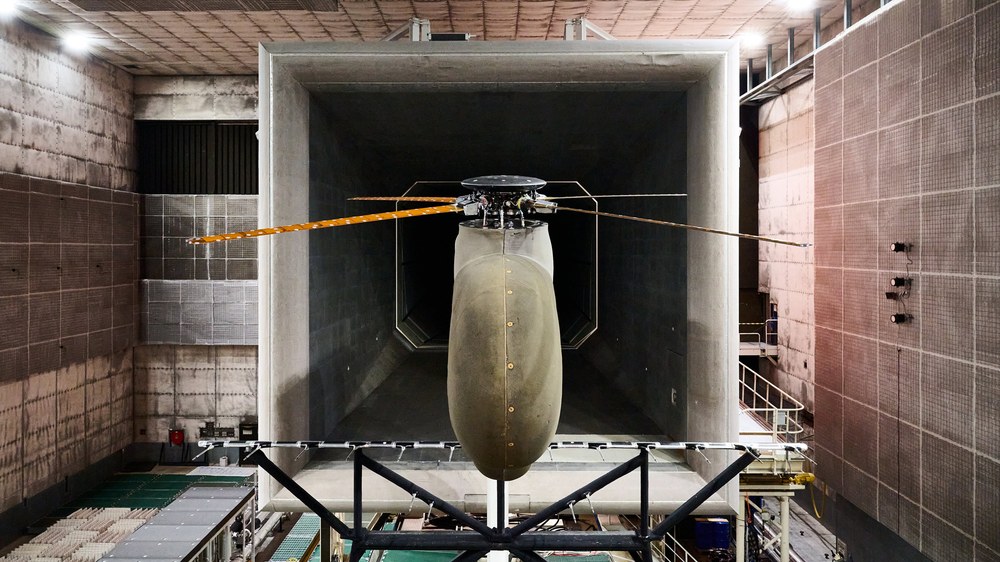
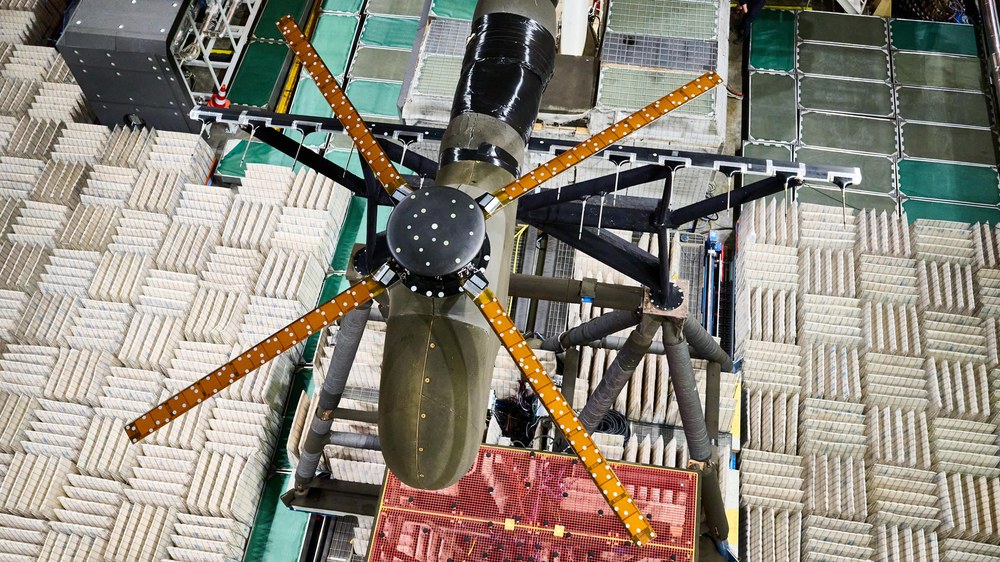
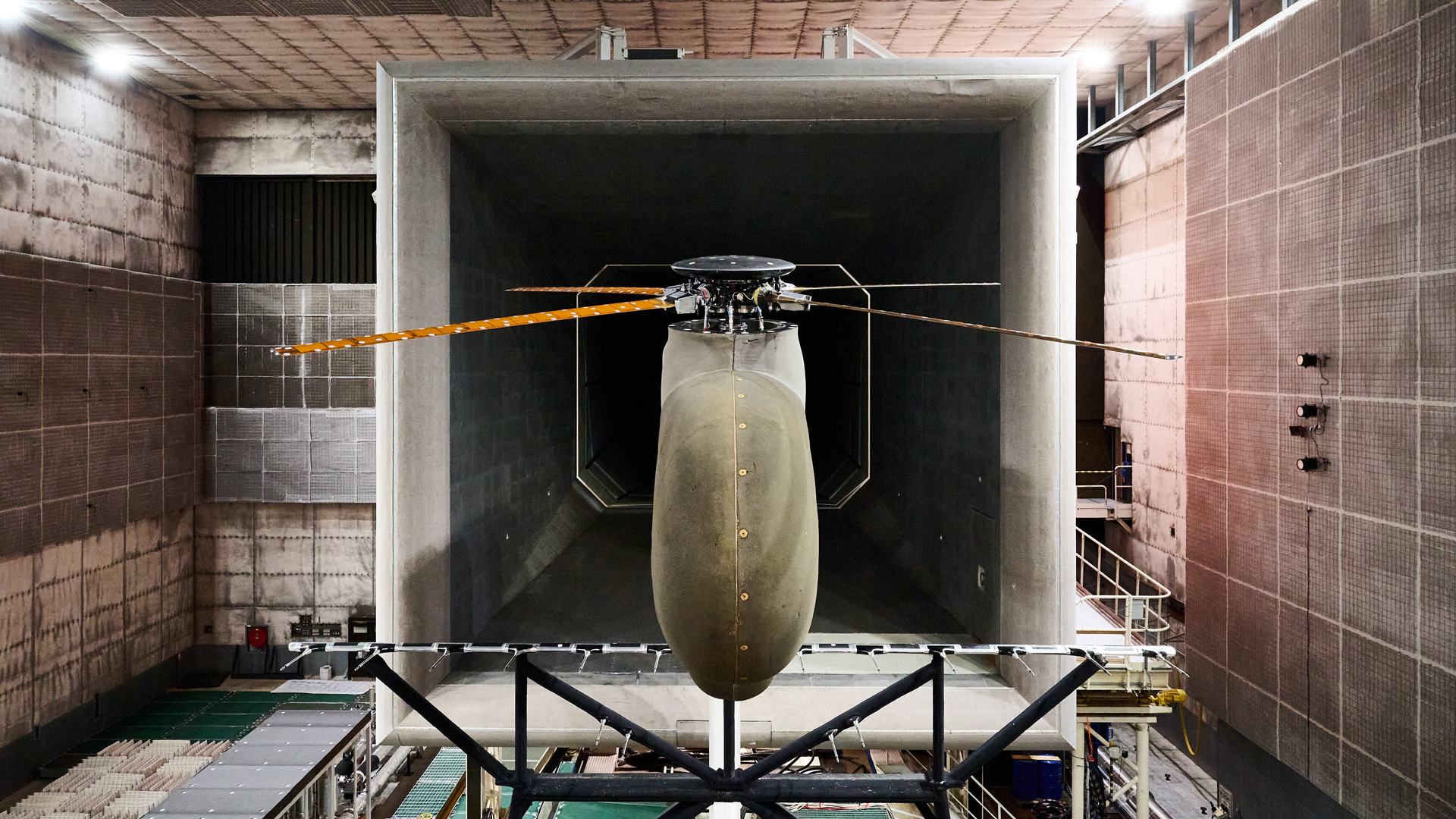
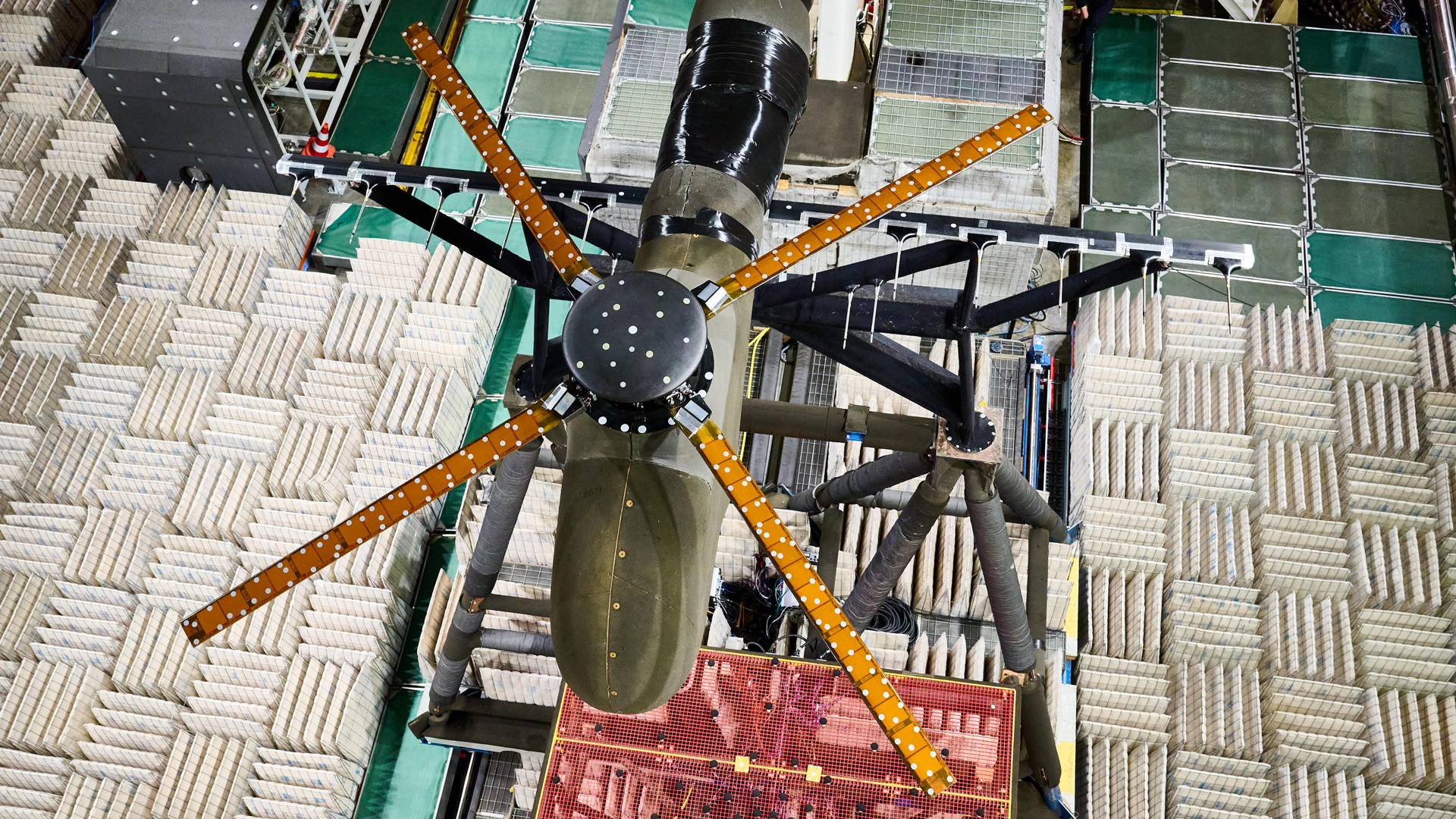
Noise source identification is made possible by microphones outside the flow (on the red square), while a 'noise carpet' is measured using microphones mounted on a wing within the flow and on a traversing system.
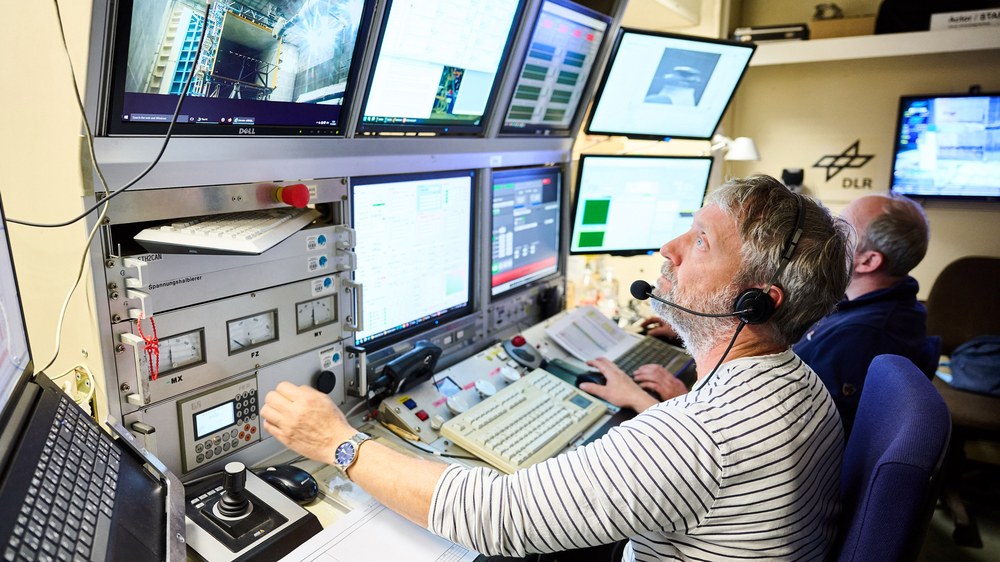
The rotor is controlled by a 'pilot' (front), who is followed by the experimenter responsible for active rotor blade twisting. Data acquisition takes place at the rear. Continuous communication between the test team and wind tunnel operators is essential.
Image: 3/3, Credit:
DLR/Leon Jakobs
A three-week measurement campaign has taken place in the large low-speed wind tunnel of German-Dutch Wind Tunnels (DNW).
Tests with a four-bladed rotor equipped with active blade twisting were successfully completed.
The results show increased efficiency and reduced noise and vibration.
Helicopters are indispensable in our society and save numerous lives when used in rescue operations. But they are also very noisy, particularly during landing descent. As part of the Smart Twisting Active Rotor (STAR) project, the German Aerospace Center (Deutsches Zentrum für Luft- und Raumfahrt; DLR) is working with collaborators from the United States, France, the Netherlands, Japan and South Korea to improve rotor blade performance while reducing noise and vibration.
During hovering and high-speed flight, helicopters require large amounts of power and are subject to high levels of vibration, especially during slow or fast flight and while manoeuvring. These effects could be significantly reduced if rotor blades could adapt statically and, above all, dynamically to aerodynamic flight conditions.
Active twisting of rotor blades without mechanical components
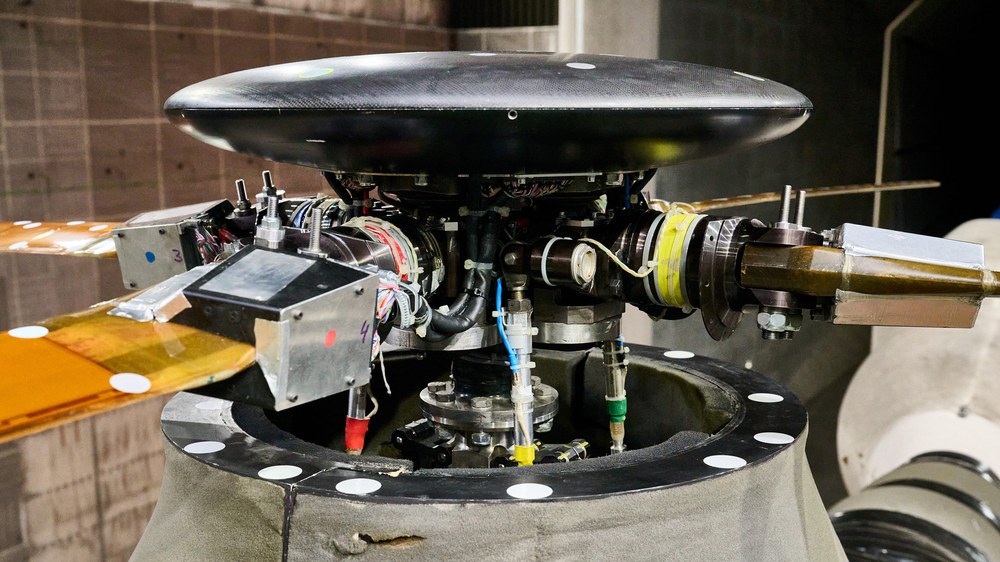
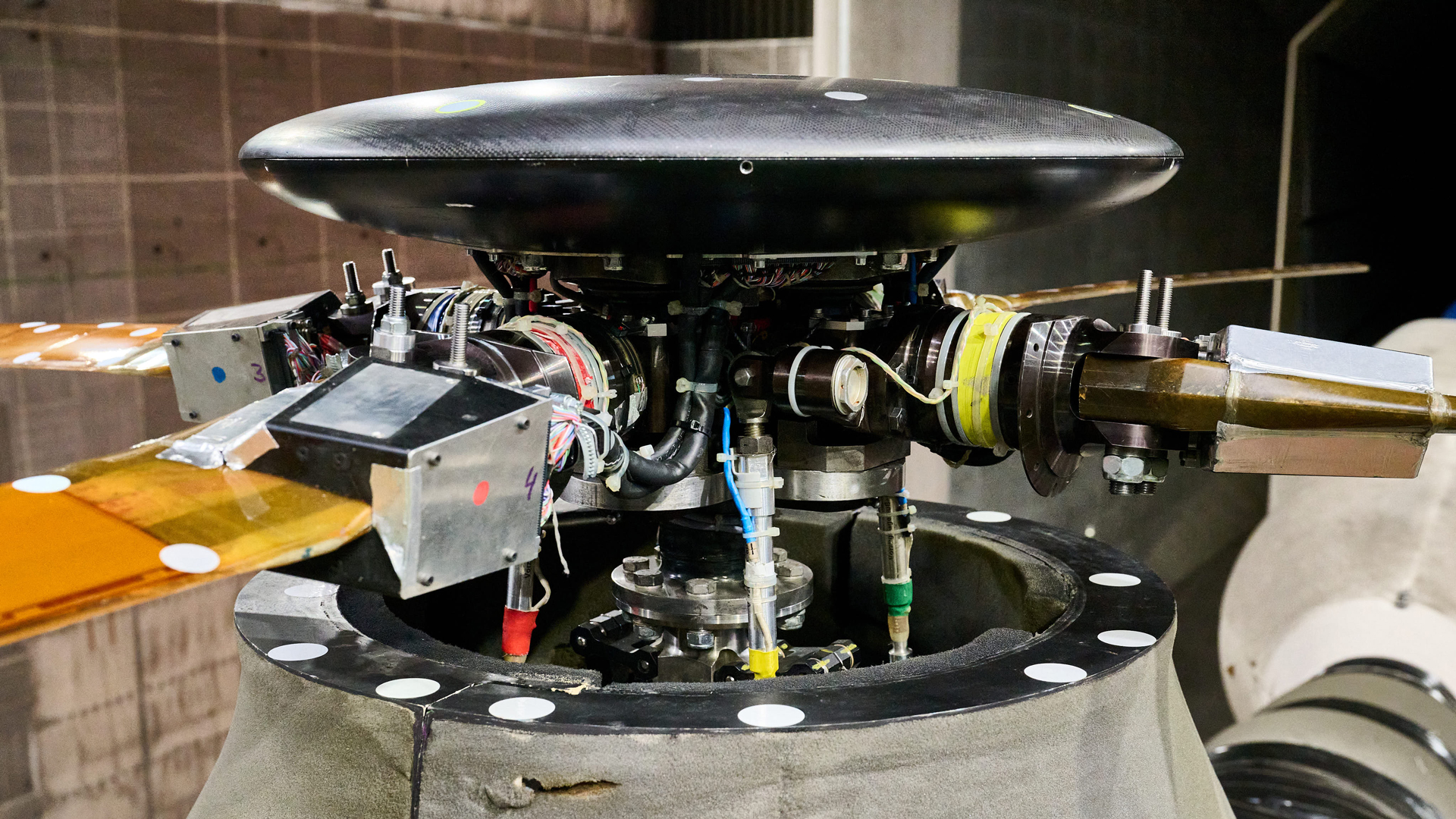
Rotor head with blade control system and sensor cabling
The rotor blades are equipped with numerous sensors and piezoceramic actuators. All cables are routed to the rotor head and must withstand high static and dynamic loads during operation.
In the STAR project, researchers from the DLR Institute of Flight Systems and the Institute of Lightweight Systems are investigating actively twisting rotor blades with piezoceramic actuators integrated into the blade surface, which twist the blade when an electrical voltage is applied – statically with direct current and dynamically with alternating current – as if an artificial muscle was at work in the blade.
"The special thing about this approach is that the active twisting of a rotor blade requires no mechanical components and is only minimally affected by the centrifugal forces acting on the rotor blades," explains Berend Gerdes van der Wall, project manager at the Institute of Flight Systems.
Measurement campaign in DNW's large low-speed wind tunnel
Following extensive preparations, a four-bladed active twist rotor with a diameter of four metres was tested for the first time worldwide in the large low-speed wind tunnel at German-Dutch Wind Tunnels (DNW) in the Netherlands.
The three-week measurement campaign took place at the end of 2025 under DLR's leadership and in close collaboration with all project collaborators: NASA, the United States Army, ONERA (France), DNW, JAXA (Japan), the Korea Aerospace Research Institute (KARI) and Konkuk University. The tests measured noise reductions of up to seven decibels during landing descent, which corresponds to more than half of the perceived noise. Vibrations were also reduced by more than half, while rotor efficiency increased under high load.
"During the measurement campaign, we were able to successfully test our concept in a realistic environment. The results show that efficiency increased while noise and vibration were significantly reduced," says van der Wall.
In addition to rotor forces, moments and power, the data obtained also includes blade motions, their deformations and loads, surface pressure measurements, acoustic measurements and flow-field and boundary-layer measurements. This information enables comprehensive validation of computational models. The results can also be applied to a wide range of scenarios, from conventional helicopters and high-speed configurations to urban air mobility concepts.
In addition to DLR, the STAR project involves NASA, the French and Japanese air and space agencies – ONERA and JAXA – the Korea Aerospace Research Institute (KARI), Konkuk University in South Korea, the United States Army Simulation and Training Technology Center and German-Dutch Wind Tunnels (DNW).
Contact
Jasmin Begli
Corporate Communications Braunschweig, Cochstedt, Stade and Trauen