
Energy consumption and renewable energies in transport
Energy consumption and renewable energies in transport
The first and second parts of this series examined mobility in Germany, discussing transport performance as well as the emissions from passenger and freight transport. This instalment focuses on final energy consumption in the transport sector in Germany, along with the share of renewable energies. Both topics are analysed over the period from 1990 to 2020.
Final energy consumption in German transport by mode of transport
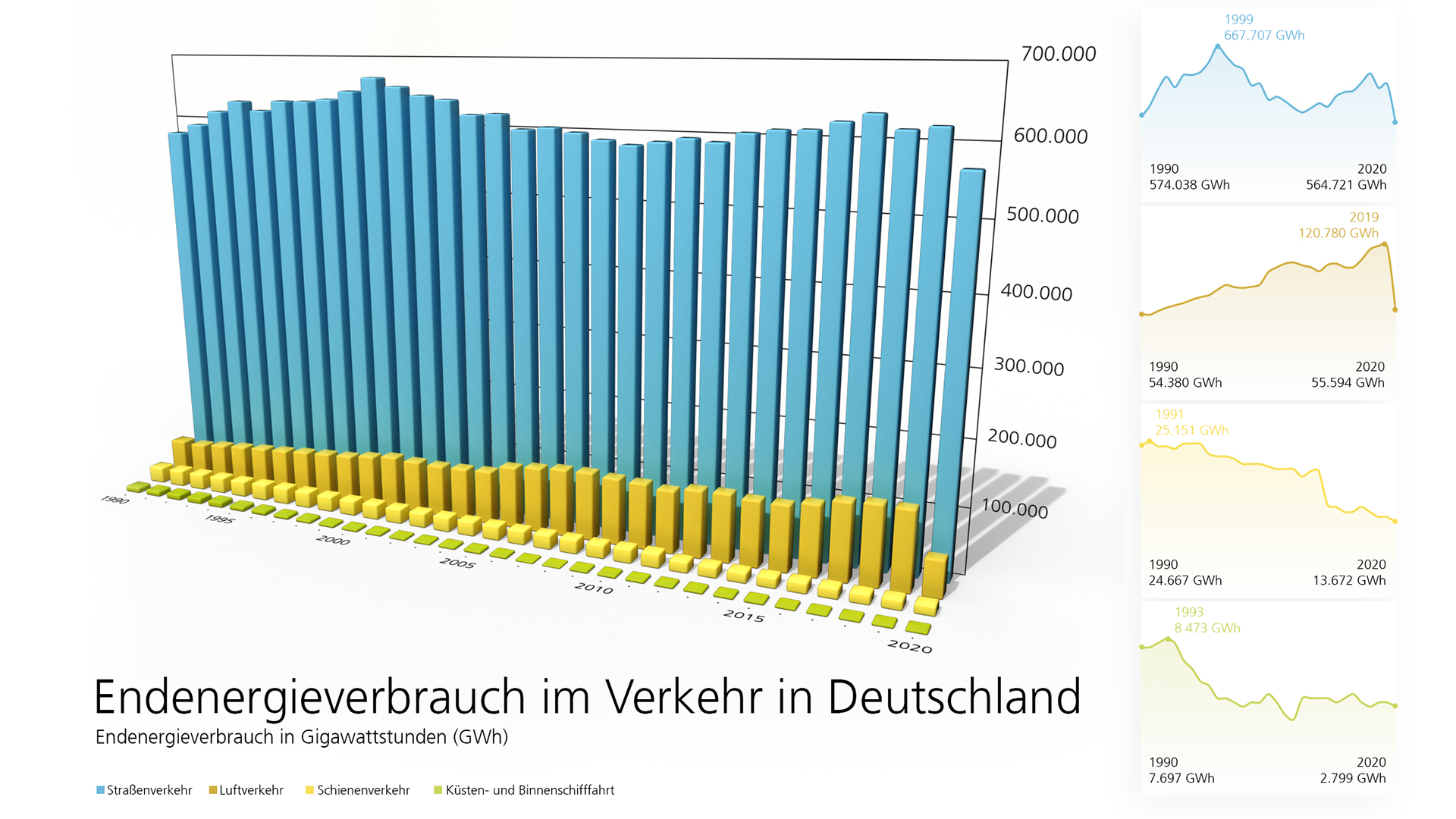

Final energy consumption in German transport by mode of transport
Over the 30-years under review, the final energy consumption of Germany's transport sector remained relatively constant. Road transport, both passenger and freight, accounted for by far the largest share of energy consumption.
- Final energy consumption includes the energy used by the modes of transport shown in the graphic. It does not include the energy required to produce and distribute the energy carriers, nor the energy used for the production of transport vehicles and infrastructure.
- Unit of measurement: gigawatt-hours (GWh). For comparison: the city-wide energy balance for Stuttgart shows approximately 12,000 gigawatt-hours of final energy consumption in 2020.
- Methodology: Energy consumption directly used for transport services is taken into account here. Indirect energy consumption, such as traffic lights and street lighting, as well as fuel consumption in agriculture, construction and the military, is not included. Kerosene consumption or domestic deliveries in the aviation sector encompass all fuel used, or energy consumed, for commercial and non-commercial flights departing from Germany up to the first destination airport. Domestic deliveries include domestic production and imports minus exports, and therefore provide information on domestic use. Data on transport energy consumption is generally based on statistics regarding deliveries to transport operators. In some cases, market research findings are also used. The data is collected and processed by AG Energiebilanzen to provide a comprehensive overview of energy trends in Germany. This is based on the official mineral oil data published by the Federal Office for Economic Affairs and Export Control (BAFA).
Overall: final energy consumption has remained relatively constant, while road transport dominates by a wide margin
- In 2020, final energy consumption in the transport sector amounted to nearly 637,000 gigawatt-hours. Primarily due to the COVID-19 pandemic, this figure was lower than in 2019, when consumption stood at approximately 756,000 gigawatt-hours.
- In 1990, final energy consumption in the transport sector was just over 660,000 gigawatt-hours.
- Over the 30-year period under review, final energy demand in transport remained relatively constant. During the same period, however, transport performance increased moderately in passenger transport and steadily at a high pace in freight transport (see the related articles on passenger and freight transport in this series).
- Road transport accounts for by far the largest share of final energy consumption throughout the entire period, followed by air transport, rail and shipping.
Road transport: final energy consumption has remained relatively constant, while transport performance increased – particularly significantly in freight transport
- Definition: Passenger and freight transport on roads
Passenger transport includes motorised private transport and public road passenger services (bus, tram, underground).
Freight transport covers domestic freight carried by German and foreign lorries within Germany (start and destination both in Germany), import and export transport (origin or destination abroad, with only the section on German roads included here) and transit transport (origin and destination abroad, with only the section on German roads included). - In 2020, final energy consumption in road transport amounted to nearly 565,000 gigawatt-hours. The slight decrease compared with 2019, which stood at 618,000 gigawatt-hours, is primarily due to the effects of the COVID-19 pandemic.
- In 1990, final energy consumption in road transport was approximately 574,000 gigawatt-hours. Over the past three decades, it has remained largely constant, fluctuating slightly around the 600,000 gigawatt-hour mark.
- Background: more efficient drive technologies, combined with an increasing number of vehicles with more powerful engines and heavier weights, as well as longer travel distances.
Air transport: energy consumption and passenger air transport more than doubled, passenger air transport performance also doubled
- Definition: Kerosene consumption, or domestic deliveries in the air transport sector, covers all fuel used for commercial and non-commercial flights. This includes scheduled services and charter flights (such as package holidays), air freight and mail services, business flights and commercial flight training. Figures are compiled according to the location or departure airport principle. This means that all outbound transport (such as departing passengers or loaded cargo) and the associated energy consumption are attributed to the domestic airport of departure, up to the first destination airport.
- In 2020, final energy consumption in air transport amounted to approximately 56,000 gigawatt-hours. The significant decline compared with 2019, when consumption reached 121,000 gigawatt-hours, is also primarily due to the effects of the COVID-19 pandemic.
- In 1990, consumption stood at approximately 54,000 gigawatt-hours. Over the past three decades, final energy consumption in air transport has therefore more than doubled. Transport performance in passenger air transport also doubled over the same period.
Rail transport: final energy consumption has fallen significantly, while transport performance has increased considerably
- Definition: Passenger and freight transport by rail.
Passenger rail transport includes S-Bahn (urban rail), regional trains, Interregio, IC and ICE services.
Freight rail transport includes all railway operators licensed in Germany for domestic transport (start and destination both in Germany), import and export transport (start or destination abroad, only the section on the German rail network included here) and transit transport (start and destination both abroad, only the section on the German rail network included). Not included here are transport within rail networks of industrial railways, such as those operating in open-cast mines, ports and large industrial sites. - Final energy consumption in rail transport amounted to nearly 13,700 gigawatt-hours in 2020, compared with approximately 14,400 gigawatt-hours in 2019.
- In 1990, at the start of the period under review, consumption stood at approximately 25,000 gigawatt-hours. Over the past 30 years, a significant decrease in final energy consumption can be observed. At the same time, passenger rail transport performance doubled, while rail freight performance increased by 50 percent.
- Background: electrification of the rail network, newer and more energy-efficient trains, higher utilisation rates in passenger and freight rail transport.
Coastal and inland waterway transport
- Definition: Domestic transport on the German inland waterway network, carried out by German and foreign independent operators who navigate their own vessels and typically own one or two boats, as well as shipping companies in domestic transport (start and destination both in Germany), import and export traffic (start or destination abroad, only the section on German waterways included here) and transit transport (start and destination abroad, only the section on German waterways included).
- In 2020, final energy consumption for coastal and inland waterway transport stood at approximately 3000 gigawatt-hours.
- In 1990, this figure was nearly 8000 gigawatt-hours.
- Over the course of 30 years, final energy consumption has therefore fallen significantly, while transport performance has declined slightly.
Renewable energies in German transport
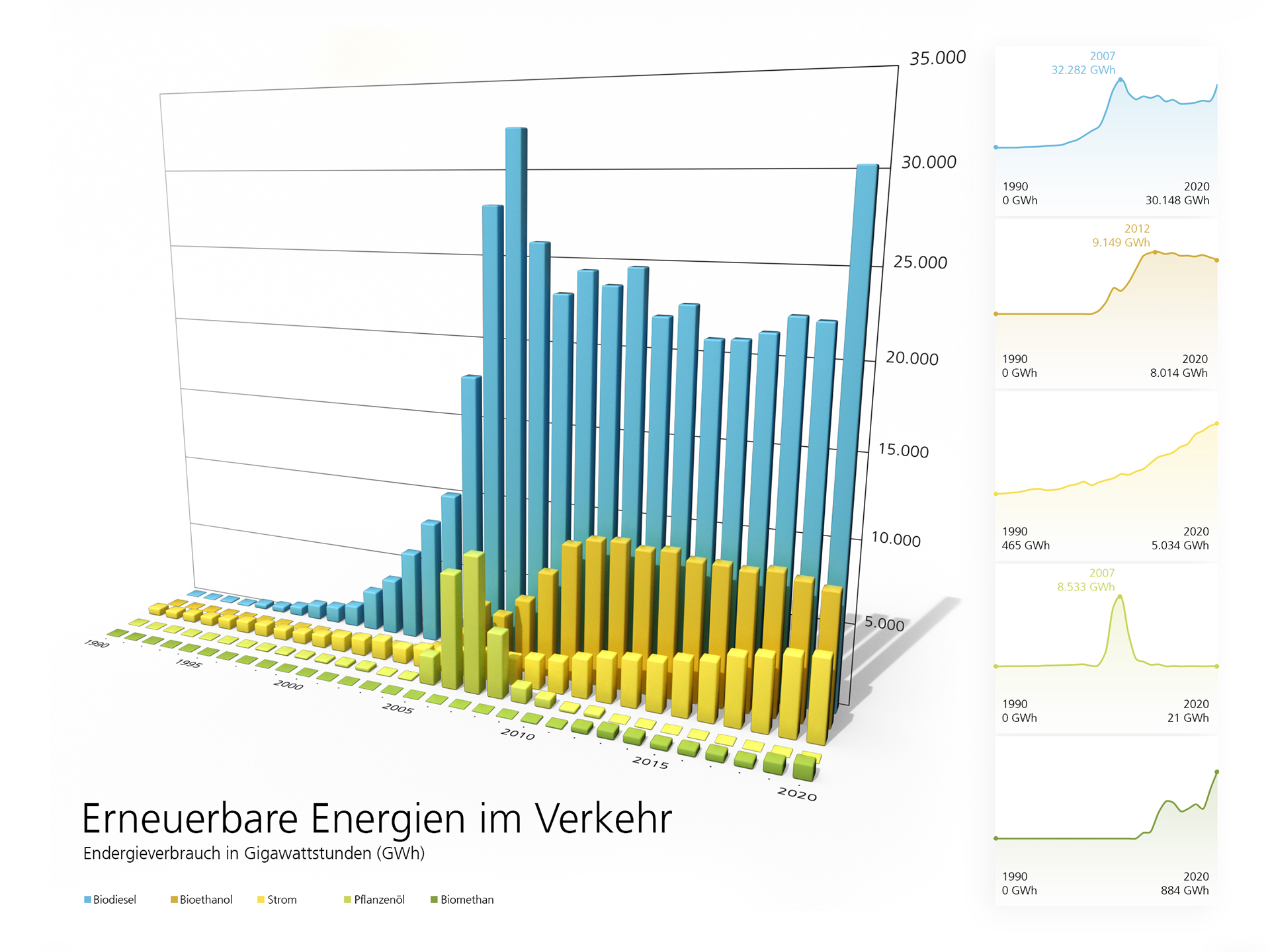
Renewable energies in German transport
Final energy consumption of renewable sources in Germany's transport sector grew strongly over the 30-year period under review. Biodiesel currently dominates, followed by electricity.
- For the definition of 'final energy consumption' and an illustrative comparison for of the energy unit gigawatt-hours, see the notes accompanying the first graph.
- Methodology: The data was compiled and processed by the Federal Ministry for Economic Affairs and Energy (BMWE), based on the work of the Working Group on Renewable Energy Statistics (Arbeitsgruppe Erneuerbare Energien-Statistik; AGEE-Stat). Electricity consumption in transport was calculated using the share of renewable energies in gross electricity consumption for the respective year. Not included are indirect energy consumption, such as the lighting of transport infrastructure, and fuel use in agriculture, construction and the military.
Overall: very strong growth since the early 2000s, yet share of final energy consumption remains in the single digits
- In 2020, total final energy consumption from renewable sources amounted to nearly 44,000 gigawatt-hours.
- In 1990, the figure stood at 465 gigawatt-hours, derived entirely from electricity generated from renewable sources.
- Over the past 30 years, final energy consumption from renewable sources in transport has increased more than ninetyfold.
- Taking the total final energy consumption in transport in Germany of approximately 637,000 gigawatt-hours in 2020 (see previous chart), the share attributable to renewable energy sources accounted for just under seven percent.
- In terms of share, biodiesel accounted for the largest proportion of renewable energy sources in transport's final energy consumption for most of the 30-year period, followed by bioethanol and electricity.
- Background: The use of renewable energies in transport is depends heavily on policy frameworks, including subsidy programmes, legal requirements and regulations, as well as tax incentives for certain fuels (such as blending quotas) and drive technologies (such as electric mobility). EU Directive 2003/30/EC sets a target of two percent biofuels by 2005 and 5.75 percent by 2010, both measured by energy content. In 2009, it was replaced by Directive 2009/28/EC (RED), which established a ten percent target for renewable energy in final energy consumption by 2020. This directive was in turn replaced in 2021 by Directive 2018/2001 (RED II).
Biodiesel (biofuel derived from plant or animal fats, oils and alcohols):
- Significant quantities have been used since the mid-1990s.
- In the 2000s, the share rose exponentially, reaching an initial peak of 32,282 gigawatt-hours in 2007, before settling in a range of between 20,000 and 25,000 gigawatt-hours up to and including 2019.
- In 2020, biodiesel recorded a new peak of more than 30,000 gigawatt-hours.
Bioethanol (biofuel produced from biomass or biodegradable waste):
- Significant use was recorded from the mid-2000s onwards, increasing rapidly to a peak of 9149 gigawatt-hours in 2012, before levelling off at a slightly lower but relatively stable level.
- In 2020, final energy consumption from bioethanol in transport amounted to approximately 8000 gigawatt-hours.
Electricity (from renewable sources)
- The share of electricity from renewable sources in transport's final energy consumption in Germany has risen continuously over the 30-year period under review.
- In 1990, consumption stood at 465 gigawatt-hours; by 2020, it had reached nearly 5000 gigawatt-hours.
- Background: the ongoing electrification of the rail network, as well as the emergence and public funding of electric mobility in road transport
Vegetable oil (used as fuel in diesel engines)
- Vegetable oil was used in significant quantities primarily between 2005 and 2010, reaching a peak of approximately 8500 gigawatt-hours in 2007.
- Its use subsequently declined following a policy shift driven by the 'tank versus table' debate and concerns over its poor environmental impact.
- By 2020, consumption had fallen to just 21 gigawatt-hours.
Biomethane (biogas)
- Since the early 2010s, the share of biomethane has been growing, reaching 884 gigawatt-hours in 2020.
- Overall, the share of biomethane remains very low compared to the other renewable energy sources listed here.
- Background: like natural gas, biomethane can be used as a vehicle fuel and is blended in proportion to the natural gas used as a fuel.
Contact
Denise Nüssle
Editor
German Aerospace Center (DLR)
Corporate Communications
Pfaffenwaldring 38-40, 70569 Stuttgart
Tel: +49 711 6862-8086