
From climate impacts to crew pairing: Perspectives on air transport at ETC 2026

- GRIDcast and OpenAirClim for assessing future air transport and climate scenarios
- Quantum algorithms for optimising crew rosters
- Robust aircraft rotations in extreme weather
- Potential of electric aircraft for the European air transport network
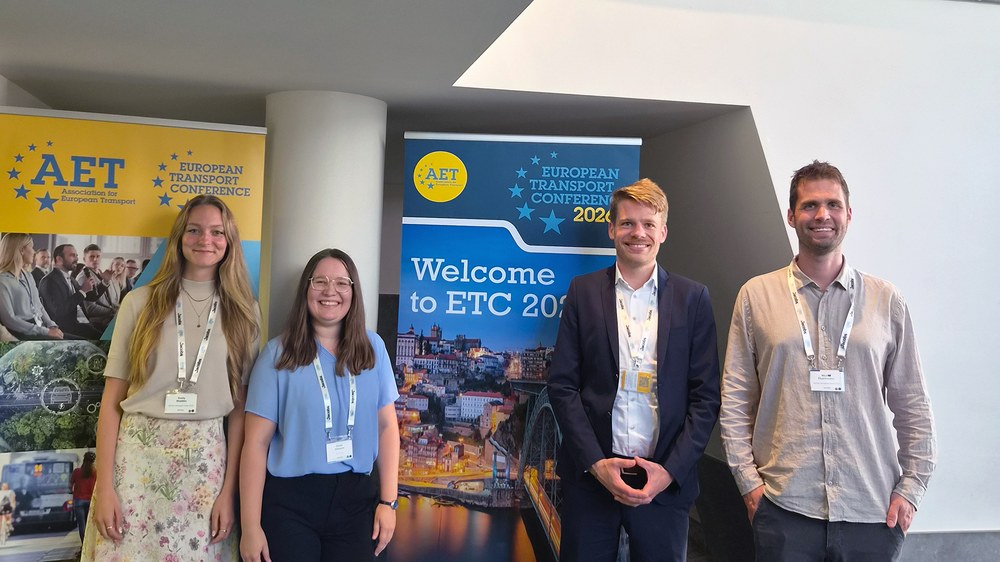
Under the motto “Bridging Minds, Building Mobility”, the European Transport Conference 2026 brought together more than 500 researchers, policymakers, consultants and other experts from more than 30 countries. The conference at the University of Porto focused on current questions surrounding the future of mobility and the development of sustainable, resilient and accessible transport systems. The DLR Institute of Air Transport contributed the following research papers to the conference.
Efficient assessment of global emissions and climate impacts
How will global aviation emissions develop as demand, fleets and technologies change? Researchers at the German Aerospace Center (DLR) have developed GRIDcast and OpenAirClim to examine such scenarios efficiently. Based on high-resolution emissions data, GRIDcast calculates future emissions inventories for different regions, market segments and aircraft generations. These serve as the basis for OpenAirClim, which assesses the effects of CO2, NOx, water vapour and contrails on climate development. This makes it possible to compare different aviation development pathways and their climate impacts without having to carry out complex simulations for each scenario.1
What quantum algorithms could contribute to crew planning
Crew planning is one of the complex optimisation tasks in airline operations. Researchers from the DLR Institute of Air Transport and the DLR Institute of Quantum Technologies are investigating whether quantum algorithms could be used for so-called “crew pairing” in the future. In a study, three different mathematical formulations of the crew-pairing problem were combined with and investigated using two quantum algorithms. Each formulation was tested using both the Quantum Approximate Optimisation Algorithm (QAOA) and Grover Adaptive Search (GAS). As current quantum computers are still limited by their available capacity, simplified problem formulations were considered using simulators. The aim was to assess the potential of these approaches for future quantum advantage and long-term cost efficiency in airline operations. The study was conducted as part of the QC Mobility project at the DLR Institute of Air Transport and builds on further work examining the potential of quantum computing for airline planning.2
When extreme weather disrupts aircraft rotations
Changes to flight routes caused by extreme weather can increase flight times and consequently affect subsequent flights in an aircraft rotation. Researchers at the DLR Institute of Air Transport are investigating the robustness of strategic flight planning under such conditions using various illustrative extreme-weather scenarios in European airspace. The Digital Airline Twin is used for this purpose, incorporating, among other things, the pyTOM tool developed at the institute for optimising flight trajectories. The changes in flight times resulting from flight diversions are incorporated into rotation planning to determine which aircraft rotation schedules are particularly vulnerable and how they can be adapted to make flight operations more resilient under changing weather conditions.3
What electric aircraft could mean for emissions and airport capacity
What role could (hybrid-)electric aircraft play in the intra-European air transport network in 2050? Another study by the DLR examines how their use could affect emissions and airport capacity utilisation. The study considers electric aircraft with a range of 400 kilometres. It shows that electric flight connections could help to reduce congestion at many European airports. Sensitivity analyses are also used to examine how increasing range could affect intra-European emissions, passenger numbers and airport capacity. For example, as range increases, the number of passengers potentially transported by electric aircraft also rises, while the additional emissions savings increase at a slower rate. The study also examines how electric aircraft could interact with the available supply of Sustainable Aviation Fuels (SAF), and how different scenarios could affect fleets, airport infrastructure and emissions.4
Further information
1 Grunau, R., Dahlmann, K., Lührs, B., Niklaß, M., Niebuhr, L., Gelhausen, M., Völk, S., Grewe, V. "GRIDcast and OpenAirClim: An Efficient Framework for Scenario-Based Aviation Emissions Modeling and Climate-Impact Assessment", European Transport Conference 2026 (ETC 2026), Porto, Portugal.
2 Stoebke, E., Ehlers, T., Lütjens, K., Lenk, S., Sefrin, O. "A Comparative Study of Crew Pairing Optimization Formulations: Exploring Quantum Algorithms", European Transport Conference 2026 (ETC 2026), Porto, Portugal.
3 Albrecht, S., Grunau, R., Röhrs, M., Ehlers, T., Wartha, N., Straub, P., Bölle, T., Lütjens, K., Lau, A. "Impacts of Climate-Related Extreme Weather on Aircraft Rotations", European Transport Conference 2026 (ETC 2026), Porto, Portugal.
4 Flüthmann, N., Gelhausen, M., Leipold, A., Link, A., Neubacher, L., Ratei, P., Hoppe, H. "Emission Reduction and Airport Capacity Constraints Relief by Integration of (hybrid) Electric Aircraft in the Intra-European Air Transport Network and optimized Allocation of SAF", European Transport Conference 2026 (ETC 2026), Porto, Portugal.