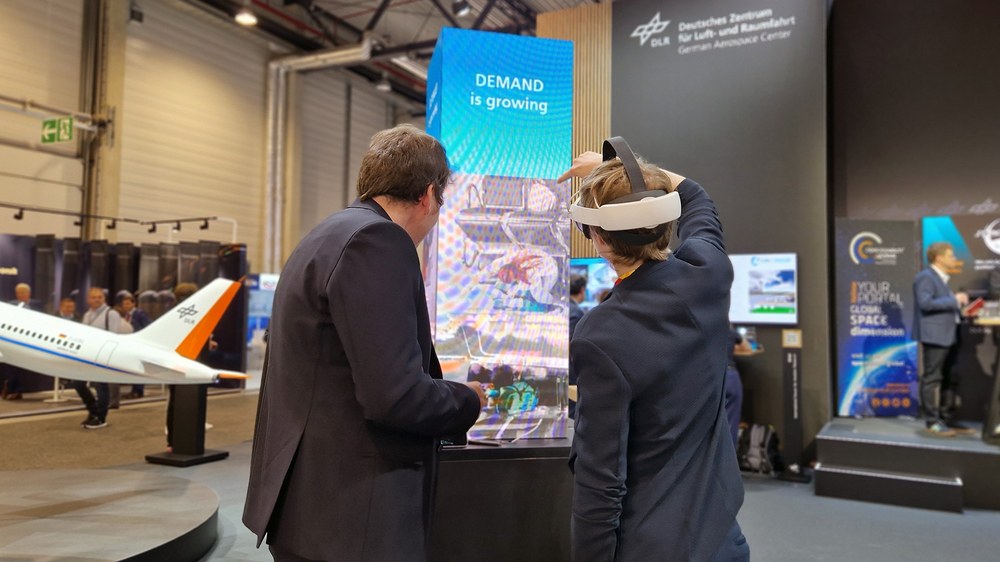
The DLR Institute of Air Transport contributed to DLR’s presence at ILA Berlin 2026 with an exhibit highlighting the benefits of air transport. Based on the DEPA 2070 study, the institute’s VR application illustrated possible developments in global aviation emissions and the impact of different technological pathways.
Discussing the Benefits and Future of Air Transport
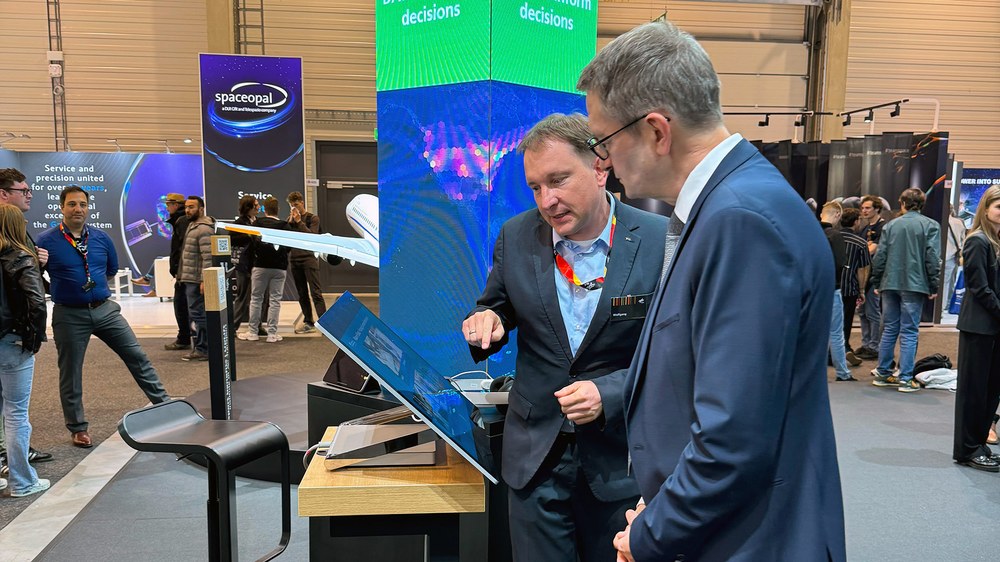
Stefan Schnorr, State Secretary at the Federal Ministry for Transport (right), discusses the economic and societal impacts of air transport with Wolfgang Grimme of the DLR Institute of Air Transport.
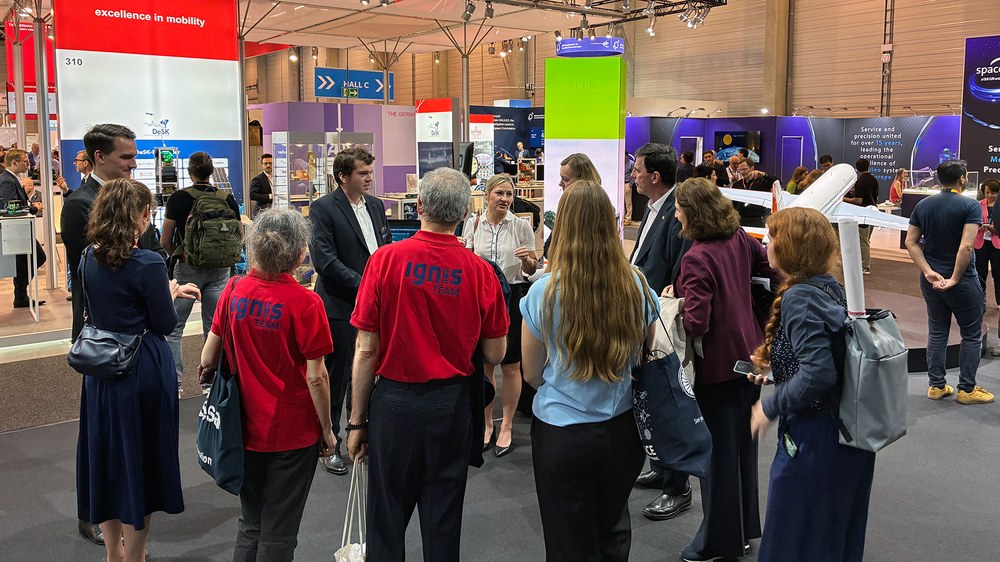
A Polish research delegation learns from Maximilian Clococeanu of the DLR Institute of Air Transport about current analyses of the economic, societal and environmental impacts of air transport, as well as future aviation scenarios.
The DLR Institute of Air Transport presented an exhibit on the benefits of air transport at the DLR stand.
The focus was on the societal and economic impacts of air transport, as well as the challenges associated with its transformation.
The exhibit provided numerous opportunities for discussions with visitors from politics, industry and research.
How can the importance of air transport be communicated without overlooking the challenges that lie ahead? This question was at the heart of the DLR Institute of Air Transport’s contribution to ILA Berlin 2026. As part of DLR’s exhibition presence, the institute presented an exhibit on the benefits of air transport, inviting visitors to consider aviation from a broader systems perspective.
Air Transport as a driver of societal and economic development
An LED installation illustrated how air transport contributes to global connectivity, trade, tourism, employment and mobility. At the same time, it highlighted the sector’s dual challenge: global air traffic is expected to continue growing, while emissions and climate impacts must be reduced. The exhibit demonstrated why this challenge cannot be addressed through technology alone, but requires consideration of the entire air transport system.
Particular interest was generated by the accompanying VR application based on the DLR study DEPA 2070. It provided insights into projected developments in global CO2 and NOx emissions and demonstrated how different technological pathways – ranging from more efficient aircraft and sustainable aviation fuels to novel propulsion concepts – could influence future developments.
Exchange with policymakers
Throughout the exhibition, the exhibit served as a focal point for numerous discussions with representatives from government and public administration. Visitors to the DLR stand included Liv Assmann, State Councillor and Representative of the Free and Hanseatic City of Hamburg to the Federal Government, the European Union and for Foreign Affairs, and Dr. Christopher Schwieger, State Councillor at Hamburg’s Authority for Economy, Labour and Innovation.
Further discussions took place with Stefan Schnorr, State Secretary at the Federal Ministry for Transport; Dr. Wilhelm Eschweiler, Director-General at the Federal Ministry for Transport; and Dr. Beate Baron, Head of the Industrial Policy Division at the Federal Ministry for Economic Affairs and Energy. Representatives from the aviation industry and the air transport research community also took the opportunity to exchange views.
The discussions focused on the economic and societal impacts of air transport, questions of international connectivity, the competitiveness of Europe as an aviation location, and the role of regulation and technology in transforming the air transport system.
Scientific foundations for decision-making
A particular focus was placed on how future developments in air transport can be assessed in a robust and evidence-based manner. Among the projects presented was the ALICIA impact assessment project and its interactive dashboard. New analyses of global fleet developments, supply chains and production capacities highlighted the links between technological innovation, industrial value creation and the competitiveness of Europe’s aviation sector.
Research in dialogue
For the DLR Institute of Air Transport, ILA 2026 primarily provided an opportunity to engage with a wide range of stakeholders on the future of air transport and to discuss how mobility, competitiveness and climate protection can be reconciled in an increasingly complex environment.