Assessment, strategies and forecasts for the development of global air transport
DEPA – ext.: visions for tomorrow's aviation
The future of aviation – how we might fly in 2070
The DEPA – ext. project expands on existing air transport scenarios developed by DLR. It takes into account key uncertainties, such as bottlenecks in capacity, production and supply chains, as well as potential changes to the air transport network up to 2070. The aim is to develop realistic and reliable future scenarios for aviation that inform decision-making in industry, politics and society.
Credit:
DLR / magann – stock.adobe.com
What might aviation look like in 2070 – even in the face of growing uncertainties? This is the question we are addressing in the research project DEvelopment Pathways for Aviation – extended (DEPA – ext.). The project aims to systematically examine possible development paths for aviation and to map out a realistic picture of future flight and transport systems – from individual airports to global air traffic.
In the project, we analyse a variety of future aviation scenarios and outline both likely developments in the sector over the coming decades and various alternative trajectories. A particular focus is placed on risks in the development process, in areas such as energy availability, infrastructure and new innovative technologies. Our goal is to identify viable pathways towards a climate-compatible, economically feasible and stable aviation sector over the long term.
Sustainable aviation: between innovation and feasibility
Working in interdisciplinary teams across six DLR institutes and facilities, we analyse various aircraft types, propulsion systems and technologies for DEPA – ext., assessing their impact on carbon dioxide (CO2) emissions, energy consumption and aircraft noise. At the same time, the project highlights constraints – for example, where new technologies depend on infrastructure, energy supply or economic conditions. In this way, we build a realistic yet multifaceted picture of tomorrow's aviation.
A key strength of DLR's aviation research lies in our impact assessment: we evaluate technologies, policy decisions and future scenarios in a holistic and quantitative way. This makes it possible to understand how developments will affect the aviation system as a whole and individual stakeholders – today and in the future. Our findings help to identify opportunities and risks at an early stage, supporting companies in the aviation, energy and infrastructure sectors with investment decisions and strategic planning. Policymakers and public authorities also benefit, as our analyses provide a foundation for sustainable mobility and also take into account rare but high-impact and hard-to-predict events such as global crises.
Strengthening resilience, safety and independence
Another focus of the project is the resilience of the air transport system. The DEPA – ext. project examines potential disruptions such as supply shortages, production delays and geopolitical changes. The aim is to reduce dependencies and develop solutions for a stable and secure system, resulting in proposals for an aviation sector that remains safe and stable even under challenging conditions.
Results, continuity and follow-on projects
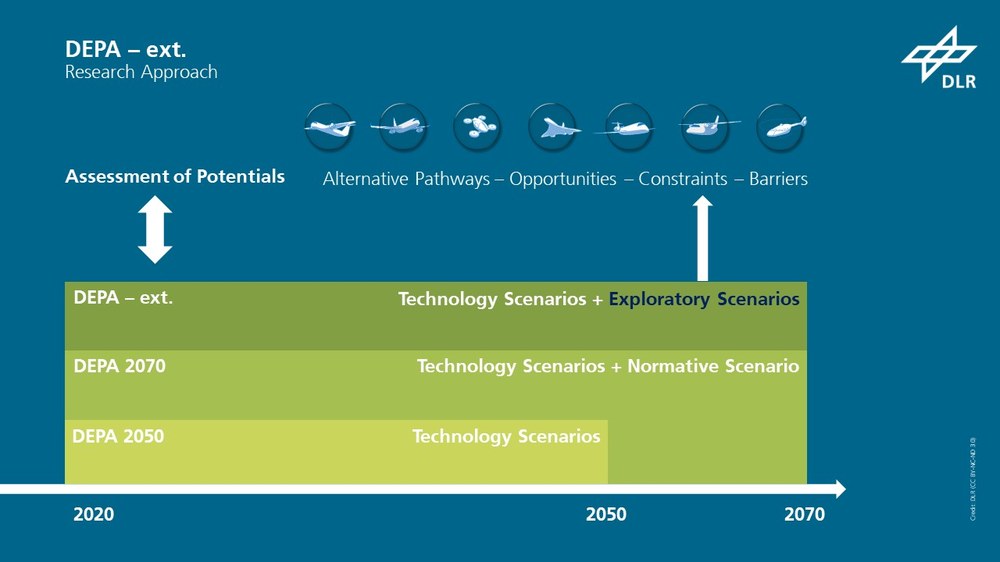
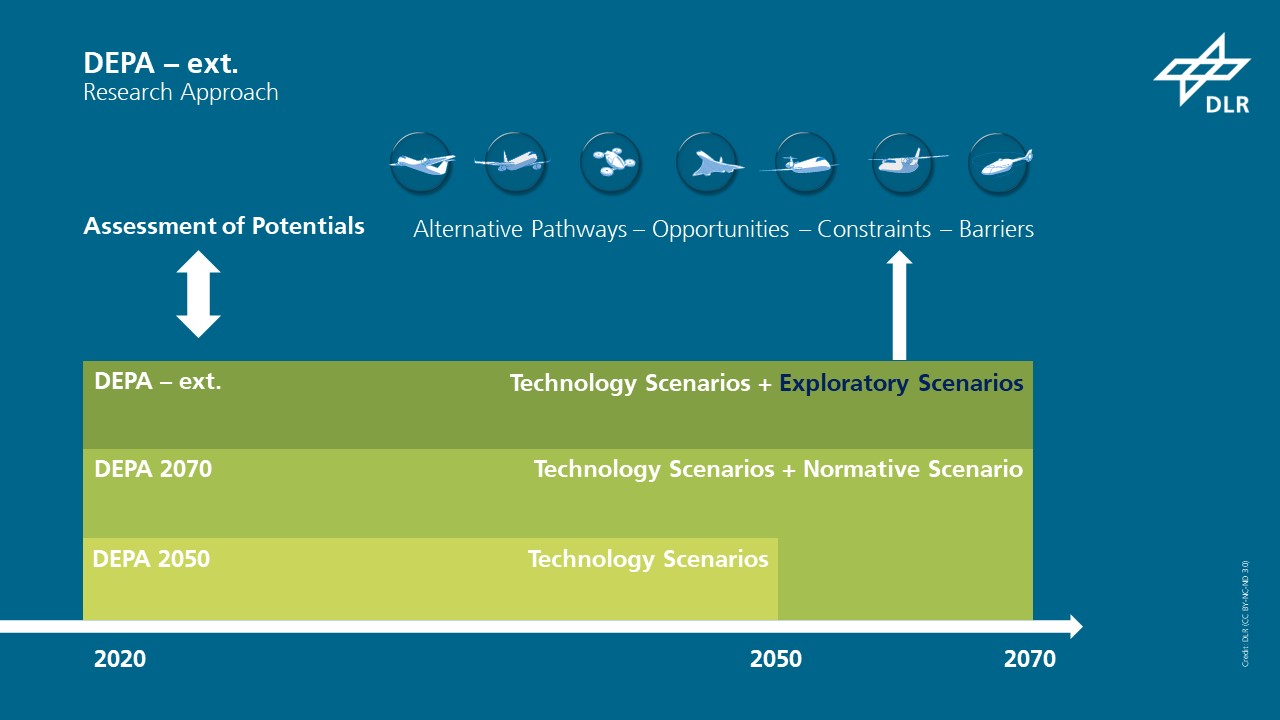
The project builds on earlier work such as DEPA 2050 and DEPA 2070, further developing their models and methods. The insights gained feed into new research approaches and form the basis for further collaboration with academia and industry.
DEPA–ext. research approach
Overview of the components of DEPA – ext. as an extension of the work carried out in the DEPA 2050 and DEPA 2070 projects.