Weather, drones, quantum computing and AI: DLR Institute of Air Transport at DLRK 2026
September 11, 2026
Weather, drones, quantum computing and AI: DLR Institute of Air Transport at DLRK 2026
Research for the aviation of tomorrow: weather, drones, quantum computing and artificial intelligence
From 8 to 10 September 2026, the German Aerospace Congress (DLRK) in Aachen brought together experts from research and industry. The DLR Institute of Air Transport was represented with contributions from its current research on weather-dependent operational capability of small aircraft, drone communications, quantum-based flight planning and AI-supported air traffic control.
Flight safety for small aircraft in regional air transport
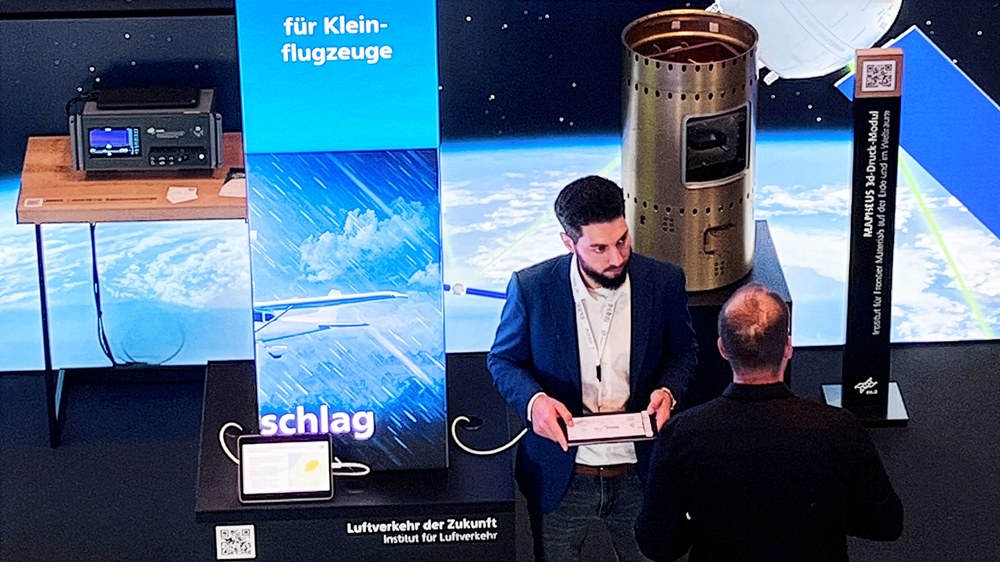
The LED exhibit presented by the DLR Institute of Air Transport at the DLR stand provided an insight into the work carried out in the SMART-MET project on the safe integration of small aircraft into regional air transport. The project focuses on weather-dependent operational capability and route availability, the prediction of wake vortices and wind conditions, as well as the detection of icing and the development of suitable de-icing systems.
The LED exhibit also illustrated a possible regional transport network using electrically powered aircraft operating from Würselen-Aachen airfield. It showed potential weekly demand and possible destination regions for regional air transport using 19-seat aircraft with a range of up to 400 kilometres. Blue: Minimum frequency of 5 flights per week. Yellow: Minimum frequency of 3 flights per week. Green: Minimum frequency of 1 flight per week.
Safe operation of small aircraft in wind and adverse weather
Can departure times be allocated more efficiently using quantum algorithms?
How well do Flying Ad-hoc Networks perform for drone communications?
Economic potential of AI in air traffic control
For three days, the German Aerospace Congress (DLRK) 2026 in Aachen focused on new technologies, specific research approaches and their application in aerospace. From 8 to 10 September, more than 1,000 participants gathered at Eurogress Aachen, presenting their work in more than 500 technical presentations and on numerous posters.
The DLR Institute of Air Transport was represented at the German Aerospace Center (DLR) stand with an LED exhibit on the potential and safety of new regional air transport concepts, using the Aachen urban region as an example. An additional VR application showed possible developments in global aviation emissions based on the DEPA 2070 study. The institute also presented current research on challenges associated with the operation of new types of aircraft, as well as technologies for the future planning and management of air transport.
Weather-dependent operational capability of small aircraft
Unfavourable weather conditions pose particular challenges for small aircraft. The SMART-MET project therefore investigates how weather conditions affect the safety and availability of routes for small aircraft. At the DLR Institute of Air Transport, factors such as icing, reduced visibility, thunderstorms, wind, extreme temperatures and precipitation were analysed using meteorological availability indices. Based on historical weather data from the European Centre for Medium-Range Weather Forecasts (ECMWF), weather-dependent route availability was modelled for a representative route network in North Rhine-Westphalia. The results show the extent to which weather conditions can restrict continuous operations.
SMART-MET also examines other safety-related aspects of small-aircraft operations. Among other things, the project investigates the separation distances from wake vortices required for safe operations at vertiports and how a corresponding wake-vortex warning system could provide support. In addition, the project addresses sensors for detecting icing and energy-efficient de-icing systems.1
Communication in drone networks
Another contribution focused on direct communication between drones without permanently installed communication infrastructure on the ground. These direct connections allow drones to form a dynamic communication network themselves – a so-called Flying Ad-hoc Network (FANET) – enabling data exchange with participants further away. However, the performance of such a FANET depends strongly on the number and density of available drones and therefore on demand for specific drone applications. The DLR contribution investigated how different spatial distributions of demand for drone-based parcel deliveries affect the performance of such a network in an urban scenario. This can be used to derive technical requirements for the communication systems needed for such applications.2
Quantum algorithms for tactical flight planning
The suitability of available quantum algorithms for the tactical allocation of departure times, taking airspace capacity into account, was also investigated. For this purpose, test instances of the mathematical model were derived from real flight schedule data in order to compare a simulated quantum algorithm with a classical optimisation method. The study examines solution quality and feasibility and identifies which model dimensions can be mapped onto current quantum hardware. The analyses showed that the number of possible departure times for each flight and the variables required to represent capacity constraints are key factors determining the size of the quantum model. This provides a basis for assessing the current potential of quantum algorithms and identifying areas for further research.3 The study was conducted as part of the QCMobility project within the DLR Quantum Computing Initiative (QCI).
Artificial intelligence in air traffic control
Another research contribution examined the economic potential of an AI-supported “Digital Interactive Reliable Controller” (DIRC) for European air traffic control. Against the background of increasing delays and staff shortages, the study investigated how supporting air traffic controllers with artificial intelligence could improve the capacity and efficiency of air traffic control while reducing costs. The study was conducted as part of the DLR LOKI project, led by the DLR Institute of Aerospace Medicine, which investigates the foundations for the safe, reliable and transparent use of AI in flight guidance and air traffic control. A particular focus is on trustworthy cooperation between humans and AI systems.4
1 El Kadaoui, H., Swaid, M., Lau, A. (DLR Institute of Air Transport), “Meteorological-Dependent Route Availability for Small Electric Aircraft: An Index-Based Framework Using ERA5 Data”, German Aerospace Congress 2026 – DLRK 2026, Aachen, Germany.
2Marks, T. (DLR Institute of Air Transport), “Interrelation of spatial demand distribution and FANET performance in varying urban UAS package delivery scenarios”, German Aerospace Congress 2026 – DLRK 2026, Aachen, Germany.
3Kanitz, R., Solzer, J., Buchtal, K. (DLR Institute of Air Transport), Tarantola, A., Schindler, M. (DLR Institute of Quantum Technologies), Lau, A. (DLR Institute of Air Transport), “Kapazitätsbeschränkte Slot-Allokation: Benchmarks und Machbarkeitsanalyse unter NISQ-Bedingungen”, German Aerospace Congress 2026 – DLRK 2026, Aachen, Germany.
4Engel, M., Wozny, F., Jung, M. (DLR Institute of Air Transport), “Economic Potential of the Digital Interactive Reliable Controller (DIRC)”, German Aerospace Congress 2026 – DLRK 2026, Aachen, Germany.