Home
>
Research & Transfer>
Projects>
3LK – Assessment of Air Pollution, Noise, Light Pollution and Climate Impacts
3LK – Assessment of Air Pollution, Noise, Light Pollution and Climate Impacts
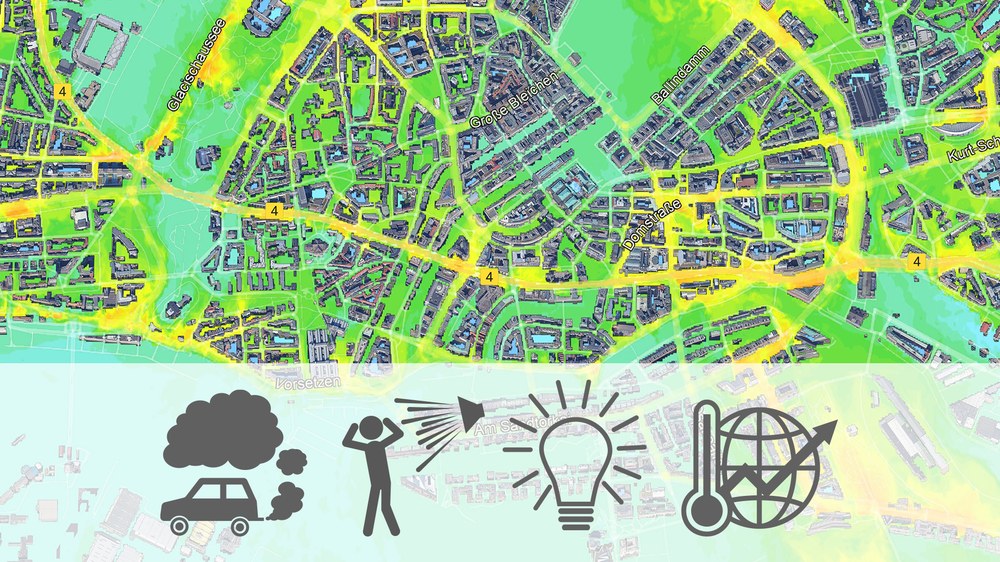

3LK supports cities, authorities and infrastructure operators in sustainable environmental and transport planning
Transport shapes our living spaces. It connects cities and regions, enables mobility and economic development, and at the same time affects air quality, noise, light, and climate. This is where the DLR impulse project 3LK comes in.
Credit:
© DLR. Alle Rechte vorbehalten
3LK stands for air pollution, noise pollution, light pollution, and climate change. Together with municipalities, authorities, infrastructure operators, industrial companies, health insurance providers, and associations, we develop practical solutions and create scientifically sound decision-making foundations.
The aim of the project is to jointly analyse the environmental impacts of air pollution, noise, light pollution, and climate change. These challenges are often closely linked – for example, when air pollutants also have climate effects, or when transport measures simultaneously affect multiple environmental aspects. Focusing on road, air, and maritime transport, we make impacts transparent, identify mitigation measures, and forecast developments under different future scenarios.
Why Integrated Environmental Strategies are Necessary
From 2030, significantly stricter EU limits for air pollutants will apply. At the same time, achieving the 1.5-degree target is becoming increasingly challenging. Air pollutants such as nitrogen oxides or particulate matter affect both health and climate. Conversely, climate change alters the chemical and physical processes in the atmosphere, with consequences for air quality.
In addition, high levels of traffic noise are a concern, for which the European Union has set ambitious noise protection targets by 2030. Quantifying the effects of noise, however, is complex and presents additional challenges for municipalities.
Capturing the hitherto little-regulated light pollution presents a further challenge. Artificial lighting alters ecosystems and affects human biorhythms. A nationwide legal framework for light pollution does not yet exist.
The central question therefore is: how can measures be designed to address these ambitious goals across multiple environmental aspects simultaneously – without causing unintended challenges in other areas?
From Emission Source to Environmental Impact: Modelling the Entire Impact Chain at DLR
At the German Aerospace Center (DLR), we analyse the full impact chain of transport in 3LK: from the generation and distribution of traffic, through emissions of gases, particulates, and noise, to their dispersion and transformation in the atmosphere, and finally their effects on the environment and climate.
3LK builds on the results of the DLR impulse project ELK. The models developed there are expanded, validated with measurement data, and systematically supplemented with the aspect of light pollution.
Instead of isolated individual models, an integrated modelling chain is established, representing a unique feature of DLR. This allows measures – for road, air, or maritime transport – to be considered not only separately but in their interactions with the environment and climate. Effects on air quality, climate, and noise can thus be quantified, and potential conflicts of objectives identified at an early stage. The results are visualised in the further-developed information system ELKIS and made accessible online for authorities and other user groups.
Regional Environmental Analyses
In addition to nationwide assessments, 3LK focuses on selected target regions with different traffic structures and environmental conditions:
- Bremen, exemplary for a port region with significant maritime emissions
- Hamburg, combining road, air, and maritime transport in a highly dense urban area
- Munich, as an international air traffic hub, particularly suitable for detailed analyses of aviation emissions, noise, and light
We also examine how transport and environmental pollution affect health, the magnitude and type of background exposure, and the role of different modes of transport. In this way, 3LK connects urban agglomerations with specialised case studies and provides a nuanced picture of transport’s environmental impacts in Germany. The insights gained are intended to support municipalities, authorities, and infrastructure operators in implementing measures to reduce emissions, noise, and light pollution in a targeted manner.
Economic Assessment of Transport Measures
Measures to reduce air and light pollution, noise, and climate impacts also involve economic challenges. Therefore, 3LK integrates an economic assessment. Among other things, we examine the efficiency of infrastructural measures in road transport, the effect of regulatory instruments in air transport, and the monetisation of air pollutant, noise, and climate-related costs. Regulatory impacts on airlines and passengers are also considered.
This linkage creates a holistic basis for decision-making: which measure achieves which environmental effect – and how does its benefit compare with the resulting costs?
Knowledge Transfer into Practice: Dialogue with Municipalities, Authorities and Infrastructure Operators
3LK is designed as a dialogue project. Municipalities, state authorities, airports, ports, industrial companies, small and medium-sized enterprises, health insurance providers, associations, and NGOs are actively involved.
Requirements are defined, scenarios developed, and results jointly discussed in workshops, symposia, and continuous exchange formats. Knowledge transfer does not occur only at the end of the project but accompanies the entire duration. This produces practical measures that can be directly integrated into planning and decision-making processes.
3LK – Assessment of Air Pollution, Noise, Light Pollution and Climate Impacts
- Duration: 1 January 2026 – 31 December 2028
- Leading institutes: DLR Institute of Atmospheric Physics, DLR Institute of Air Transport
- Project type: DLR impulse project
3LK stands for an integrated, scientifically sound, and practical assessment of transport’s environmental impacts. By jointly considering air pollution, noise, light pollution, and climate, we make a tangible contribution to a healthy environment, effective climate protection, evidence-based policy advice, and sustainable transport planning. In this way, we support cities, regions, and the federal government in achieving environmental goals and securing long-term quality of life.