Pilots have an extremely demanding job with enormous responsibility; they have to make multiple decisions simultaneously within a short period of time. Anneke Hamann is a scientist at the DLR Institute of Flight Guidance in Braunschweig and researches how pilots' mental and physical states can be measured and interpreted. The aim of her work is to use brain data, heart rate, breathing and other physiological signals to detect states such as high mental workload and fatigue – before they become critical. In the following interview, she discusses how such experiments are conducted and what the challenges are.
Anneke, how do you approach this complex topic?
We start by asking ourselves which states are actually relevant for pilots. These include mental workload – that is, how difficult a task is perceived to be – stress, time pressure, drowsiness and mental fatigue. Physical factors can also play a role, for example when someone is simply having a bad day or feels unwell.
What methods and tools are used?
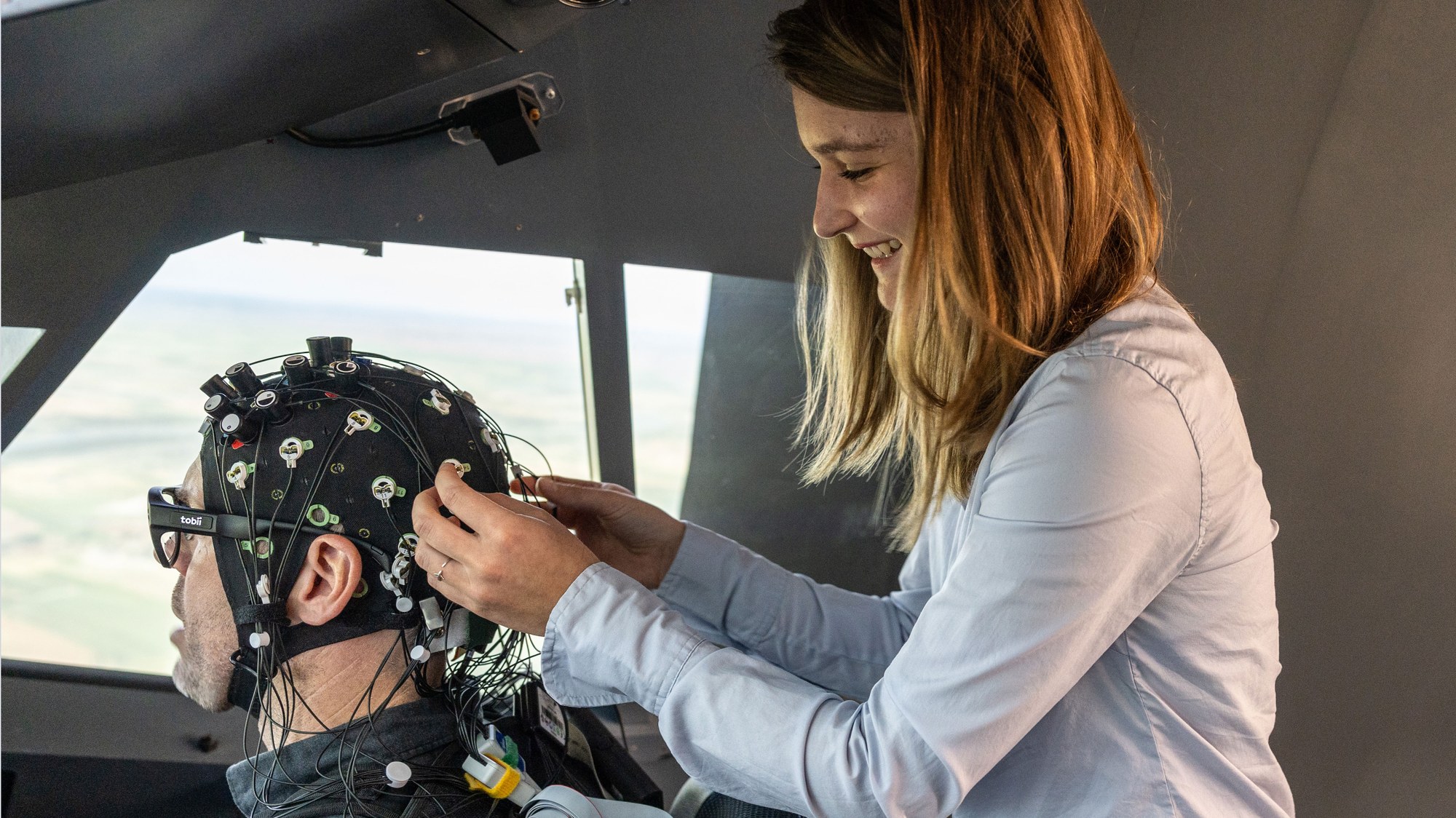
Our main focus is on cognitive processes – in other words, what happens in the brain when information is absorbed, processed and translated into actions. To make these processes measurable, we use methods such as electroencephalography; EEG for short. This involves placing electrodes on the scalp to record electrical signals. When many nerve cells are active at the same time, a measurable pattern emerges. This allows us to determine which areas of the brain are working hardest – for example, whether someone is highly concentrated, stressed or perhaps becoming fatigued.
We use combined EEG with a second, complementary method: functional near-infrared spectroscopy, or fNIRS. In this method, light in the near-infrared range is directed through the scalp into the brain. You can think of it a bit like when, as a child, you likely shone a torch through your finger and could see your blood vessels. By analysing the light absorption, we can determine how much oxygenated and deoxygenated blood is present and how this ratio changes over time – and thus how active the brain is. The more demanding the task, the harder the brain has to work and the more energy required.
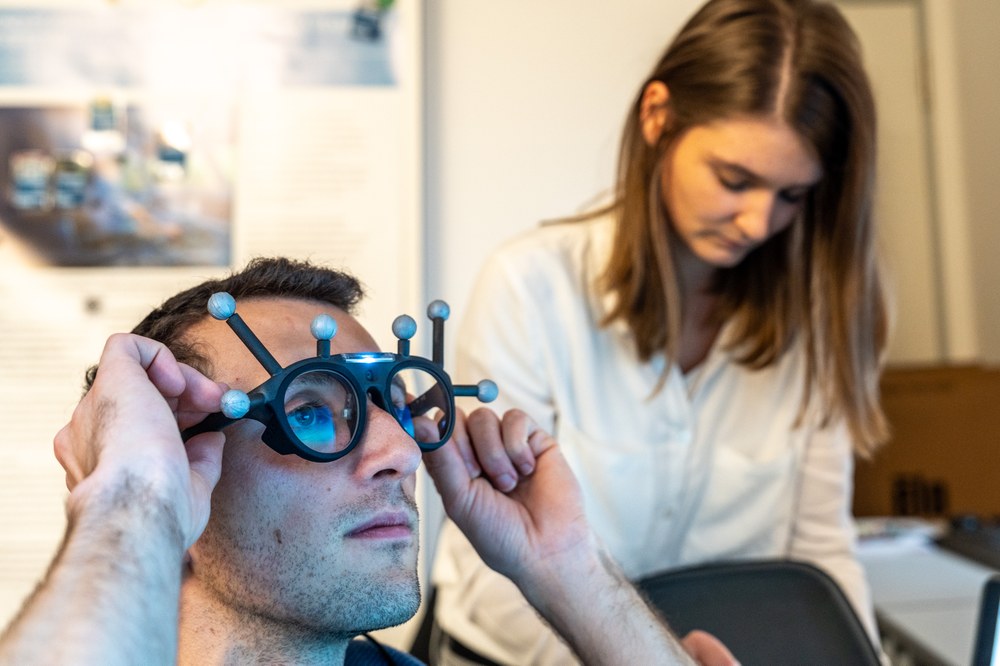
Test setup with eye tracker
Trackers like these are used in the test setup to record participants' gaze direction, helping to determine how long information is viewed in the cockpit.
Can parameters other than brain activity also reveal something about a person's condition?
Yes, absolutely. We also observe behaviour, for example using eye trackers that show us where the participants are looking and how long they view certain information. In addition, we measure physical parameters such as heart rate, respiration and skin conductivity. Taken together, all this data combined provides as complete a picture as possible of a person's mental and physical state.
Do these experiments take place in the air?
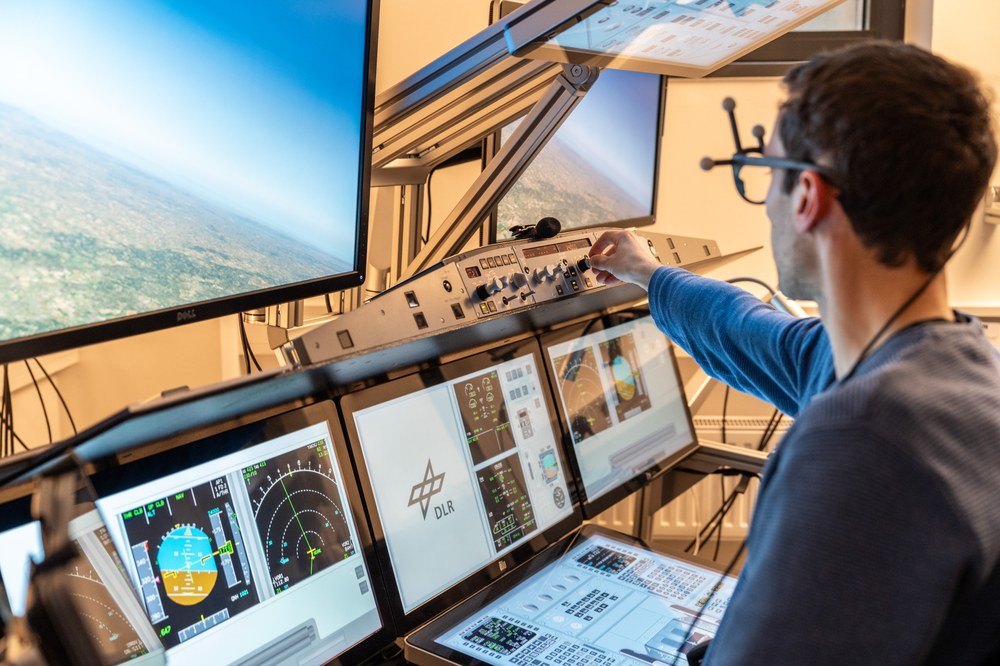
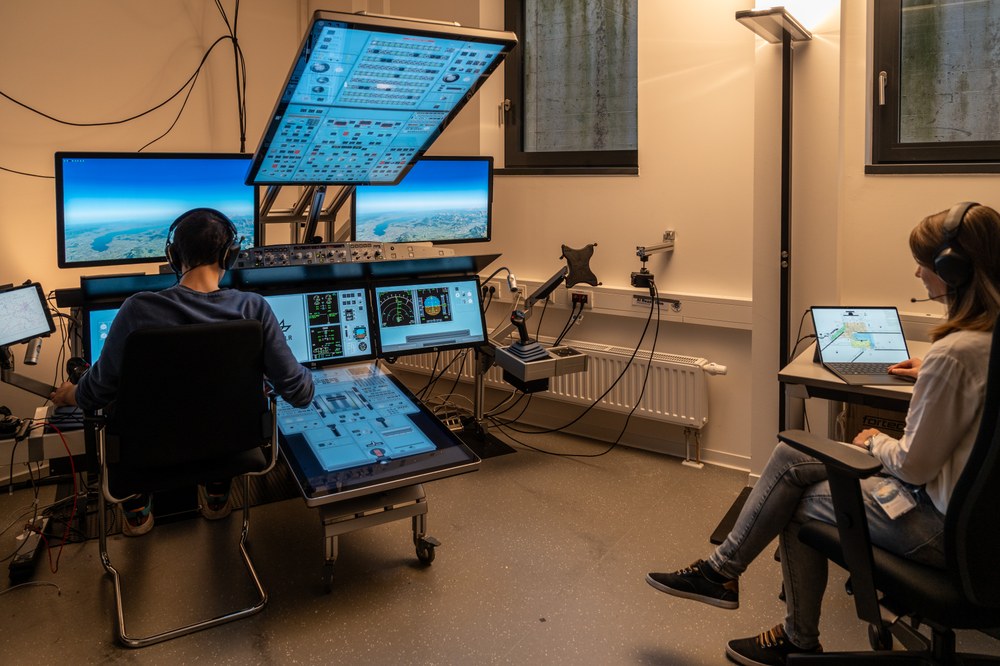
We mostly conduct tests in flight simulators, where realistic but controllable and repeatable scenarios can be created. This allows us to examine in a targeted way how pilots respond in demanding situations – and which signals indicate that they are reaching their stress limits. This combination of modern technology and psychological observation is leading to an increasingly accurate understanding of how humans function in the cockpit. In the future, pilots could be supported by dedicated assistance systems.
Stress test in the simulator
The experiments in flight simulators provide real-life conditions without any risk. The aim is to understand how humans function in the cockpit.
In the future, pilots could be supported by dedicated assistance systems. What should they be able to do?
In our ideal scenario, the system would be unobtrusive and reliable, fitting comfortably on the body without interfering. Sensors would continuously transmit collected data to an assistance system which would recognise how the person is feeling and respond accordingly – for example by issuing warnings, adapting information or temporarily taking over routine tasks.
Do the design and comfort of the measuring devices affect how well participants tolerate the measurements?
Surprisingly, appearance matters very little – comfort is far more important. In the military sector in particular, the equipment is already extensive so additional sensors are barely noticeable. What really counts is that they can be easily integrated, are easy to put on and do not restrict movement. When these conditions are met, acceptance increases.
Who decides what data is collected and how it is evaluated?
Assessment to evaluate the mental and physical state of pilots
Anneke Hamann (right) is a scientist at the DLR Institute of Flight Guidance in Braunschweig and supervises the experiments..
As a researcher, I currently decide what data is collected and evaluated. However, my scientific work always takes place under the supervision of an ethics committee. Every study is reviewed to ensure that participants are protected and research is conducted responsibly. I think it's essential that someone keeps an eye on scientific practice.
It will become particularly exciting when such systems are actually used in aircraft one day. Then, clear rules will be required. Pilots must be able to trust that the data is not accessible to everyone and is used exclusively for their benefit – for example, to improve safety or provide support during flight. Employers or third parties must not have access to personal performance data, to prevent misuse or unfair performance evaluations.
How realistic is it that such systems will become standard in civil aviation in the next 20 years?
I consider systems that can detect specific states such as stress, fatigue or overload and respond at an early stage – before a person's ability to act is impaired – to be realistic. The aim is therefore not to take over human thinking or decision making, but to provide targeted support to people in demanding situations.
An article by Andrea Haag from theDLRmagazine 179. She is an online editor in DLR Communications. She has long been fascinated by human–machine interaction and the ethical questions raised in this interview, in particular, have inspired her to write further stories on the topic.