
The data detective
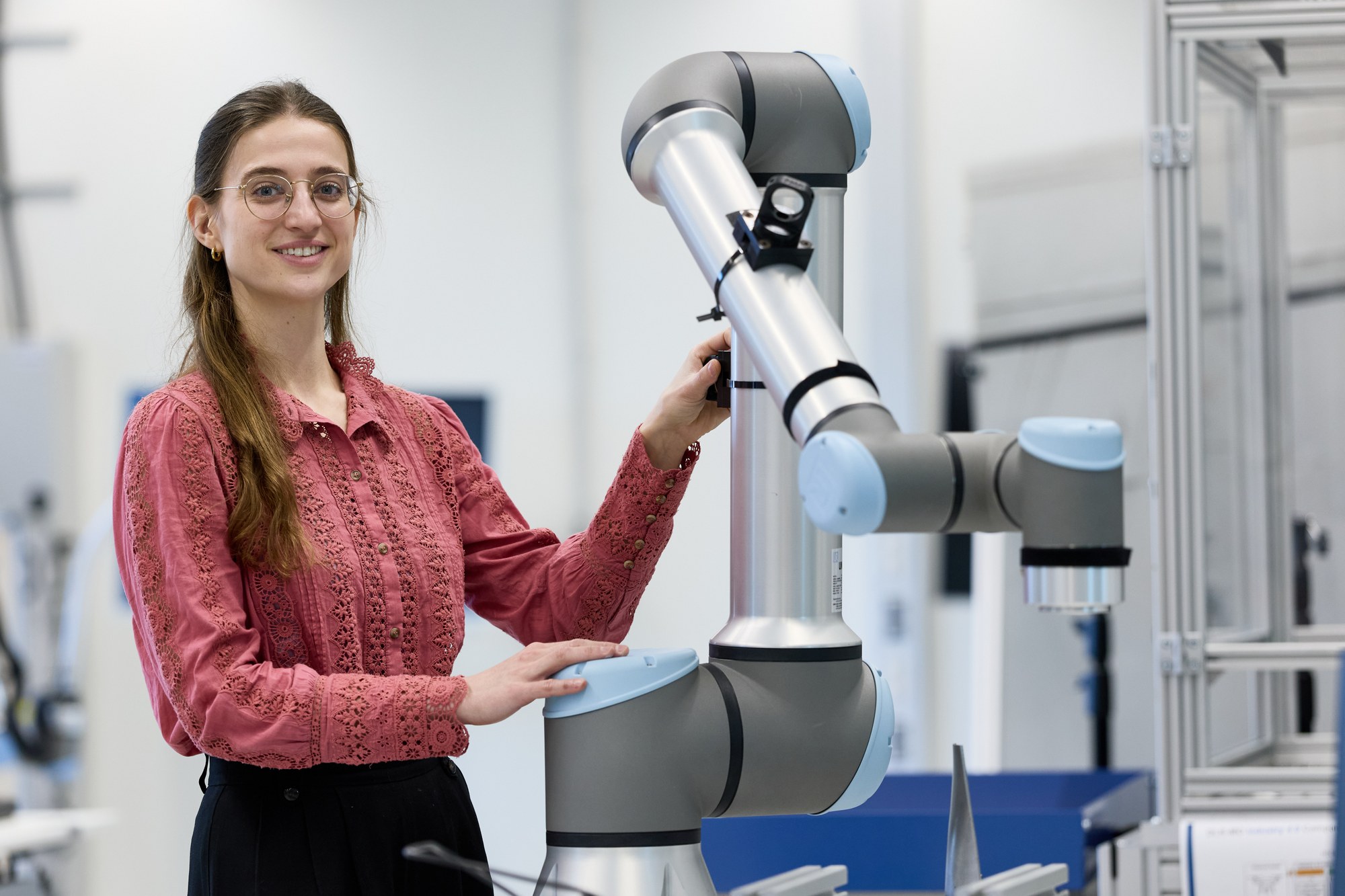

Joséphine Koffler has been fascinated by the world above us from an early age. She grew up near Strasbourg Airport, with the constant roar of aircraft in her ears. At 17, she sat in the cockpit of a small aircraft for the first time, and by 23 she had earned her light aircraft pilot’s licence. For just under three years now, the materials scientist has also been concerned with objects that orbit Earth far above aircraft.
At the DLR Institute of Maintenance, Repair and Overhaul, the French-born researcher is exploring how we can use satellites in Earth orbit in a more sustainable and longer-lasting way. “I first read about space debris during an internship,” recalls Koffler. “I hadn’t realised before just how many small and large fragments are orbiting Earth, or that the fascinating technology we send into space leaves behind so much debris.” In most cases, these are decommissioned satellites or fragments of old rocket stages. Currently, there are approximately 1.2 million pieces larger than one centimetre in orbit – all of which pose a threat to active satellites. The crucial question, therefore, is: How can we ensure that as little new space debris as possible is generated in the future?
A whole lifetime
ESA
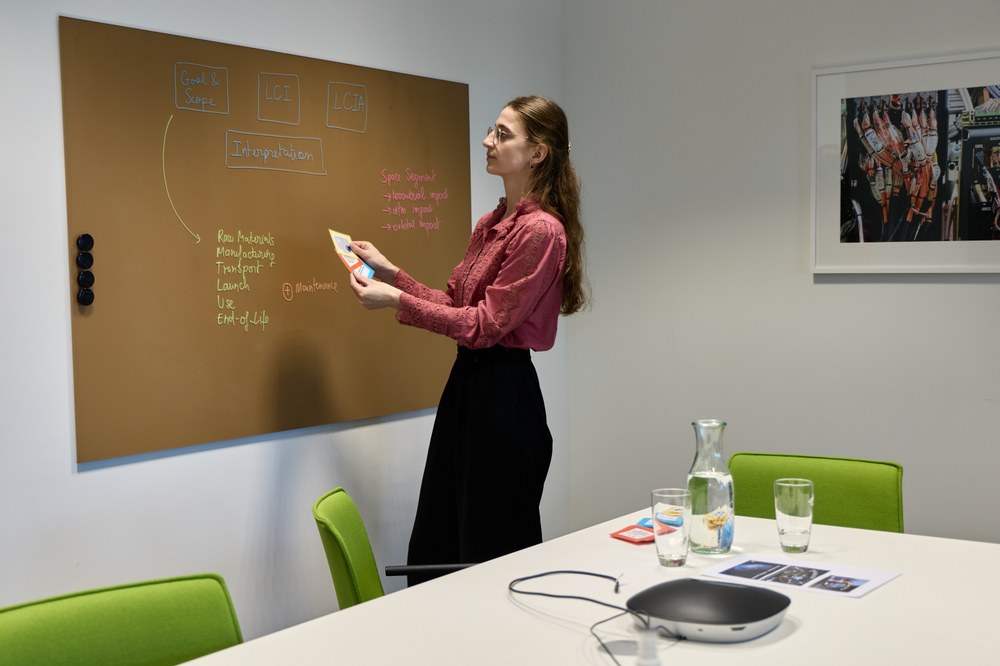
To answer this question, Koffler uses what is known as a Life Cycle Assessment (LCA). What makes this standardised methodology particularly valuable is its versatility. Any imaginable product can be assessed for sustainability using an LCA – from a yoghurt pot to a satellite. The method helps researchers to measure the ecological footprint of a product across its entire life cycle. For a satellite, this would encompass everything from the extraction of raw materials and production to its launch into space, its operation and eventual end of life in Earth’s orbit. The analysis reveals which stages of the life cycle have the greatest environmental impact. “Our job is to provide engineers with relevant information for the design, construction and operation of satellites. This way, we ensure that we do not create new environmental problems in space that we will have to solve again in 10 or 20 years,” explains the Hamburg-based scientist.
Detective work in a data jungle
To begin her analysis, Koffler collects data on every component of a satellite. She has to dive deep into global supply chains and the properties of aluminium, titanium and carbon-fibre-reinforced plastics – materials that make up most modern satellites. Like a detective, she searches for reliable data on water consumption in titanium production or the toxicity of burning aluminium. She combs through countless databases and research papers. “The biggest challenge in my work is the availability and quality of data,” she explains. Information is often incomplete, either because it is classified or simply because no figures are yet available for certain materials.
No room for gut feeling
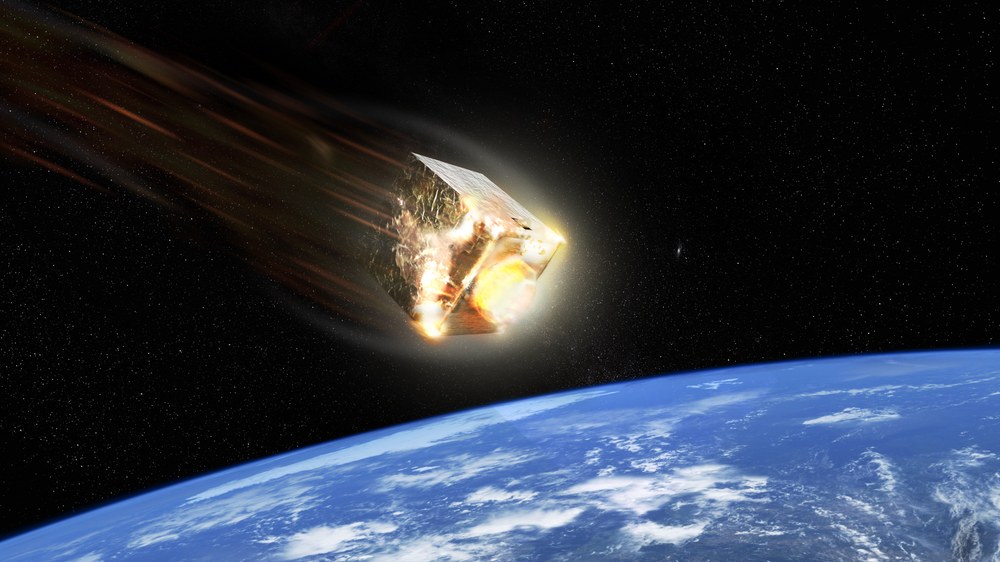
The reward for this painstaking research is the complete picture that emerges at the end of Koffler’s analysis. Often, the numbers paint a picture that completely overturns previous assumptions. For a long time, for example, satellite design focused on ensuring that satellites burn up as completely as possible on re-entry into the atmosphere, before reaching Earth’s surface. However, a comprehensive Life Cycle Assessment has shown that the environmental impact of burning up entirely is actually greater than simply letting a satellite fall into the ocean. This is because modern satellites are predominantly made of aluminium, which releases harmful aluminium oxide when exposed to high heat. “What is essential is invisible to the eye,” wrote the French writer and pilot Antoine de Saint-Exupéry in his world-famous novel The Little Prince. “I think this sentence applies to my work in many ways,” says the French scientist about her research.
Recently, wood has also been discussed as a sustainable material for satellite construction. Although certain materials are perceived as environmentally compatible, their use is not automatically better for the planet. “Sometimes, new materials simply shift the environmental impact to a different phase of the life cycle or into a different environmental category,” explains Koffler. Speaking to her about sustainability, it becomes clear that, unlike her hobby in the cockpit, her research leaves no room for gut feeling.
Learning from aviation
Although the Life Cycle Assessment provides a reliable framework, Koffler finds herself pioneering new approaches time and again when working on satellites designed to operate for as long as possible. “Satellites aren’t yet built to be repaired or refuelled in orbit, but this could extend their lifespan,” she explains. After all, a satellite’s mission almost always ends with either a fault or an empty fuel tank. Once the high-tech satellite is defective or runs dry, a replacement must be launched into space. Researchers aim to end this single-use approach by introducing a completely new maintenance phase in orbit – one in which satellites could be refuelled and, if necessary, repaired to prolong their operational life. The idea is inspired by the aviation industry, where Koffler spent several years working both as a researcher and flight attendant. Particularly in commercial aviation, maintenance and servicing are fundamental components of the product’s life. Regular checks not only ensure the safety of passengers but also keep aircraft in Service for decades.
In space, there is not yet an established procedure for what is known as ‘on-orbit servicing’. Before satellites can be adapted for such a ‘pit stop’ in Earth’s orbit, Koffler first needs to determine under what circumstances the transition is actually worthwhile. To do this, she is searching for the ecological ‘break-even point’. In practical terms, this means: How many satellites would an orbital refuelling station or repair facility in Earth orbit need to service before it has offset its own environmental impact?
Until a true circular economy in space is established, Koffler still has plenty more calculations and environmental data to analyse. In her personal life, she also ensures the meals she serves are resource-efficient, and enjoys preparing them using refurbished, second-hand kitchen appliances. “You can already find a lot of information online about the water and land consumption of individual foods,” she says. And that requires far less research than compiling data for an entire satellite.
An article by Max Braun from the DLRmagazin 180.