>
>
Projects & Missions>
Exergie – interdisciplinary research for high-performance and sustainable wind farms
Home
>
Research & Transfer>
Projects & Missions>
Exergie – interdisciplinary research for high-performance and sustainable wind farms
Exergie – interdisciplinary research for high-performance and sustainable wind farms


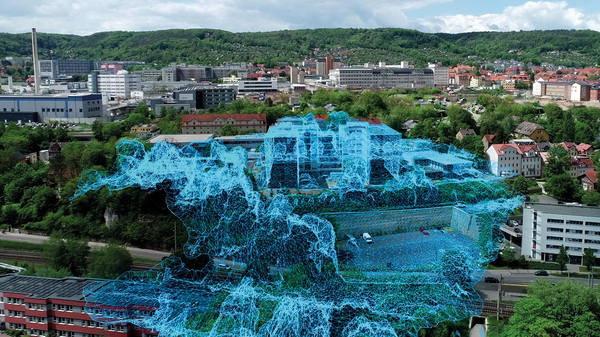
DLR WiValdi research wind farm
The research wind farm comprises several wind turbines as well as measurement masts.
Operating wind farms requires balancing energy yield, environmental impacts and grid requirements. Even at the planning and design stages, numerous parameters must be considered – including the size of the farm and its turbines, turbine positioning and spacing, rotor design and connection to the local electricity grid. At the same time, constraints such as distances to residential areas, noise emission limits and minimising the impact on local flora and fauna must be observed.
These are the questions we address in the Exergie project by combining numerical computational methods with sensor measurement data from DLR's WiValdi wind energy research farm.
Understanding and harnessing interactions in wind farms
A central research focus is on better understanding the interactions between individual wind turbines within a wind farm and the atmosphere. The goal is to increase energy generation through new turbine control strategies while simultaneously reducing – or keeping constant – both structural loads and environmental impacts.
Long-term measurement data enables the identification of representative meteorological conditions, which are then reproduced in simulations. Based on this, we use our simulation methods to analyse the loads and deformations of rotor blades as well as the wake flows behind turbines. Aeroacoustic emissions and their effects in the immediate vicinity of turbines are also examined – taking atmospheric influences into account – to identify and avoid critical operating states.
The interaction between electrical components and the power grid is also modelled, allowing us to investigate how wind turbines could in future contribute to grid stability, provide ancillary services such as instantaneous reserve and support security of supply as grid-forming systems.
Innovative technologies and concepts
A further focus is on the development and evaluation of new technologies and turbine concepts:
- Flexible trailing edge: Reduction of loads, particularly on large rotors, through aerodynamically and structurally integrated concepts.
- Sensor software solutions: Improved detection of flow separation and long-term measurements to identify and avoid critical operating states.
- Structural monitoring: Development of sensor systems to monitor adhesive bonds, reducing maintenance requirements.
- All-sky imager: Use of cameras for bird detection in anti-collision systems and for determining cloud movement and deriving wind speeds.
Data infrastructure as a foundation
Analysing and making use of experimental data from our research wind farm demands a powerful data infrastructure. The project therefore develops new algorithms, interfaces and data access methods to ensure consistent data quality, easy discoverability and the interoperable linking of different data sources.
Knowledge transfer and outlook
Exergie also actively promotes the transfer of knowledge into practice: findings are shared at annual workshops with participating companies, fed into international networks such as the International Energy Agency (IEA) and made available in an advisory capacity to policymakers and industry associations. In parallel, we are working on patenting new sensor-software solutions and methodological improvements for the acoustic approval practice for wind turbines.
In this way, Exergie makes a significant contribution to the further development of wind energy and a sustainable, decentralised energy supply.
Project Exergie – experiments and numerical methods for wind turbines
- Duration: 1 January 2026 to 31 December 2028
- Lead institute: DLR Institute of Aerodynamics and Flow Technology
- Project type: Core funding
- Funding body: DLR Energy Programme Directorate