
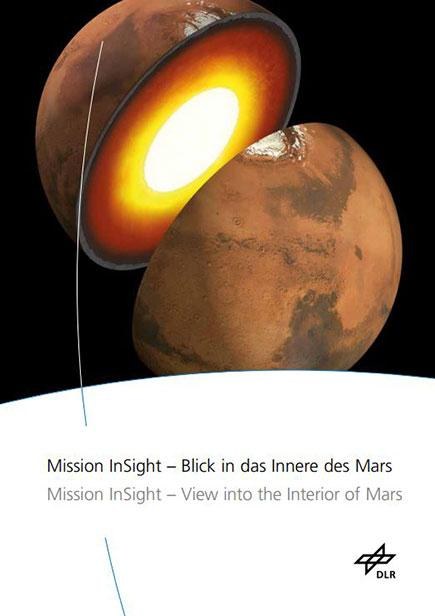
Brochure: Mission InSight (2018)
1013.9 KB | PDF
View into the Interior of Mars

Last updated: 1 October 2026
The NASA Insight mission was launched on 5 May 2018. In this mission, a lander carried out geophysical measurements directly on the surface of Mars to explore the planet’s inner structure and thermal balance. The German Aerospace Center (Deutsches Zentrum für Luft- und Raumfahrt; DLR) contributed to this mission in the form of the Heat Flow and Physical Properties Package HP3. On 26 November 2018, InSight landed north of the equator, on the Elysium Planitia plain. Following a test phase, the experiments commenced after the 2018/19 turn of the year. The duration of the mission was initially set at one Mars year, which corresponds to approximately two Earth years.
The expense of space travel and the mass and energy that would be required rule out the creation of specialised observatories on Mars for cost reasons, so the alternative option of creating an observatory as a payload, equipped with several instruments was chosen for the InSight mission. The idea of installing networks of several stations at the same time was also deemed too risky and expensive. As such, InSight was the first geophysical observatory to fly to Mars. Scientists had developed new technology for the mission in order to get as much scientific value out of the station as possible.
InSight was proposed in 2011 as an entry to the NASA Discovery competition, and selected in August 2012. The scientists were able to draw upon a large number of earlier suggestions, particularly from Europe. The European Space Agency (ESA) looked more closely at two MarsNet and InterMarsnet proposals, while the French space agency CNES examined the most recent NetLander proposals from 2000–2003. NASA had also carried out preliminary studies in the form of the Mars Environmental SURvey (MESUR) and the Gravity and Extreme Magnetism Small Explorer (GEMS). One feature of the mission was that it combined US expertise in lander technology with European competence in geophysical instruments.
While InSight was a Mars-based mission, scientists are interested in investigating rocky planets in general. Of these, they have a relatively detailed knowledge of Earth. InSight was intended to allow a reasonably accurate determination of the interior structure and an insight into the formation of an Earth-like planet. Mars was a good choice, as it is accessible as Earth’s planetary neighbour, while the surface conditions are manageable for terrestrial technology, unlike Venus, whose atmosphere is too hot at 400 degrees Celsius, not to mention highly corrosive. In addition, scientists believe Mars to be sufficiently representative of Earth-like planets, although such planets may have starkly different individual features.
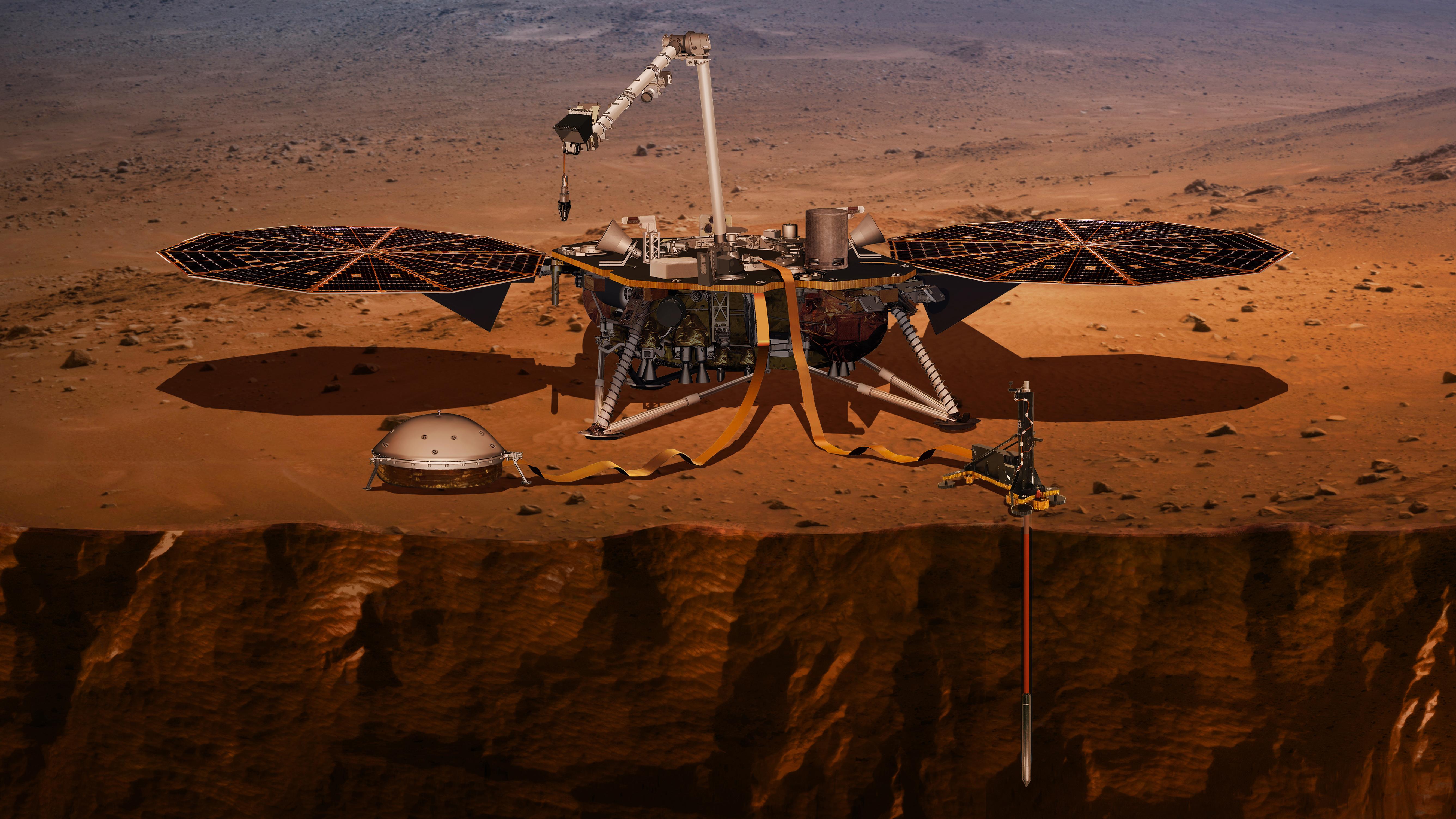
Despite the financial constraints of this relatively small-scale Discovery mission, the key instruments required by a geophysical observatory were all present. These included the Seismic Experiment for Interior Structure (SEIS) and a heat flow probe – the Heat Flow and Physical Properties Probe (HP3). Weather sensors (atmospheric pressure and temperature) and a magnetometer were also on board as auxiliary instruments for the seismometer.
Germany, the German Aerospace Centre (Deutsches Zentrum für Luft- und Raumfahrt; DLR) and its scientific institutes, in particular the DLR Institute of Planetary Research (today DLR Institute of Space Research), were involved in the mission.
DLR provided the HP3 heat flow probe which was developed under the leadership of Principal Investigator Prof. Tilman Spohn. HP3 is an abbreviation that stands for Heat Flow and Physical Properties Package. The experiment consisted of a housing which was placed on the Martian surface by the lander using a small crane, and to the front of which a device approximately 40 centimetres high was attached. Inside this was a 40-centimetre-long ram probe – dubbed the ‘mole’ by the scientists – which drove itself into the Martian soil using an electrically powered spring-tension mechanism. The mole dragged a sensor-equipped cable behind it, which carried out heat flux measurements. The experiment also included a radiometer on the lander to determine the temperature of the Martian surface. Knowing the surface temperature is important for calculating variations in the temperature distribution beneath the surface.
Significant contributions to HP3 were also made by the DLR institutes of Space Systems in Bremen, Optical Sensor Systems (today DLR Institute of Space Research) in Berlin, Space Operations and Astronaut Training at the facility in Cologne, System Dynamics and Control in Oberpfaffenhofen, Composite Structures and Adaptive Systems in Braunschweig, and Robotics and Mechatronics in Oberpfaffenhofen.
The Max Planck Institute for Solar System Research developed the mechanical system for levelling the seismometer and was financed by the DLR Space Administration in its capacity as Germany’s Space Agency.