The Emission-Free Port – transforming key logistics sites
Ports as a key to a climate-neutral economy
The Emission-Free Port – transforming key logistics sites
A systemic view of energy and logistics
In the Emission-Free Port (Emissionsfreier Hafen) project, 11 DLR institutes are comprehensively investigating the interplay between energy supply, transportation and industrial processes in port facilities. To this end, researchers are developing an integrated model that collectively incorporates the port industry's energy requirements, infrastructure and logistics processes.
Ports are complex industrial and transportation systems. Acting as a transport link between land and sea, they house terminal facilities, industrial production sites and extensive energy and fuel infrastructure. To support these various functions, ports require a great deal of energy, with their requirements closely tied to their economic efficiency and their role in global supply chains.
Looking at the climate objectives set by Germany and Europe, ports are increasingly faced with the challenge of switching their energy supply and logistics processes to low-emission or emission-free technologies. At the same time, the high reliability of logistics chains and industrial processes must remain intact – this is vital for economic stability and competitiveness.
A systemic view of energy and logistics
In its Emission-Free Port (Emissionsfreier Hafen) project, the German Aerospace Center (Deutsches Zentrum für Luft- und Raumfahrt; DLR) is for the first time comprehensively investigating the interplay between energy supply, transportation and industrial processes at ports. To this end, researchers are developing an integrated model that takes into account energy requirements, infrastructure and logistics processes.
A newly developed analysis tool makes it possible to assess the impact of climate-friendly technologies on port operations. The model is being tested and enhanced using proprietary data, industrial sources and public-sector information.
Modelling climate-neutral port operations
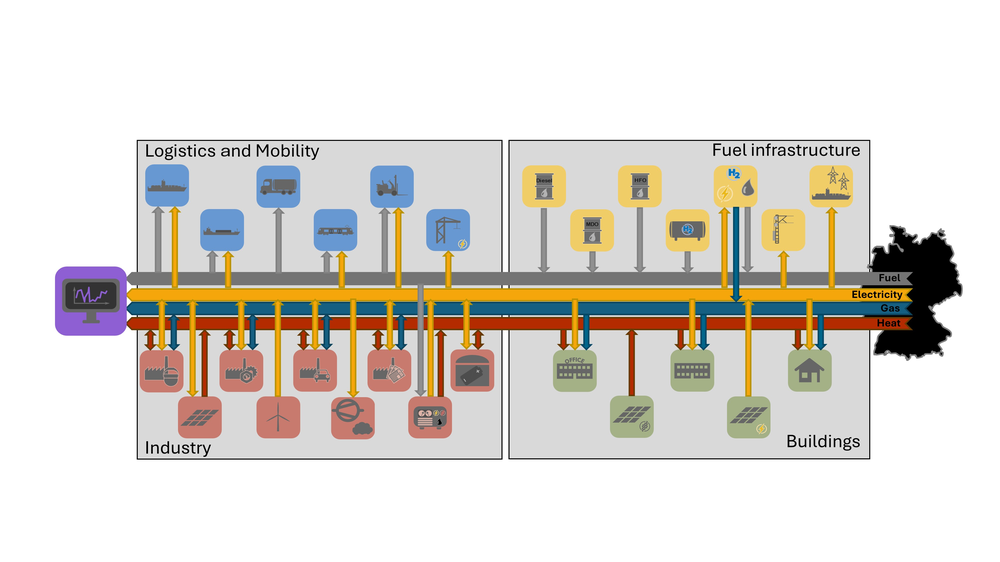
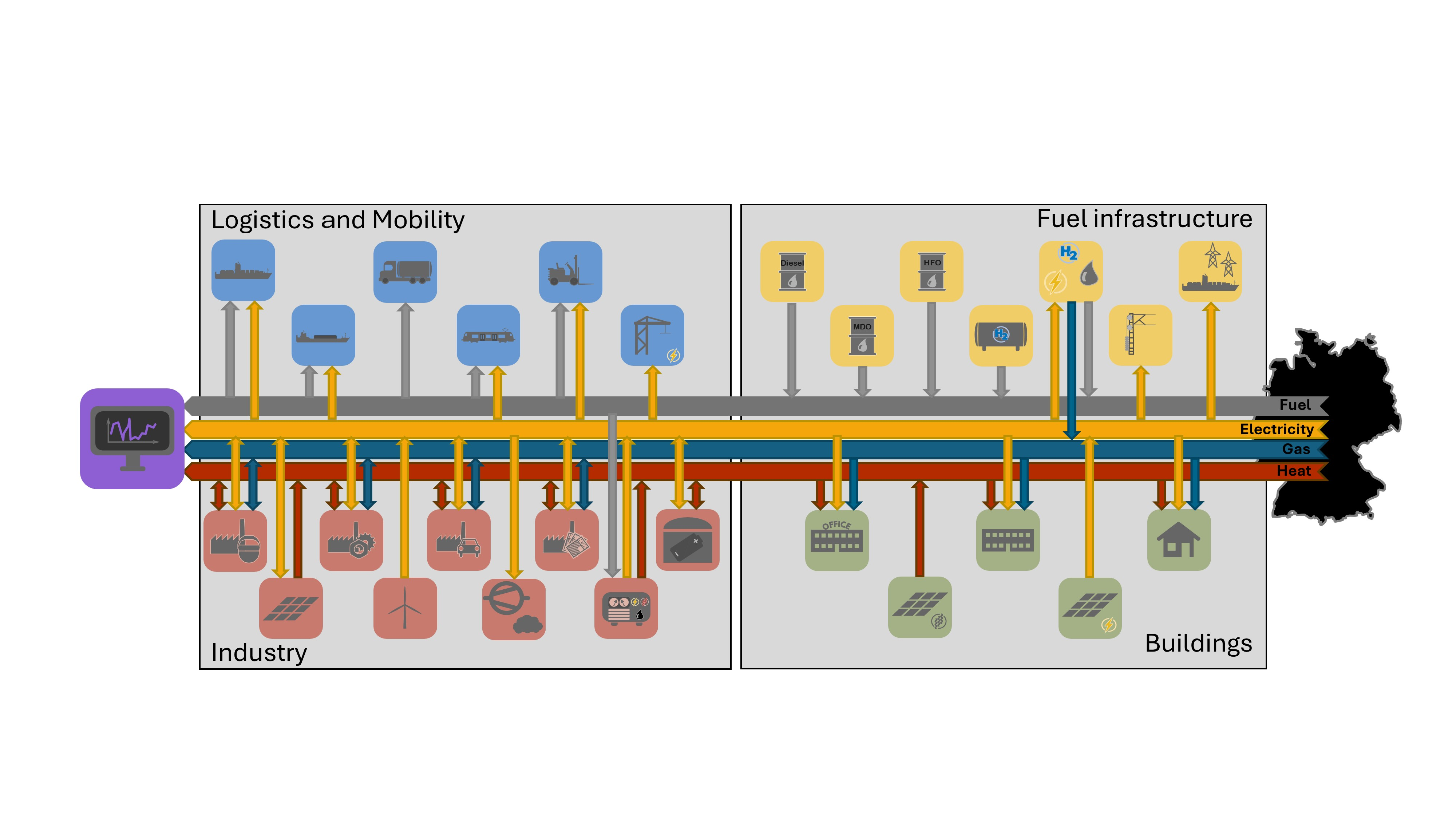
The project is structured into multiple interconnected work packages. A port's energy requirements are first analysed and modelled in detail. Consideration is given to various sub-areas, including:
Logistics and transport
Fuel infrastructure
Industrial facilities
Buildings
Based on these conditions, DLR scientists are developing future scenarios for emission-free port operations. For this purpose, they design innovative energy supply concepts and integrate new system components, such as renewable energy facilities, energy storage units and alternative mobility solutions.
All sub-areas are then linked in an end-to-end system simulation. This makes it possible to analyse how changes in energy provision, transport or industrial processes affect the port as an overall system. Findings and opportunities for optimisation can be visualised via a dashboard.
Project overview
DLR's Emission-Free Port (Emissionsfreier Hafen) project aims to provide a systemic assessment of the energy requirements and logistics of ports. Some of the factors taken into account include various influences from buildings, industrial facilities and transportation and infrastructural components, and their respective interactions with the energy system. Fuel infrastructure is being more closely analysed, too. To this end, DLR expertise in the fields of transport, aeronautics and energy has been bundled into a tool. The goal is to assess and ensure the reliability of logistics chains when a transition to low‑ or zero‑emission technologies is pursued for the entire port system. The tool is being validated across various ports in anticipation of more widespread adoption.
The findings of this project support the long-term efforts of policymakers, business people and port operators to make ports climate neutral in the long term. At the same time, new opportunities for using innovative technologies and business models are opening up in the fields of energy, transport and logistics.
The project is therefore helping to execute Germany's High-Tech Agenda campaign and is supporting the development of climate-neutral energy and transportation systems – with ports as core components of sustainable industry and logistics.
Project objectives
To develop scenarios for zero-emission port operations
To build an integrated end-to-end port system model for energy, transport and logistics
To develop sector-specific transformation paths for logistics and transport, fuels and industry
To devise innovative energy provision concepts that incorporate DLR technology
To draw up systematic action plans for the transformation of port infrastructure