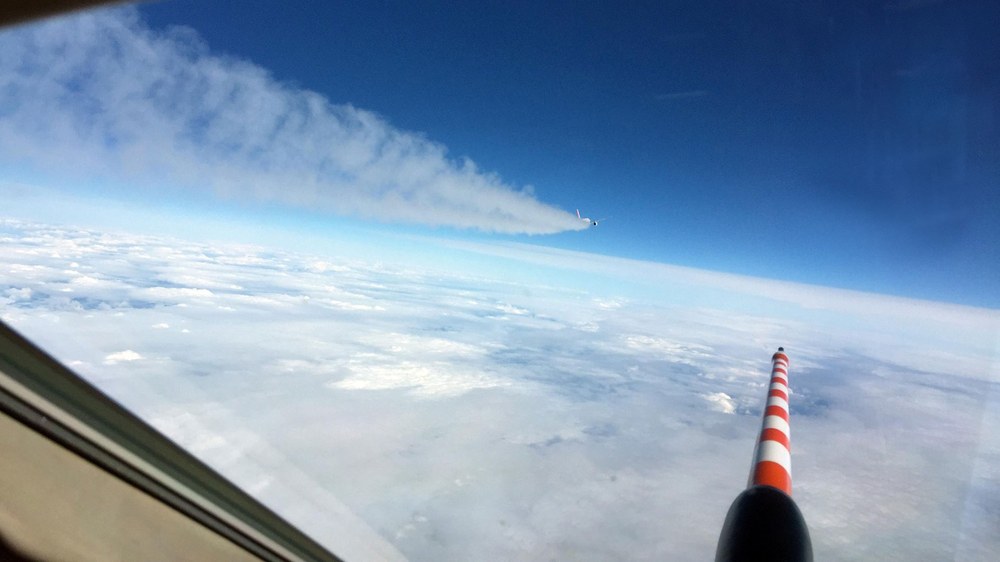
The Falcon measurement aircraft was used to measure the exhaust emissions of the DLR aircraft ATRA, which was fuelled with SAF for the flight test campaign.
Image: 1/5, Credit:
DLR/NASA/Florian Friz
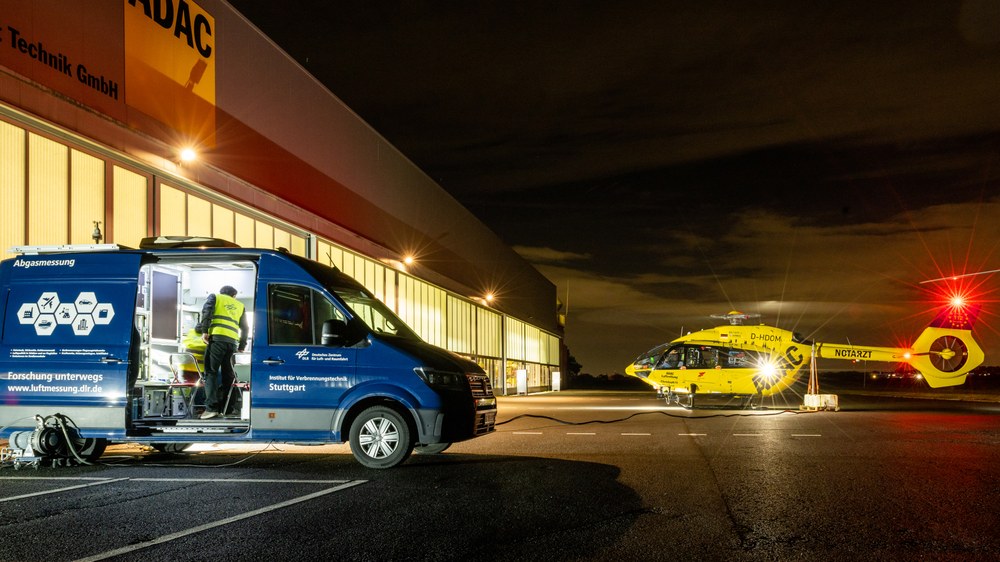
DLR and ADAC Luftrettung measurement campaign investigates the use of bio-kerosene in rescue helicopters
DLR's mobile measurement vehicle in operation at the Bonn-Hangelar airfield. Using this vehicle, a DLR team investigated the performance of a blend of sustainable aviation fuel (SAF) and conventional kerosene in the ADAC Luftrettung rescue helicopter 'Christoph Rheinland'. The tests were carried out at the end of the helicopter's shift.
The combustion of liquid fuels in aircraft engines produces emissions in the form of gaseous and particulate matter. At our institute, we analyse these emissions throughout the entire process chain, in laboratories, on test benches, in real traffic or at airports and by taking measurements directly on aircraft. This data provides a reliable basis for understanding combustion processes, classifying new technologies and scientifically evaluating the environmental and climate impact of alternative fuels
Analysing emissions enables detailed conclusions to be drawn about what happens during engine combustion. It reveals how effectively the chosen engine configuration operates, the dominant reactions at the current temperature and pressure, and the impact of fuel composition on performance. This information enables us to evaluate new combustion concepts and scientifically classify the advantages and disadvantages of novel fuels.
To gain a comprehensive understanding of emissions, we measure them in various environments, including laboratories, test benches, airports and aircraft. Each environment provides specific insights, helping us understand the emission process from origin to initial atmospheric reactions.
From lab tests to measurement campaigns on airports
In the laboratory, we examine the emission behaviour of new and alternative fuels under controlled conditions. This allows us to isolate reaction mechanisms, create comparable conditions and vary specific parameters to reveal the fundamental relationships between fuel structure, combustion conditions and emissions. These tests provide a solid foundation for understanding the composition of fuels and identifying their differences.
On test benches, we analyse emissions under realistic and largely standardised operating conditions. These include engine test benches, combustion chamber assemblies and motor systems, in which technological developments can be evaluated directly. By using reproducible load profiles and defined boundary conditions, we are developing a more detailed understanding of how different fuels behave during technical operations.
We record emissions at the airport under real operating conditions, such as during ground operations, taxiing, idling or take-off preparation. These measurements demonstrate how engines and fuels perform in an operational environment and the emissions produced during practical operation. They complement our laboratory and test bench data.
Taking measurements directly at the aircraft - during flight and on the ground
We carry out detailed ground measurements directly on the aircraft engine, both at the engine exit and in the area between 30 and 100 metres behind the aircraft (known as the 'near field'). With the aircraft parked, the pilot runs the engine through all operating conditions, from take-off to landing, so that emissions can be clearly assigned to individual load points and thrust levels (ICAO LTO cycle). Using probes installed at various distances from the engine, we record emissions immediately after combustion and track initial dilution and ageing processes. This makes it possible to see the effects of fuel and technology directly at the source.
The probes used for these measurements are developed in-house by our team. They must be able to withstand the high temperatures, pressure surges and jet velocities of a running engine. This work requires careful preparation and coordinated implementation with all partners involved.
In addition to our ground-based measurements, our colleagues at the DLR Institute of Atmospheric Physics and Flight Experiments are recording emissions during flight. While we characterise emissions directly at the engine and in the immediate vicinity, the focus during flight is on the resulting contrails. There, they investigate how the properties of the emissions, such as particle number and composition, are reflected in the resulting contrails. This enables DLR to correlate emissions and contrails directly and evaluate the specific influence of fuels and technologies on contrail formation, characteristics and development.
Measurements in road traffic
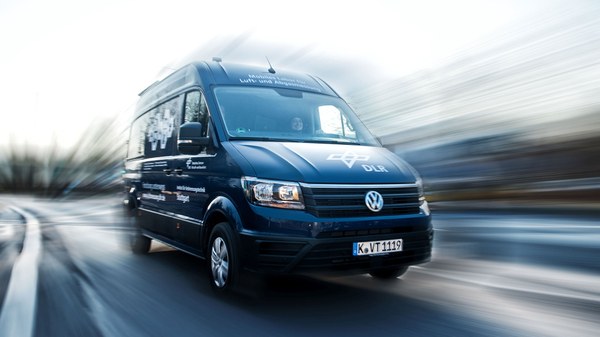
We examine not only aircraft and their engines, but also record emissions in road traffic. Using our mobile measurement laboratory, we can analyse various vehicle and operating situations in real time and under real conditions.
Another area of focus is the investigation of tyre abrasion. These particles are becoming increasingly relevant in road traffic. However, rather than carrying out these measurements in traffic, we conduct them in a controlled manner on the roller test bench at the DLR Institute of Vehicle Concepts. There, we have developed various measurement systems to record tyre abrasion as reproducibly as possible and characterise particle emissions precisely.
Together with our colleagues at the Institute of Vehicle Concepts, we analyse the ultrafine particles (UFP) produced by tyre abrasion which are currently largely unregulated. The reproducible conditions of the roller test bench enable us to examine the formation mechanisms, size distributions and properties of these particles in detail, thereby establishing a scientific basis for future assessment approaches.
So, what exactly are emissions?
Emissions are all gaseous and particulate components produced during the combustion process. Gaseous components include carbon dioxide (CO₂), carbon monoxide (CO), nitrogen oxides (NO_x) and unburned hydrocarbons. The presence of these substances in different phases of combustion provides experts with valuable information about the combustion process itself, the air–fuel ratio, flame stability and the subsequent chemical processes in the exhaust gas stream. Analysis reveals differences between various fuels. We measure both gaseous and particulate emissions.
In addition to gases, particulate emissions play a central role. Particular attention is paid to ultrafine particles (UFPs) with diameters of less than 100 nanometres. These particles are formed very early in the combustion process through mechanisms such as soot formation and nucleation, and they form the basis for further transformations in the exhaust gas. They act as condensation nuclei and influence the formation of contrails and long-lived cirrus clouds in the atmosphere. Due to their pivotal role, ultrafine particles form the focus of many of our investigations, whether we are evaluating new engine technologies or comparing sustainable aviation fuels.
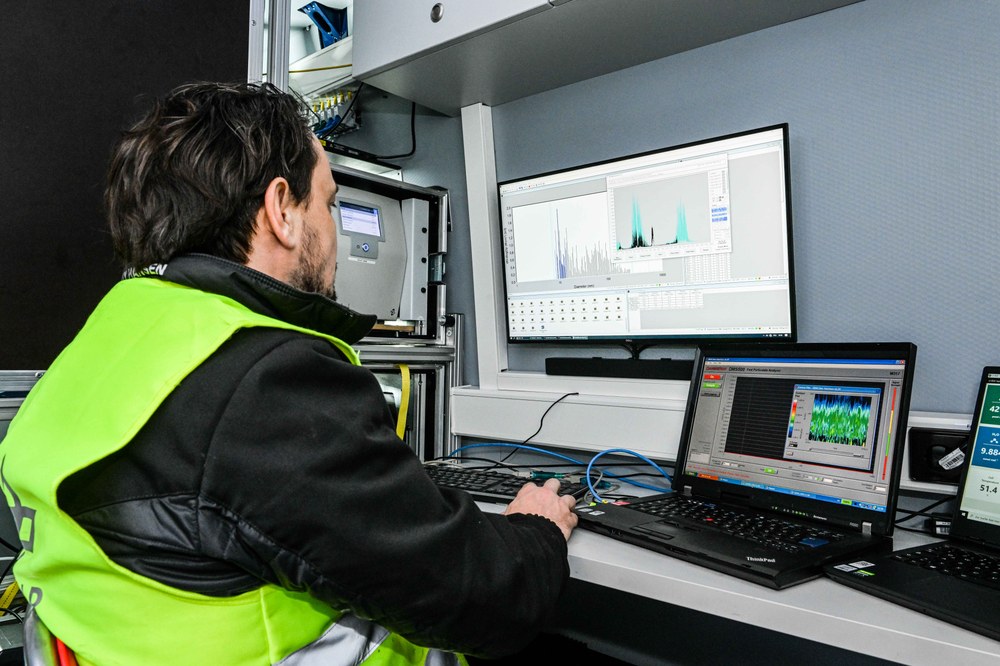
Our mobile measuring laboratory, equipped with specially developed instruments, is used for ground measurements at airports and for direct aircraft measurements. It is fitted with a range of real-time analysers, enabling highly flexible measurements of gaseous and particulate emissions.