
Human-like ball catching (2007)
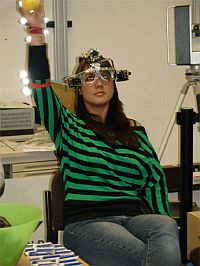

DLR has been doing ball catching with the Light-Weight Robot for some years now. The system works very well but it behaves purely technical. The idea of this work is to examine the human ball catching strategy for a one-handed catching task and see if a human-like catching strategy does enhance the robots performance. Furhtermore the new hand-arm-system DLR is developing right now is very anthropomorphic and shall thus behave and move in a human like way.
Two series of human catching experiments were done. In the first experiments 10 catchers were equipped with optical markers at the wrist, elbow and shoulder which are tracked by optical tracking cameras. Each catcher had to catch a tennis ball (equipped with markers as well) that was thrown with a catapult. The position of the catapult varied during the experiment. For the second series the catchers were additionally equipped with an eye-tracker and had to catch a styrofeam ball, that was thrown with the catapult, too. In some trials the ball was perturbated with an air compressor.
Analysis is not yet finished but so far it can be said that the velocity profile of the human hand is bell shaped and its movement can be imitated using minimum jerk theory (Flash and Hogan 1985). However an improvement of the robots performance using this approach is questionable because peak velocities are often above 2m/s which is maximum velocity of the robot's end effector (in strechted configuration).