2018 theme: Environmentally compatible aircraft of the future
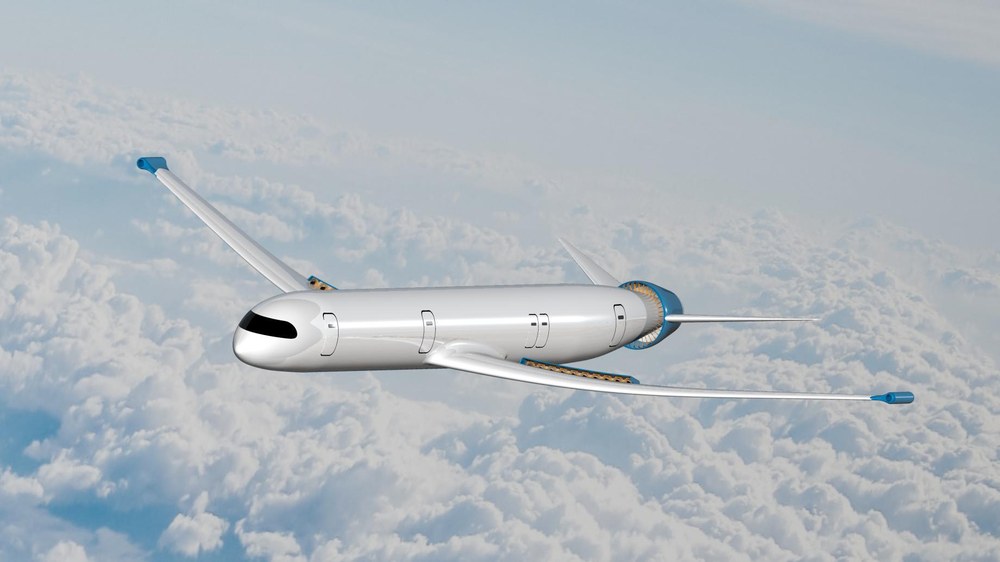
The 'eRay' aircraft concept by the winning team from TU Munich
The winning team from TU Munich designed an aircraft with an integrated turbo-electric propulsion system. Noticeable features include engine units on the trailing edges of the wings and a slightly raised tail plane, which facilitates easy integration of an engine enclosing the rear of the aircraft.
Image: 1/2, Credit:
TU Munich/eRay
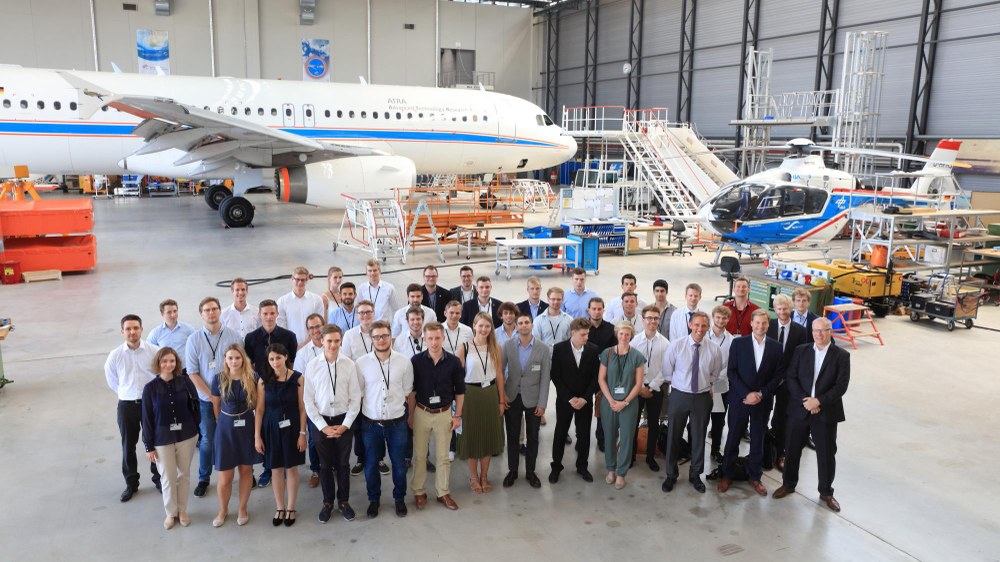
Participants in the DLR/NASA Design Challenge in Braunschweig
This year's NASA/DLR Design Challenge featured submissions by 41 students from seven teams at six German universities.
The task of the NASA/DLR Design Challenge 2018 was to design an unconventional aircraft which can replace a current airliner but with significantly reduced fuel consumption and noise emissions.
Forty-one students from seven teams competed.
The team from the Technical University of Munich won over the judges with their 'eRay' concept, taking first place.
In the NASA/DLR Design Challenge 2018, entrants were tasked with developing an innovative subsonic passenger aircraft for entry into service from 2045. Designs were required to reduce energy consumption by at least 60 percent compared to a reference aircraft from 2005, and ideally achieve a reduction of up to 80 percent. Energy consumption was defined as the total energy required for the mission, regardless of the energy source. Students had to select a reference aircraft of at least the 'single-aisle' class, such as the Airbus A320 or Boeing 737, and determine its performance characteristics in order to evaluate the improvement offered by their new design. The concept had to achieve at least the same mission performance as the reference aircraft, especially in terms of range, payload, cruising speed and take-off and landing performance. Entrants could also integrate configuration solutions requiring changes to ground infrastructure or flight operations. In this case, the feasibility, costs and impact of such adjustments to the air transport system also had to be evaluated. Aspects such as customer requirements, development costs and risks, certifiability and passenger acceptance had to be included in the evaluation, especially for unconventional concepts. Assumptions about future technologies had to be well-founded and realistically evaluated within the context of the development timeframe.
"Aviation is a global, international and innovative sector, to a greater extent than practically any other industry," said Rolf Henke, DLR Executive Board Member for Aeronautics during the 2018 Challenge. "In the NASA/DLR Design Challenge, two of the world's leading aeronautics research institutions are promoting cross-border exchange between students in the USA and Germany to generate fresh ideas for the future of flying."
Seven teams present their designs in 2018
A total of 41 students from Germany, spread across seven teams from six universities, participated in the NASA/DLR Design Challenge 2018. On the other side of the Atlantic, a double-digit number of students from US universities also took part. Following the awards presentation at the German closing ceremony in Braunschweig, the winning team from the Technical University of Munich visited the US space agency NASA in the autumn of 2018. There, they presented their award-winning project alongside the US winners at a symposium attended by internationally renowned aerospace researchers.
Aircraft design entries: an overview
First place: 'eRay' by the Technical University of Munich
The eRay aircraft concept is based on a fully integrated turbo-electric propulsion system with multiple electrically driven fans along the wings and an additional propulsion unit on the rear fuselage. This distributed configuration allows for boundary layer ingestion (BLI), which reduces drag and increases propulsion efficiency, while simultaneously enabling smaller control surfaces. The design also uses laminar flow control to improve aerodynamics and employs lightweight structures to reduce overall mass. The electric propulsion system is supported by turbines and generators, plus battery systems for energy storage and load distribution. The optimised concept significantly improves aircraft mass, aerodynamic performance and propulsion efficiency, which substantially reduces energy consumption. An innovative cabin design and a reduction in active turbulence also result in a lower weight and greater efficiency. Overall, technical, operational and economic analysis shows that the concept meets future requirements for an efficient commercial aircraft.
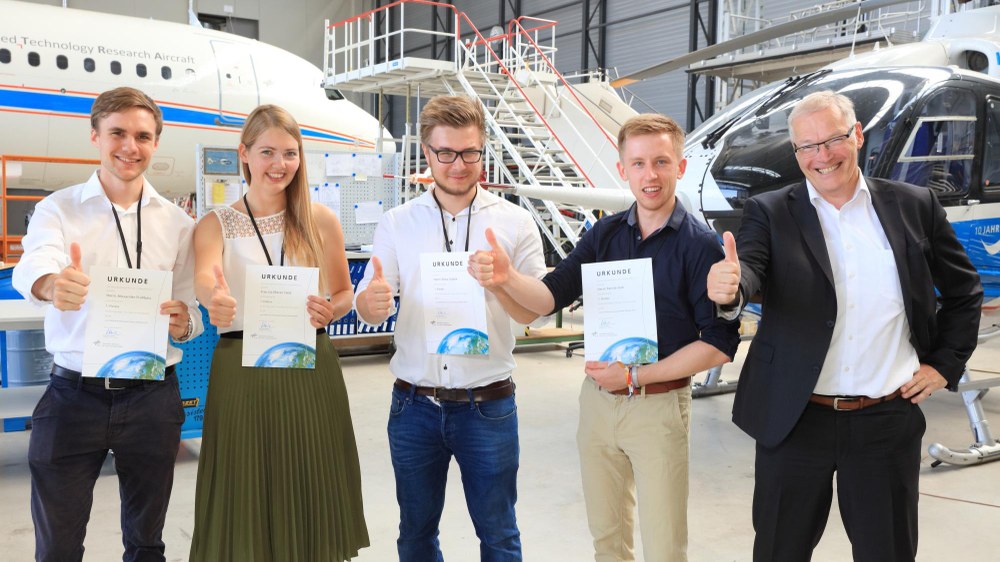
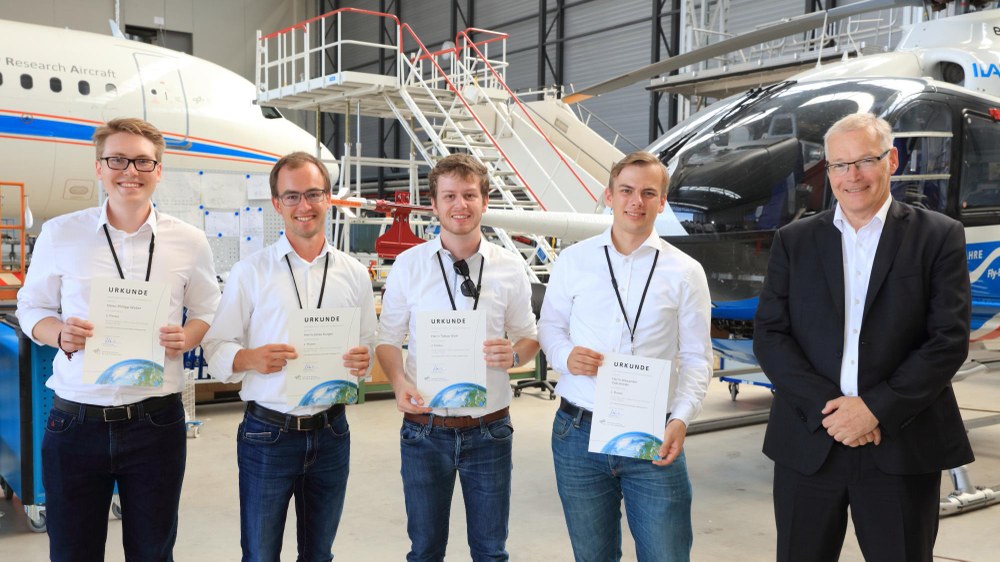
Technical University of Munich team
From left to right: Alexander Frühbeis, Isa Held, Artur Usbek, Patrick Sieb and DLR Executive Board Member for Aeronautics Rolf Henke.
Second place: 'Polaris' by the University of Stuttgart
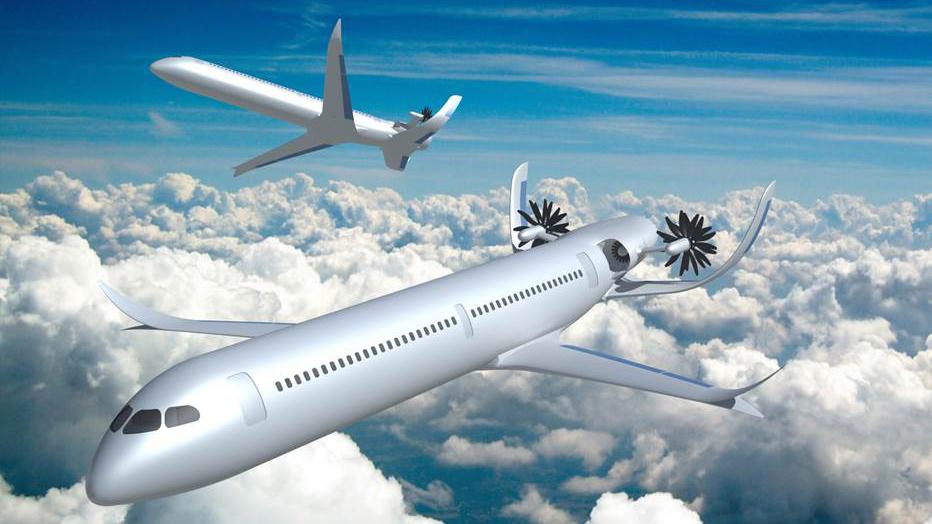
The Polaris aircraft concept by the second-placed team from the University of Stuttgart
Credit:
University of Stuttgart/Polaris
The Polaris aircraft design features the novel integration of a turbo-electric propulsion system using liquid hydrogen as fuel. Contra-rotating propellers at the rear significantly increase propulsion efficiency without raising noise levels, while the forward-sloping wings reduce aerodynamic drag. The system combines a superconducting electric motor with an optimised gas turbine cycle, with the liquid hydrogen serving both as fuel and for cooling between the compressor stages, enabling superconductivity in the electrical components. This results in high overall efficiency and synergy within the propulsion system. This is complemented by a multifunctional fuselage concept, which is designed to hold the fuel, reduce the weight of the fuselage and increase safety margins in the event of fire or a crash. Part of the concept is a nacelle structure that divides the fuselage into a primary, pressurised structure and a secondary, non-pressurised structure for the liquid hydrogen tanks. Overall, the design incorporates aerodynamic optimisations, efficient energy conversion and innovative fuselage architecture into a forward-looking aircraft concept.
University of Stuttgart team
From left to right: Philipp Weber, Jonas Karger, Tobias Dietl, Alexander Zakrzewski and DLR Executive Board Member for Aeronautics Rolf Henke.
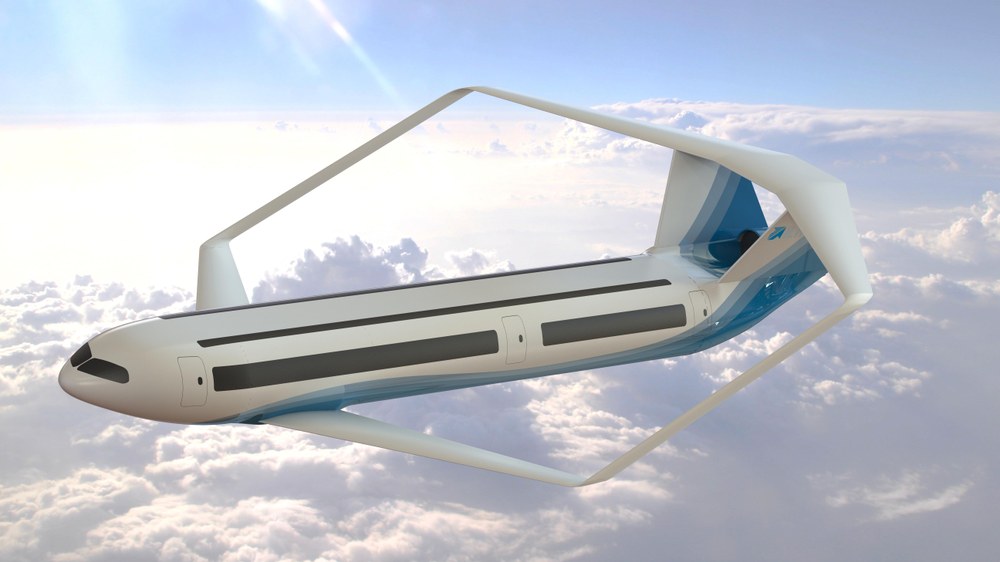
Third place: 'AirBox One' by RWTH Aachen University
The AirBox One aircraft concept by the third-placed team from RWTH Aachen University
Credit:
RWTH Aachen/AirBox One
The third-place concept from the team at RWTH Aachen University is particularly striking due to its distinctive wing shape, which gave the AirBox One its name. Another key feature of the concept's innovative approach is the external booster module, which is attached to the fuselage for take-off and ascent, and can land autonomously. This allows the aircraft to operate much more efficiently during cruising flight, resulting in excellent energy consumption and levels of emissions.
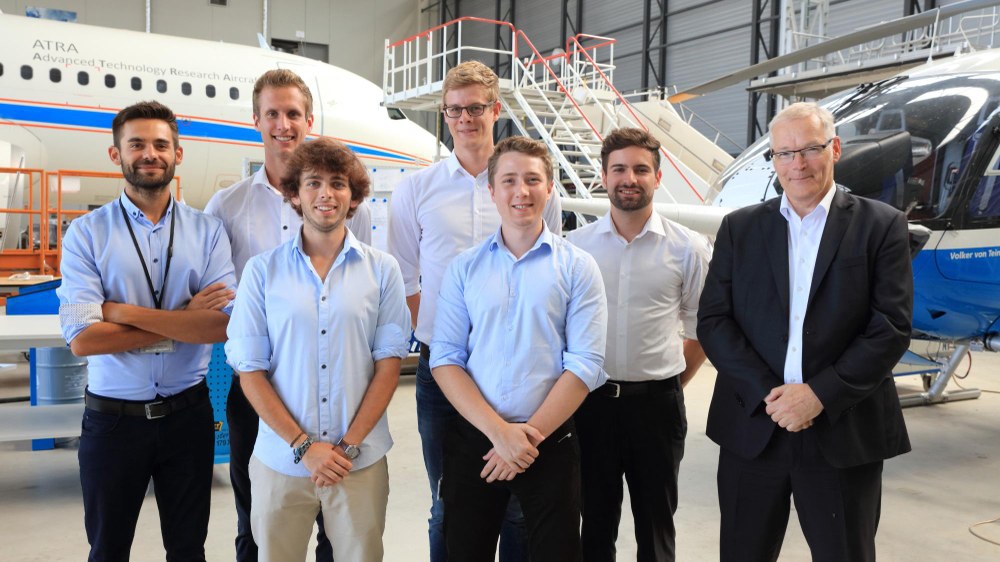
RWTH Aachen University team
From left to right: Miguel Yael Pereda Albarrán (concept supervisor), Hendrik Fuest, Marc-Antoine Le Gars, Thomas Lürkens, Philipp Podzus, Joel Rösick and DLR Executive Board Member for Aeronautics Rolf Henke.
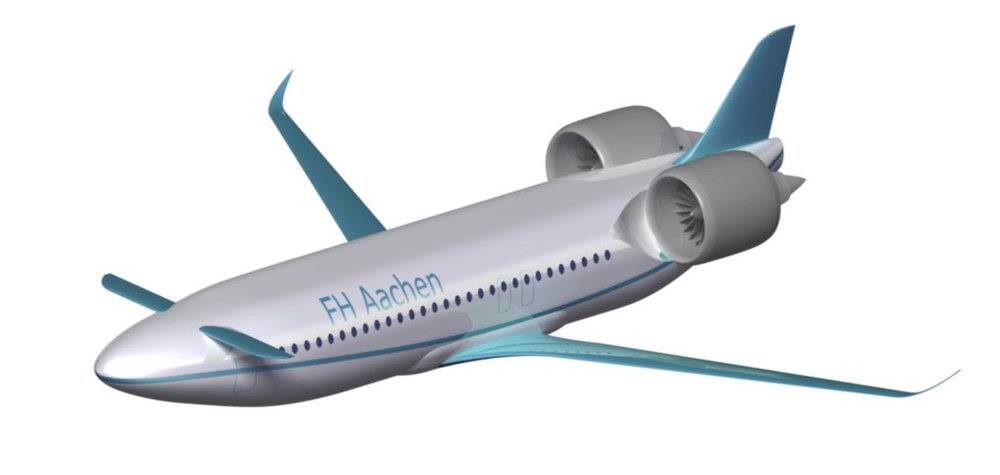
Commended entry: 'Horizon' by the Aachen University of Applied Sciences
FH Aachen – Horizon
Credit:
FH Aachen/Horizon
The Horizon aircraft features a double-bubble fuselage with two ultra-high bypass ratio hybrid-electric propulsion systems. An active aeroelastic wing with a high aspect ratio reduces the aircraft's drag. The canard wings are retractable and are only used at low airspeeds. Parts of the wing, fuselage and vertical tail are equipped with active laminar flow control.
Team: Nils Böhnisch, René Maasmeier, René Rings, Jakob Roth and Christian Szepanski.
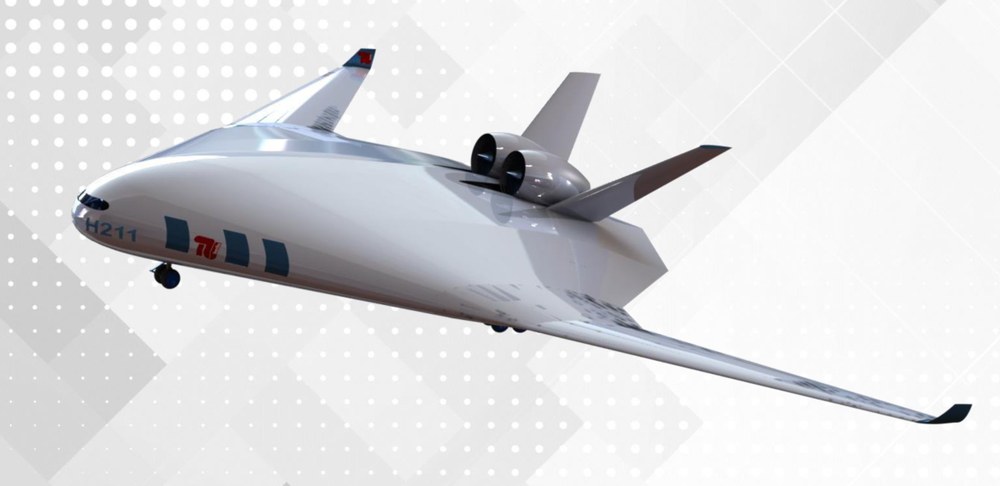
Commended entry: 'H211' by the Technical University of Berlin
The H211 concept by the Technical University of Berlin
Credit:
TU Berlin/H211
The H211 is a blended-wing-body aircraft powered by liquid hydrogen. The central wing area is used efficiently through the integration of multiple cabin tubes and cylindrical hydrogen tanks. The combination of high-bypass turboprop engines and overhead mounting reduces noise emissions.
Team: Ramon Beck, Juri Bieler, Simon Borsutzki, Yannic Cabac, Jiri Dehmel, Raman Khosravi, Arthur Klünder, Lennart Kracke, Jorge Lopez, Stephanie Roscher and Pascal Rüthnik.
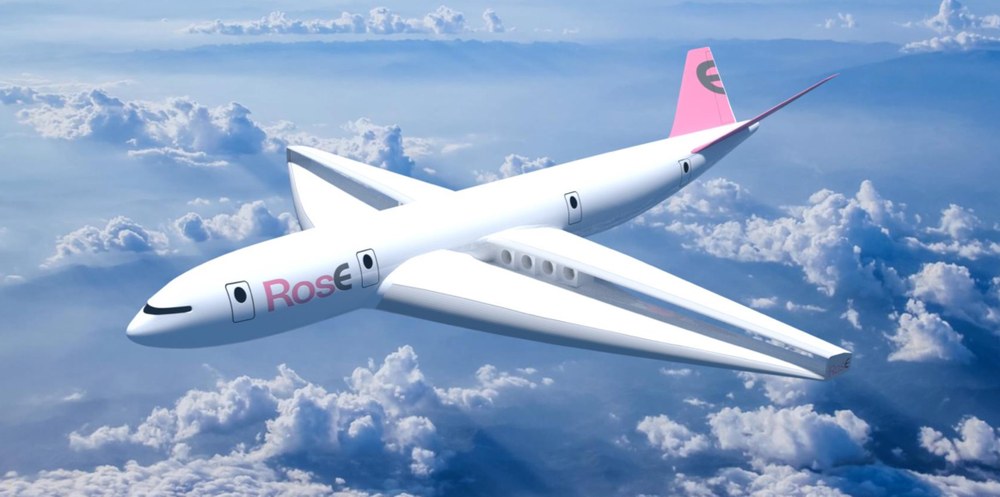
Commended entry: 'RosE' by the Dresden University of Technology
The RosE design by the Dresden University of Technology
Credit:
TU Dresden/RosE
The standout feature of the RosE design is its blended box wing structure with integrated turbofan engines. The lower, thicker wing provides ample space for the liquid hydrogen tanks and fuel cells, while the upper wing enhances stability. The electric turbofans mounted above the wing improve aerodynamic efficiency and the V-tail further reduces drag.
Team: Martin Trapp, Antonia Rahn, Viktor Dingelmaier, Lion Sano, Tim Klotsche, Agnieszka Jastrzebska and David Adamik.
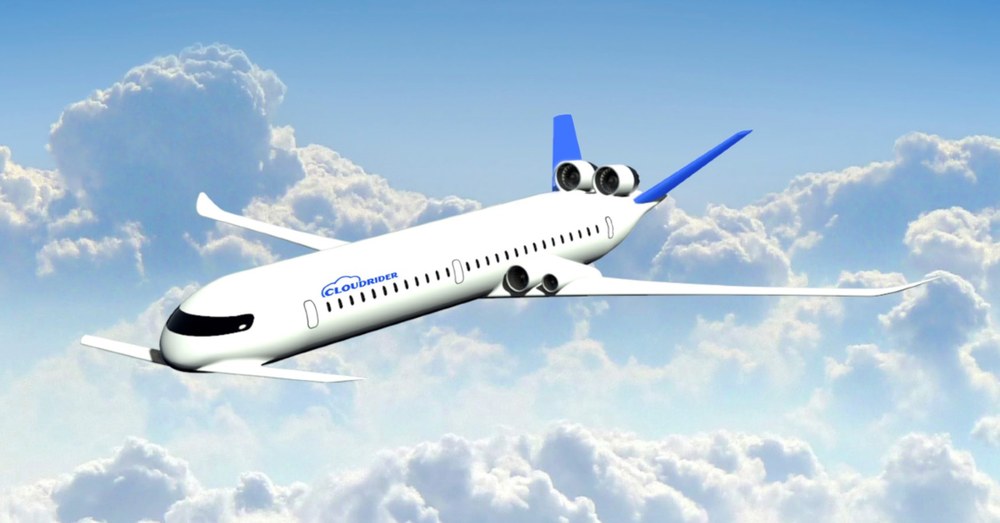
Commended entry: 'Cloudrider' by the Technical University of Munich
The Cloudrider concept by the Technical University of Munich
Credit:
TU München – Cloudrider
The aerodynamic design of the Cloudrider concept features three wings with excellent potential for reducing the surface area exposed to airflow. High-aspect-ratio wings equipped with hybrid laminar flow control are used to maximise aerodynamic efficiency. The hybrid propulsion system comprises two turbofans on the rear fuselage, powered by either liquefied natural gas or kerosene, and four electric turbofans at the wing roots.