RWTH Aachen's Urban Ray Urban Ray aircraft concept from RWTH Aachen.
Image: 1/2, Credit:
RWTH Aachen/Urban Ray
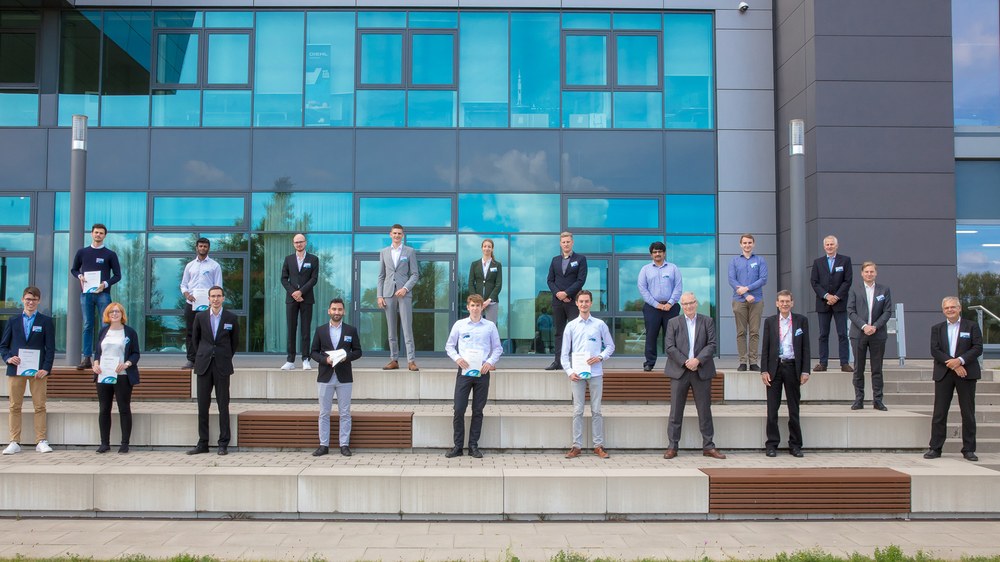
The DLR jury together with student teams during the NASA/DLR Design Challenge 2020
On 27 August 2020, the final event of the fourth NASA/DLR Design Challenge took place at DLR's ZAL TechCenter in Hamburg-Finkenwerder, including the award ceremony and presentation of prizes. Due to Covid only two members per team were attending on-site.
The task of the NASA/DLR Design Challenge 2020 was to design concepts for autonomous and reliable airborne systems for delivering goods in inner-city areas.
Forty students from seven teams competed.
The team from RWTH Aachen impressed the judging panel with their 'Urban Ray' design, taking first place.
The aim of the NASA/DLR Design Challenge 2020 was to develop an uncrewed aerial system for the autonomous transport of goods in cities.
The system had to transport parcels weighing up to 2.5 kilograms over a distance of up to 15 kilometres, operating completely autonomously. Short take-off and landing distances as well as safe operation under various weather conditions were also required.
Concepts for logistics, ground stations and safe operational procedures had to be developed to enable integration into the urban environment.
Seven teams present their designs in 2020
"The NASA/DLR Design Challenge brings together many important aspects: it focuses on fostering young talent, on cooperation between large-scale research organisations and universities, on new designs, ideas, inspiration and the transatlantic cooperation that is so important to us," emphasised Rolf Henke, DLR Executive Board Member for Aeronautics at that time and lead judge at the event in Hamburg. "All participants are winners, taking away the experience of competing as a team and working together to achieve personal bests. As a jury, we were particularly pleased this year to see how the students submitted seven fantastic concepts despite the difficult times caused by the coronavirus pandemic."
Due to the coronavirus pandemic, the students collaborated mainly digitally within their teams and attended the kick-off meeting via videoconference. At the closing event in Hamburg, up to two members per team were able to attend in person to present the concepts they had developed. The rest of the team followed the event online. In 2022, the winning team travelled to the NASA Langley Research Center in the USA together with the winners of the 2021 Design Challenge and presented their work there, alongside the winning American teams.
Aircraft design entries: an overview
First place: 'Urban Ray' by RWTH Aachen University
Presentation of the 'Urban Ray' concept
Cem Uyanık from RWTH Aachen University presents the Urban Ray concept at the final symposium of the German round of the NASA/DLR Design Challenge 2020.
The Urban Ray concept from RWTH Aachen consists of a fully autonomous, electric UAS (uncrewed aerial system) in a blended-wing-body configuration. It features separate propulsion systems (rotors) for hovering and forward flight, allowing the team to develop an innovative, thrust-based solution for flight control that eliminates the need for conventional control surfaces. Furthermore, the design combines a parachute system with a shock-absorbing foam structure to meet the high safety standards required to deploy such a system in inner-city areas. The vertical take-off and landing capability also enables the use of small platforms while maintaining high cruising speeds. To establish a dense and adaptable network, a modular platform family was developed, ranging from a simple, foldable platform to a central hub with a fully automated system for parcel loading, storage and battery replacement. Urban Ray would be offered as a pay-per-use service to parcel logistics companies and other customers who sell, for example, consumer goods or healthcare products.
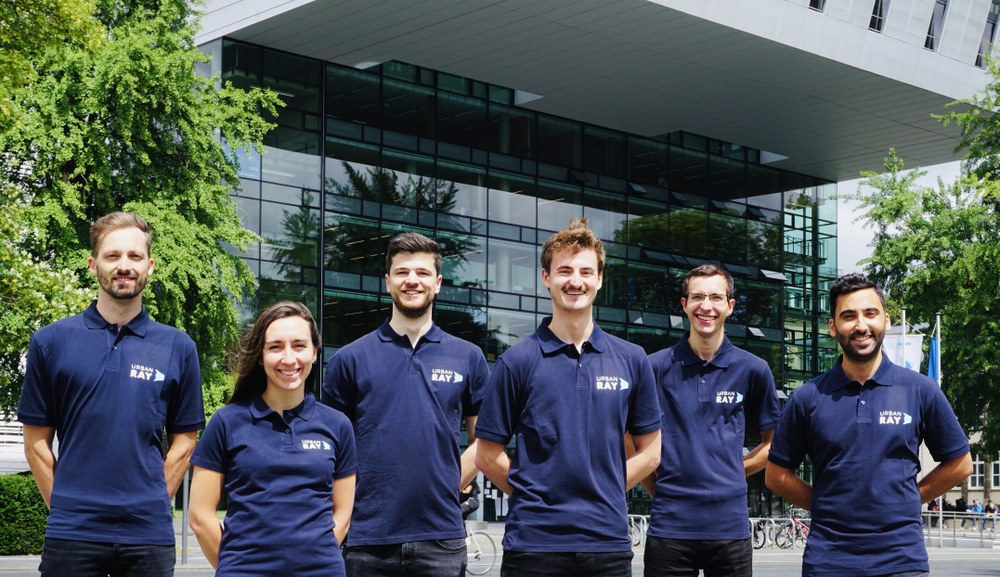
RWTH Aachen team
From the left: Julian Matt, Lourdes Ramos Camarma, Karl Funke, Fabian Binz, Ivo Zell and Cem Uyanik.
Credit:
RWTH Aachen/Urban Ray
The RWTH Aachen University team presents the 'Urban Ray' concept in a short video .
The 'Urban Ray'
Your consent to the storage of data ('cookies') is required for the playback of this video on Quickchannel.com. You can view and change your current data storage settings at any time under privacy.
The 'Urban Ray'
The RWTH Aachen University team presents the 'Urban Ray' concept in a short video .
Credit:
RWTH Aachen University, Chang Cao
Second place: 'aIRO' by University of Stuttgart
The aIRO concept by University of Stuttgart
Credit:
University of Stuttgart/aIRO
The aIRO concept from the University of Stuttgart team is a UAS consisting of a parcel drone with four wings, eight rotors and a distinctive red vertical stabiliser. The connection between the on-board systems and the ground control computer is maintained via real-time 5G communication, resulting in significant weight savings for the aircraft. A secondary flight control computer on board safeguards the drone in the event of a connection problem. The combination of tandem and multicopter configuration with quiet, electrically driven tilting rotors uses a hybrid energy system consisting of lithium-sulphur batteries and lithium-ion capacitors for optimal power supply. Redundant systems for vertical take-off and landing (VTOL) capabilities form the heart of aIRO. Ground stations, each the size of two standard parking spaces, can be flexibly distributed across urban areas. The risk to personnel and ground facilities is minimised by a comprehensive safety concept: a high-performance, ground-based passive radar detection and avoidance system (DaA) provides input for flight path control via the 5G network.
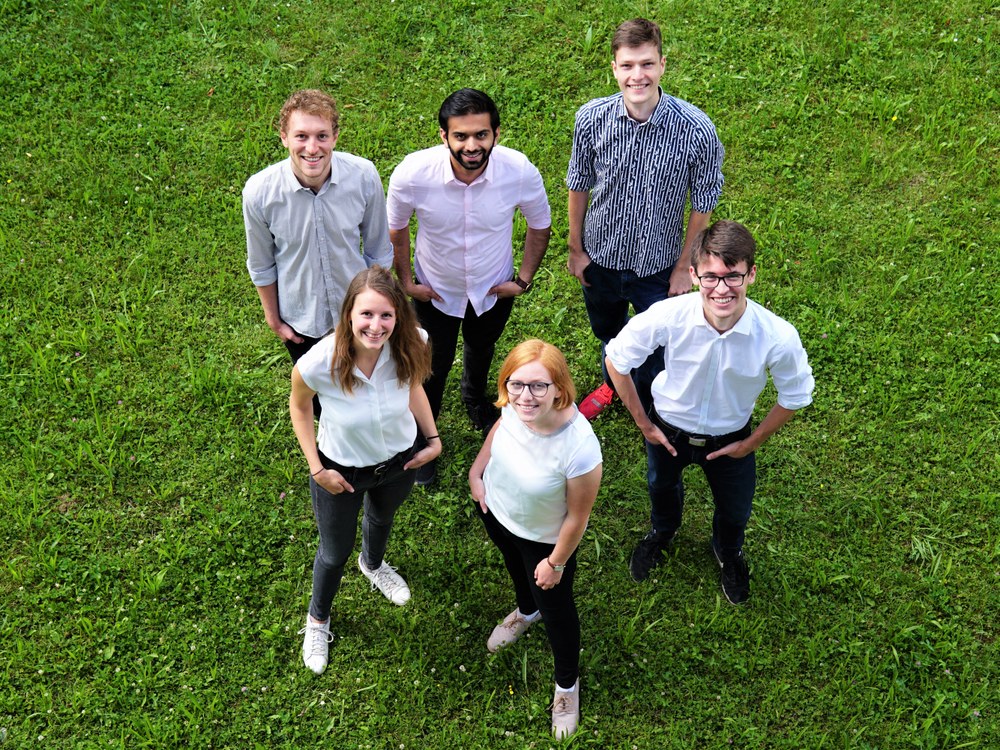
University of Stuttgart team
From the left: Connor Thelen, Mareike Hoffmann, Sajeel Khan, Sonja Hauber, Erik Wegener and Jasper Jonitz. Credit: University of Stuttgart/aIRO
Credit:
University of Stuttgart/aiRO
Third place: 'Mercurius' by the Technical University of Munich
The Mercurius concept by Technical University of Munich
Credit:
TU München/Mercurius
The design of the Mercurius drone developed by a team at the Technical University of Munich focuses on maximum efficiency with minimum weight. Two fixed front propellers and six swivelling upper-wing propellers at the rear reconcile the conflicting requirements of hovering and horizontal flight. Design features such as lowered winglets and upper-wing struts result in good aerodynamic characteristics. The hybrid propulsion system, comprising a fuel cell and a lithium-ion battery, enables operational performance that cannot be achieved with purely battery-powered designs. This increases flight safety and energy efficiency, leading to a one-third reduction in costs per delivered parcel. The ground stations combine a lightweight design with advanced automation, ensuring rapid drone loading and battery charging.
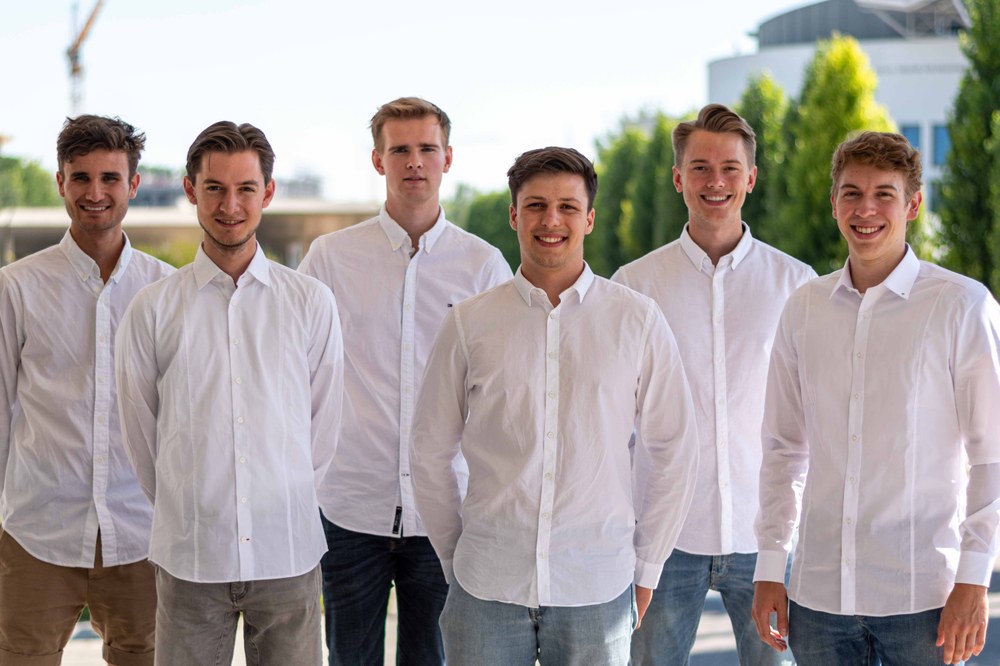
TU Munich team
From the left: Nathanael Pfanner, Markus Sailer, Moritz Wenzel, Manuel Prinz, Cornelius Kauffmann and Jan Rudzki.
Credit:
TU Munich/Mercurius
Commended entry: 'BeeHive' by Dresden University of Technology
The BeeHive concept by Dresden University of Technology
Credit:
TU Dresden/BeeHive
The BeeHive concept from the team at Dresden University of Technology is a cost-effective and highly functional autonomous transport system capable of transporting small payloads at high speeds within an urban environment. It consists of two components: the carrier drone, called 'Bee', and the ground system, called 'Hive'. The aircraft features a canard configuration with swivelling canards and is powered by four electric motors. This enables vertical take-off and landing, as well as energy-efficient horizontal flight. Consequently, the 2.5-kilogram payload can be transported over a distance of up to 72 kilometres. The motors are powered by lithium-ion batteries, which are replaced fully automatically on the landing platform while new cargo is loaded. The system meets the highest standards of safety, noise reduction and efficiency. It is easily scalable and can be readily adapted to customers' requirements.
Team: Luckas Bach, Anton Liegert, Tobias Hofmann, Tim Aurin, Edgar Lilienthal and Thomas Hanl.
Commended entry: 'Ciconia' by the University of the Bundeswehr Munich
The eCiconia concept by University of the Bundeswehr Munich
Credit:
Universität der Bundeswehr München/eCiconia
The eCiconia concept developed by a team at the University of the Bundeswehr Munich combines vertical take-off and landing (VTOL) capability with fuel-efficient conventional wing-based aerodynamics. Horizontal flight enables precise take-off and landing manoeuvres in the smallest of spaces, while a catapult system allows for energy-efficient drone launches. A central ground station operates a conveyor belt system for loading and unloading parcels as well as battery swapping. An integrated control centre ensures efficient and reliable operation with minimal space and time requirements. An attractive feature of the concept is the use of existing parcel stations, extended as landing platforms, which enabling reliable parcel delivery without the risks associated with ground landings. A combined safety system, consisting of a parachute and airbags, prevents damage in the event of a system failure.
Team: Johannes Lehtonen, Antonia Sattler, Tobias Kreutz, Matthias Lettl and Sebastian Privik.
Commended entry: 'HecTO-R' by Hamburg University of Technology
The HecTO-R concept by Hamburg University
Credit:
TU Hamburg/TUHH HecTO-R
The HecTO-R concept from a team at Hamburg University of Technology is a hybrid between a quadcopter and a blended-wing tail-sitter, combining vertical take-off and landing with fast cruise flight. The wings are optimised to ensure stable and safe flight characteristics and to minimise potential accident risks. The system is powered by Licerion High Energy batteries, which have sufficient storage capacity for two flights. To reduce weight and costs, almost all components are made from carbon fibre-reinforced polymers. HecTO-R can land very flexibly on folding landing gear located at the rear of the fuselage. The lightweight aluminium loading mechanism is integrated into the fuselage, enabling HecTO-R to place parcels almost anywhere autonomously.
Team: Anushan Thiripuvanam, Flavio Geronimo, Michael Szymanski, Niklas Schmidtke and Juan Felipe Ricardo Ramirez.
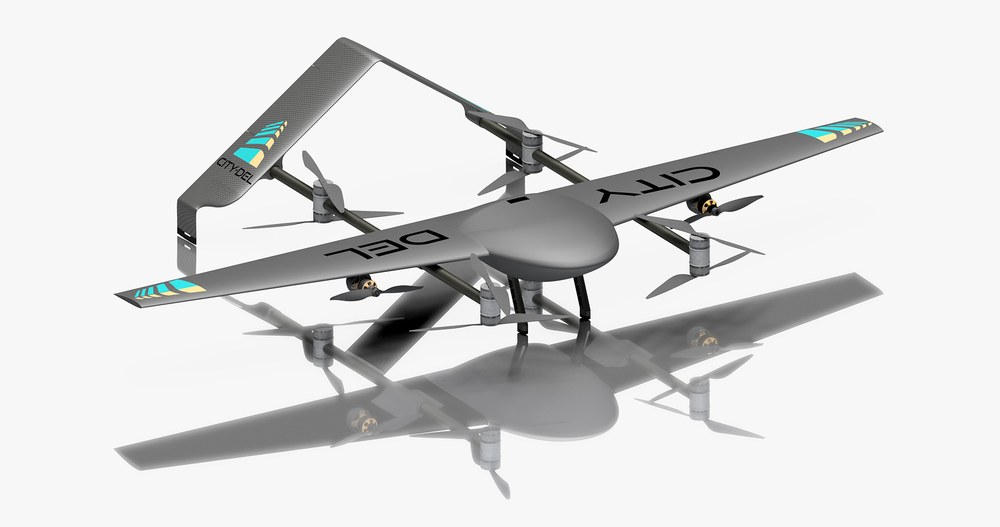
Commended entry: 'City-Del' by Hamburg University of Technology
The City-Del concept by Hamburg University of Technology
Credit:
TU Hamburg/City-Del
The City-Del parcel drone concept, developed by another team at Hamburg University of Technology, is made entirely of carbon fibre-reinforced polymer to minimise weight. To operate in confined spaces, City-Del features both a vertical and a horizontal mode. The vertical mode is enabled by eight coaxially arranged rotors, providing the drone with high manoeuvrability. The horizontal mode is enabled by two rotors mounted on the wings and an inverted V-tail. During operation, a battery pack consisting of 60 cells supplies sufficient power to the motors and avionics. City-Del contains a capacitor that bridges the power supply during changes of the combined battery and charging unit.
Team: Sören Bähr, Lenard Barkow, Jannik Herrmann, Neermegha Mishra, Sofia Schäfer and Rakshith Sudarshana.