First place in the DLR Design Challenge 2022 – INFERNO
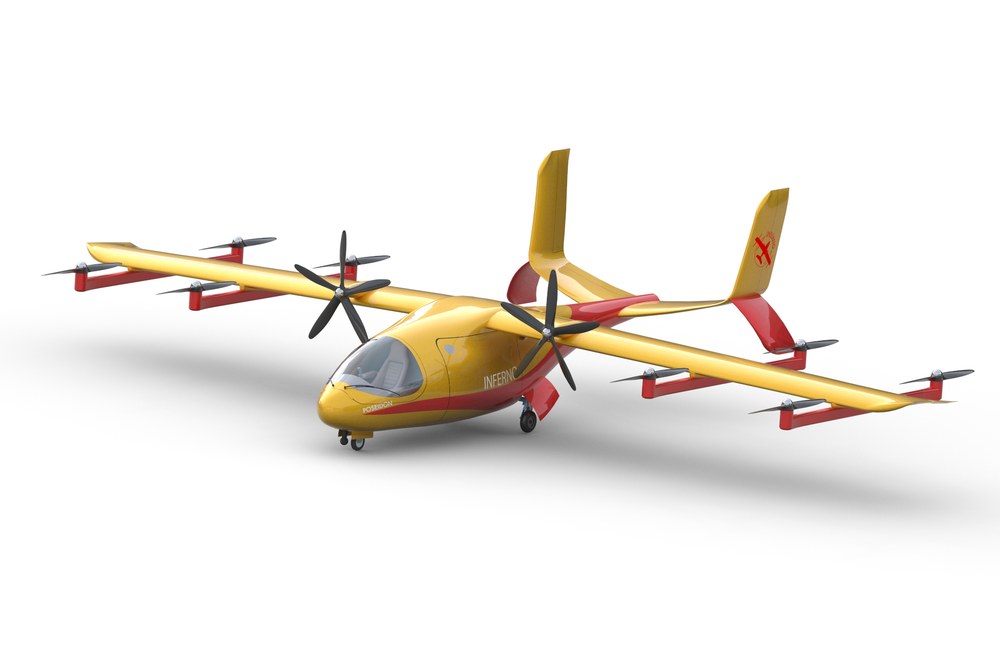
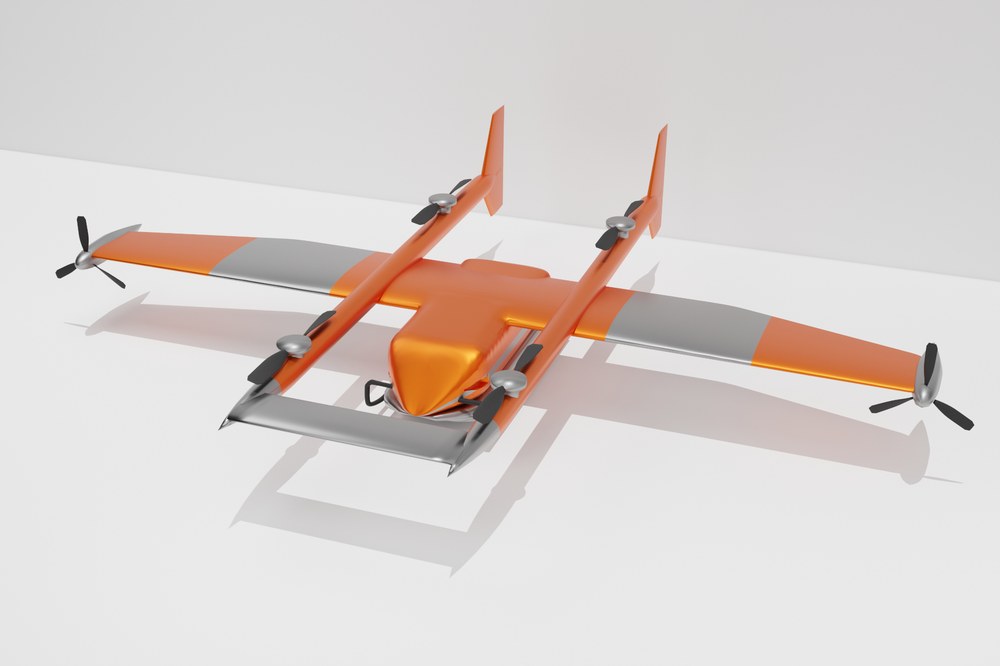
INFERNO from the winning team at the University of Stuttgart.
Image: 1/2, Credit:
Universität Stuttgart/INFERNO
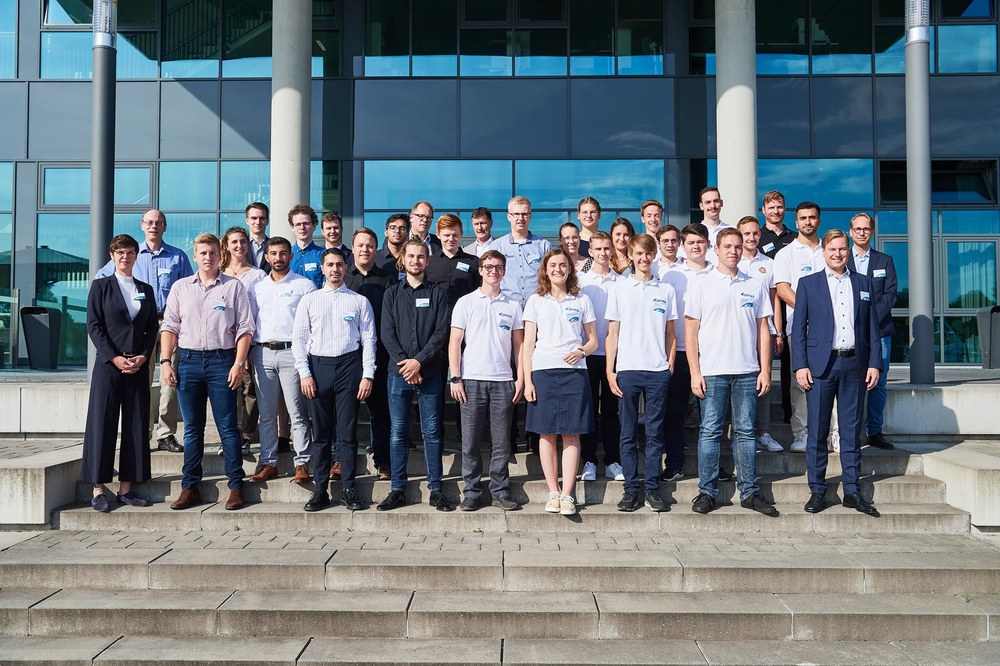
The DLR jury together with student teams during the DLR Design Challenge 2022
The closing event and award ceremony for the sixth Design Challenge took place at the Center of Applied Aeronautical Research (Zentrum für Angewandte Luftfahrtforschung; ZAL) in Hamburg on 4 August 2022.
The task of the DLR Design Challenge 2022 was to design a fleet of aircraft for systematic forest firefighting.
Thirty-three students from six teams competed.
The team from the University of Stuttgart impressed the DLR jury with their INFERNO concept, taking first place.
The aim of the 2022 Design Challenge was to develop a fleet of aircraft for aerial wildfire management. The designs were intended to enable rapid and efficient firefighting operations.
The aircraft had to be capable of collecting water from various sources and taking off and landing safely even under difficult conditions. Flexible deployment options and cost-effective use outside the wildfire season were also required.
Six teams presented their designs in 2022
This was the sixth edition of the annual DLR Design Challenge. Due to restrictions caused by the COVID-19 pandemic, both the kick-off event and the majority of the teams' design work took place online. The challenge culminated in a hybrid closing event at the Center for Applied Aviation Research (ZAL) on DLR’s site in Hamburg. Following the DLR Design Challenge 2022, the three best-placed teams presented their concepts at the German Aerospace Congress (DLRK 2022) also in Hamburg. The winning team also presented its design at the International Council of the Aeronautical Sciences (ICAS 2022) congress in Stockholm.
Aircraft design entries: an overview
First place: 'INFERNO' by the University of Stuttgart
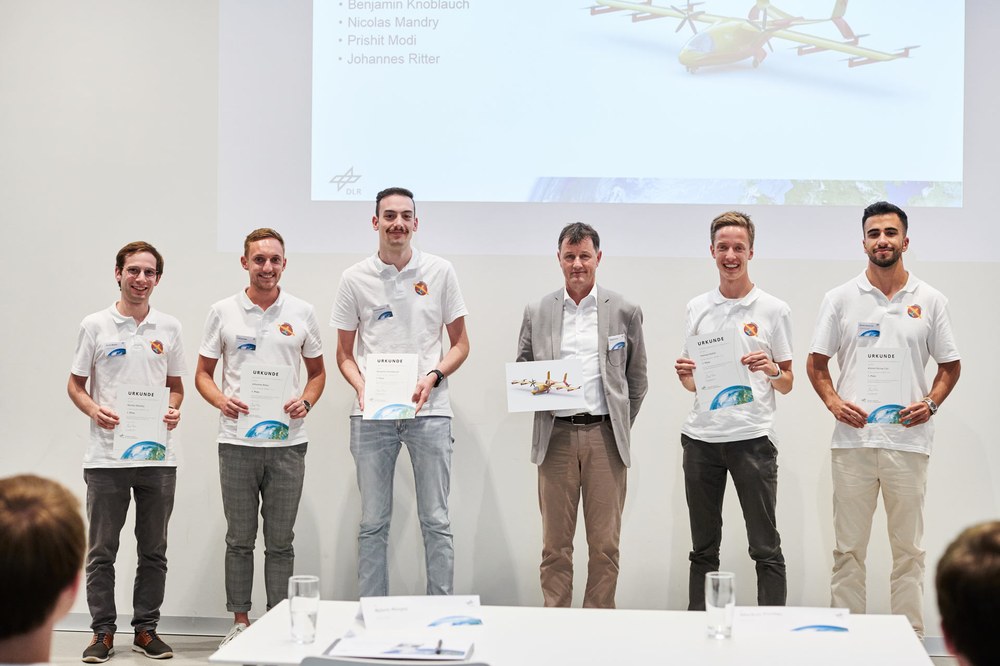
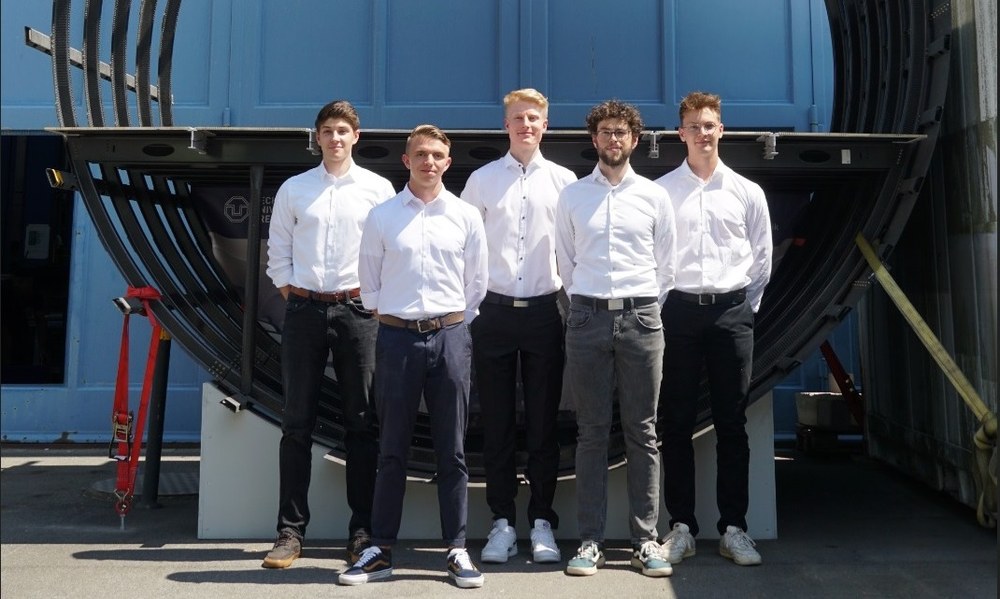
The winning team from the University of Stuttgart at the DLR Design Challenge 2022
The 2022 DLR Design Challenge was won by students from the University of Stuttgart. From left: Nicolas Mandry, Johannes Ritter, Benjamin Knoblauch, Markus Fischer (Chair of the DLR jury), Hannes Kahlo, Ahmet Günay Can, Prishit Modi (not shown)
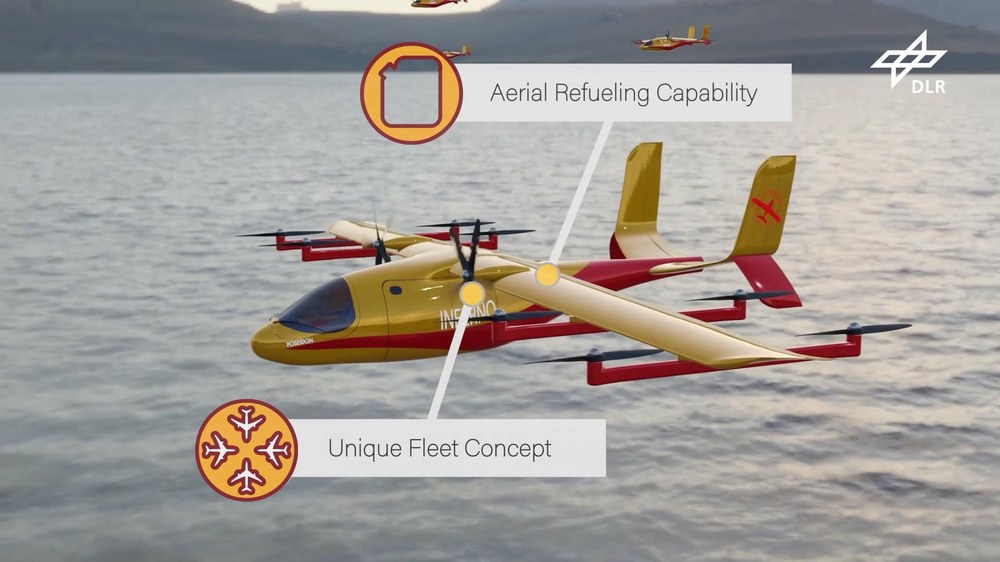
INFERNO (INtelligent FirERespoNse Operation) from the winning team at the University of Stuttgart uses eight horizontal rotors to take off and land vertically, and two propellers for forward flight. This configuration is made possible by a hybrid-electric propulsion concept powered by Sustainable Aviation Fuel (SAF). In addition to the familiar scooping method, the team uses the immersion method – as employed by firefighting helicopters – to collect water from small bodies of water. As INFERNO is piloted by a single person on board, the team has developed a comprehensive cockpit design to ensure safe flight even in poor visibility and at night. INFERNO is designed to be highly modular, allowing it to transport both cargo and passengers. To make firefighting operations even more effective, the operational concept includes the option for in-flight refuelling.
The University of Stuttgart wins the first place of the DLR Design Challenge with INFERNO (short for INtelligent FirE RespoNse Operation). It uses eight horizontal rotors for vertical take-off and landing and two propellers for forward flight, thanks to the hybrid-electric propulsion concept powered by Sustainable Aviation Fuel (SAF). The aircraft can also take up water from small bodies of water. INFERNO is designed to be highly modular, so it could also transport cargo or passengers. In order to make it even more effective at extinguishing flames, the operating concept provides for the possibility of aerial refuelling.
Video: INFERNO concept of the University of Stuttgart
Your consent to the storage of data ('cookies') is required for the playback of this video on Quickchannel.com. You can view and change your current data storage settings at any time under privacy.
Video: INFERNO concept of the University of Stuttgart
The University of Stuttgart wins the first place of the DLR Design Challenge with INFERNO (short for INtelligent FirE RespoNse Operation). It uses eight horizontal rotors for vertical take-off and landing and two propellers for forward flight, thanks to the hybrid-electric propulsion concept powered by Sustainable Aviation Fuel (SAF). The aircraft can also take up water from small bodies of water. INFERNO is designed to be highly modular, so it could also transport cargo or passengers. In order to make it even more effective at extinguishing flames, the operating concept provides for the possibility of aerial refuelling.
Second place: 'PEL-E-FAN-T' by Dresden University of Technology
The PEL-E-FAN-Tace PEL-E-FAN-T concept by Technical University of Dresden
Credit:
TU Dresden/PEL-E-FAN-T
The PEL-E-FAN-T (proPELlor driven turbo Electric hybrid Firefighting AutoNomous vTol) concept from Dresden University of Technology is an uncrewed drone. The hybrid-electric propulsion architecture enables vertical and horizontal flight. The four vertical propellers allow the drone to take off and land vertically. This also allows PEL-E-FAN-T to use even very small water sources for firefighting operations. The design includes interchangeable modules that can be attached beneath the fuselage depending on the mission. For fleet operations, two drones will initially be equipped with a reconnaissance module to relay important information for wildfire management operations to the rest of the fleet. PEL-E-FAN-T can also take on water using pumps. The team also plans to incorporate cargo and passenger modules to facilitate its use outside the wildfire season.
TU Dresden team
From the left: Hannes Jerzembek, Paul Sanderbrand, Maximilian Wenk, Lennard Köhler and Dominik Brunner.
Credit:
TU Dresden/PEL-E-FAN-T
Third place: 'FireWasp' by RWTH Aachen University
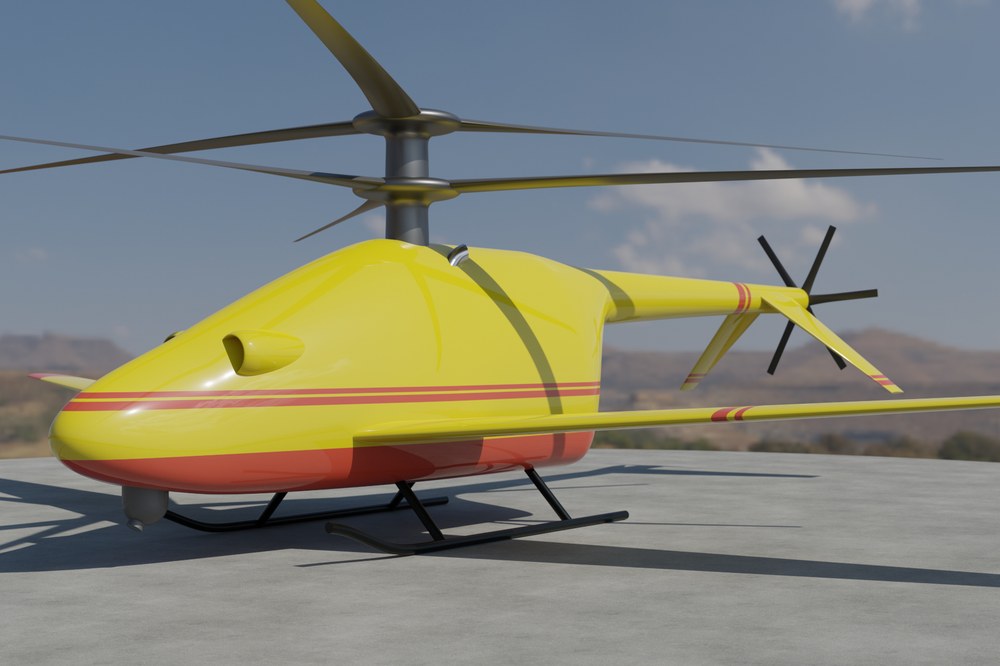
The FireWasp concept by RWTH Aachen
Credit:
RWTH Aachen/FireWasp
The FireWasp compound helicopter from RWTH Aachen University combines the best features of helicopters and aeroplanes. Rotors and wings ensure efficient cruise flight while maintaining high speeds. A conventional gas turbine is planned for propulsion, which could be powered entirely by SAF by the time the aircraft enters service in 2030. Thanks to its chosen system architecture, FireWasp can take off and land vertically with efficiency, allowing water to be drawn from very small sources using a snorkel pump. The fleet, consisting of a reconnaissance helicopter with specialised equipment and six further vehicles with firefighting equipment, is operated autonomously and can be remotely controlled from a mobile ground station if required. Owing to the modular integration of the subsystems, FireWasp can also be used for cargo transport, to apply plant protection products and for airborne environmental monitoring.
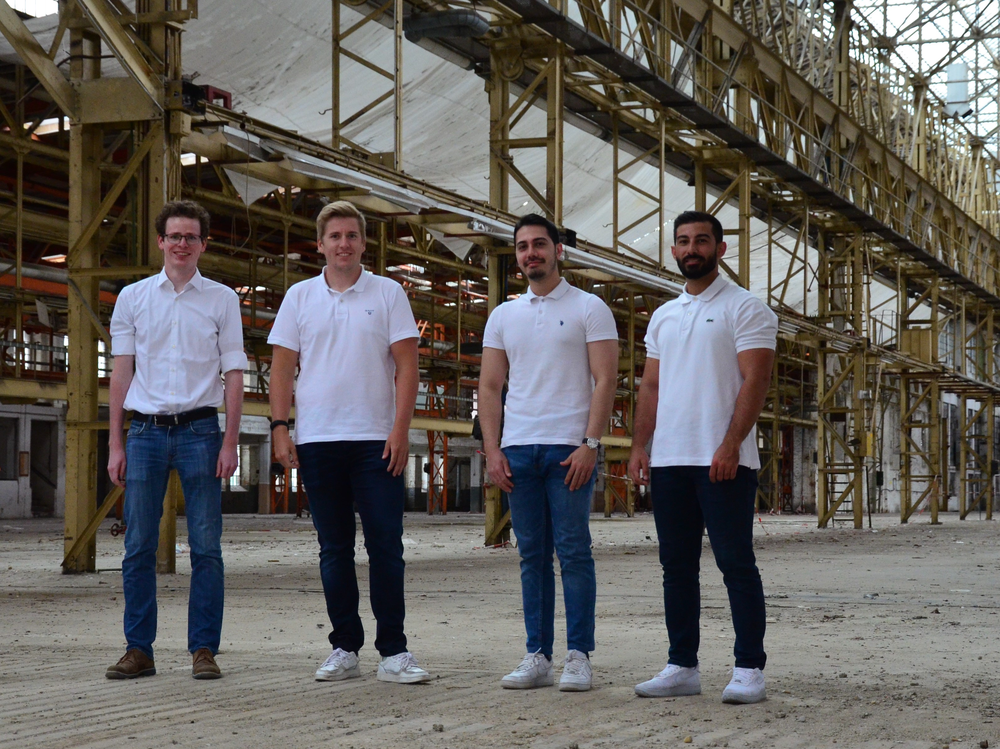
RWTH Aachen team
From the left: Dominik Kau, Robin Mörsch, Mucahit Fatih Evliyaoglu and Selim Karakus.
Credit:
RWTH Aachen/ FireWasp
Commended entry: 'GLAROS' by Dresden University of Technology and Braunschweig University of Technology
The GLAROS concept by TU Dresden and TU Braunschweig
Credit:
TU Dresden/TU Braunschweig/GLAROS
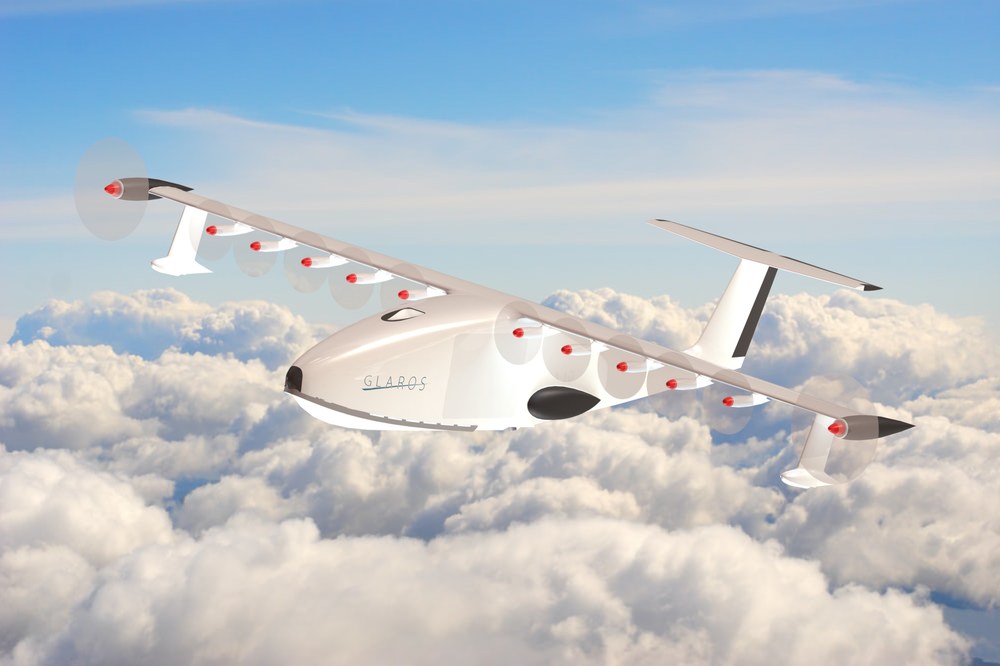
The aircraft configuration developed by the inter-university team from TU Dresden and TU Braunschweig enables high efficiency in-cruise flight to carry large quantities of water. To provide some of the advantages of vertical take-off aircraft, GLAROS – Greek for 'seagull' – utilises the increased lift generated by the distributed propulsion units of its turbo-electric power system to minimise take-off distance. Two batteries and a turbo generator serve as the energy source. Sustainable Aviation Fuel can be used to reduce the environmental impact. As GLAROS is a remotely piloted aircraft, the team uses communication via 4G/5G mobile networks and satellite for reliable control. GLAROS is a flying boat and uses the well-known scooping technique to take on water.
Team: Alejandro Antonio Arjona Reyes, Alexander Bloi, Jannis Link, Benedikt Rings, Dominik Vogt and Philipp Wilkendorf
Commended entry: 'Dipper' and 'AEGIS' by the Baden-Wuerttemberg Cooperative State University in Ravensburg
DHBW Ravensburg with Dipper & AEGIS
Credit:
DHBW Ravensburg/Dipper/AEGIS
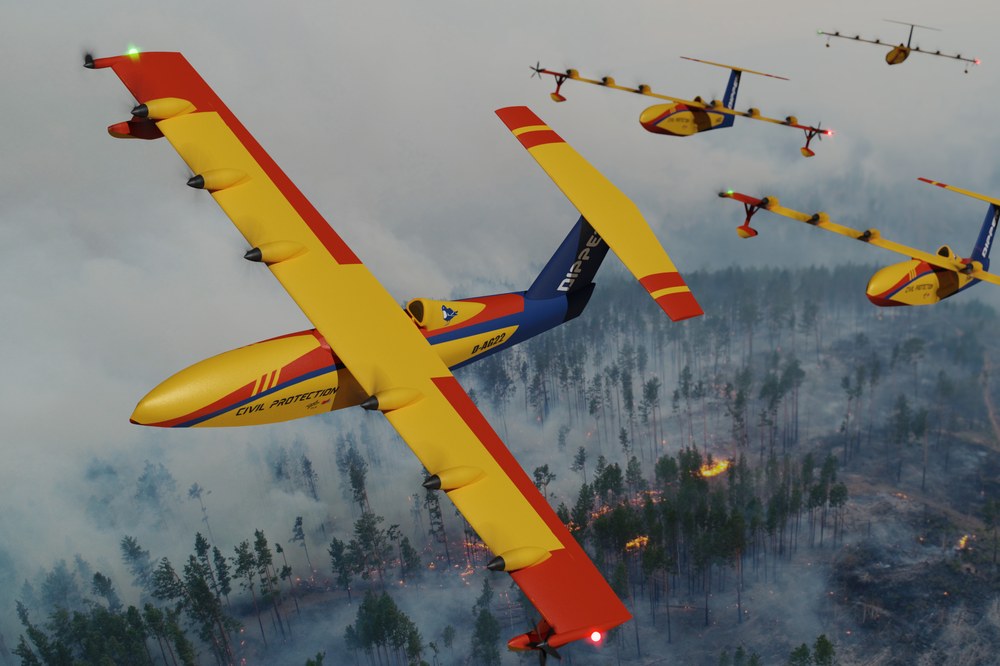
Dipper is a hybrid-electric amphibious aircraft designed by one of the teams at the Baden-Wuerttemberg Cooperative State University (DHBW) in Ravensburg. A simulation model was used to further evaluate and determine fleet requirements. Distributed electric propulsion via six counter-rotating propellers along the wingspan and two propellers at the wingtips enhances aerodynamic properties. This configuration allows short distances for take-off, landing and scooping on open water surfaces. To implement the systematic deployment of the fleet for wildfire management, the team has developed the AEGIS (Aerial Extinguishing Grouped Intervention System) software. The aircraft fleet consists of six vehicles that are remotely controlled, coordinated and monitored via AEGIS. The aircraft can also be used for transport or research in remote and rugged areas. Conversion for humanitarian missions following natural disasters is also possible.
Team: Brendan Berg, Paul Droste, Isabella Kullmer-Ispas, Magnus Schoder, Pascal Trapp and Florian Wolff
Commended entry: 'FireF(l)ighter' by DHBW Ravensburg
The FireF(l)ighter concept by DHBW Ravensburg
Credit:
DHBW Ravensburg/FireF(l)ighter
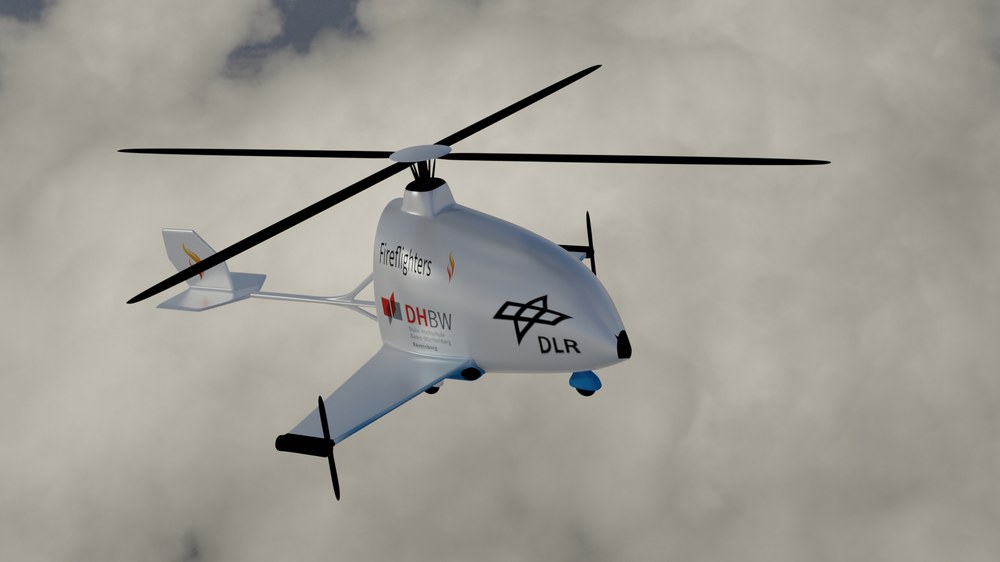
FireF(l)ighter, from another team at DHBW Ravensburg, is a combination of a helicopter and a gyrocopter. Power for both vertical flight as a helicopter and horizontal flight as a gyrocopter is provided by a conventional gas turbine. In helicopter mode, very small and forested water sources can be used to collect water for firefighting. The water tank in the lower section of the fuselage is filled with a suction device. By using fire-retardant additives, foam blankets can assist in suppressing reignition in coordination with fire crews on the ground. The fleet operation of a total of ten vehicles is controlled by several people from the ground.
Team: Hannah Feiler, Hannes Loheide, Sabrina Schaible, Maren Traber, Frieder Völkle and Tristan Wiegner