First place in the DLR Design Challenge 2024: TU Berlin's CHARGE
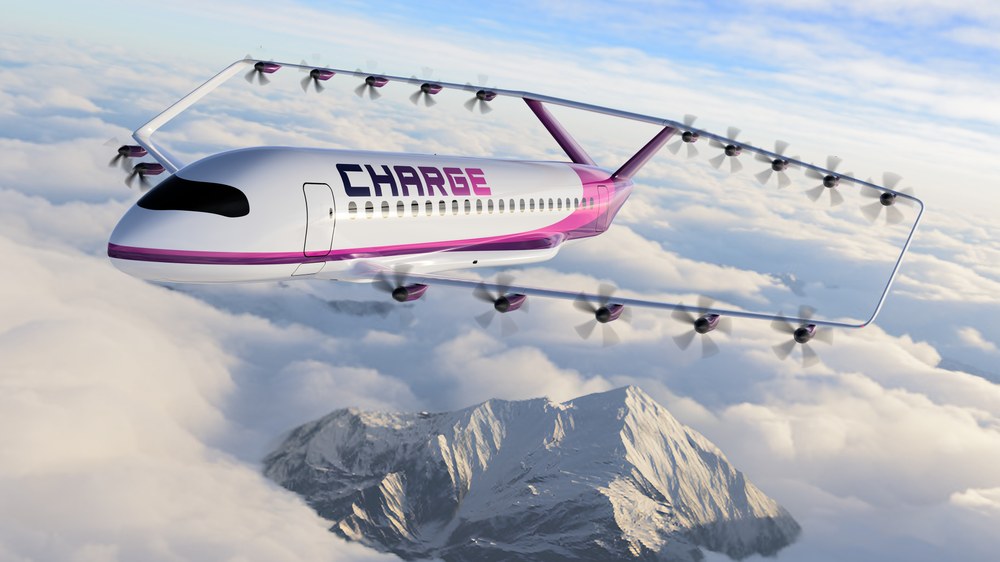
The winning CHARGE (Carbon-neutral High-efficiency Aircraft for ReGional Electric flight) design combines a box-wing configuration with distributed electric propulsion to achieve a high level of aerodynamic and propulsive efficiency. For its energy supply, the concept relies exclusively on batteries due to their extraordinarily high efficiency. CHARGE is designed to be able to transport 110 passengers over a distance of up to 894 kilometres.
Image: 1/2, Credit:
TU Berlin/CHARGE
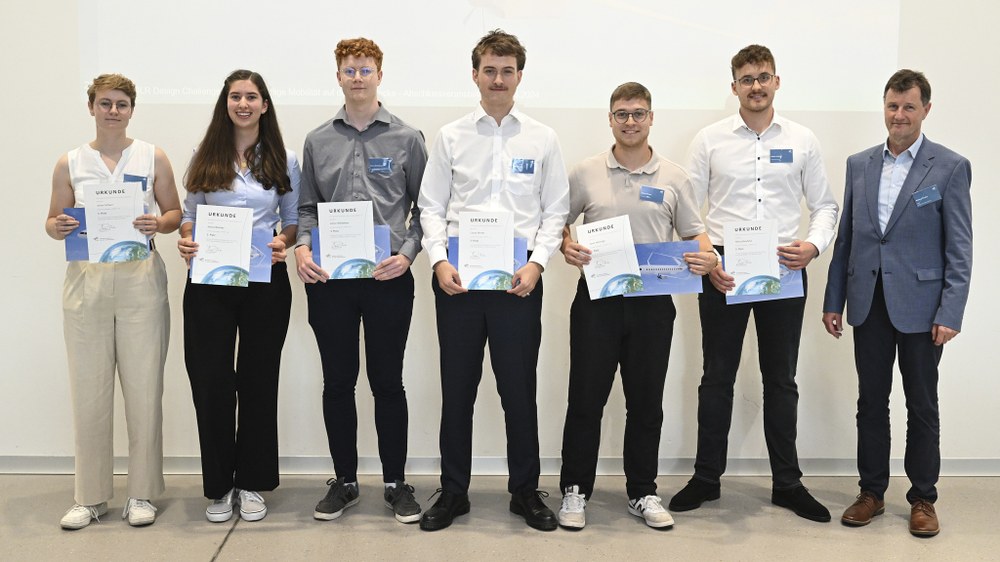
The DLR jury together with student teams during the DLR Design Challenge 2024
On 8 August 2024, the final event of the eighth DLR Design Challenge took place at DLR's ZAL TechCenter in Hamburg-Finkenwerder, including the award ceremony and presentation of prizes.
The task for the 2024 Design Challenge was to design a short-haul aircraft that is both climate compatible and economical.
34 students from five teams competed.
Students from TU Berlin impressed the jury during the DLR Design Challenge 2024, winning first place with their CHARGE concept.
To make air transport climate compatible in the coming decades, innovative technologies must be advanced. Since short-haul flights account for a significant proportion of current carbon dioxide emissions from aviation, the DLR Design Challenge 2024 addressed this issue. The task was to design a low-emission aircraft for future short-haul mobility.
"Aviation is currently undergoing one of the most intensive transformation processes in its history. There is therefore a considerable need for research and development. In this context, DLR sees itself as both an architect and integrator of aviation research," emphasises Anke Kaysser-Pyzalla, Chair of the DLR Executive Board. "The exchange of knowledge, new and disruptive thinking and openness to technology are indispensable for our work. The participants in the DLR Design Challenge 2024 have successfully demonstrated all of these qualities in their design of an environmentally compatible and economically efficient short-haul aircraft for the year 2050."
Six teams presented their designs in 2024
Part of the challenge was to design an aircraft suitable for entry into service by 2050. The new aircraft should be able to serve a specified network of European regional routes, both ecologically and economically. By analysing the network, participants were left to choose the range and passenger capacity themselves, and thus optimally fulfil both requirements. The choice of energy source was also open: hydrogen, electricity or sustainable aviation fuel (SAF) in hybrid application could be selected.
Six student teams presented their designs, for which they had approximately four months, at the final event of the competition. The students went through processes similar to those involved in real aircraft design – from the initial conceptualisation and detailed elaboration and calculation of technical aspects, all the way to a convincing presentation in front of an expert jury. They gained valuable experience and combined their acquired knowledge with practical skills by working under realistic conditions and addressing current challenges facing the aviation industry. The task required not only technical expertise, but also creativity and teamwork.
Over the course of the project, the students invested several hundred hours into developing their concepts and will benefit from the comprehensive experience and contacts with experts from the industry. The Design Challenge was jointly organised by the DLR Institute of System Architectures in Aeronautics and the DLR Institute of Aerodynamics and Flow Technology.
As part of the 2024 DLR Design Challenge, the three best-placed teams presented their concepts at the German Aerospace Congress (DLRK 2024) in Hamburg. The top team also presented their design at the 34th Congress of the International Council of the Aeronautical Sciences (ICAS 2024) in Florence.
Aircraft design entries: an overview
First place: 'CHARGE' by the Technical University of Berlin
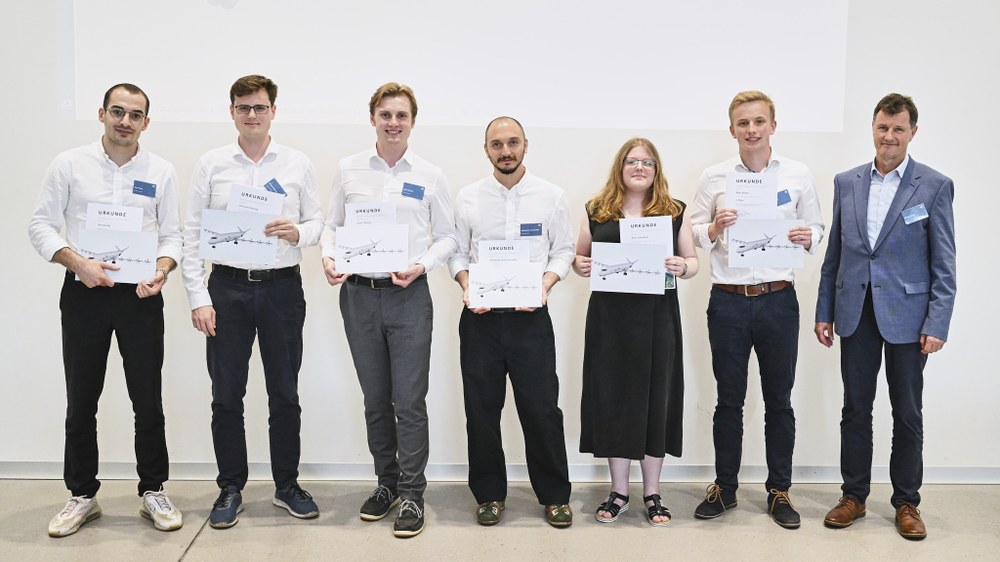
The winning TU Berlin team
From the left: Clemens Ehrich, Mathias Tekkel, Luca Kriebel, Leonid Wenz, Tim Schulz, Lennart Wauer and Markus Fischer, DLR’s Divisional Board Member for Aeronautics.
CHARGE (Carbon-neutral High-efficiency Aircraft for ReGional Electric flight) combines a box-wing configuration with distributed electric propulsion (DEP) to achieve high aerodynamic and propulsive efficiency. For energy supply, the concept relies exclusively on batteries owing to their exceptionally high efficiency. CHARGE is designed to transport 110 passengers over a distance of up to 894 kilometres.
Video: DLR Design Challenge 2024, the winning design by TU Berlin – CHARGE
Your consent to the storage of data ('cookies') is required for the playback of this video on Quickchannel.com. You can view and change your current data storage settings at any time under privacy.
Video: DLR Design Challenge 2024, the winning design by TU Berlin – CHARGE
Credit:
TU Berlin/CHARGE
Second place: 'VoltAirs-95' by the Technical University of Braunschweig
Team from TU Braunschweig
From the left: Gent Gutaj, Christian Dietrich, Lukas Thiesen, Aleksandre Kobeshavidze, Anna Vorndran, Mika Rasch and Markus Fischer, DLR's Divisional Board Member for Aeronautics.
The VoltAirs-95 concept, submitted by the team from TU Braunschweig, accommodates 95 passengers. It has a flight range of just under 900 kilometres and is powered by ten distributed electric propellers. An additional rear-mounted generator, powered by SAF, is available for back-up missions or can be switched on as a range extender to more distant destinations.. The batteries are housed in the aircraft's fuselage and wings. While the aircraft design is conventional, it features a V-tail. The windowless fuselage is equipped with OLED displays in the cabin to provide passenger comfort while reducing structural weight.
Video: DLR Design Challenge 2024, design by TU Braunschweig – VoltAirs-95
Your consent to the storage of data ('cookies') is required for the playback of this video on Quickchannel.com. You can view and change your current data storage settings at any time under privacy.
Video: DLR Design Challenge 2024, design by TU Braunschweig – VoltAirs-95
Credit:
TU Braunschweig/VoltAirs-95
Third place: 'HYPER' by DHBW Ravensburg University
DHBW Ravensburg team
From the left: Jonna Bleeker, Lena Hennige, Julius Wildeboer, Lucas Weser, Jonas Schaur, Niclas Neufeld and Markus Fischer, DLR's Divisional Board Member for Aeronautics.
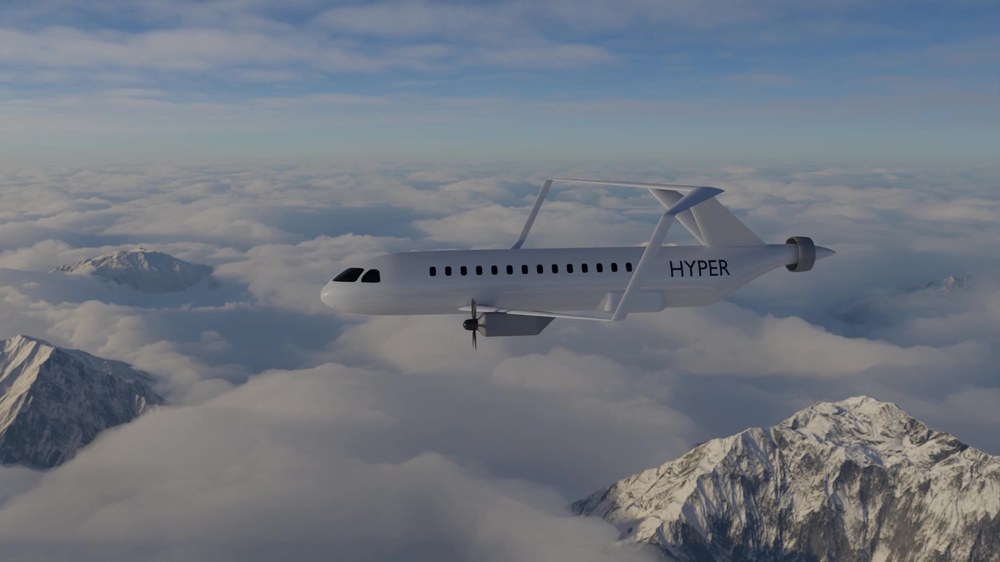
The HYPER (HYdrogen Powered Electric Regional aircraft) concept transports 89 passengers up to 1250 kilometres and uses a highly efficient and innovative box-wing configuration. The electric propulsion systems are powered by a hybrid power supply: during cruise flight, fuel cells provide energy from liquid hydrogen, while batteries support flight phases requiring high power. Additionally, a boundary layer ingestion (BLI) motor – which uses the airflow close to the fuselage to generate thrust – further enhancing motor efficiency.
Your consent to the storage of data ('cookies') is required for the playback of this video on Quickchannel.com. You can view and change your current data storage settings at any time under privacy.
Commended entry: 'EcoAir' by RWTH Aachen University
The EcoAir concept by RWTH Aachen University
Credit:
RWTH Aachen/EcoAir
RWTH Aachen University presented EcoAir, an aircraft capable of carrying 76 passengers over a range of 900 kilometres. The concept is based on a hybrid-electric propulsion system that uses liquid hydrogen fuel cells and batteries. To achieve high aerodynamic efficiency, EcoAir features foldable wingtips, which allow for a large wingspan without compromising airport compatibility. Additionally, the wing is equipped with a 'hybrid laminar flow control system', which extracts the turbulent boundary layer air through the wing skin to reduce frictional resistance.
Team: Talha Sor, Yuvraj Salhan, Shuhan Yang, Constantin Koopman, Peter Faber and Prakhar Sharma
Commended entry: 'MOBULA' by the University of Stuttgart
The MOBULA concept by the University of Stuttgat
Credit:
Universität Stuttgart/MOBULA
MOBULA (MOdular Blended Wing Body Ultra Low Emission Aircraft), designed by students of the University of Stuttgart, combines the aerodynamic advantages of a flying wing with an innovative airport handling process. Designed for 72 passengers and with a range of 1500 kilometres, it features the ability to separate the fuselage from the wing section at the airport. This allows passengers to board and disembark whilst the wing segment is still being prepared, speeding up the overall handling of the aircraft. MOBULA is powered by six electric propeller motors, fuelled by electricity from a fuel cell and batteries. Hydrogen stored in two interchangeable tanks at the rear of the aircraft.
Team: Felix Wolf, Lars Wössner, Luka Wolf, Fabian Haas, Felix Fuchs und Arthur Bernhardt
Commended entry: 'HydroProp' by Hamburg University of Applied Sciences (HAW)
The HydroProp concept by Hamburg University of Applied Sciences
Credit:
HAW Hamburg/HydroProp
The HydroProp, developed by HAW Hamburg, is designed for 110 passengers with a range of just under 2000 kilometres. It features a conventional design and is powered by two turboprop engines using direct hydrogen combustion, with the hydrogen stored cryogenically. The concept's fuselage is optimised for maximum aerodynamic efficiency and offers passenger comfort despite its windowless design thanks to built-in OLED displays.
Team: Aya Yaakoub, Bogdan Atanasoaie, Ilsa Meister and Leon Kaim