
DLR greenhouse gas review 2024
1.1 MB | PDF


We are keenly pursuing our dedicated efforts to reduce greenhouse gas (GHG) emissions. Building on our 2023 greenhouse gas review, in which the internationally recognised Greenhouse Gas (GHG) Protocol was applied for the first time, we have now published a more comprehensive greenhouse gas report for the 2024 reporting year. This report provides a more in-depth analysis of emissions across all three areas – 'scopes' – of the GHG Protocol.
The introduction of the GHG Protocol in the 2023 accounting year saw an important foundation being laid for an internationally comparable and robust recording of our greenhouse gas emissions. We are now building on this groundwork – focusing on data quality and accuracy, the incorporation of emission sources previously not taken into account and the further development of methodical standards. In this way, we are creating the foundation for devising further emission reduction measures, making progress measurable and ensuring transparency across all areas.
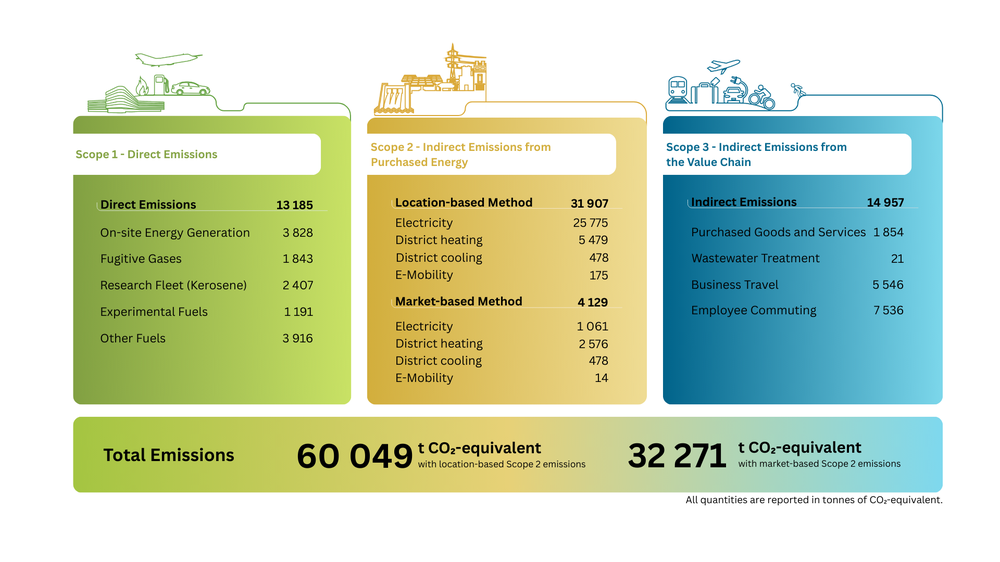
Overall, 60,049 tonnes of carbon dioxide (CO2) equivalents (location-based) and 32,271 tonnes of CO2 equivalents (market-based) were generated in 2024. In the previous review period, greenhouse gas emissions amounting to 61,036 tonnes of CO2 equivalents (location-based) and 28,899 tonnes of CO2 equivalents (market-based) were recorded.
Compared to the 2023 review, the following categories have been added: in Scope 1, our own energy production and 'fugitive emissions' (leaks); Scope 2, acquired heating (market-based), acquired cooling (market-based) and e-mobility (both location and market-based); and in Scope 3, the procurement of computer hardware as well as drinking water supply and wastewater disposal.
The new report is a core component of our sustainability strategy, forming the basis for managing and further enhancing our environmental and energy management operations. It combines our scientific and administrative responsibilities with a clear outlook shaped by climate objectives.
Today, the vast majority of our energy already comes from renewable energy sources. We are continuously working to expand our in-house energy production, improve energy efficiency and replace fossil fuels wherever possible – a clear signal that sustainability, climate protection and responsibility are key pillars of our future viability.