Ontario Lacus

Ontario Lacus
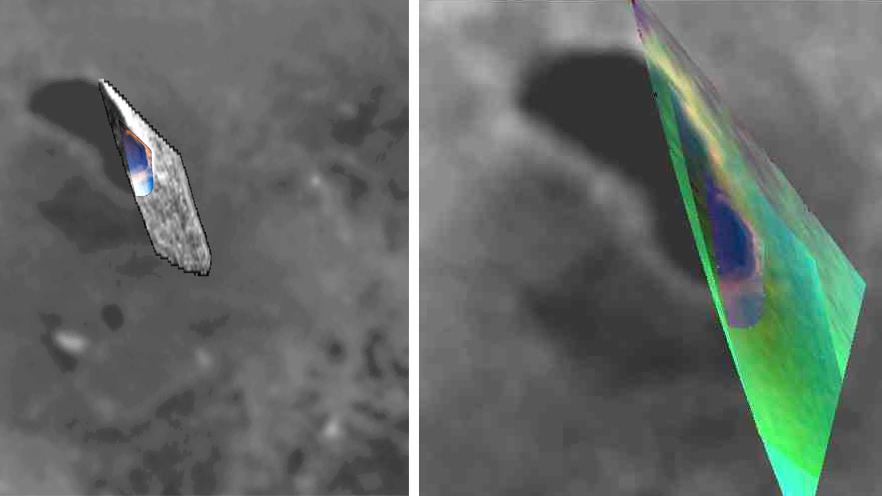
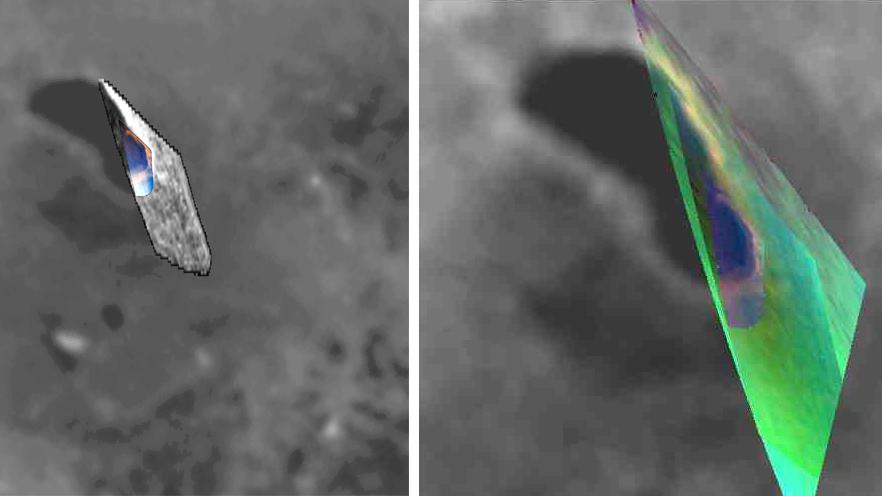
VIMS (the Visual and Infrared Imaging Mapping Spectrometer) on board Cassini took pictures of the eastern and southern sections of Ontario Lacus on 5 December 2007, sections of the lake which showed up on earlier images from the ISS (Imaging Science Subsystem) camera of Cassini as a striking dark, smooth plateau near the South Pole of the Satellite of Saturn.
The VIMS pictures, taken at a resolution of 500 metres per pixel were overlaid on the ISS image to create a 'negative'. For the bottom picture, infrared wavelengths of 4.99 micrometres (µm), 2.03 µm and 1.29 µm on the three colour channels, red, green and blue were used; because liquids absorb certain colours significantly at 5 µm, this being particularly the case for liquid ethane at 2.03 µm, Ontario Lacus appears as a dark blue area: it is filled with liquid ethane. It is possible that the sea also contains liquid methane, but this is difficult to ascertain, as Titan's atmosphere contains relatively high levels of methane. The sea is surrounded by a narrow, bright band, which is probably a transitional zone, a sort of 'beach'.
VIMS obtained the top picture was taken using several infrared filters, a technique which creates a colour ratio similar to a negative. That allows further details to be revealed in the south-eastern corner of Ontario Lacus. However, it remains difficult and speculative to interpret the information: the slightly brighter area may be an island, or a trough. In the red channel, a ratio was created out of the 2.03 µm/1.27 µm wavelengths, for the green channel 1.59/1.27 µm, and for the blue channel 5.0 µm/1.27 µm.