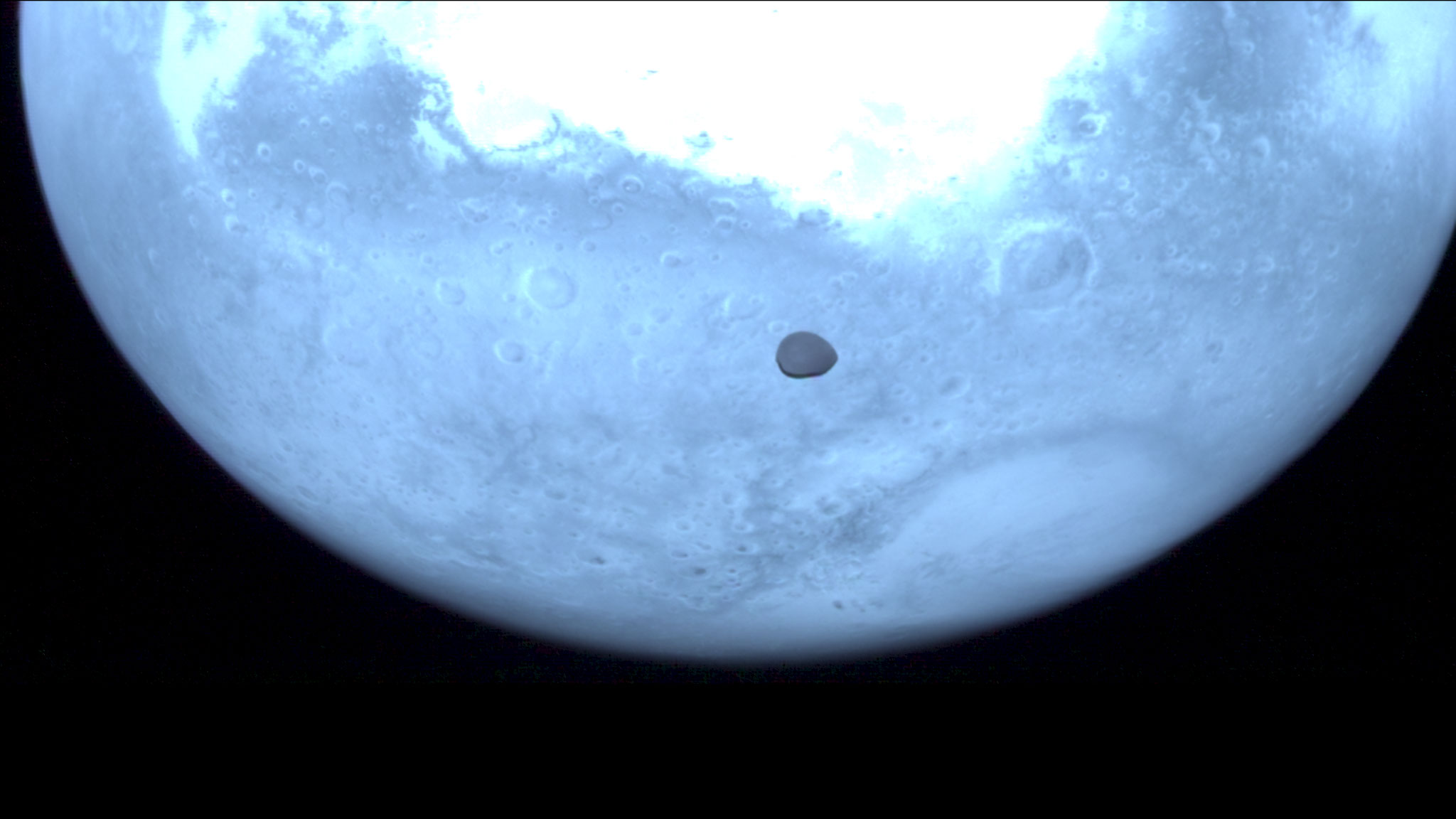
HyperScout-H image in near-infrared during Hera's flyby of Mars
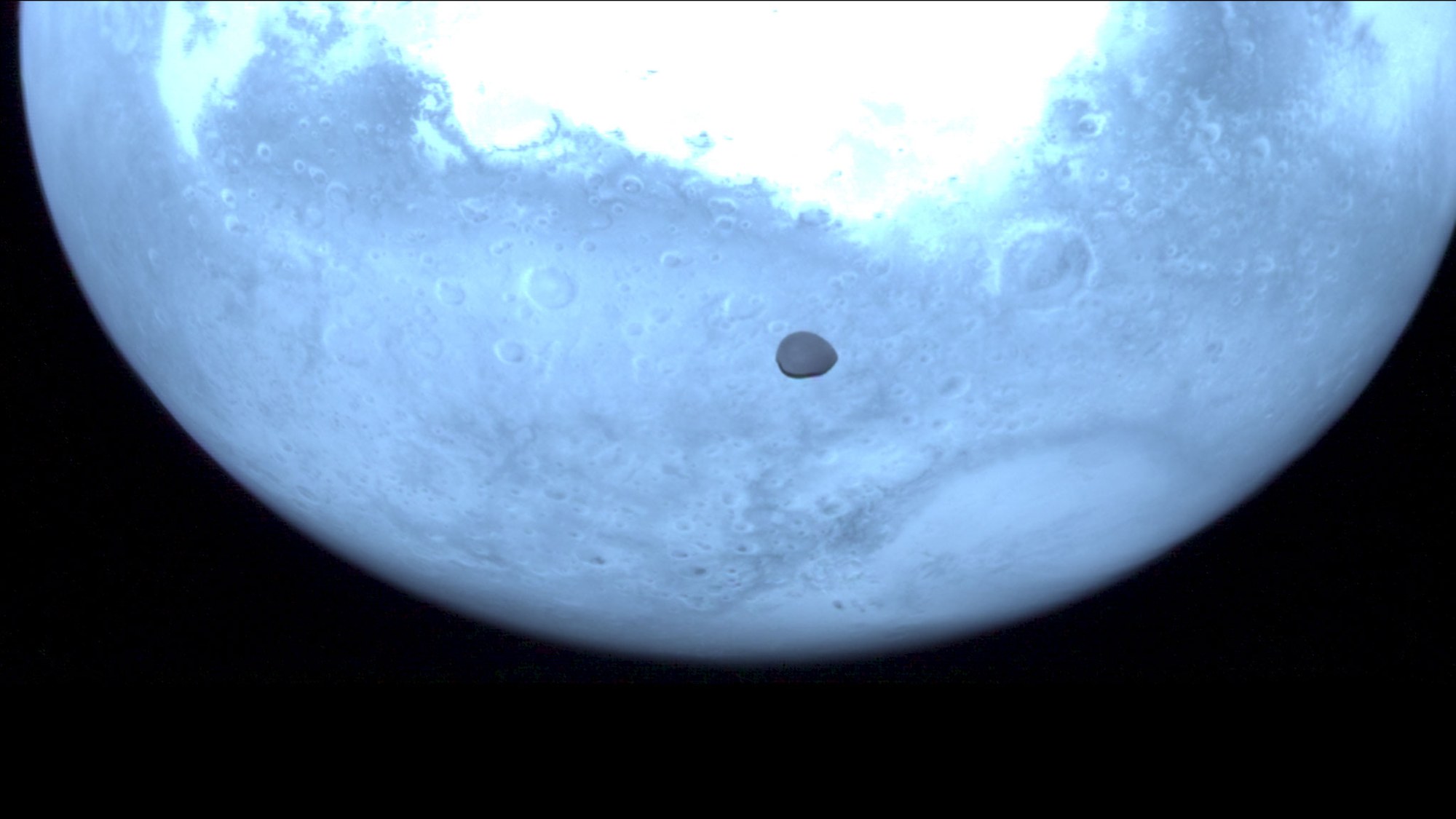

HyperScout-H image in near-infrared during Hera's flyby of Mars
The Red Planet appears light blue in this near-infrared HyperScout-H image from ESA's Hera spacecraft, acquired during the mission’s 12 March 2025 gravity-assist flyby of Mars, with Martian moon Deimos seen ahead of it.
The car-sized planetary defence spacecraft was approximately 1000 kilometres from the 12.4-kilometre-diameter Deimos moon when this hyperspectral image was acquired. Deimos orbits at approximately 23,500 kilometres from the surface of Mars and is tidally locked, so that this side of the moon is rarely seen.
In the background a variety of Martian features can be observed. At the top of the image is the bright Terra Sabaea region, close to the Martian equator, outlined by darker regions around it, with the 450 kilometre-diameter Huygen crater to the bottom right of Terra Sabaea and the 460-kilometre-diameter Schiaparelli crater to its left. To the bottom right of the Martian disc is Hellas Basin, among the largest known impact craters in the Solar System with a diameter of 2300 kilometres and a depth of more than seven kilometres.
Hera's HyperScout-H hyperspectral imager observes in a range of colours beyond the limits of the human eye, in 25 visible and near-infrared spectral bands to characterise surface materials.