DLR and Frequentis develop advanced airspace for drones
December 17, 2025 | Practical infrastructure for uncrewed aircraft systems
DLR and Frequentis develop advanced airspace for drones
Safe integration of crewed and uncrewed aircraft in airport environments
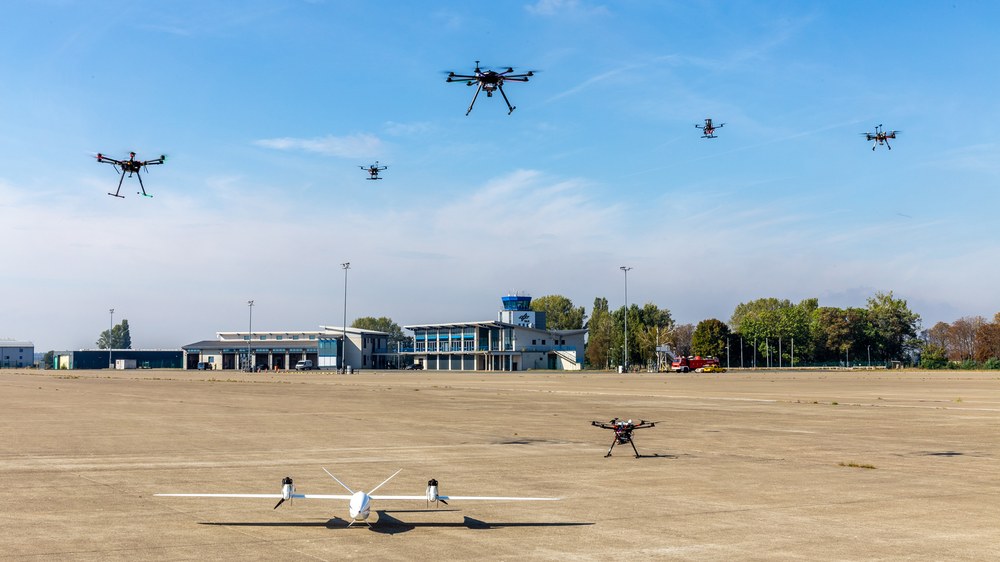
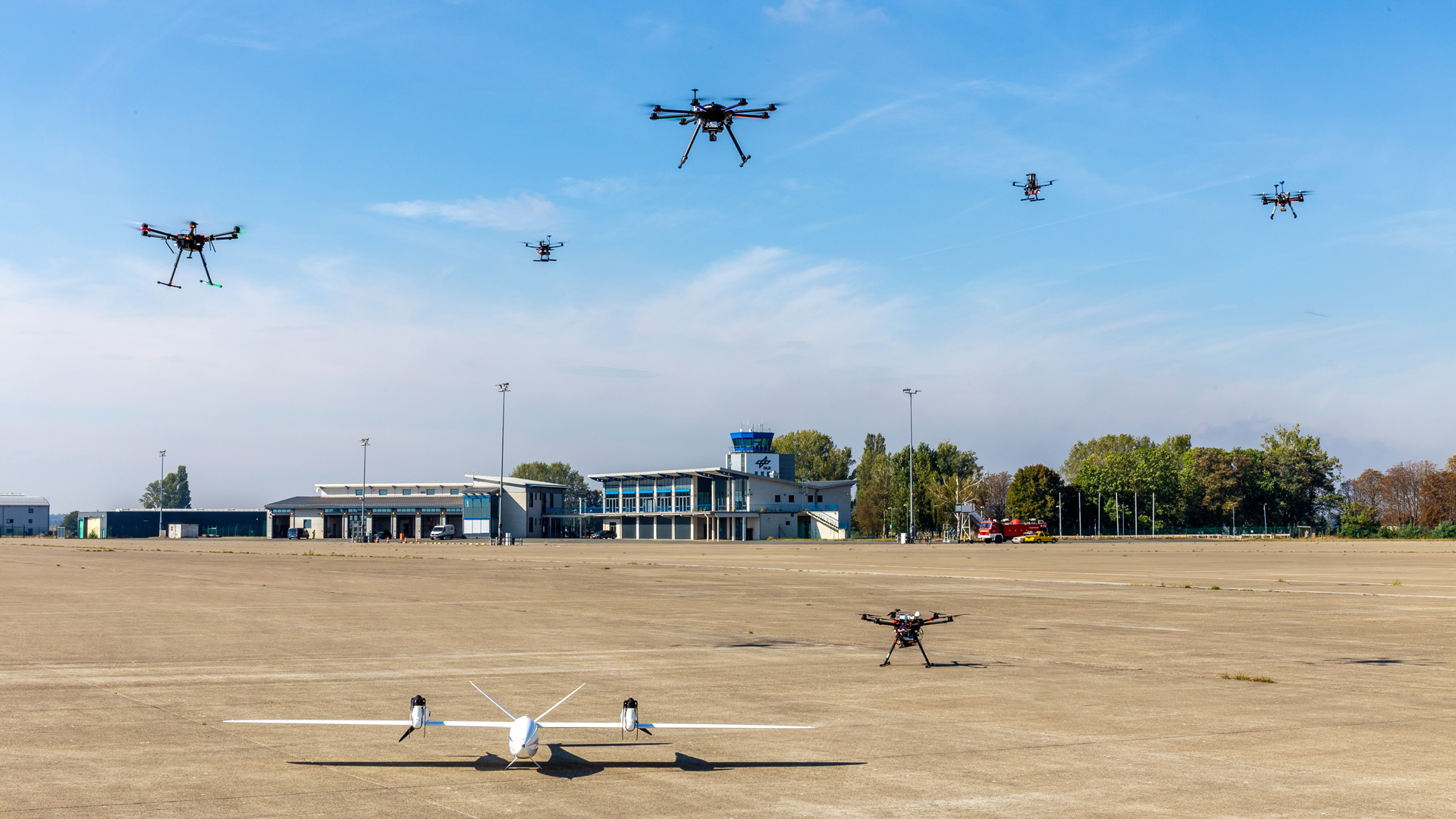
At Magdeburg–Cochstedt Airport, the safe integration of a range of crewed and uncrewed aircraft in airport environments is being trialled in realistic test campaigns with various stakeholders. The goal is to ensure the flow of traffic in the vicinity of airports remains safe and orderly while integrating new airspace users.
At the DLR Institute of Flight Guidance, researchers are developing prototype U-space services for automated interactions. U-space services provide digital, standardised support and facilitate air traffic control, particularly for drones and other uncrewed aircraft.
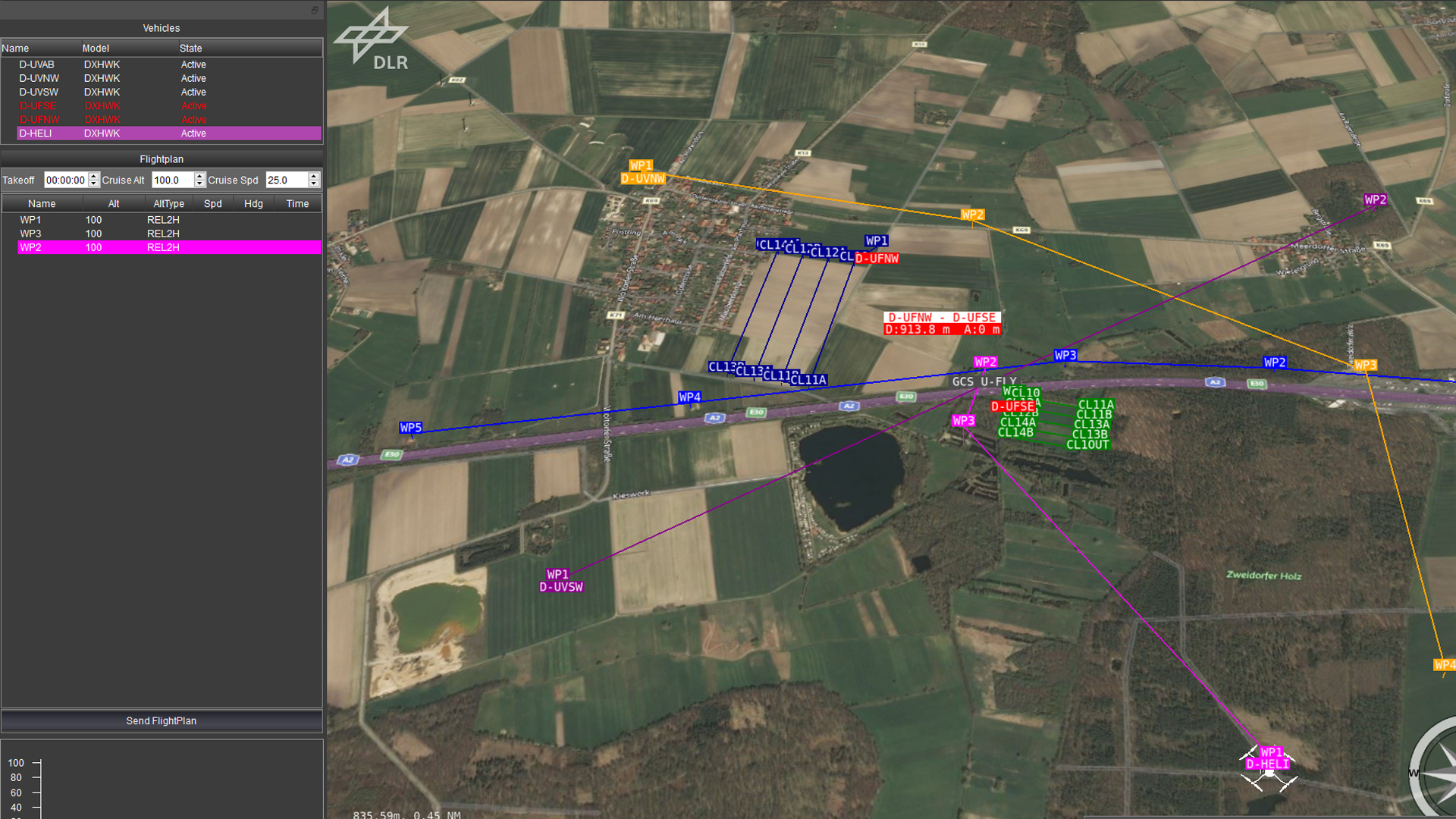
Mission planning for multiple uncrewed aerial vehicles
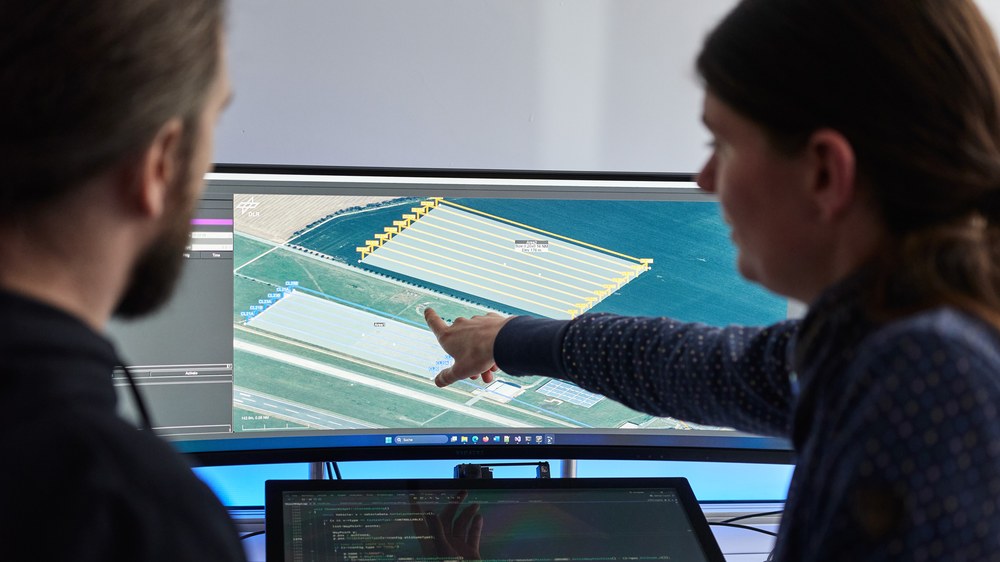
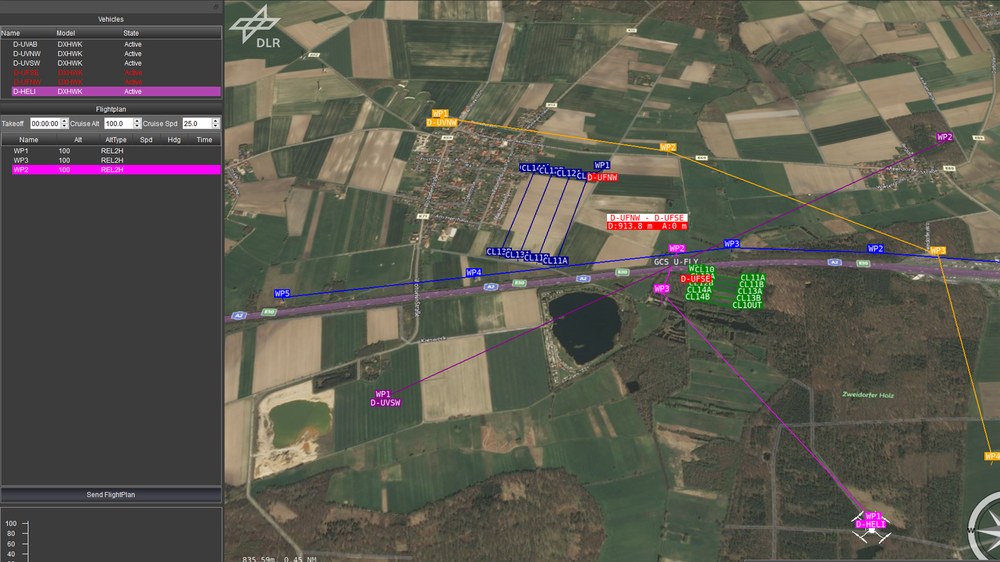
This image shows the 'U-Fly' ground control station developed by the DLR Institute of Flight Guidance for mission planning involving multiple uncrewed aircraft systems (UAS). A shared map provides a clear overview of planned routes, operational areas and relevant areas subject to flight restrictions, so that flights can be efficiently coordinated, avoid conflicts and make optimal use of available airspace.
The 'U-space' framework is under development by DLR and Frequentis with the goal of integrating drones into airspace in a safe, efficient and coordinated manner.
DLR is providing key digital U-space services such as identification, authorisation and traffic monitoring.
The U-space is being established at DLR's site in Cochstedt and tested in both research and practical applications.
This creates a realistic environment for the further development of drone technologies and new operational procedures.
Focus: Aviation, security and defence, uncrewed aircraft
To ensure uncrewed aircraft systems (UAS) will in future be able to operate in European airspace in a secure, efficient and coordinated manner, the German Aerospace Center (Deutsches Zentrum für Luft- und Raumfahrt; DLR), together with skyzr – a subsidiary of Frequentis – is developing advanced procedures for their safe integration. The goal of the collaboration is to create an interoperable, practical and scientifically sound environment in which future UAS operating procedures can be tested and further developed under realistic conditions.
"As part of our ongoing collaboration with Frequentis, DLR is providing essential U-space services such as network identification, geo-awareness, UAS flight authorisation and traffic information in accordance with relevant EU regulations," explains Dagi Geister, Head of department for Unmanned Aircraft Systems at the DLR Institute of Flight Guidance. "Additional digital systems support these essential services by automatically monitoring and managing air traffic."
Background info: U-space
The number of uncrewed aircraft systems (UAS) operating within airspace is set to increase significantly in the coming years. To safely and efficiently integrate large numbers of UAS into Europe's existing air traffic management (ATM) system – and to pave the way for suitable technologies and services for both crewed and uncrewed aircraft – the EU has developed and defined a standardised framework known as U-space. Central to this are the U-space airspaces: defined geographical zones in which it is permitted to operate UAS by way of U-space services. U-space services refer to digital services and automated functions that will allow a large number of UAS to access U-space airspaces safely and efficiently.
Implementing U-space services in Cochstedt
The mandatory – that is, essential – U-space services such as network identification, geo-awareness, UAS flight authorisation and traffic information form the basis of the work that DLR researchers are carrying out at the Braunschweig site.
The U-space is being established at the National Experimental Test Center for Unmanned Aircraft Systems at DLR's site in Cochstedt, with the services not only used in research projects but also trialled in various practical use cases. As a result, a realistic environment is emerging in which new technologies and operational procedures can be tested under real-world conditions.
In the long run, the emerging U-space will also be open to external partners to test their applications on site. "This is a major step towards establishing U-space in Germany and safely testing the integration of uncrewed systems into airspace alongside crewed aircraft," says Geister.
Research and development in the European context
The modular architecture of the U-space opens up opportunities to incorporate additional optional services that can be tested within research projects. In this way, DLR is making a key contribution to the development of safe and efficient drone traffic in Europe.
The cooperation follows established international standards, with the automated interaction between services and UAS laying the foundation for future highly automated operating concepts.
At the same time, a flexible and open infrastructure is being created that supports new research concepts for U-space and Innovative Air Mobility (IAM) – in other words, the interconnected integration of crewed and uncrewed aircraft in the same airspace. This includes approaches for the integration of multiple U-space service providers (multi-USSP), the integration of vertiports – take-off and landing sites for air taxis and cargo drones – and coordination with crewed aircraft. Significantly, operations remain completely independent of external networks and services.
Long-standing collaboration the foundation of U-space development
The work on U-space builds on many years of cooperation between DLR and Frequentis in the field of flight guidance, making it possible to implement certified services in a time- and cost-efficient manner and to develop them further under real-world conditions. With this initiative, DLR and Frequentis are helping to safely integrate UAS into European airspace and contributing to the development of a networked, forward-thinking airspace management system.
"By rolling out U-space services in Cochstedt, we are – together with DLR – creating a safe and practical environment for testing drone technologies under real-world conditions," says Günter Graf, Vice President New Business Development at Frequentis. "Our objective is to provide solutions that make the operation of uncrewed aircraft systems efficient, reliable and fit for the future – thereby opening up new opportunities for industry and research."
Cochstedt site the real-world lab for U-space and UAS
U-space operations are initially planned to take place in the Cochstedt Aerodrome Traffic Zone (ATZ). The infrastructure at DLR's National Experimental Test Center offers ideal conditions for research, testing and demonstration of drone technologies.