DLR at the UITP Summit 2025 in Hamburg





- The UITP Summit is taking place from 15 to 18 June 2025 in Hamburg, Germany.
- It is the world's largest trade congress covering all topics related to public transport.
- DLR will be showcasing its mobility research at the event.
- Focus: Transport, future mobility, intelligent mobility, automated and connected driving
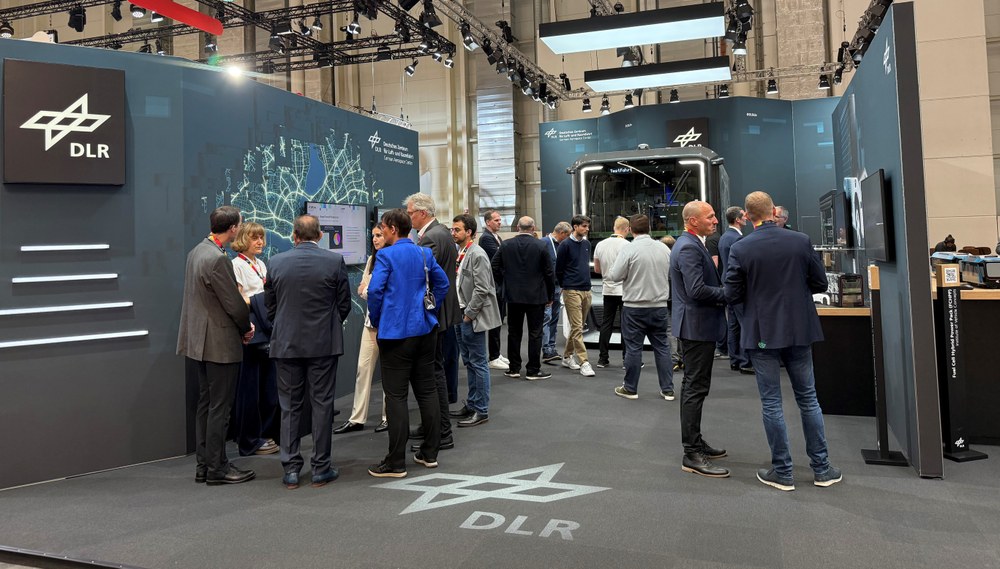
The UITP Summit – the world's largest specialist congress for public transport – is coming to Germany. From 15 to 18 June 2025, around 10,000 experts from over 100 countries will gather in Hamburg. Operators and authorities will be joined by representatives from industry, research and politics. At the exhibition accompanying the congress, the German Aerospace Center (Deutsches Zentrum für Luft- und Raumfahrt; DLR) will showcase mobility research and technology transfer projects. The centrepiece of the stand (A-1400) is a prototype of DLR's modular vehicle concept, U-Shift – which offers holistic and, above all, flexible solutions for 'last-mile' mobility.
"The transformation of mobility – including in the public transport sector – is a key challenge for society, industry and research. With innovative technologies and human-centred concepts, DLR is making a crucial contribution to designing transport systems that are sustainable and future-proof. Cost-efficiency and safety are just as important as social participation and climate protection. In collaboration with industry, we combine technological innovation with practical application – quite literally bringing the future to the roads and rails," says Meike Jipp, DLR Executive Board Member for Energy and Transport.
IMoGer research project puts U-Shift into practice
Developed by DLR, the U-Shift vehicle concept is electric and autonomous. It combines a U-shaped drive unit (the 'driveboard') with interchangeable capsules for transporting people and goods. This modular, autonomous and connected approach enables a high degree of flexibility and a wide range of potential applications. The vehicle concept is also being used in the IMoGer research project (Innovative Modular Mobility made in Germany), which is supported with 35 million euros in funding from the German Federal Ministry for Transport (BMV). A test fleet will trial the system in real-world settings – for local public transport and last-mile logistics. The aim is to pave the for automated driving in mixed traffic to enter regular operation. The planned pilot in a district of Braunschweig marks an important developmental step, demonstrating how DLR transfers technologies from research into practice and strengthens industrial value creation in Germany.
High-tech railbus for disused lines, alternative drives for rail transport
With NGT-TAXI, DLR is developing a concept for a small, lightweight, efficient and modular rail vehicle. It is designed to operate autonomously, primarily on secondary branch routes, using battery or hydrogen fuel cell power. In the future, it could significantly improve connectivity in rural areas. NGT stands for 'Next Generation Train' – DLR's umbrella term for its ideas and technologies for the rail transport of tomorrow. At the UITP Summit, DLR is presenting several NGT-TAXI models illustrating different railbus variants, alongside a screen exhibit explaining various operating concepts.
DLR is a sought-after partner for industry and research in the field of sustainable, high-performance rail propulsion systems. One area of focus is a standardised, modular propulsion and energy architecture called the 'Fuel Cell and Hybrid Power Pack (FCHPP)', which combines battery and fuel cell systems. Its modular design allows for easier component replacement, increasing longevity and sustainability. In collaboration with international industry partners, DLR demonstrated how this approach works in practice with a prototype train in Spain as part of the EU's FCH2Rail project.
Preparing transport systems for autonomous driving – analysis tools and smart intersections
With the SmartTransitFleetplanner (STF), DLR has developed a tool to help deploy autonomous road vehicles – like U-Shift – efficiently in public transport. The tool focuses on improving connectivity in underserved residential areas in order to improve accessibility. STF can simulate a range of scenarios, allowing stakeholders to comprehensively analyse future options based on relevant key factors, supporting the strategic planning of sustainable, future-proof public transport systems.
The road junction of the future will think for itself – enhancing safety for all road users, especially as automated and autonomous vehicles become more prevalent. Together with machine vision specialist VITRONIC, DLR is developing the Local Traffic Safety Analyzer (LTSA) – a system to make road intersections safer and to optimise traffic flow. The system pays particular attention to the needs of pedestrians and cyclists – vulnerable road users with a higher risk of being injured in road traffic accidents. DLR and VITRONIC are already testing the system at an intersection in Potsdam, monitoring the movement paths of road users, issuing alerts in critical situations and improving the timing of pedestrian traffic lights.
DLR spin-off atSTAKE – transport planning at the push of a button
Founded in early 2025, the start-up atSTAKE markets software that simulates the impact of new transport services for strategic mobility planning. With minimal effort, the three DLR researchers behind the research company devised the system to model new transport schemes and their effects. This enables realistic and reliable insights – even when regional data is limited. The software uses data science methods and provides a user-friendly planning and decision-making tool for municipalities, mobility providers and consulting firms.
Related links
- UITP Summit website
- IMoGer project page
- U-Shift project page
- NGT TAXI project page
- FCH2RAIL project page
- FCHPP project page
- Factsheet – SmartTransitFleetplanner (STF)
- Local Traffic Safety Analyzer (LTSA) project page
- VITRONIC website
- atSTAKE spin-off website
- Featured topic – Future road transport
- Featured topic – Technologies for the rail transport
About the UITP Summit
The UITP Summit is organised annually by the International Association of Public Transport (Union Internationale des Transports Publics; UITP). Founded in 1885, UITP is a global network that brings together all actors in public transport and sustainable mobility. The UITP Summit will be held in Hamburg in both 2025 and 2027.