December 1, 2025 | Research to augment large satellite systems
Small satellite for observing activities at sea
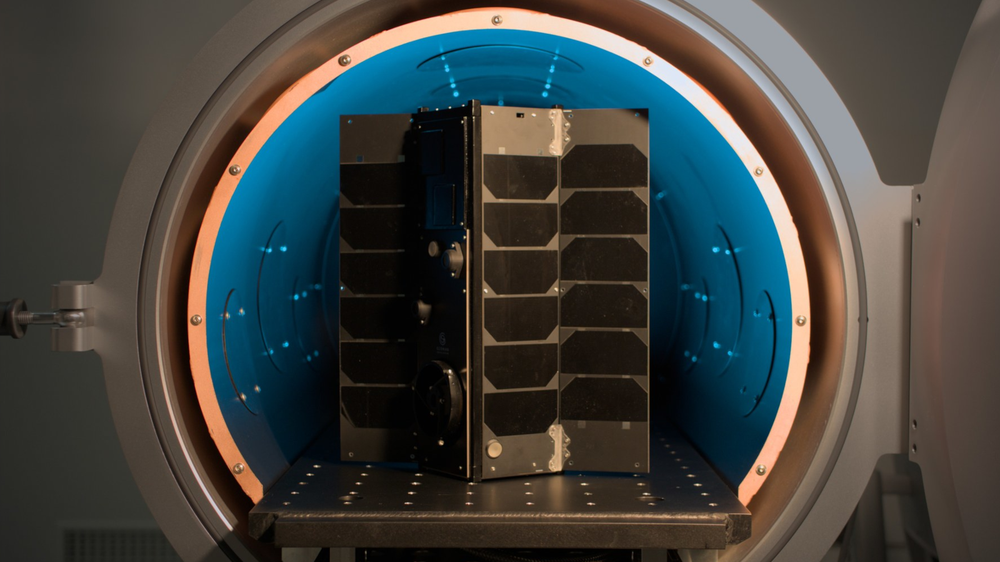
Model of the OTTER satellite in a thermal vacuum chamber
Thermal tests are essential to qualify a satellite for use in space, where it is exposed to extreme environmental conditions. This image shows a model of the OTTER small satellite in a thermal vacuum chamber at DLR's RSC³ research site in Trauen, northern Germany.
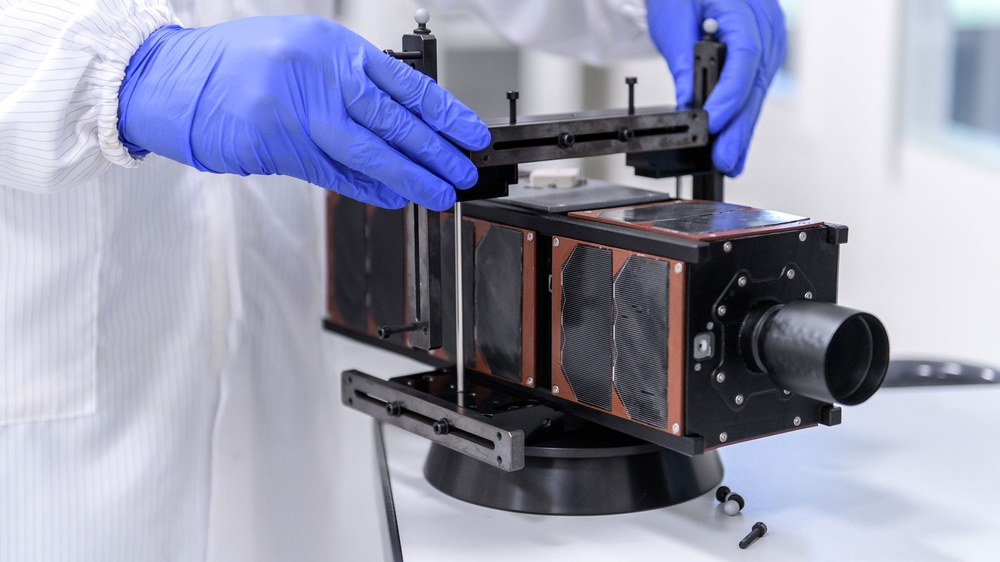
OTTER small satellite in an attitude control test rig
The Responsive Space Cluster Competence Center (RSC³), located at DLR’s site in Trauen, is responsible for the OTTER mission. Its cleanrooms and testing facilities include this attitude control test rig, which simulates the attitude dynamics of a satellite in a representative orbital environment.
The Responsive Space Cluster Competence Center (RSC³) in Trauen, northern Germany, is responsible for the OTTER mission. This image shows a model of a small satellite being prepared for testing. The RSC³ has several cleanrooms available for this purpose.
The OTTER mission has been successfully launched on board a carrier rocket.
The small satellite will operate in an approximately 500-kilometre orbit for two years.
OTTER will collect data on illegal fishing, ships in distress and pollution.
Focus: Space, security, Earth observation, small satellites, maritime research
It may weigh in at only six kilograms and be no bigger than a shoebox, but it's what’s inside the OTTER (Optical Traffic Tracking Experiment for Responsive Space) satellite that equips it to observe the world's oceans. Following a successful launch into its 500-kilometre orbit on 28 November 2025, the small satellite deployed its solar panels and activated its instruments to keep a watchful eye on ships and irregular events on the high seas. The German Aerospace Center (Deutsches Zentrum für Luft- und Raumfahrt; DLR) is responsible for the planning and execution of the OTTER mission together with industry stakeholders. The mission is an experiment designed to identify where further research is needed to accelerate the provision of space-based capabilities. OTTER is also intended to demonstrate how effectively a small satellite can complement large existing systems for maritime reconnaissance.
Using one of its antennas, OTTER records position signals from ships, with an onboard camera verifying these readings. Additional antennas, receivers and reflectors enable the detection of, for example, illegal fishing, ships in distress, oil pollution and signal manipulation on the high seas.
The use of orbiting infrastructure for maritime reconnaissance offers significant advantages compared to land- and sea-based systems, as situational images collected by satellites cover the seas without regard for national borders. In addition to large proprietary satellites, an increasing number of small commercial satellites are being deployed to complement existing capabilities. Several smaller, easy-to-replace systems also boast greater resilience and wider coverage.
RSC3 in Trauen responsible for the mission
With OTTER, DLR is conducting practical research into responsive space capabilities for specific maritime requirements. Responsive space refers to the ability to provide space-based services at short notice – for example, to expand satellite infrastructure or replace individual satellites in the event of failure. Five years ago, DLR established the Responsive Space Cluster Competence Center (RSC3) in Trauen, which is responsible for rapid satellite deployment and for the OTTER mission.
The experimental small satellite – which is classed as a three-unit (3U) CubeSat – was launched by SpaceX in the United States. Over the next two years, it will operate in low Earth orbit before burning up in Earth’s atmosphere. To accelerate its destructive re-entry, the satellite will use its electric propulsion system. Together with industry colleagues, the RSC3 is using OTTER both to test concepts for the construction and operation of small satellites and to study techniques for monitoring marine activities. The satellite receives, for example, information from ships' Automatic Identification System (AIS) while also taking camera images and sending both to a ground station, where the data is evaluated. Via the ground station, the satellite also obtains new instructions and schedules.
Satellites weighing under 500 kilograms are known as small satellites – or SmallSats. At six kilograms, OTTER is a true lightweight even in this category and so belongs to the class of nanosatellites, which weigh no more than ten kilograms.
The Responsive Space Cluster Competence Center (RSC3) in Trauen
In September 2020, with support from Germany's Federal Ministry of Defence (BMVg) – DLR established a new national competence centre for responsive space in Trauen, Lower Saxony. The RSC3 implements Germany's Responsive Space Capabilities research programme both within and beyond DLR by leveraging synergies in security and defence research and building a network of researchers, users and industry stakeholders. Acting as a coordinator, catalyst and central point of contact, the RSC3 is active at an international level.
Responsive space is the capability to respond to changing needs at short notice by rapidly deploying small satellites or reconfiguring existing space systems. Responsive space enhances the resilience of critical space infrastructure by replacing failed satellites, expanding existing capabilities or deploying new assets.