50 years of German-Dutch Wind Tunnels: a European success story in aviation research
June 23, 2026
50 years of German-Dutch Wind Tunnels: a European success story in aviation research
DNW celebrates its 50th anniversary
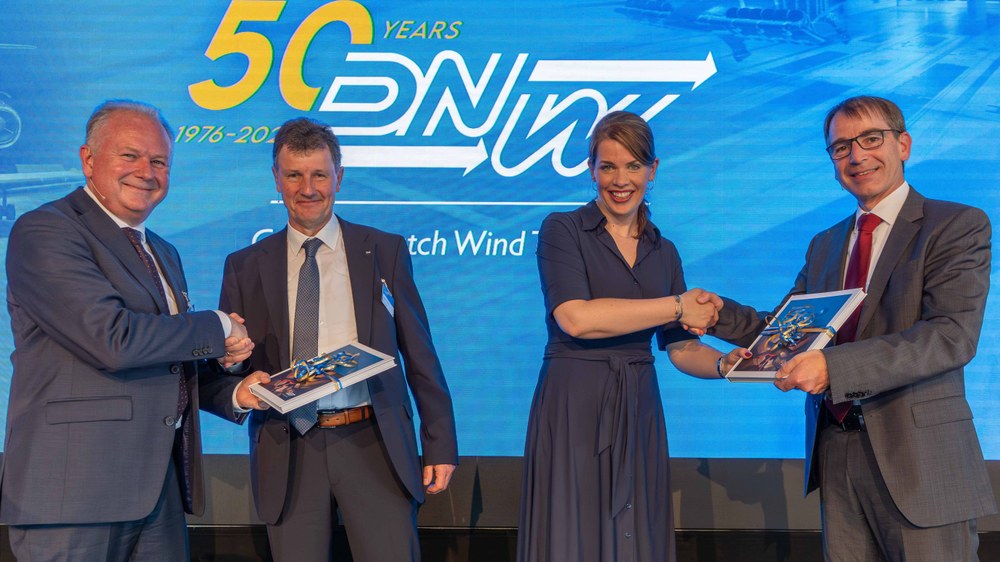
The German-Dutch Wind Tunnels (DNW) foundation is celebrating its 50th anniversary. It was founded in 1976 by a predecessor of today's German Aerospace Center (DLR), the Netherlands Aerospace Centre (NLR) and the governments of the Netherlands and Germany. From left: DNW Director for the Netherlands, Joost Hakkaart; DLR Divisional Board Member for Aeronautics, Markus Fischer; NLR Chief Executive Officer, Tineke van der Veen; and DNW Director for Germany, Holger Mai.
Image: 1/4, Credit:
Klaas Eissens
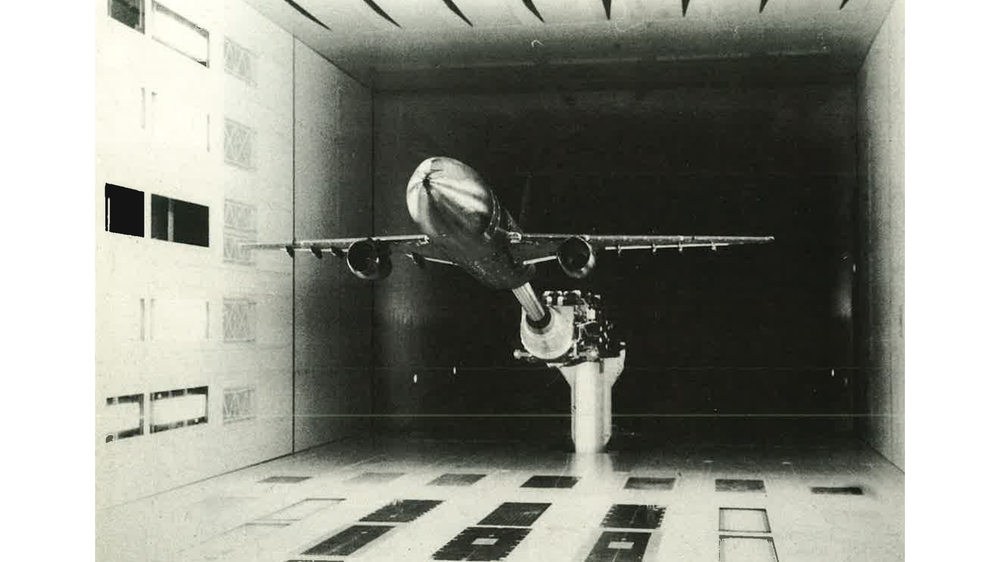
A300 model in the wind tunnel
Wind tunnel model of the first Airbus, the A300, in the large LLF wind tunnel at DNW in the Netherlands in 1981.
Image: 2/4, Credit:
DNW
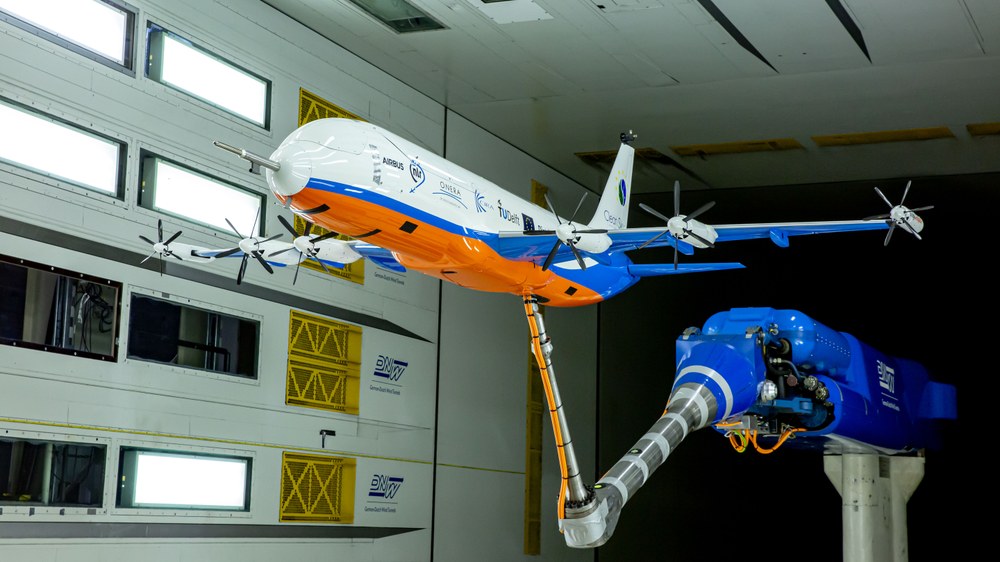
Scaled Flight Demonstrator in the DNW-LLF wind tunnel
Scaled Flight Demonstrator of a large passenger aircraft with distributed electric propulsion, in DNW's large LLF wind tunnel.
Image: 4/4, Credit:
Clean Sky 2 Joint Undertaking (JU)
The German-Dutch Wind Tunnels foundation (Deutsch-Niederländische Windkanäle; DNW) will celebrate its 50th anniversary on 30 June 2026.
DNW was founded in 1976 by the DFVLR (now DLR), the Netherlands Aerospace Centre (NLR) and the governments of Germany and the Netherlands.
Today, DNW operates six wind tunnel facilities across four sites in Germany and the Netherlands.
For five decades, the test facilities have supported the development of aircraft, helicopters and other aviation technologies for research and industry.
On DLR sites, DNW operates the Low-Speed Wind Tunnel in Braunschweig (DNW-NWB) and the Transonic Wind Tunnel (DNW-TWG) in Göttingen.
Focus: Aviation, spaceflight
The German-Dutch Wind Tunnels foundation (Deutsch-Niederländische Windkanäle; DNW) is celebrating its 50th anniversary. It was founded on 30 June 1976 by the German Research and Test Institute for Aviation and Space Flight (Deutsche Forschungs- und Versuchsanstalt für Luft- und Raumfahrt; DFVLR) – a predecessor organisation of today's German Aerospace Center (Deutsches Zentrum für Luft- und Raumfahrt; DLR) – together with the Netherlands Aerospace Centre (NLR) and the governments of Germany and the Netherlands. Since its inception, DNW has stood for successful European cooperation in aerospace research. What began with the shared goal of building and operating Europe's largest wind tunnel has developed into an internationally recognised research infrastructure with six wind tunnels across four locations in Germany and the Netherlands.
The German-Dutch Wind Tunnels foundation is an outstanding example of how cross-border cooperation enables innovation and strengthens Europe's competitiveness. For five decades, DNW’s facilities have made a significant contribution to the development of safe, efficient and sustainable aircraft. The European sovereignty and resilience this brings have always been important and are once again highly relevant today.
From vision to cutting-edge European research
The origins of DNW date back to 1973. At that time, representatives of what was then the German Test and Research Institute for Aviation and Space Flight (Deutsche Forschungs- und Versuchsanstalt für Luft- und Raumfahrt; DFVLR) and NLR discussed the idea of a joint large-scale wind tunnel for the first time. The initiative was supported by both governments and culminated in the official establishment of the foundation on 30 June 1976. Just one day later, construction of the Large Low-speed Facility (LLF) began in Marknesse, the Netherlands.
When the LLF came into operation in 1981, it became Europe’s largest low-speed wind tunnel. In the decades that followed, the collaboration was continuously expanded. Since the 1990s, further wind tunnels belonging to DLR and NLR have been brought together under the DNW umbrella. Today, the organisation operates six state-of-the-art test facilities and offers a wide range of experimental services to the international aerospace industry, research institutions and the automotive industry.
Wind tunnels as a key technology
Wind tunnels make it possible to investigate the behaviour of aeroplanes, helicopters, vehicles or individual components under controlled and realistic flow conditions. This enables the analysis of key aerodynamic properties such as drag, lift, flow separation and noise emissions. The insights gained help to make new technologies more efficient, safer and more sustainable, even before the first prototypes are built.
Despite major advances in numerical simulations, experimental investigations in wind tunnels remain indispensable. They provide highly precise measurement data and underpin the validation of modern simulation methods.
Successful contributions to international aviation programmes
Over the past five decades, DNW’s test facilities have supported numerous international development programmes. These include the Airbus A320, A330, A340, A380 and A400M families, the Embraer E-Jets and E2 aircraft, the Eurofighter and F-35 fighters and the NH90 helicopter programme. The high-quality and efficient testing carried out at DNW’s facilities has made a significant contribution to aerodynamic optimisation and, consequently, to the success of these programmes.
DNW sites on DLR premises in Braunschweig and Göttingen
In Germany, DNW operates two major test facilities on DLR premises.
The Low-Speed Wind Tunnel in Braunschweig (DNW-NWB) serves as an aeroacoustic reference wind tunnel. It enables highly precise investigations into aerodynamic and aeroacoustic issues and helps to make future aircraft quieter and more efficient.
The Transonic Wind Tunnel in Göttingen (DNW-TWG) forms a central part of DNW’s high-speed portfolio. The facility offers unique opportunities for aerodynamic and aeroelastic investigations in the transonic and near-supersonic speed ranges.
Anniversary with an eye to the future
On 18 June 2026, DNW celebrated its anniversary with a symposium at its headquarters in Marknesse. Representatives from the worlds of research, industry and politics, as well as long-standing collaborators and customers, came together to look back on five decades of successful cooperation.
DNW will continue to play a key role in the development of new aviation technologies. Topics such as climate-compatible flying, sustainable propulsion systems, innovative aircraft configurations and the validation of digital development tools will continue to require high-performance experimental research infrastructure. With its unique expertise and state-of-the-art facilities, DNW remains a key partner for aviation research in Europe and worldwide.
DNW in figures
Founded: 30 June 1976
Supported and operated by: DLR and NLR
Locations: 4, in Germany and the Netherlands
Wind tunnels: 6
Largest facility: Large Low-speed Facility (LLF) in Marknesse
Staff: approximately 125
Customers: the aerospace industry, research organisations and the automotive industry worldwide
Programmes supported: Airbus A320/A330/A340/A380/A400M, Embraer E-Jets/E2, Eurofighter, F-35, NH90 and others