AI-powered robotics in Europe – the next generation of intelligent machines
September 2, 2026 | A unique live demonstration in the European Parliament
AI-powered robotics in Europe – the next generation of intelligent machines
Support in everyday life
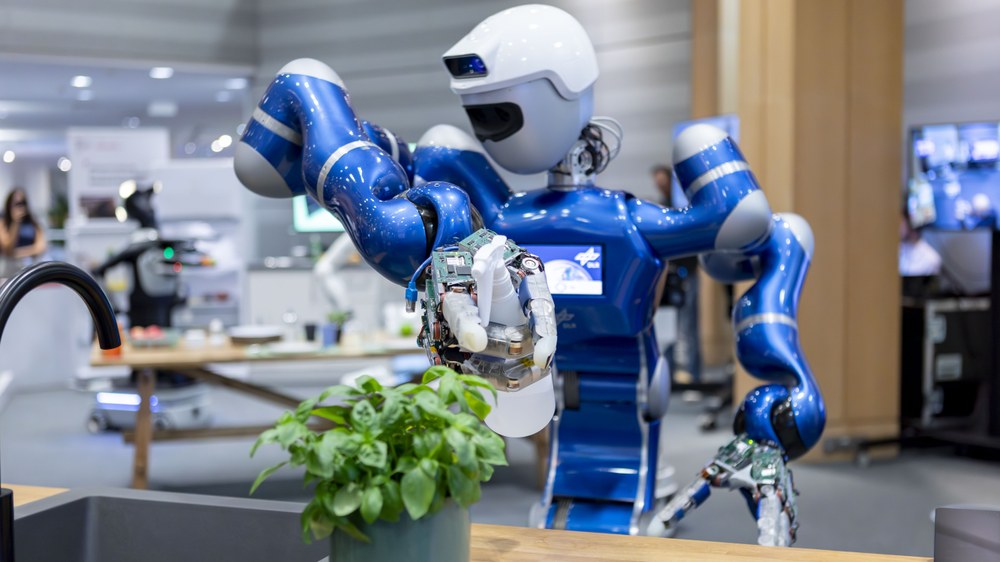
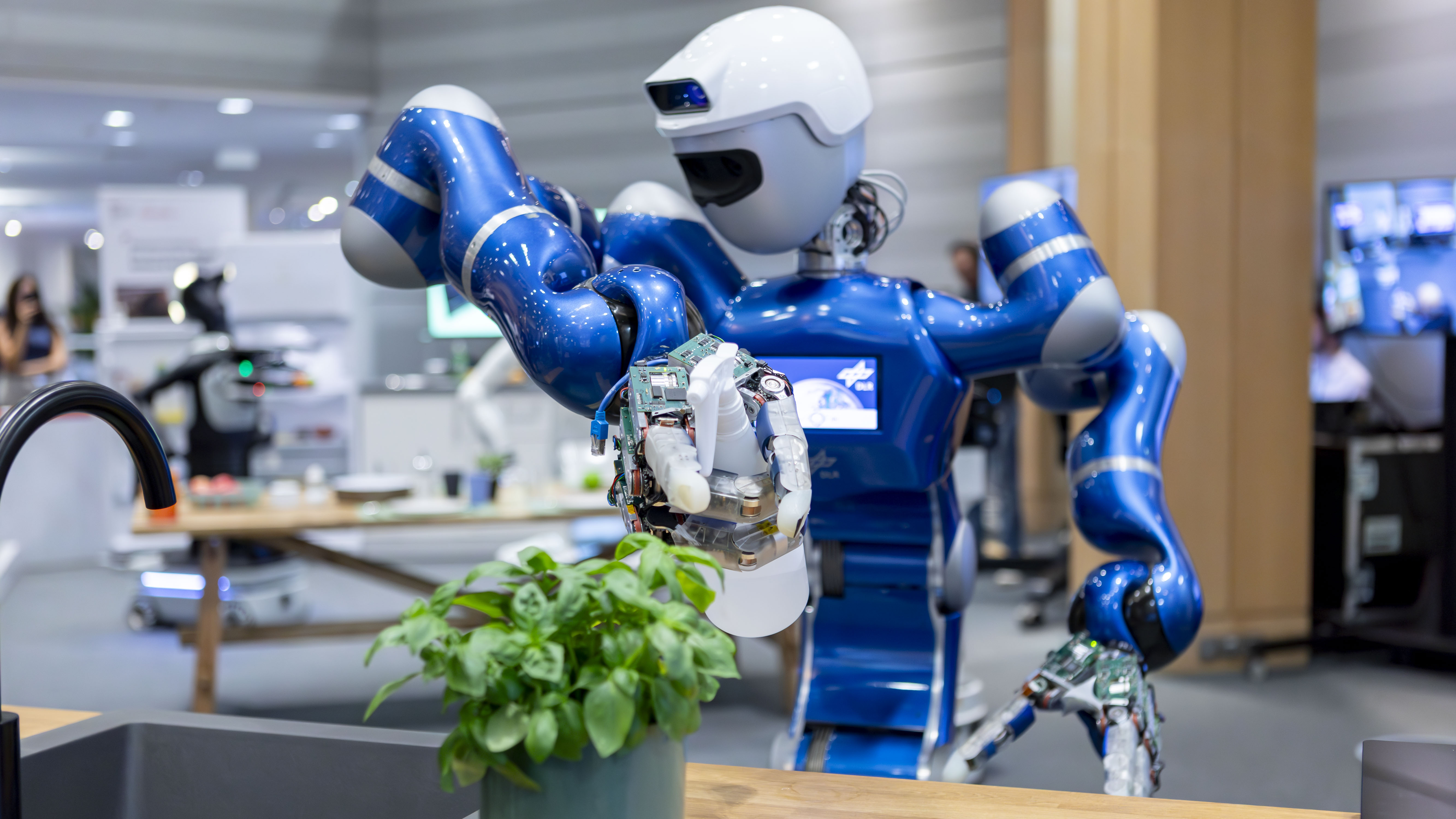
Advances in artificial intelligence are enabling robots to perceive, learn and act in increasingly complex physical environments. AI-based robotics has the potential to develop, within 10 to 15 years, into an industry sector in Europe that matches the size and significance of today's automotive industry. Here, DLR robot Rollin' Justin can be seen autonomously taking on an everyday task: watering a kitchen plant.
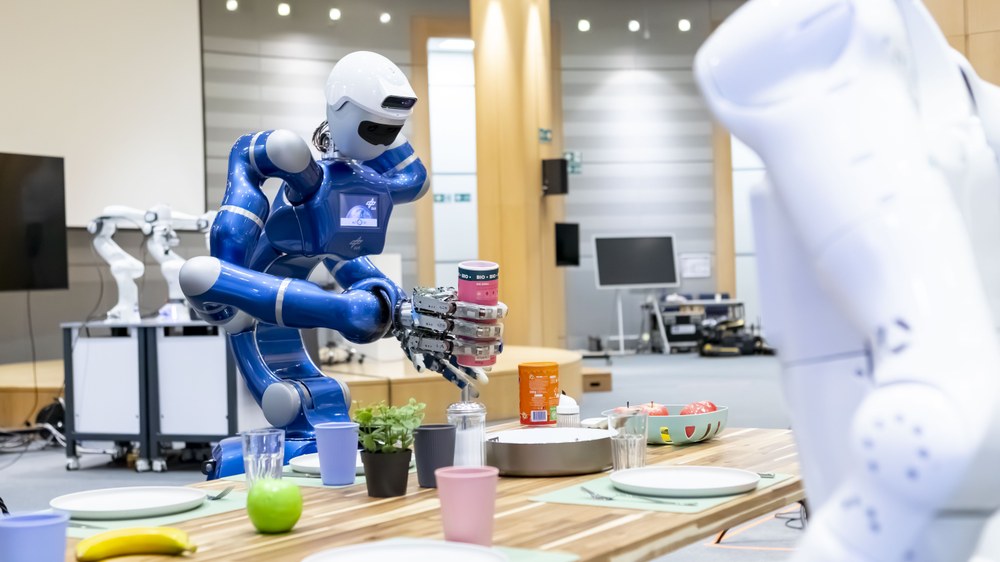
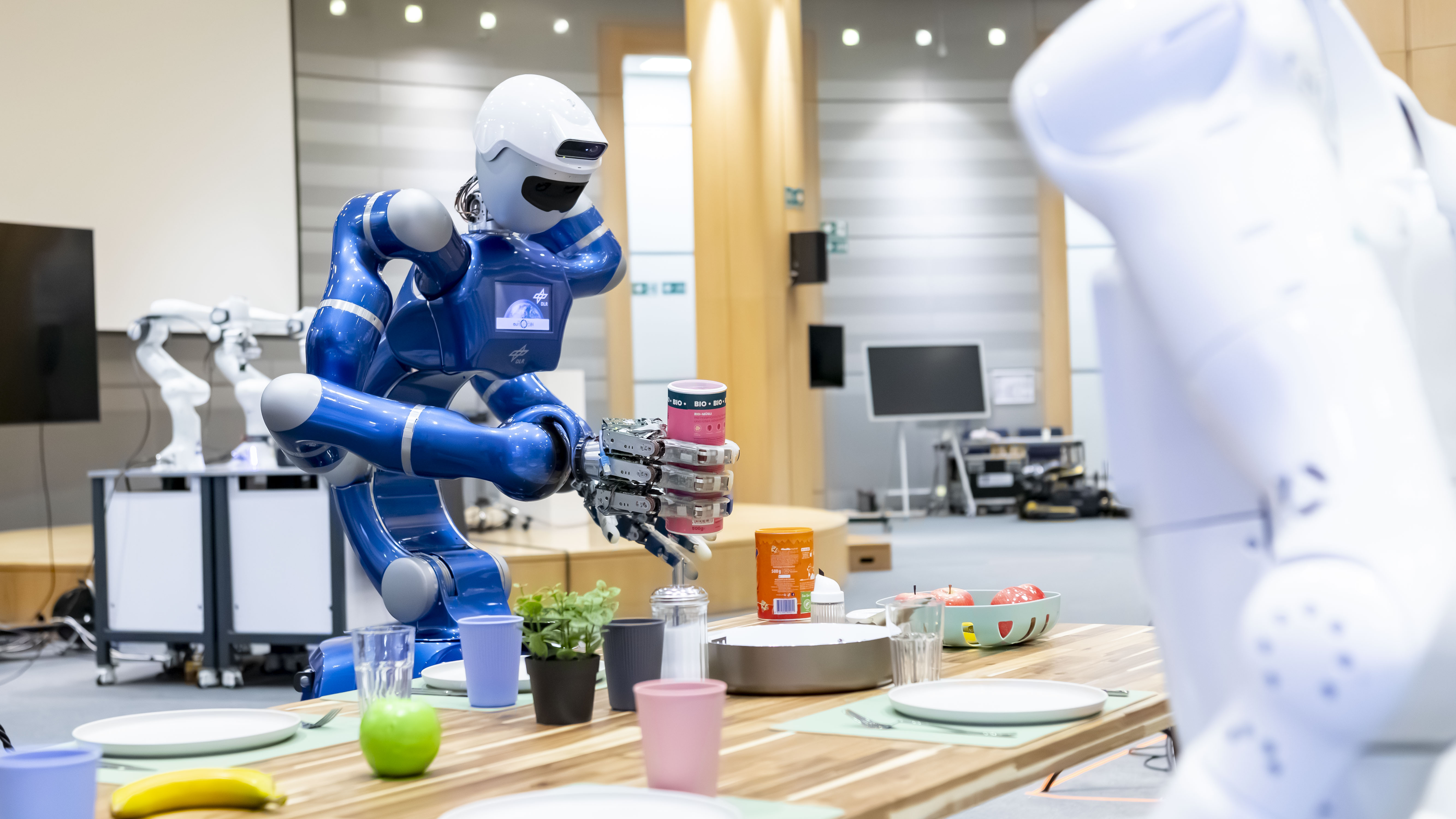
Researchers in the euROBIN network are working to ensure that different robots will be able to work together in the future. In the shared task of 'clearing the breakfast table', four different robots each act autonomously here, while showing 'consideration' for the other robots.
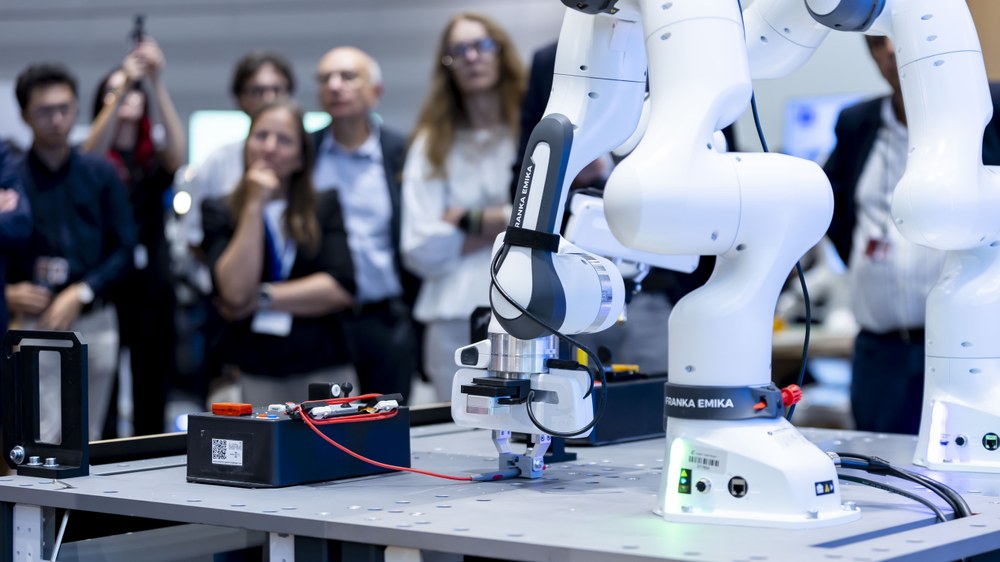
The Franka dual-arm robot cell is trained to use various tools and manoeuvres in industrial settings. Here, the cell demonstrates skilful cable routing during wiring harness assembly. To further develop its capabilities, the system uses digital twin simulations. The robot cell is being developed by the Technical University of Munich (TUM), the Jožef Stefan Institute (JSI) and the University of Bremen.
In the European Parliament, 15 of the world's most advanced AI-based robots demonstrated their capabilities, including DLR robot Rollin' Justin.
European robotics is at a turning point, where the challenge is to secure Europe's competitiveness and technological sovereignty while addressing societal challenges.
In 10 to 15 years, AI-based robotics in Europe could develop into an industry sector similar to today's automotive industry.
The technology demonstration was initiated by euROBIN, the European Excellence Network on AI-based Robotics, which is coordinated by DLR.
Focus: Space, robotics, artificial intelligence
On 2 September 2026, the next generation of intelligent machines was presented at the European Parliament in Brussels. Fifteen of the world's most advanced AI-based robots – including humanoids, quadrupeds, drones and industrial systems – demonstrated how European researchers are paving the way for a new era in robotics. The German Aerospace Center (Deutsches Zentrum für Luft- und Raumfahrt; DLR) showcased the capabilities of its humanoid robot Rollin' Justin as a household assistant.
The technology demonstration and subsequent panel discussion brought together approximately 170 senior European and international representatives from politics, industry and research. Discussions focused on measures to develop AI-based robotics into an industry in Europe within 10 to 15 years, comparable in scale and significance to today's automotive industry.
Global race
European robotics is at a turning point: Europe remains the global leader in robotics research and continues to lead ahead of the United States and Asia in several areas. European researchers and companies have pioneered the field and achieved groundbreaking advances, particularly in collaborative robots, robotic avatars, autonomous navigation, dexterous hands, legged robots and aerial robotics. However, the international robotics landscape is currently undergoing a fundamental transformation, and the global race is entering a new phase.
Advances in artificial intelligence (AI) are enabling robots to perceive, learn and act in increasingly complex physical environments. Robotics is evolving from a specialised industrial market into a mass market that, in terms of scale and economic significance, has the potential to rival the automotive, computer and telecommunications industries. Europe now faces a strategic choice: to help shape this emerging economy, or to become dependent on technologies developed and manufactured elsewhere in the world.
15 robots, three societal challenges
The aim is to secure Europe's competitiveness and technological sovereignty while addressing societal challenges such as demographic change, security, sustainability, healthcare and industrial productivity. The event was initiated by the European network of excellence euROBIN (European Excellence Network on AI-based Robotics), which is coordinated by DLR. The network’s members addressed these strategic issues at the European Parliament with technological expertise. A total of 15 robotic systems demonstrated three thematic scenarios of particular economic and social relevance:
Robotically dismantling laptops and vacuum cleaners
In the 'Robotic manufacturing for a circular economy' scenario, five teams demonstrated applications in manufacturing and resource efficiency, including technologies for refurbishing and dismantling laptops, disassembling a robotic vacuum cleaner, advanced robotic manipulation, a mobile disassembly system and a virtual environment of a building.
Robotic household helpers clear the breakfast table
In 'Personal robots for enhanced quality of life and well-being', robots demonstrated how they support people in everyday environments. Acting as kitchen helpers, four systems, including DLR's humanoid robot Rollin' Justin, showed their capabilities in human-robot interaction, object handling and autonomous support. Operating autonomously, the four robots collaboratively took on the task of clearing a breakfast table: they independently identified the various objects randomly distributed across the table, picked up plates as delicately as they did the cereal box, placed everything in the dishwasher, cupboard and fridge, and disposed of the rubbish.
Robotic parcel delivery
In the 'Outdoor robots for sustainable communities' scenario, various robotic technologies for outdoor applications and logistics were used. The development teams demonstrated autonomous parcel delivery using agile robots such as a centaur robot, a wheeled quadruped and an arm-equipped drone. They also presented systems designed for use in challenging outdoor environments.
An additional exhibition of legged humanoid robots by industry collaborators further highlighted Europe's expertise in this field. euROBIN brings together Europe’s leading robotics and AI research laboratories. Led by DLR, the network of excellence used the Brussels event to showcase the breadth of the European robotics ecosystem.
From cutting-edge research to industry leadership
Europe has spent decades building an exceptional scientific and technological foundation in robotics. "The challenge now is to translate this strength into industrial-scale, widespread deployment and European technological sovereignty. AI-based robotics offers us the opportunity to combine European excellence in robotics with the extraordinary advances that have taken place in the field of AI in recent years," explains Alin Albu-Schäffer, director of the DLR Institute of Robotics and Mechatronics and euROBIN coordinator.
The live demonstration and closed-door discussion with leading figures from politics, industry and research therefore also provided impetus for future strategic direction. "Europe can do robotics – we're demonstrating that impressively here,” says Axel Voss, Member of the European Parliament and host of the euROBIN demonstration in the European Parliament. “Now we need to ensure that European cutting-edge research also produces European market leaders. If AI and robotics are set to define the next major industrial revolution, we must not allow a repeat of the situation where the key technologies are developed here but commercialised elsewhere. We need fewer barriers, greater momentum and better conditions for investment and scaling."
The European Excellence Network on AI-based Robotics (euROBIN) brings together European research expertise in robotics and artificial intelligence. One of the network's key objectives is to achieve significant scientific advances in core topics in artificial intelligence and robotics, with the scientific focus on AI-based transferability between robots, tasks and environments. In addition, the integrative research platform aims to strengthen the robotics research community in Europe. euROBIN is funded by the European Union's Horizon Europe framework programme and coordinated by the DLR Institute of Robotics and Mechatronics. The core consortium comprises 31 collaborating organisations from 14 countries across 26 European cities, complemented by a further 38 collaborators funded through cascade funding.