September 18, 2026 | Automated driving on rail, bogie technology, climate control and virtual coupling
DLR at InnoTrans 2026
DLR's RailSET laboratory – research into automation in rail
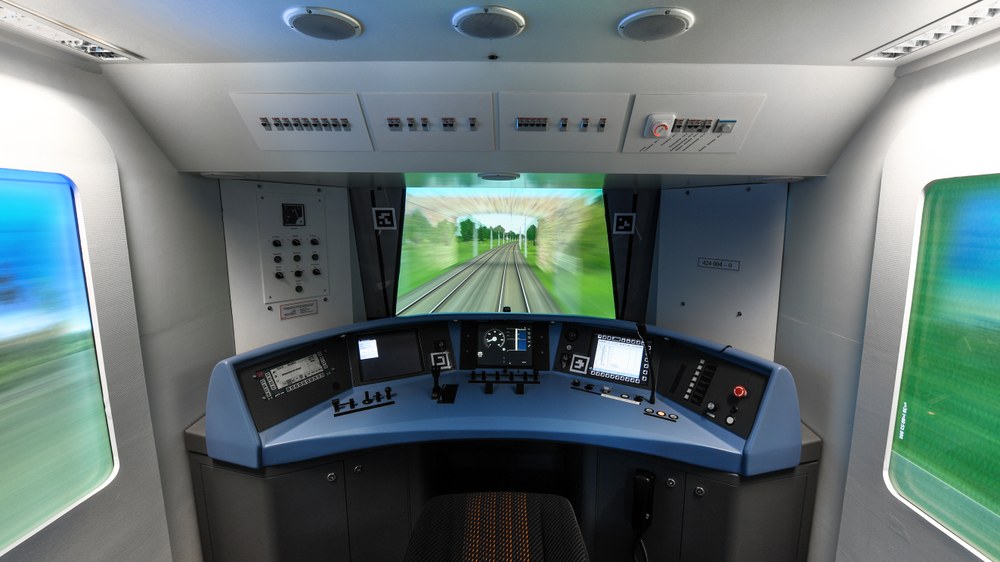
Automated functions in rail require reliable perception of the surrounding environment to function safely and efficiently. Modern sensor systems form the backbone of this. That is why DLR is researching how multi-sensor systems can be tested under reproducible conditions in the laboratory.
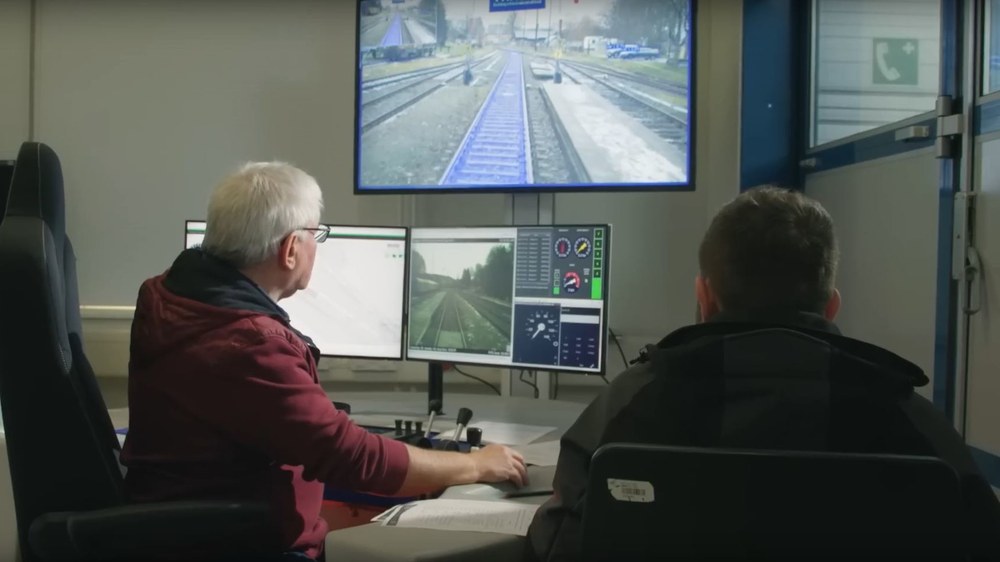
Tests on remote control of trains in DLR's RailSiTe laboratory
Remote train operation (RTO) is already technologically possible and is coming within reach for large-scale operation. An important success criterion for its practical use is the design of the control centre. DLR is researching the optimal layout of a control centre to increase the performance of personnel in the driver's cab and in the control room.
DLR technologies address key challenges in rail transport – from staff shortages and capacity bottlenecks to comfort and operational safety.
At InnoTrans, DLR will present automated driving functions, mechatronic bogies and a radio system for virtual coupling, among other things.
Concepts for gender inclusive interiors, individual climate control and connected public transport planning complement the technological solutions.
Focus: Transport, mobility of the future, rail transport research, automated driving
At InnoTrans, the leading international trade fair for rail and transport technology in Berlin, the German Aerospace Center (Deutsches Zentrum für Luft- und Raumfahrt; DLR) will present the latest projects from its rail research. From 22 to 25 September 2026, innovative solutions for efficient, reliable and people-oriented rail transport will be the focus of DLR's exhibition (Hall 2.2, stand number 440).
Rail has traditionally been a cornerstone of public transport and an established mode of transport in logistics. At the same time, it faces immense challenges – in rail vehicles, in operations and in infrastructure. DLR's technologies and solutions address these challenges from a comprehensive perspective: in the fields of automated and energy-efficient vehicles, the collaborative planning of public transport services and strategic mobility planning.
Remote-controlled and automated rail operation
An interactive exhibit explains DLR's research into operating trains, in the near term [RJ1.1]and for a wide range of applications, either by remote control (remote train operation, RTO) or in automated mode (automated train operation, ATO). Sensors play a key role in this: they capture essential information – where is a train located? At what speed and in what direction is it travelling? And what is its distance from other trains? Visitors to the DLR stand can use figurines to create disruptions in operations. The exhibit then shows them how the sensors respond and work out solutions. If, for example, the automated system cannot resolve a situation on its own, it hands over to a human operator, who then intervenes using remote control.
Given the shortage of train drivers, RTO and ATO offer a solution for maintaining and increasing rail capacity. One example is reactivating decommissioned branch lines to offer an attractive public transport service in rural areas. DLR places particular emphasis on safe and resilient solutions in this area.
Novel bogies for less noise and wear
As the 'running gear' of a rail vehicle, the bogie is a central component. It is located beneath the carriage body, houses the wheelsets and can rotate. It bears and distributes the weight of the train, dampens vibrations and enables it to negotiate bends more effectively. DLR is developing pioneering bogie technology and operates state-of-the-art test rigs to test it under realistic conditions. At InnoTrans, DLR will demonstrate in several live broadcasts how its powered, mechatronic single-wheel rail bogie runs on a specialised test rig. The individual wheels are controlled so that they make optimal contact with the rail, resulting in less friction, which leads to reduced wear and tear and lower maintenance costs. It also causes fewer vibrations and, as a result, less noise.
Gender Mobility Design Gap – safe travel on public transport for all
In a short study back in 2024, DLR investigated the extent to which the interiors of public transport vehicles also meet the design requirements of women. A frequently cited problem was that many handholds in public transport vehicles are positioned too high for women. Building on this, DLR has developed a gender-inclusive public transport handrail, which has since been successfully patented: people of different heights can hold onto it comfortably. This also allows passengers to distribute themselves more evenly within the interior of a bus or train carriage. A full-scale exhibit shows the handrail concept as part of a train interior.
Researching the right climate on trains
Temperature in the train carriage is an important comfort factor and influences how appealing a rail journey is. The coronavirus pandemic also showed how important climate control technologies are with regard to the spread of aerosols and microbial contamination through contact with surfaces. DLR is therefore working on concepts that allow all passengers to adjust their own climate control individually while travelling safely and hygienically. At the InnoTrans stand, the interior of a train carriage with six seats has been recreated. Inside it, DLR researchers demonstrate and explain the solutions they are working on for ventilation, individual climate control and antimicrobial surfaces.
Virtual coupling for further automation
DLR has developed a novel radio system for the rail sector and tested it in practice for the first time at a marshalling yard. It is based on ultra-wideband technology and enables fast, precise communication, positioning and distance measurement over short distances of up to 300 metres. This technology enables the 'virtual coupling' of train sections and train sets as part of the ongoing automation of rail transport. DLR is exhibiting this test system at InnoTrans. It is housed in a weatherproof enclosure and can be mounted on the coupling of trains.
Platform for public transport planning and the atSTAKE spin-off
Also on display at the DLR stand is a collaborative platform for planning regional public transport services. Whether transport operators or funding authorities, all parties involved can access this platform and plan together. Different planning stages – from strategic to operational – are integrated into a single, seamless workflow. This means service planning can be organised in a more flexible, demand-responsive and cost-efficient manner. Using open interfaces, the platform integrates timetable and duty planning, traffic models and evaluation modules from external providers. Municipalities and operators with limited resources in particular benefit from data exchange and process integration.
The DLR spin-off atSTAKE offers software for strategic mobility planning that is specifically tailored to the requirements of municipalities, planning offices and transport operators. The application provides locally tailored traffic simulations at the touch of a button, allowing mobility measures to be assessed quickly, on a data-driven basis and in a transparent way.
Other exhibits at the DLR stand include: a special balise reader for maintenance and surveying tasks, an additive repair process for composite material structures, a simulation framework for analysing and optimising energy flows in rail vehicles, and a hydrogen-powered air conditioning unit for hydrogen trains, designed for mounting on the carriage roof.