DLR tests energy-optimised approach procedures for busy airports
October 2, 2026 | DYN-MARS makes approaches quieter and more efficient
DLR tests energy-optimised approach procedures for busy airports
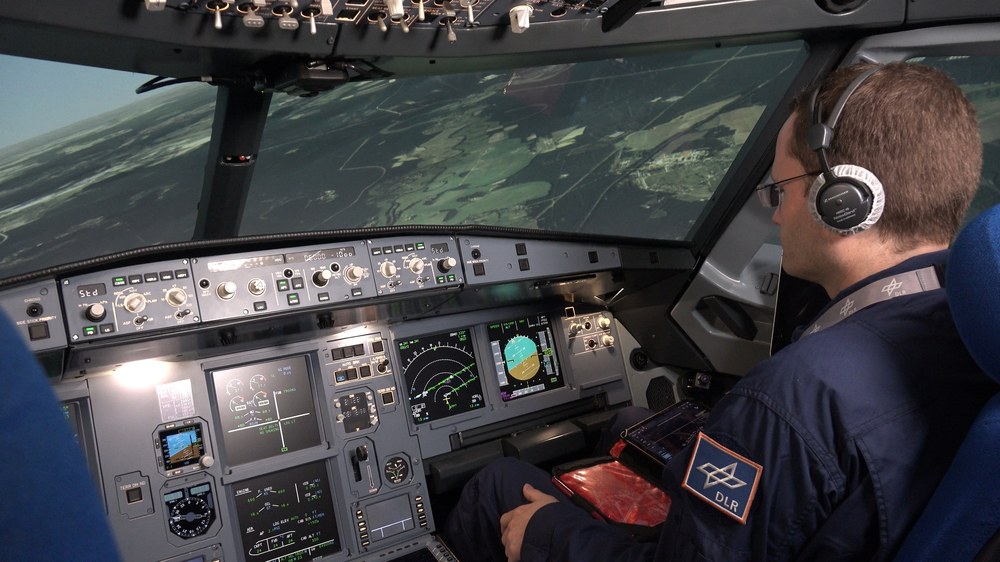
DLR test pilot in the DLR Airbus A320 simulator cockpit
The functionality of the enhanced DYN-MARS flight management system was tested and evaluated in a series of extensive experiments carried out with the assistance of test pilots in DLR's Airbus A320 simulator cockpit.
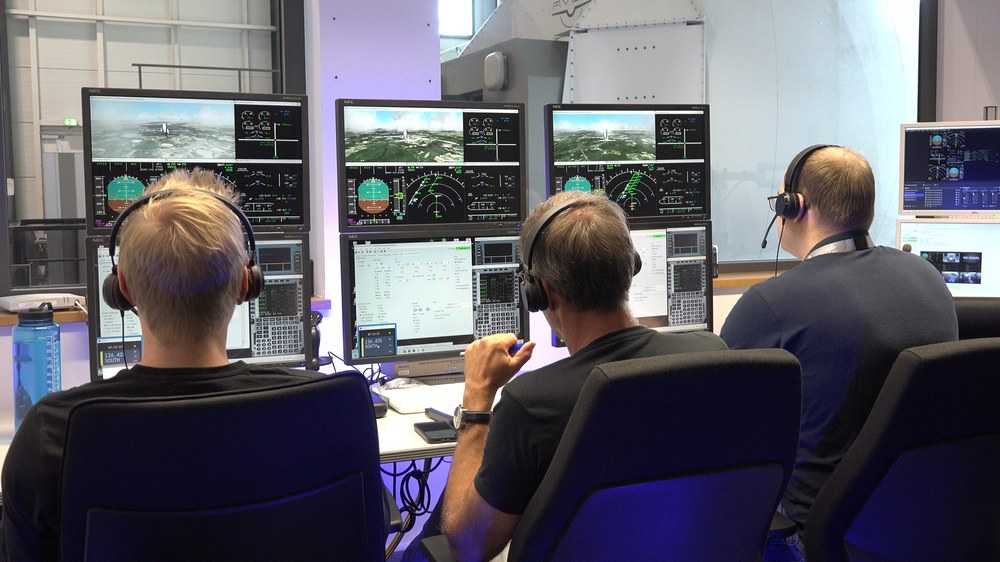
Pilots at the desktop simulator during the DYN-MARS trial
The DYN-MARS solution was developed for complex, busy airport approach areas. To explore the solution's potential, traffic scenarios were realistically replicated using desktop simulation stations at AVES, with DLR test pilots trialling both conventional flight management systems and systems featuring DYN-MARS capabilities.
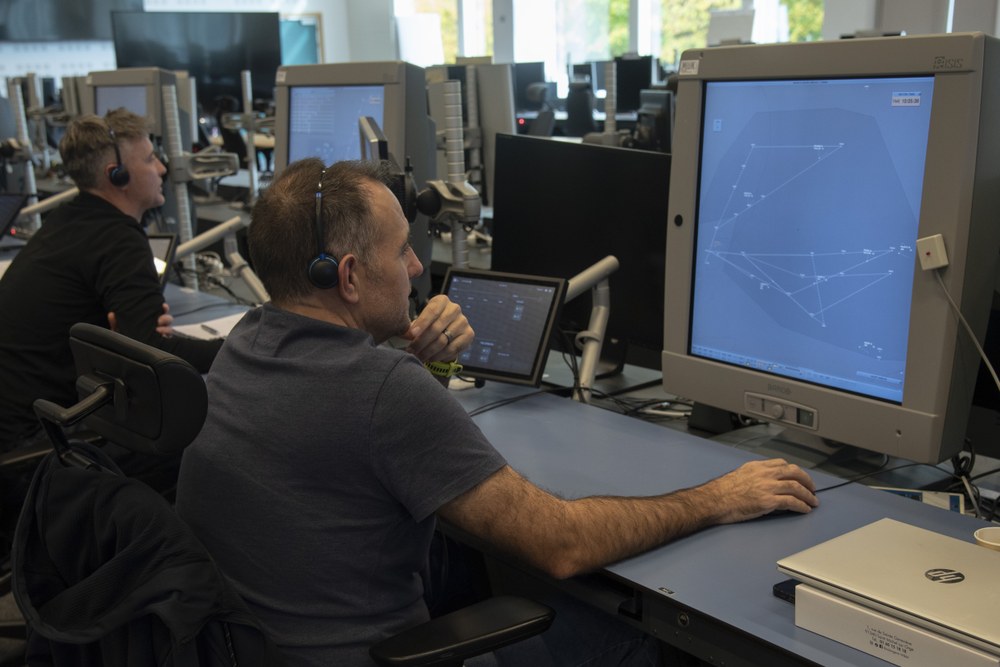
Air traffic controllers at EUROCONTROL's simulator centre
As part of the EU-funded DYN-MARS project, simulators at EUROCONTROL and DLR were linked together. The air traffic simulated at DLR was monitored and controlled by DYN-MARS test controllers in Brétigny, France.
Image: 4/4, Credit:
EUROCONTROL
The DYN-MARS research project has validated procedures for fuel-saving and quieter descent and landing approaches under realistic traffic conditions in a simulator.
An enhanced flight management system dynamically recalculates the descent profile in response to air traffic control speed instructions.
Anticipated route changes can be transmitted digitally to the cockpit and factored into flight planning at an early stage.
More than 70 pilots completed over 60 scenarios and almost 1000 simulated approaches to seven airports.
Focus: Aviation
Landing more efficiently and quietly – DYN-MARS trials new approach procedures
Almost 1000 simulated approaches, more than 70 pilots and seven airports: the German Aerospace Center (Deutsches Zentrum für Luft- und Raumfahrt; DLR) has successfully trialled new procedures for fuel-saving, quieter descent and landing approaches under realistic traffic conditions, as part of the EU-funded research project DYN-MARS (DYNamic Management of Aircraft Configuration and Route Structures).
A descent that is as smooth as possible, flown with idle thrust, can reduce fuel consumption, emissions and aircraft noise. However, this is difficult to achieve in busy airport approach areas. High traffic density, short-notice speed instructions from air traffic control and changes to the planned flight route often force crews to adjust the flight profile.
DYN-MARS therefore combines two approaches: the dynamic recalculation of the vertical flight profile and the digital transmission of expected flight routes to the cockpit.
Descent profile adapts during approach
As part of the project, researchers developed an enhanced flight management system that automatically recalculates the vertical flight profile in response to tactical speed instructions from air traffic control. This allows an aircraft to continue its descent with idle thrust for as long as possible, even under changing conditions.
"With dynamic recalculation, the flight management system can take short-notice instructions from air traffic control into account while still making a descent that is as energy-efficient as possible. The trials show that this principle can also be implemented in complex, busy airport approach areas," said Fethi Abdelmoula, DYN-MARS project coordinator at the DLR Institute of Flight Systems.
Expected flight route transmitted digitally
In addition, the project team tested 'route uplinks' via Controller-Pilot Data Link Communications (CPDLC). These enable air traffic controllers to transmit an expected shortcut or route change directly to the flight management system.
The system first loads the route as a secondary flight plan. Once clearance has been granted, the crew can activate it. This means the flight management system knows the expected remaining flight path earlier and can therefore adjust the descent profile more precisely.
"Digital route transmission improves the predictability of the approach for both the cockpit and air traffic control. At the same time, it reduces manual inputs and creates an important prerequisite for more automated and efficient approach procedures," said Abdelmoula.
Almost 1000 simulator approaches
For validation purposes, the researchers integrated the enhanced flight management system into the simulation environment of the DLR AVES (Air Vehicle Simulator) simulation centre at the Institute of Flight Systems. To do this, the team linked the simulator to the Air Traffic Management and Operations Simulator (ATMOS) at the DLR Institute of Flight Guidance and several desktop pilot stations. In a further phase of the experiment, they connected the environment to the ESCAPE simulator (EUROCONTROL Simulation Capability and Platform for Experimentation).
The pilots flew more than 60 scenarios featuring different traffic situations, speed requirements and route changes. More than 70 pilots completed almost 1000 simulated approaches, which were assigned to them by air traffic controllers from the linked air traffic management simulators.
The results show that energy-optimised descents using idle thrust and digitally transmitted routes are operationally feasible even in high-traffic conditions.
Basis for the follow-on project DYN-MAX
The technologies validated in DYN-MARS are being further developed by the researchers in the follow-on project DYN-MAX (Dynamic Aircraft Energy Management in ATC-Complex Environments). Among other things, the plan is to incorporate an 'Aircraft Departure Optimiser', with the aim of extending energy-efficient flight management to departure procedures.
DYN-MARS stands for DYNamic Management of Aircraft Configuration and Route Structures. The aim of the project was to develop technologies for more energy-efficient descent and landing approaches in complex and heavily trafficked airport approach areas, and to validate them under realistic operational conditions. DYN-MARS was funded by the SESAR 3 Joint Undertaking under grant agreement No. 101114627. UK air traffic services provider and project collaborator NATS received funding from UK Research and Innovation (UKRI) under the UK government's Horizon Europe Funding Guarantee [grant number 10091273]. The project, funded by the Swiss State Secretariat for Education, Research and Innovation (SERI), ran from September 2023 to August 2026.
Project participants included EUROCONTROL, Thales AVS France, Netherlands Aerospace Centre (NLR), NATS, Swiss research institute Empa, Swiss Skylab Foundation, Swiss International Air Lines and DLR. Project coordination was led by DLR.
Contact
Jasmin Begli
Corporate Communications Braunschweig, Cochstedt, Stade and Trauen