
Spectacular high-speed flyby of the asteroid Torifune
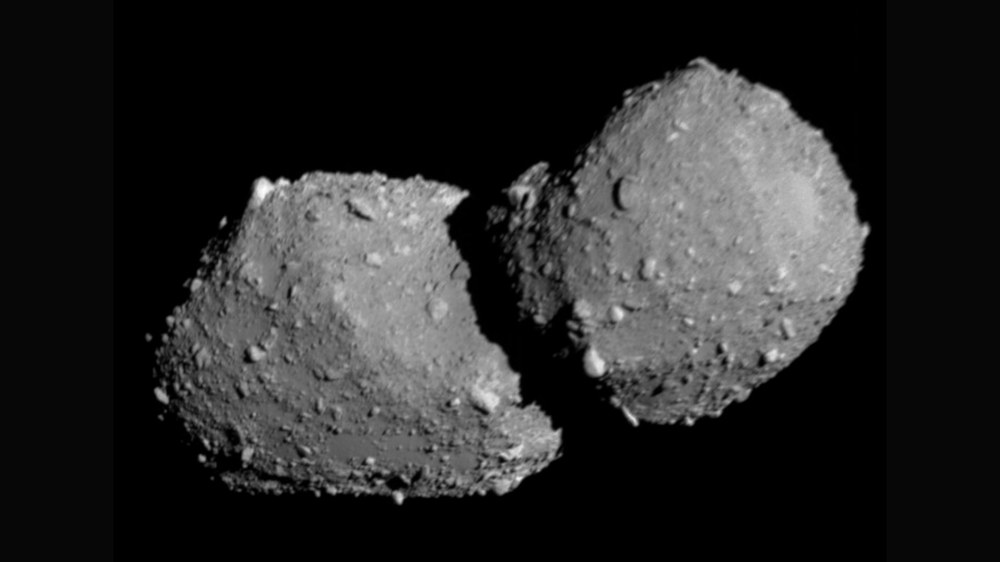

©JAXA, The University of Tokyo, Chiba Institute of Technology, Tokyo University of Science, National Institute of Advanced Industrial Science and Technology, Paris Observatory, Instituto de Astrofísica de Canarias
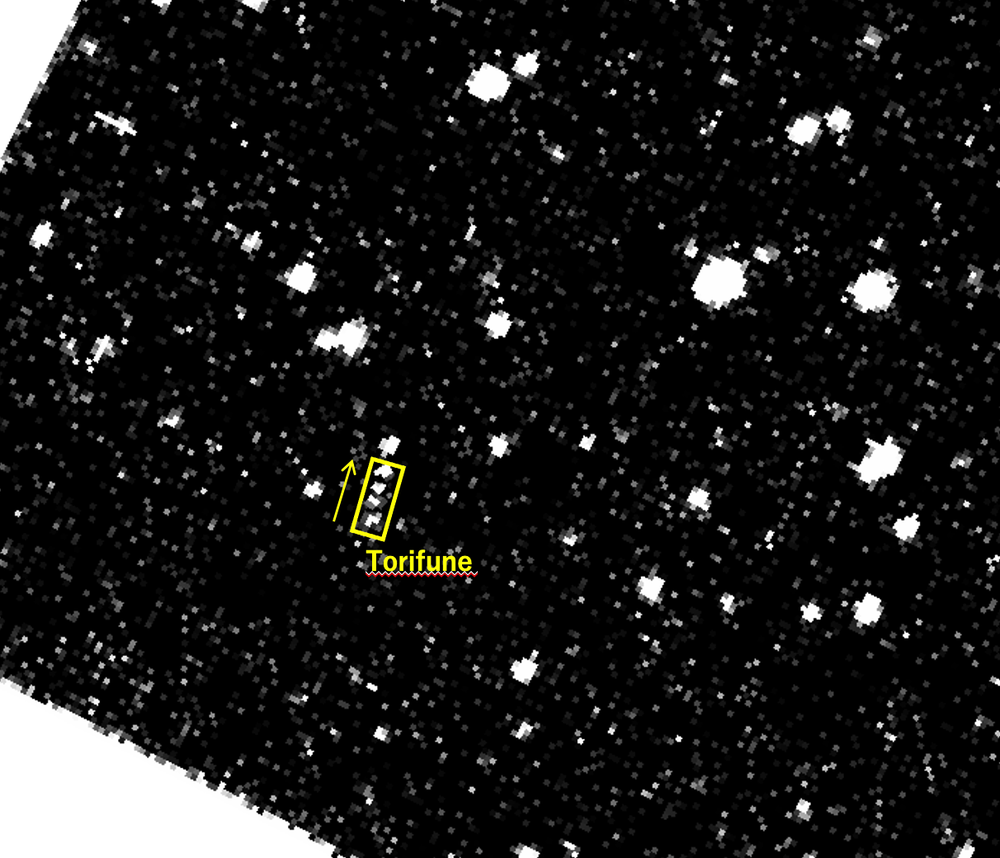
© JAXA, Chiba Institute of Technology, Japan Spaceguard Association
- On 5 July at 11:30 CEST, the Japanese Hayabusa2♯ space probe flew past asteroid (98943) Torifune, which is estimated to be approximately 450 metres in diameter.
- Extreme precision: the aim was to approach the asteroid as close as 800 metres from the asteroid's centre, at a speed of 18,000 kilometres per hour.
- Hayabusa2 completed its original mission in 2020 with the successful delivery of a sample capsule to Earth, containing grains collected from the asteroid Ryugu in 2019.
- As part of the extended Hayabusa2♯ mission (pronounced 'Hayabusa2 Sharp'), the probe has now reached Torifune and is scheduled to arrive at asteroid 1998 KY26 – thought to measure just 11 metres across – in 2031.
- DLR is scientifically involved in Hayabusa2♯, deployed the MASCOT lander on the asteroid Ryugu as part of the 2018 mission and is engaged in research into asteroids.
- Focus: Space, Solar System research, asteroid defence
On Sunday 5 July 2026, the Japanese Hayabusa2♯ asteroid mission flew past asteroid (98943) Torifune at very close range and at an extremely high speed of approximately five kilometres per second (18,000 kilometres per hour). The plan was to pass just 800 metres from the centre of the approximately 450-metre asteroid. During this close approach, photographs were captured and measurements carried out. The mission – now designated Hayabusa2♯ (♯ or # pronounced 'sharp', which stands for Small Hazardous Asteroid Reconnaissance Probe) – aims to gather fundamental data for future defence technology projects, to protect Earth against potentially hazardous asteroids. In particular, the extended mission aims to steer the probe with such precision that it could, in principle, make a controlled impact on a small celestial body – using a 'kinetic impact' to divert it from a collision course with Earth. Hayabusa2♯ was, however, not intended to impact Torifune; instead, after the precisely navigated flyby, it will set course towards asteroid 1998 KY26. The German Aerospace Center (Deutsches Zentrum für Luft- und Raumfahrt; DLR) is scientifically involved in Hayabusa2♯.
The original Hayabusa2 mission was launched in December 2014 aboard the H-IIA Launch Vehicle No. 26. The spacecraft reached the kilometre-sized asteroid Ryugu in June 2018 and achieved a number of world-first results, including the creation of an artificial crater on the surface of the small celestial body through an explosion. On 3 October 2018, the MASCOT (Mobile Asteroid Surface Scout) lander – developed jointly by DLR and the French space agency CNES – landed on Ryugu carrying four scientific instruments, three of which were German experiments. Hayabusa2 returned to the vicinity of Earth in December 2020 and successfully delivered samples of the asteroid material. The DLR Institute of Space Research examined some of the grains returned from Ryugu.
Technologies for altering the orbits of Earth-crossing asteroids
After completing its original mission, Hayabusa2 remained completely intact in space, in orbit around the Sun. This allowed for the start of the 'extended mission' – Hayabusa2♯. On 5 July 2026, the spacecraft reached its intermediate target, asteroid Torifune, and carried out observations. The flyby was designed to demonstrate high-precision trajectory control and develop technologies that could be used to alter the orbit of an asteroid in a controlled manner. The second goal of the Hayabusa2♯ mission is to carry out a further rendezvous and investigation of an asteroid in 2031. The target will then be the tiny planetoid 1998 KY26. Initiatives such as this play an important role in protecting Earth from asteroid impacts – a field known as 'planetary defence' – and helping to reduce the risk in the future.
Planetary defence refers to efforts to identify and monitor asteroids and other celestial bodies approaching Earth at an early stage, and to take action to prevent damage should there be a risk of collision. Since such impacts by celestial bodies would pose a threat to all humanity, transcending national borders, these efforts are being pursued through international cooperation under the leadership of the United Nations.
Currently, there are approximately 12,000 asteroids in the catalogue measuring 140 metres or more – and roughly 32,000 smaller asteroids – that are known to be near-Earth objects (NEOs). This means their orbits intersect or pass very close to Earth's orbit around the Sun. Approximately 2500 of these asteroids are classified as Potentially Hazardous Asteroids (PHAs). These objects are at least 140 metres in size and come as close as 7.5 million kilometres to Earth's orbit – roughly 20 times the distance between Earth and the Moon. The orbits of these PHAs are generally known with great precision and are constantly monitored. At present, no known PHA is expected to collide with Earth in the foreseeable future. However, even an asteroid smaller than 100 metres could cause massive damage if it entered Earth's atmosphere.

Illustration by Akihiro Ikeshita
Planetary defence
Hayabusa2♯ will primarily contribute to planetary defence in two ways. The first is its high-speed flyby of asteroid Torifune on 5 July 2026, conducted at very close range. The aim of such manoeuvres is to gather fundamental data on the technology required to control a probe precisely enough that it could deliberately collide with a small celestial body and alter its orbit.
The second goal of this Hayabusa2♯ 'extended' mission is to investigate ultra-small, rapidly rotating asteroids. After Torifune, in 2031, the space probe will reach asteroid 1998 KY26, whose diameter is estimated at approximately 11 metres and which rotates extremely quickly – one day on 1998 KY26 lasts just 5.4 minutes. Since such small celestial bodies could survive passage through Earth's atmosphere and collide with its surface or explode at low atmospheric altitudes, understanding the physical structure of these fast-rotating small bodies provides extremely important data for future planetary defence measures. For example, it could help with determining whether these bodies consist of monolithic rock or an aggregate of rock fragments with many cavities between them.
Final preparations completed
On 9 June at 18:33 CEST, it was confirmed that during the approach to Torifune the ion engines had successfully completed their operation. Between 20 and 21 June Hayabusa2♯'s camera spotted Torifune from a distance of seven million kilometres. Since the return of the sample reentry capsule to Earth in December 2020, the Hayabusa2♯ project team has been carrying out the extended mission. During this phase, three of the four ion engines – A, C and D – experienced an unexpected increase in 'neutraliser' voltage, indicating a reduction in performance. As a result, only ion engine module B was used for Sunday's Torifune flyby, 5 July at 18:30 JST (11:30 CEST).
By 9 June, ion engine B had completed a total of 8143 operating hours – the ion propulsion system had already achieved a total impulse approximately 20 percent higher than the engines used on the first Hayabusa mission, which reached and sampled asteroid Itokawa in 2005. After the flyby of Torifune, the ion thruster team will begin preparations for an Earth flyby planned for December 2027, during which the spacecraft's trajectory will be redirected towards asteroid 1998 KY26.
Asteroid defence – a vital topic in Solar System research
DLR's Institute of Space Research in Berlin is part of the Hayabusa2 science team and will support the scientific analysis of data from the ONC cameras and the thermal infrared spectrometer (TIR). It was not, however, involved in planning and preparing the probe's flyby of Torifune. Nonetheless, asteroid defence and planetary defence are currently high-priority topics at the institute. This autumn, the Hera mission – launched in 2024 – will arrive at the Didymos/Dimorphos binary asteroid system. Hera will study at close range the effects of the targeted impact by NASA's DART (Double Asteroid Redirection Test) probe on Dimorphos on 26 September 2022. DLR leads the Asteroid Framing Camera (AFC) experiment aboard Hera – an optical system built by Jena Optronik.
Racing towards asteroid Apophis
DLR is also involved in the European Space Agency's RAMSES (Rapid Apophis Mission for Space Safety) mission, which is set to rendezvous with and study the approximately 340-metre asteroid Apophis in 2029. Apophis is an asteroid that crosses Earth's orbit and was initially considered a potential impact threat when it was discovered. The massive rock, whose impact on Earth would likely have devastating consequences, is expected to fly past Earth on Friday 13 April 2029 at a distance of just 32,000 kilometres.
In the vastness of the Solar System, that is almost nothing. By comparison, the Moon is approximately 400,000 kilometres from Earth. Nevertheless, it is an entirely safe flyby distance. RAMSES is currently being prepared by the German company OHB for launch in April 2028. The Japan Aerospace Exploration Agency (JAXA) is also involved in the mission. The largest joint project between JAXA and DLR is, however, the Mars Moons Exploration (MMX) mission, which is scheduled to launch in late 2026. The mission will investigate whether the two Martian moons, Phobos and Deimos, are indeed asteroids captured by the Red Planet. Together with CNES, DLR is contributing the Idefix rover to the mission, which will explore the surface of Phobos from 2029 onwards.
Asteroid Torifune is classified as an Apollo asteroid, as it crosses Earth's orbit with a semi-major axis larger than Earth's. This means it reaches distances from the Sun greater than 150 million kilometres, which corresponds to the distance between the Sun and Earth (1 AU, or one astronomical unit). Numerous asteroids from the Apollo family cross Earth's orbit. Torifune's orbital period around the Sun is approximately similar to Earth's, allowing the small body to remain in Earth's vicinity for extended periods. Torifune can approach Earth to within 0.083 AU (12.4 million kilometres) but cannot come dangerously close. Torifune (an abbreviation of Ame-no-torifune) is a god in Japanese mythology. It is also the name of the god's ship, "which can travel safely at high speed like a bird and steady as a rock". Torifune was discovered on 3 February 2001 during the Lincoln Near-Earth Asteroid Research (LINEAR) survey in Socorro, New Mexico.