HYDRA aircraft concept takes first place in the DLR Design Challenge 2026
August 21, 2026 | Tenth DLR Design Challenge combines nurturing young talent with research for tomorrow's aviation
HYDRA aircraft concept takes first place in the DLR Design Challenge 2026
First place at the DLR Design Challenge 2026 – TU Berlin's HYDRA concept
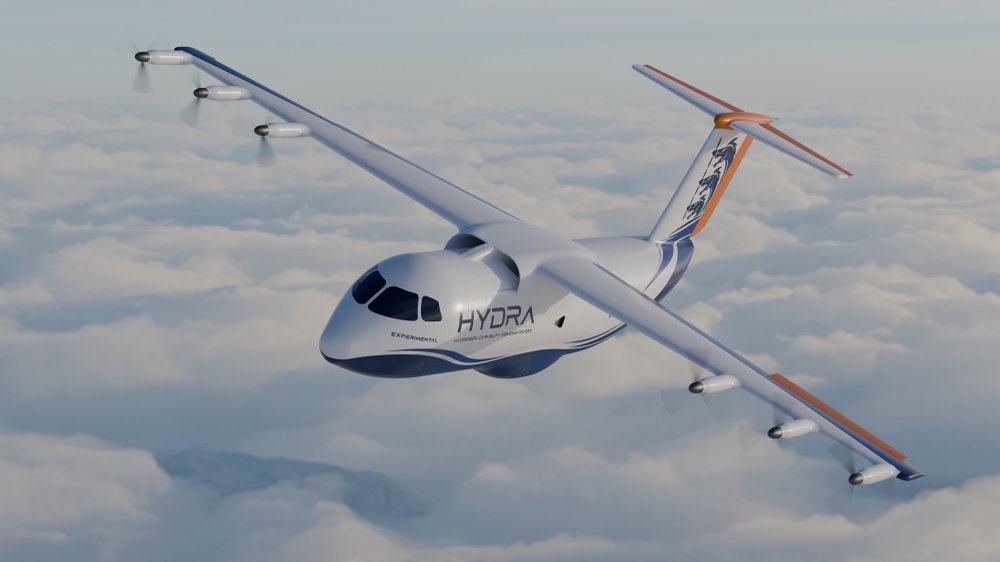
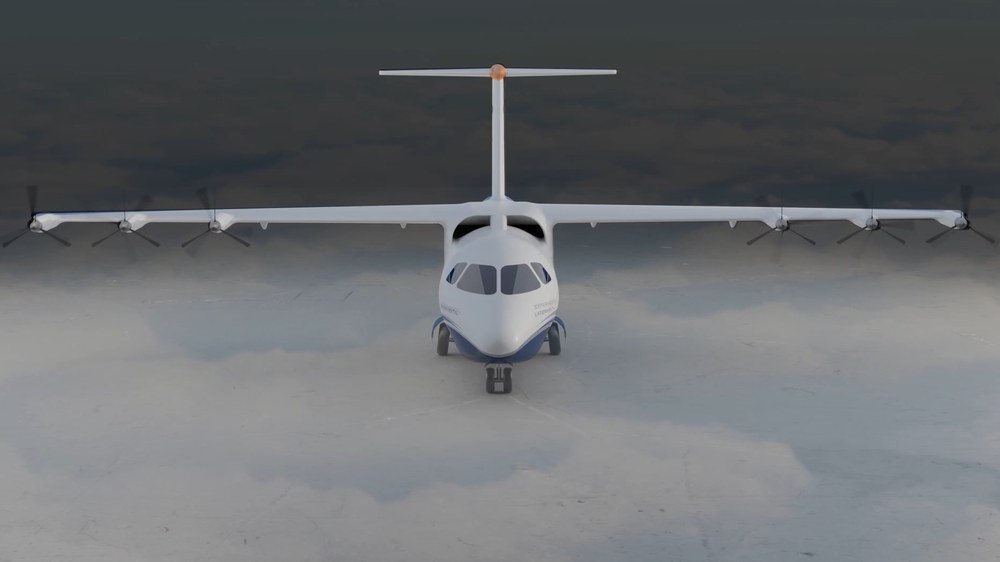
The HYDRA concept is a fundamentally new demonstrator aircraft for future hydrogen aircraft technology, enabling the experimental validation of hybrid-electric propulsion systems under real flight conditions. Thanks to a modular architecture with interchangeable powertrain containers, fuel cells and turboshaft engines with generators can be quickly swapped within a single working day. The shared airframe uses liquid hydrogen (LH₂) as the primary energy source, batteries as supporting storage and electric motors as part of the Distributed Electric Propulsion (DEP) concept, including a wingtip propeller to improve aerodynamics. The modular design means flight tests can be conducted close to the aircraft's performance limits – in particular to investigate performance dynamics and thermal management – and serves to validate theoretical models and inform the development of future certification criteria. HYDRA thus forms a central platform for the research and development of sustainable, emission-free aviation technologies.
Image: 1/6, Credit:
TU Berlin/HYDRA
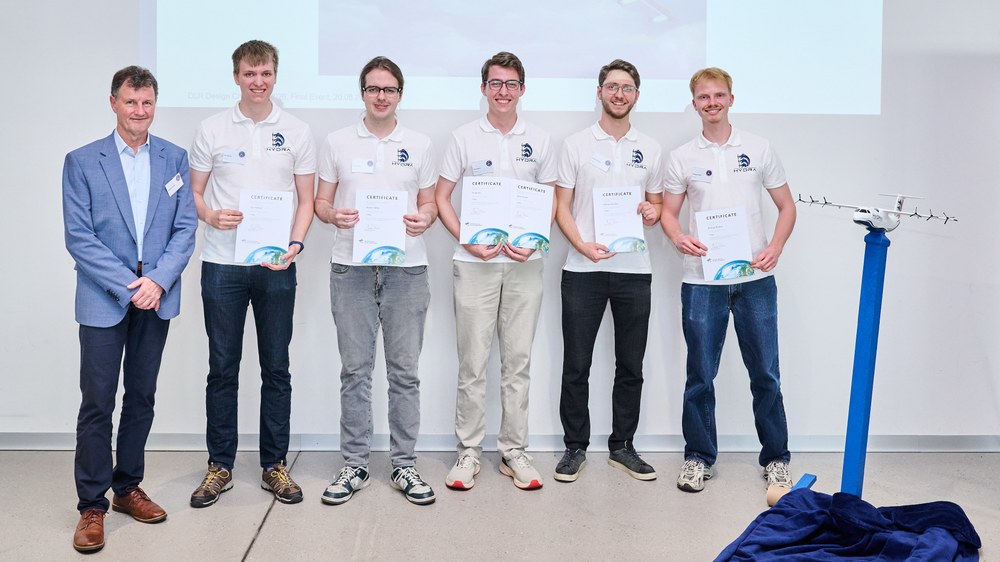
Winning team from TU Berlin – their HYDRA concept won the DLR Design Challenge 2026
From left: Markus Fischer (DLR Divisional Board Member for Aeronautics), Tilo Hänsel, Aaron Allen, Vitus Reick, Fabian Kerskes and Philipp Riedel.
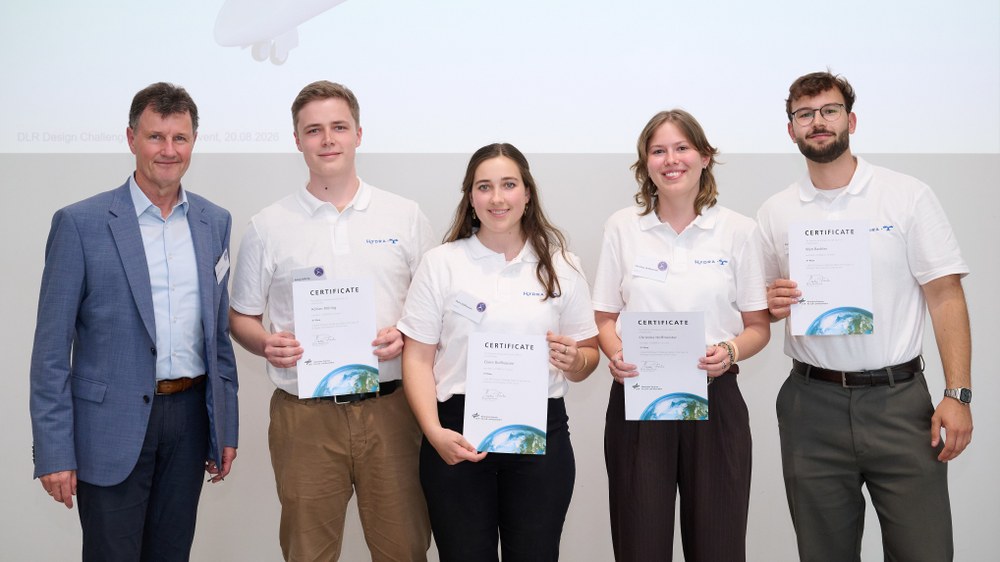
Team from RWTH Aachen – their HYDRA-X concept takes third place in the DLR Design Challenge 2026
From left: Markus Fischer (DLR Divisional Board Member for Aeronautics), Adrian Möring, Claire Dollhausen, Christina Hoffmeister and Wyn Bachler (not pictured: Ben Maulhardt).
Sixteen student teams have developed concepts for a small aircraft to serve as a flying testbed.
The aircraft are intended to test new aviation technologies under real-world conditions and investigate how they work together.
The team from the Technical University of Berlin won the DLR Design Challenge 2026 with its HYDRA concept.
Focus: Aeronautics, young talent
The jury of the German Aerospace Center (Deutsches Zentrum für Luft- und Raumfahrt; DLR) has awarded first place in the tenth DLR Design Challenge to the team from the Technical University of Berlin (TU Berlin) for its HYDRA concept. At the closing event on 20 August 2026 at DLR's site in Hamburg-Finkenwerder, 16 student teams presented their designs to a panel of experts.
The task was to develop an entirely new small aircraft that can serve as a flying testbed for future aviation technologies. The aircraft had to be designed with enough practical relevance that it could realistically be built and tested within the next few years.
To advance the market readiness of technologies for use in commercial airliners starting in 2050, the students were tasked with designing a flexible research platform that would allow different technologies to be investigated under real flight conditions. This meant first identifying relevant future technologies, then considering how testing them on the aircraft could provide added value. A modular design was intended to make it possible to test different systems and propulsion types with as little effort as possible.
The competitiveness of the aviation industry in Germany and Europe depends crucially on quickly bringing new technologies from research into practical application. Flying testbeds make it possible to test innovative technologies at an early stage, at a high system level and under real-world conditions. At the same time, we need highly trained young professionals who can develop these technologies and put them into practice. My thanks and congratulations go to all the students, as well as to the organising team, for their great commitment and the outstanding, innovative concepts produced by the design teams.
Three teams honoured
First place went to the TU Berlin team with HYDRA. The jury was particularly impressed by the synergistic selection of technologies. The modular, interchangeable powertrain allows for rapid conversion between different configurations, resulting in a well-thought-out concept that enables the timely testing of relevant aviation technologies.
Second place went to the TU Braunschweig team with KANGAROO. Their design is characterised in particular by its focused testing of hydrogen propulsion systems at high altitudes and the associated challenges.
Third place went to the RWTH Aachen University team with HYDRA-X. The concept places particular emphasis on holistic aircraft design methods, and the team's captivating presentation won over the jury.
From the test bench to the skies
A key challenge in developing new aviation technologies is the transition from laboratory and ground tests to real flight operations. This is due to technical, regulatory and economic hurdles. In aviation in particular, development, certification and testing cycles are long and complex. Flying testbeds can bridge the gap between research and later application, enabling technologies to be tested in combination, measurement data to be collected under real operating conditions and technical risks to be identified at an early stage.
The requirements were based on a realistically feasible research aircraft with sufficient space for measurement equipment and flight test personnel.
Expertise, creativity and team spirit
The 16 teams had approximately four months to develop their concepts, adhering to a design process modelled on the development of real aircraft. For the first time, experienced DLR specialists were on hand to offer guidance as mentors. The DLR Design Challenge was jointly organised by the DLR Institute of System Architectures in Aeronautics and the DLR Institute of Aerodynamics and Flow Technology.
The Design Challenge illustrates very clearly what modern aircraft design is all about: a good solution does not come from individual innovative technologies, but from the interplay of aerodynamics, propulsion, systems, structure and operations within the overall system. Students must understand and evaluate these interrelationships and use them to develop a coherent concept. It is precisely this systems-based thinking that is crucial if we want to shape the aviation of tomorrow.
Next steps
The three top-ranked teams will go on to present at the German Aerospace Congress 2026 in Aachen. The winning team will also present its design at the European Aerospace Science Network Conference (EASN 2026) in Toulouse.
The Design Challenge thus combines testing new technologies with promoting the next generation of scientists and engineers – two key prerequisites for a competitive aviation sector of the future.
Overview of submitted aircraft designs
Your consent to the storage of data ('cookies') is required for the playback of this video on Quickchannel.com. You can view and change your current data storage settings at any time under privacy.
Video: DLR Design Challenge 2026 – first place: TU Berlin with HYDRA
HYDRA is a fundamentally new concept for a demonstrator aircraft for future hydrogen aircraft technology, enabling the experimental validation of hybrid-electric propulsion systems under real flight conditions. Thanks to a modular architecture with interchangeable powertrain containers, fuel cells and turboshaft engines with generators can be quickly swapped within a single working day. The shared airframe uses liquid hydrogen (LH₂) as the primary energy source, batteries as supporting storage and electric motors as part of the Distributed Electric Propulsion (DEP) concept, including a wingtip propeller to improve aerodynamics. The modular design allows flight tests to be conducted close to the aircraft's performance limits – in particular to investigate performance dynamics and thermal management – and serves to validate theoretical models as well as inform the development of future certification criteria. HYDRA therefore forms a central platform for the research and development of sustainable, emission-free aviation technologies.
Image: 1/16, Credit:
TU Berlin/HYDRA
Your consent to the storage of data ('cookies') is required for the playback of this video on Quickchannel.com. You can view and change your current data storage settings at any time under privacy.
Video: DLR Design Challenge 2026 – second place: TU Braunschweig with KANGAROO
KANGAROO is a modular flight demonstrator for investigating hydrogen-based propulsion technologies under the high-altitude conditions relevant to the future of commercial aviation. Interchangeable power packs enable the flight testing of a proton exchange membrane (PEM) fuel cell system and a hydrogen-powered turbogenerator. KANGAROO thus creates a flexible research platform for the technological maturation of hydrogen-based aircraft propulsion. The modular architecture also makes it possible to integrate additional propulsion systems and individual technologies into the demonstrator in future, and to test them safely in flight.
Image: 2/16, Credit:
TU Braunschweig/KANGAROO
Successful entry: AETHERIUS – TU Darmstadt
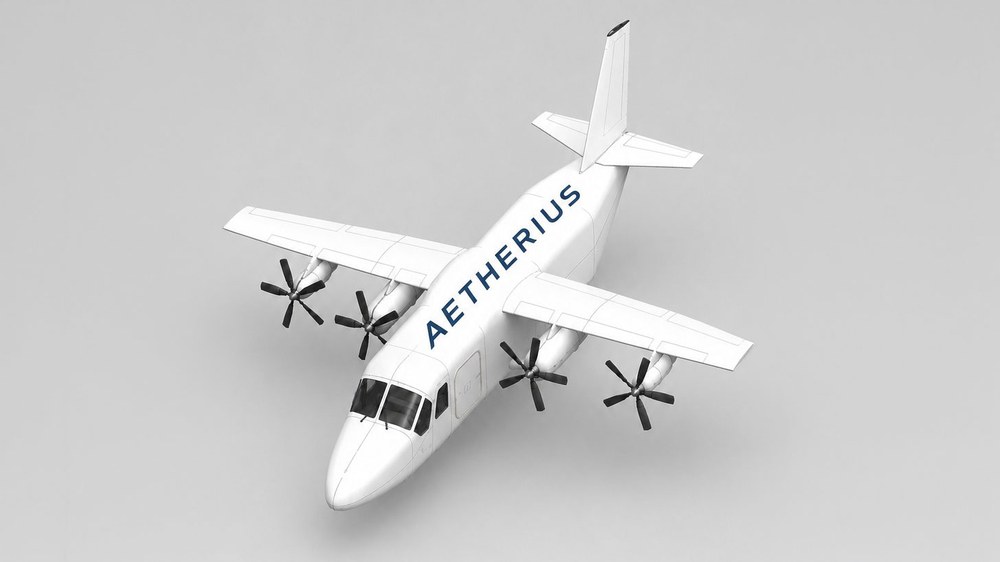
AETHERIUS is a modular, CS-23-compliant research aircraft designed to experimentally validate a hybrid hydrogen-electric propulsion system that combines high-temperature PEM fuel cells (HT-PEMFC), a 150-kilowatt-hour lithium-ion battery buffer, and a DEP on a high-aspect-ratio wing with high-lift systems. The central scientific question is: how can DEP, combined with high-lift surfaces, overcome the transient power deficits and thermal challenges of an HT-PEMFC drive in a regional aircraft? The modular architecture allows rapid switching between the fuel cell drive and a hydrogen turbine-generator propulsion system, with both systems communicating via a shared 800-volt DC main bus and a standardised interface. The combination of DEP blowing, a high aspect ratio (AR = 10) and an intelligent energy management system (EMS) enables short take-off and landing performance within 750 metres, along with high aerodynamic efficiency. AETHERIUS thus serves as a central platform for testing future emission-free aircraft technologies and developing future certification criteria.