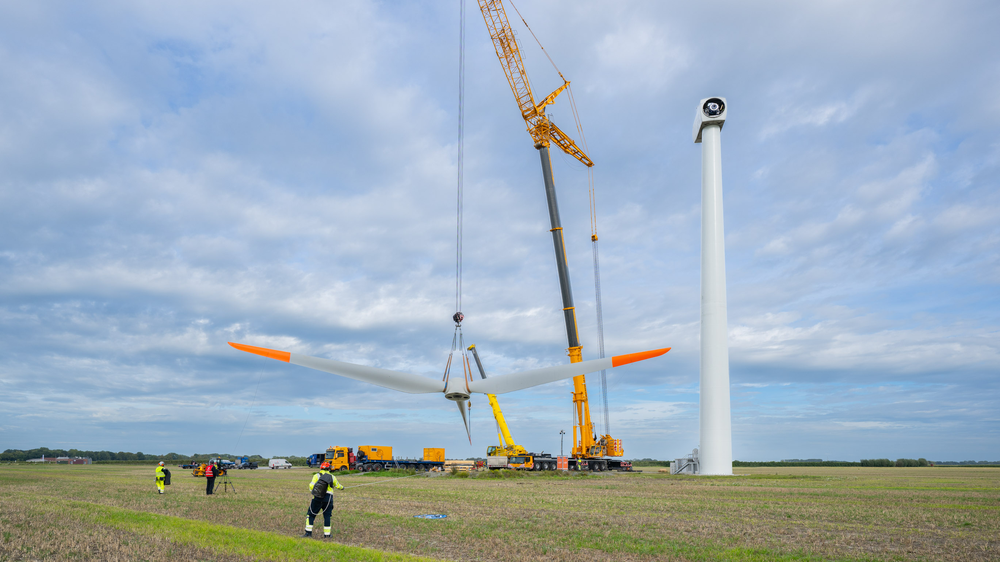
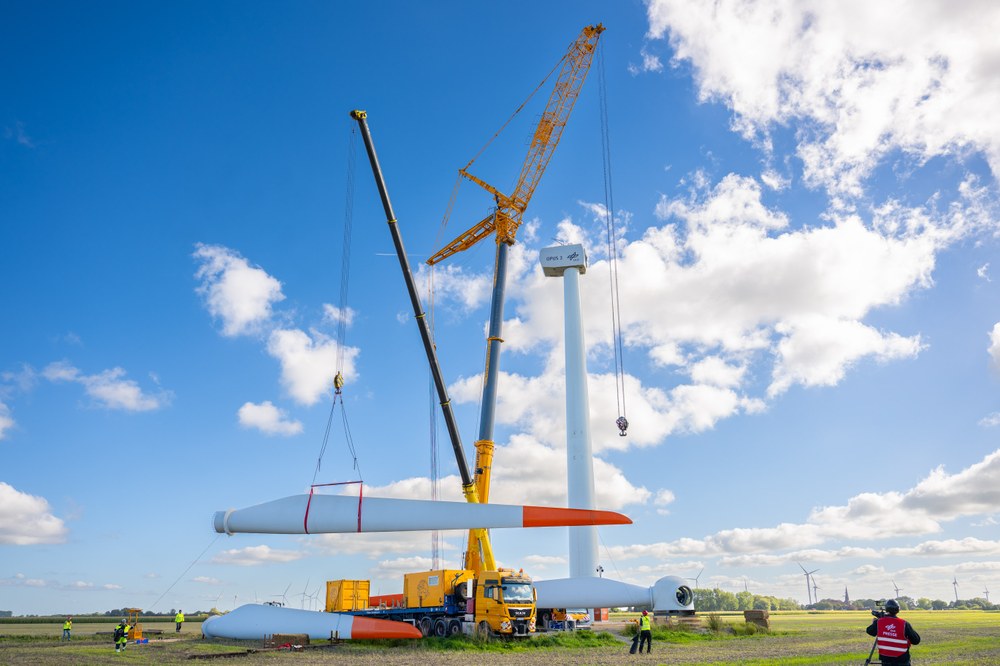
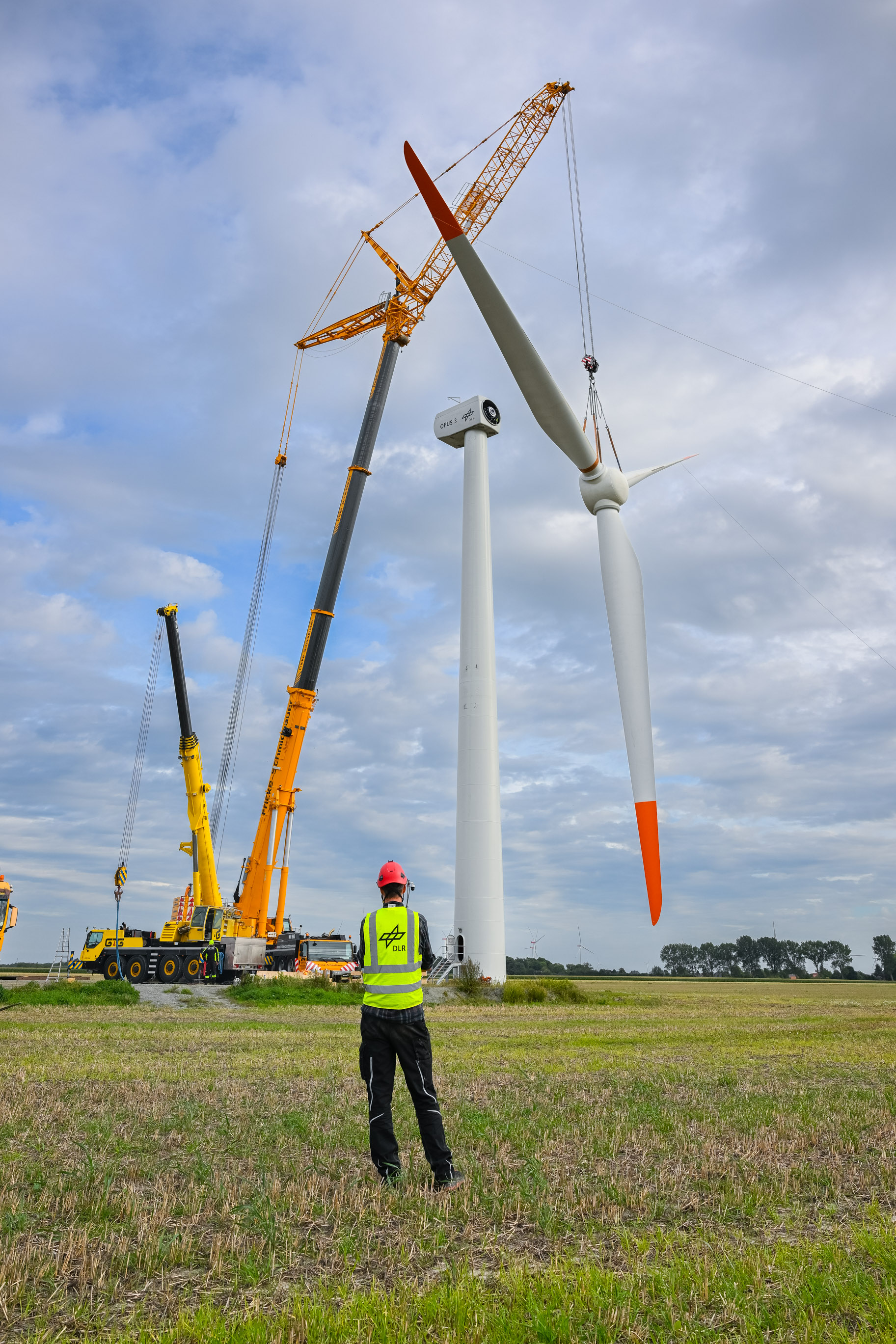
Preparing the rotor blades for installation on the rotor hub
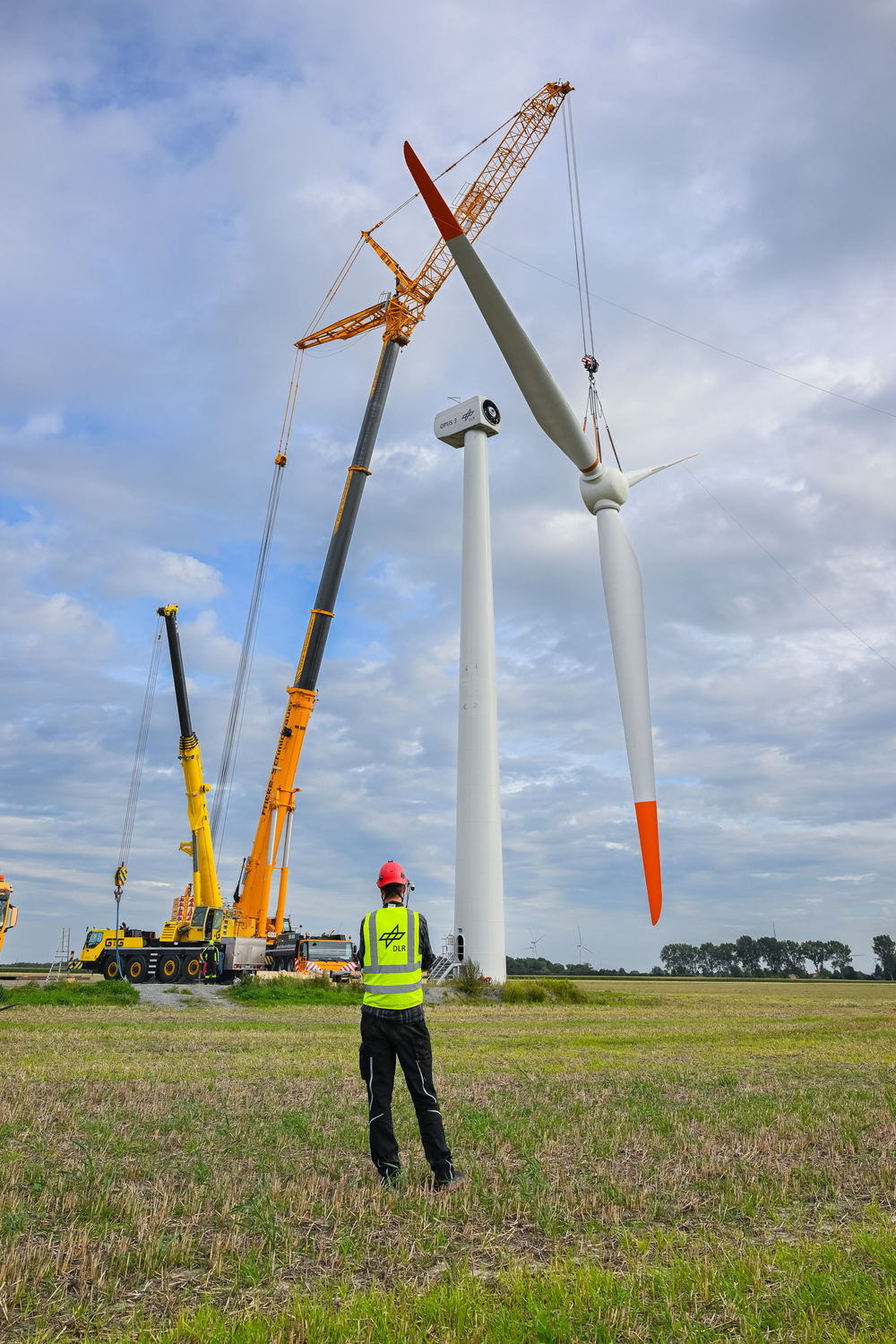
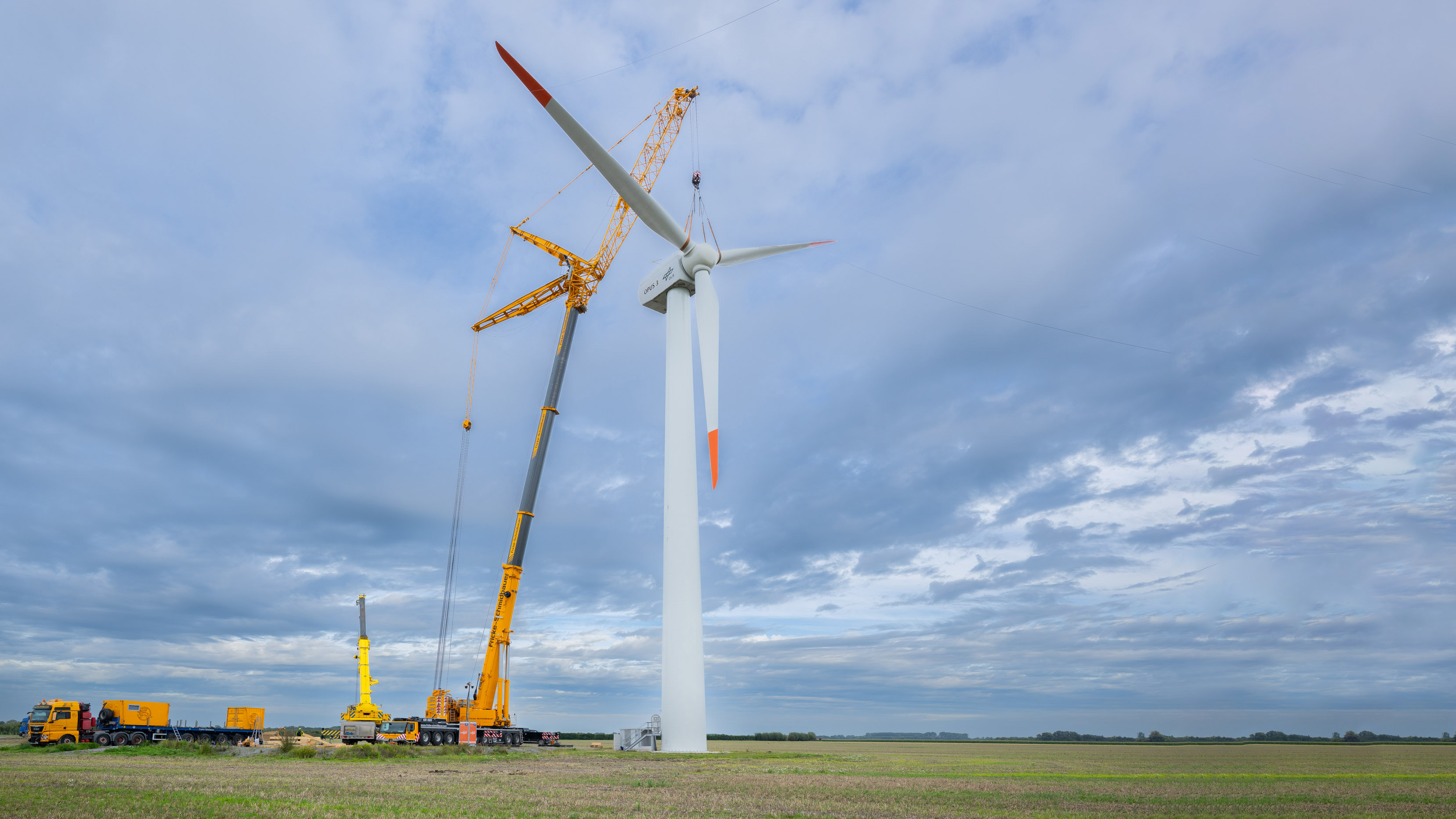
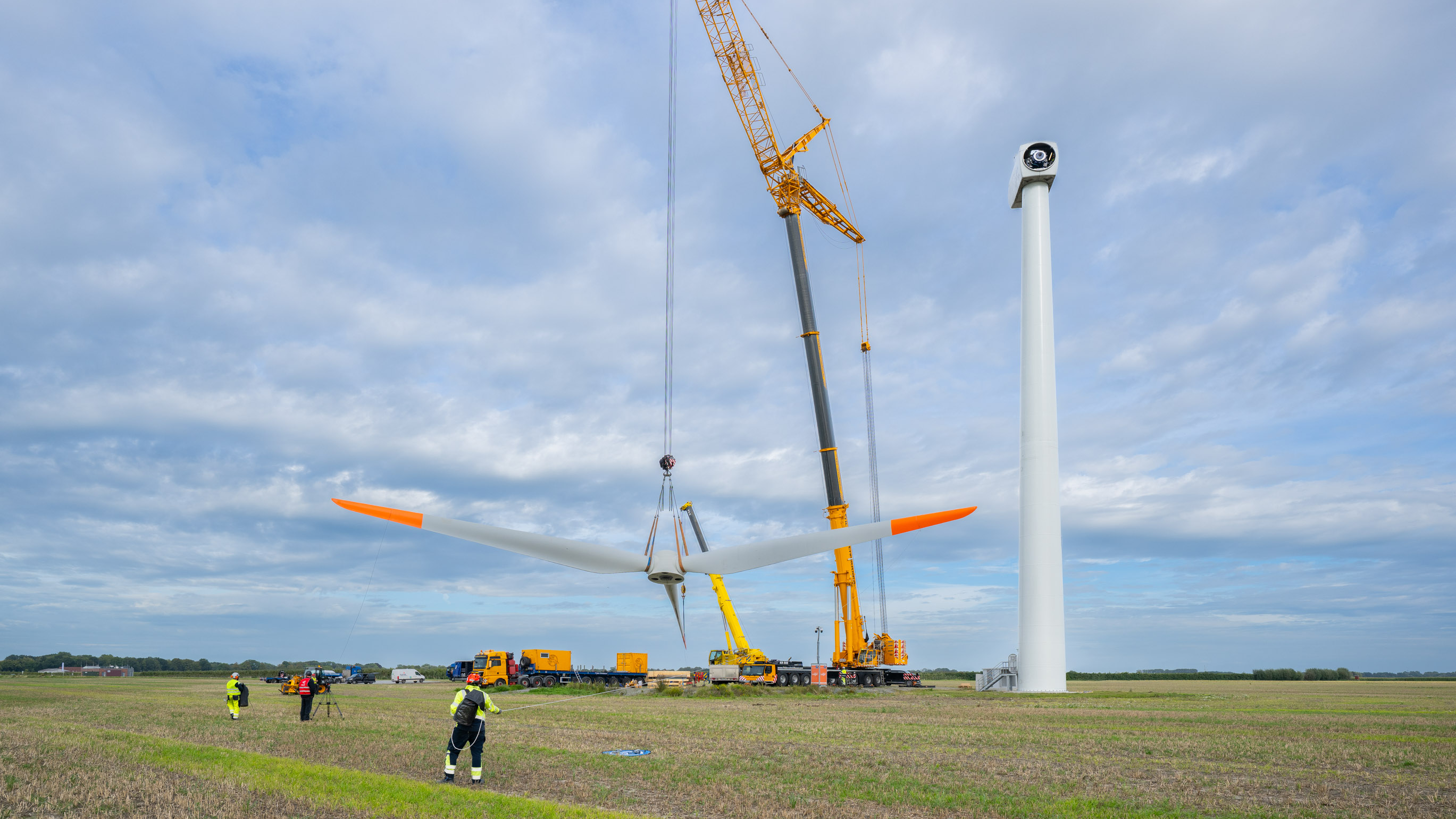
A crane lifted OPUS 3's rotor blades – each 25 metres long and weighing 2.5 tonnes – into position so they could be attached to the turbine's rotor hub while still on the ground.
A third turbine, OPUS 3, has been erected at the DLR WiValdi wind energy research park in Krummendeich.
DLR has developed this modular wind turbine specifically for research purposes. It enables new components and technologies to be tested under real operating conditions.
The turbine has a flexible and modular design, providing an important intermediate stage between simulation, laboratory testing and large-scale industrial plants.
The first scientific measurements were carried out while the turbine was still being assembled.
Focus: Energy, wind energy research
The German Aerospace Center (Deutsches Zentrum für Luft- und Raumfahrt; DLR) has expanded its WiValdi wind energy research park in Krummendeich, Lower Saxony, with a third, very special installation: OPUS 3, a one-of-a-kind, modular wind turbine that DLR has designed and built specifically for research purposes. It enables new components and technologies, as well as control and regulation methods, to be tested in practice and further developed in a targeted manner. The assembly and installation of the turbine on site were completed on 23 September 2026. With assembly now complete, the DLR team is beginning the extensive process of commissioning OPUS 3. As it is not a mass-produced turbine but a bespoke unit, the individual systems and their interactions are being tested step by step. OPUS 3 is scheduled to commence regular research operations in early 2027. The Federal Ministry for Economic Affairs and Energy (BMWE) has provided funding of approximately six million euros for the project.
Flexible hardware testbed for large-scale research
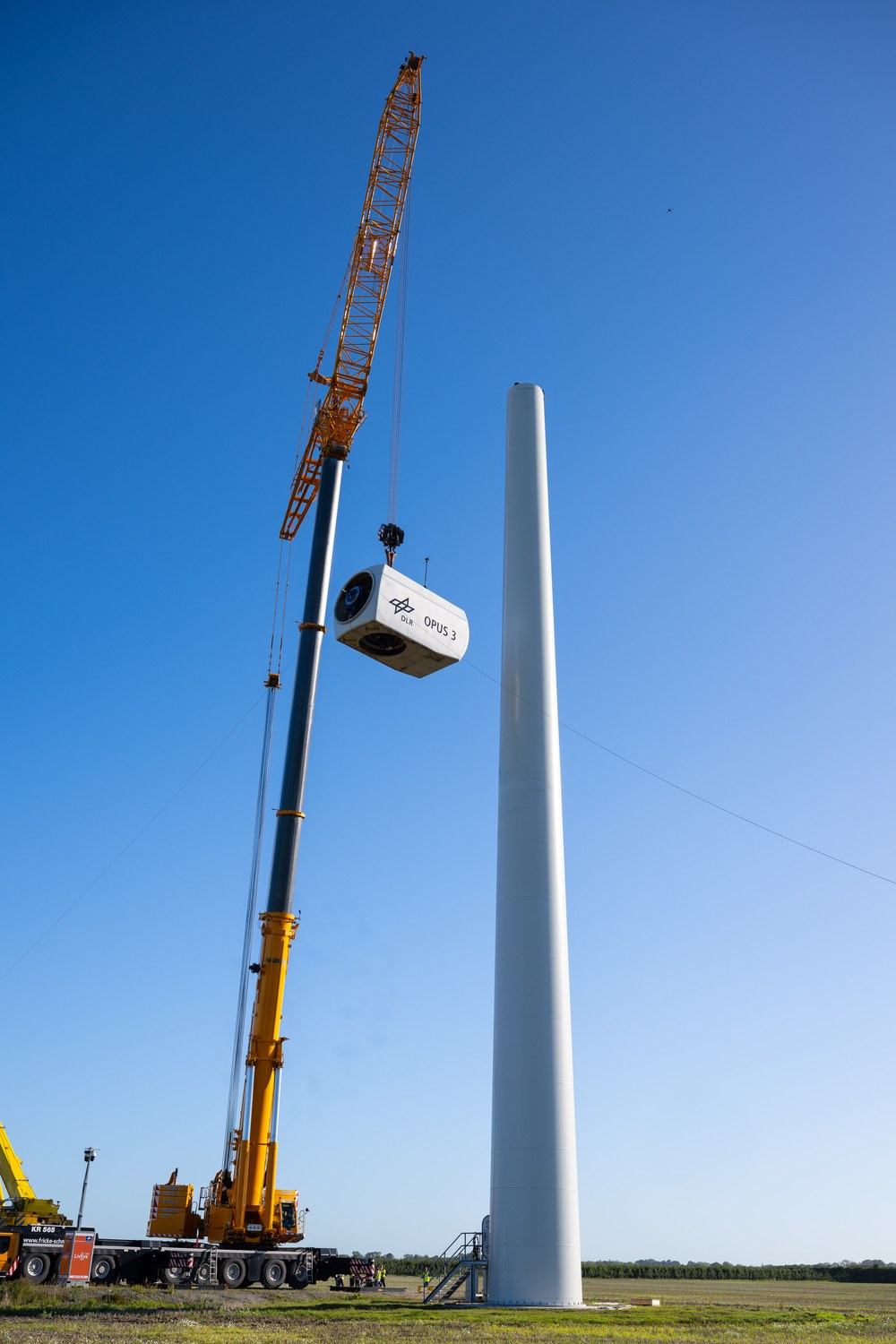
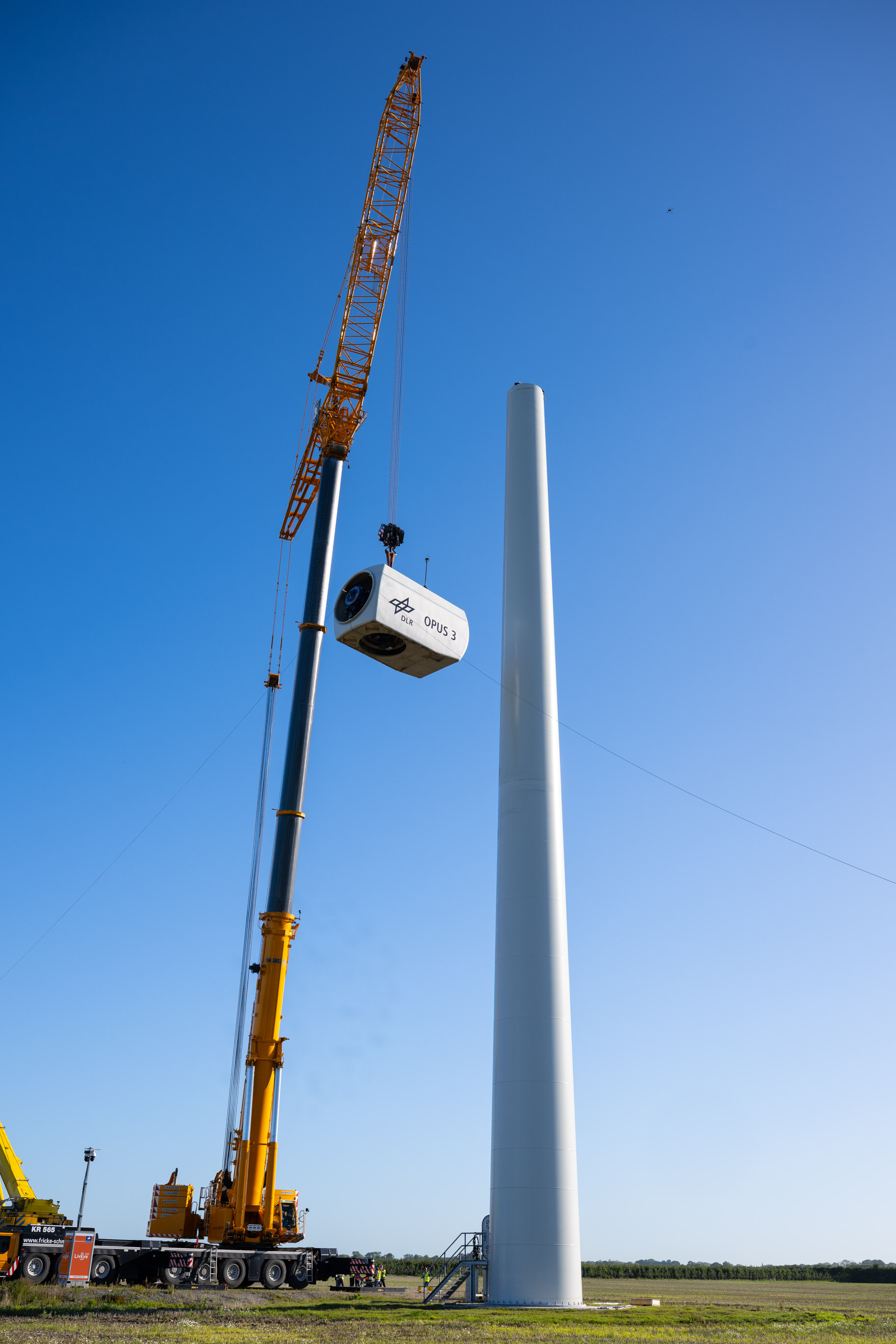
Mounting the nacelle of OPUS 3
The nacelle of the third wind turbine at the DLR WiValdi wind energy research park in Krummendeich weighs approximately 30 tonnes. It houses the drivetrain, consisting of the gearbox and generator.
DLR's new OPUS 3 turbine in Krummendeich has a rated output of 500 kilowatts, a hub height of 50 metres and a rotor diameter currently measuring 50 metres. This makes it considerably smaller than many current turbines – which is deliberate. These dimensions make it possible to initially test pre-industrial prototypes and new components at a smaller scale, but close to realistic operating conditions. At the same time, DLR researchers know their turbine inside out. This allows them to make modifications, swap out components or combine them in new ways – for example, the rotor blades, parts of the gearbox or the turbine's control system. New control algorithms can also be investigated during operation. This level of flexibility is not possible with commercial turbines. All adjustments and component changes are carried out within the framework of the applicable approval requirements. Where necessary, the corresponding modification and recertification procedures are carried out.
If technologies and solutions prove successful in trials with OPUS 3, the findings can subsequently be applied to market-specific wind turbines and taken into account when designing new turbines. "This means OPUS 3 closes an important gap in the development of new technologies for the wind energy industry. As a modular wind turbine, it forms an important stage between simulations and laboratory tests and deployment in large industrial plants. Within the context of the DLR WiValdi wind energy research park, it enables application-oriented research and development under real weather and operating conditions," says Lukas Firmhofer, DLR engineer and project lead for OPUS 3.
The turbine is also a research and development project in its own right. The DLR team has specifically designed key parts of OPUS 3 to meet the requirements of experimental research, rather than commercial operation. To this end, they adapted the components, partially pre-assembled them and transported everything to Krummendeich using several heavy-duty transport vehicles. The approximately 80-tonne tower consists of two sections, which were erected and bolted together one after the other. It supports a nacelle weighing approximately 30 tonnes, which houses the drivetrain, consisting of the gearbox and generator. The rotor hub weighs around 15 tonnes, and attached to it are the three rotor blades, each 25 metres long and weighing 2.5 tonnes.
Research even during construction
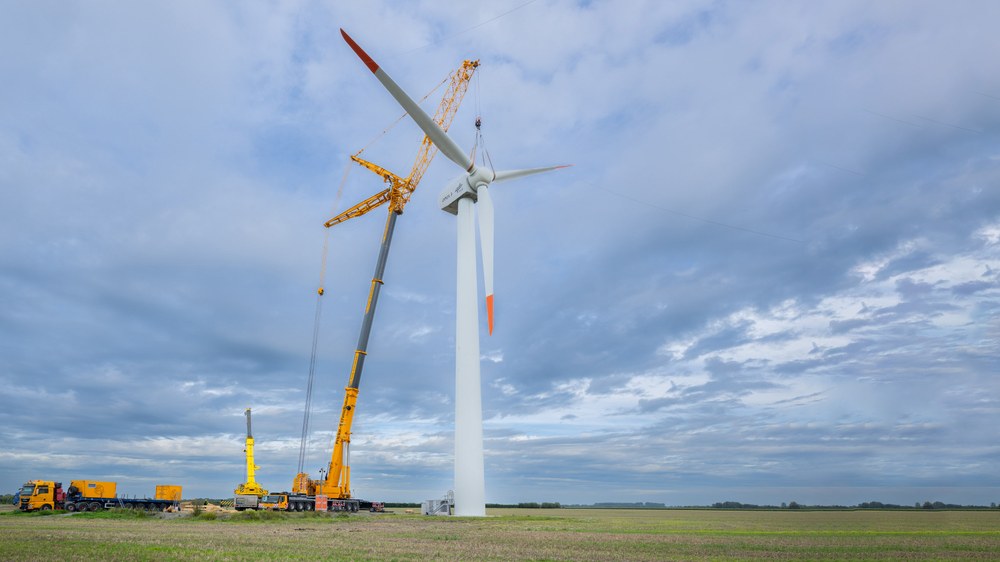
Precision work with more than 15 tonnes on the hook
The rotor hub weighs approximately 15 tonnes, and each of the rotor blades weighs 2.5 tonnes.
Even before the rotor of OPUS 3 began to turn, the new turbine had already delivered its first scientific data. During the assembly phase, researchers measured the tower's behaviour in the wind before the nacelle was fitted. At this stage, the weight of the nacelle was not yet added to the top of the tower, altering the vibration behaviour of the tower structure. The measurements are intended to help improve our understanding of such specific conditions during the assembly of wind turbines. This is particularly relevant given the trend towards ever-larger turbines, as insights into critical vibration states during construction can help to plan assembly processes more effectively, reduce risks and provide important data for the simulation of these components.
Further projects are already in the pipeline – both within DLR and in collaboration with industry and academia. These include, for example, the development and testing of particularly flexible rotor blades. Such technologies are intended to help make future wind turbines lighter and more efficient, while at the same time better managing the loads they experience.
A trio for the future of wind energy
OPUS 3 complements the two existing turbines – OPUS 1 and OPUS 2 – which were erected in 2023, and expands the capabilities of the DLR WiValdi research park. The two large turbines, each with a capacity of several megawatts, are equipped with extensive measurement technology. Some 2000 sensors are distributed from the foundations right up to the tips of the turbines' blades, mounted on the measurement masts or on the ground. They record, for example, loads, airflow, vibrations and the interactions between the turbines. Together, they provide a globally unique treasure trove of data to better understand wind energy and all the factors that influence it, thereby making it more efficient, economical and quieter.