Test benches for engine innovations now in operation
October 2, 2026
Test benches for engine innovations now in operation
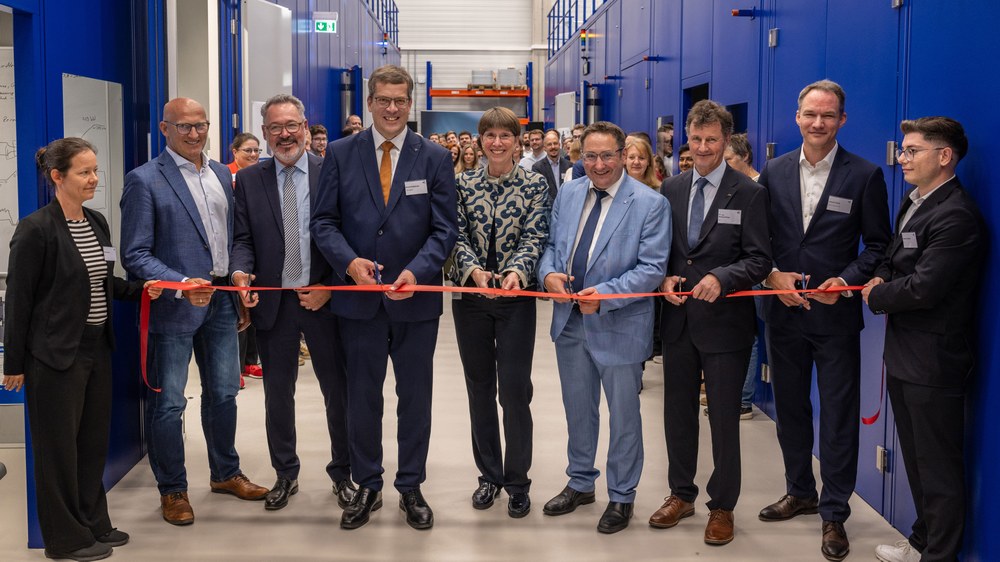
Opening ceremony
From left: Maria Cortes, DLR Institute of Test and Simulation for Gas Turbines; Anton Rittel, member of the Bavarian State Parliament; Thomas Köhler, Chief Operating Officer of Industrieanlagen-Betriebsgesellschaft (IABG); Bernd Zitzelsberger, Third Mayor of Augsburg; Sabine Ardey, director of the DLR Institute of Test and Simulation for Gas Turbines; Tobias Gotthardt, State Secretary in the Bavarian State Ministry of Economic Affairs, Regional Development and Energy; Markus Fischer, DLR Divisional Board Member for Aeronautics; Andreas Schilp, Head of Sales and Business Development at RENK Test System; and Antonio La Maida, DLR Institute of Test and Simulation for Gas Turbines.
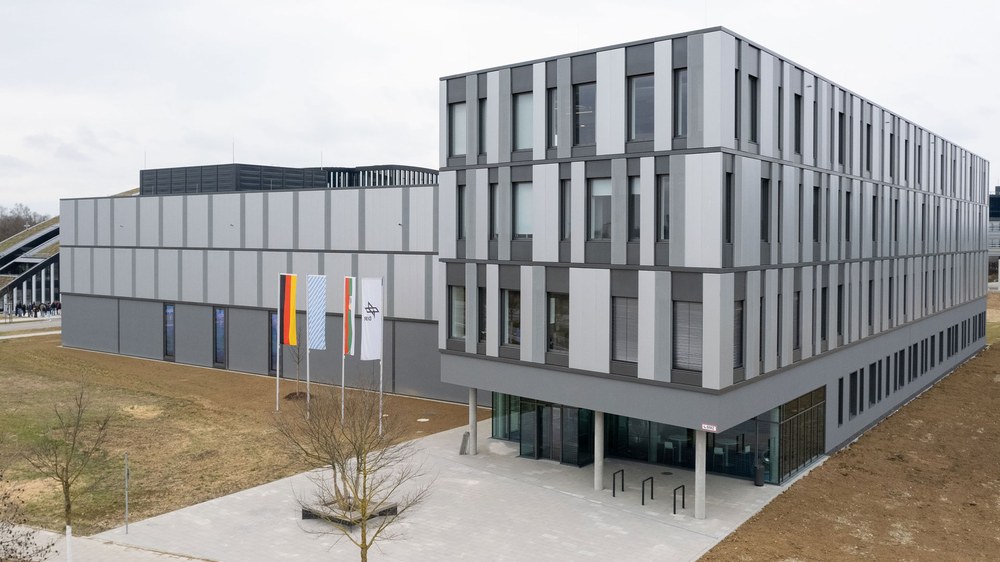
DLR Institute of Test and Simulation for Gas Turbines in Augsburg
The DLR Institute of Test and Simulation for Gas Turbines opened its new institute building in Augsburg on 25 March 2025. At the heart of the facility are digitally networked component test benches. These are complemented by an end-to-end digital platform under development – the 'virtual engine'.
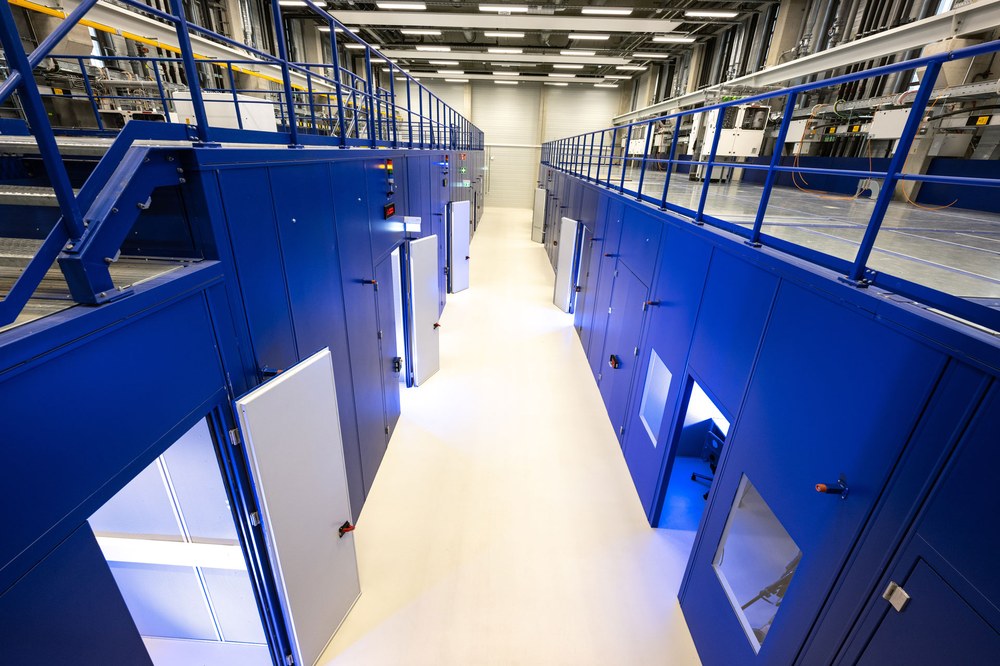
Hall overview – the DLR test laboratory for engine innovations
The test benches are housed in individual enclosed chambers in the test hall, for noise protection and safety reasons. The doors remain closed during tests, as the test benches operate with harmful gases. The technical infrastructure is visible in the upper part of the hall, including supply lines for the harmful gases, cooling water and the laser sources.
On 1 October 2026, the DLR Institute of Test and Simulation for Gas Turbines at the DLR site in Augsburg commissioned its test benches for engine components.
The new test infrastructure enables investigations under near-realistic conditions.
This infrastructure is unique in its range of capabilities.
Focus: Aeronautics, climate-compatible and economically efficient propulsion technology
Work on the research facility of the German Aerospace Center (Deutsches Zentrum für Luft- und Raumfahrt; DLR) is progressing at the Augsburg Innovation Park. On 1 October 2026, the DLR Institute of Test and Simulation for Gas Turbines commissioned its test benches for engine components. Researchers can now determine the behaviour and service life of components and materials even more precisely and optimise the effectiveness of sealing systems, with the aim of developing climate-compatible and economically efficient propulsion technologies.
Institute Director Sabine Ardey welcomed approximately 80 guests from politics, industry and research to the opening ceremony. The ceremony was held jointly with Tobias Gotthardt, State Secretary in the Bavarian State Ministry of Economic Affairs, Regional Development and Energy; Markus Fischer, DLR Divisional Board Member for Aeronautics; Bernd Zitzelsberger, third mayor of Augsburg; Thomas Köhler, Chief Operating Officer of Industrieanlagen-Betriebsgesellschaft (IABG); and Matthias Karrer, member of the management team of RENK Test System.
The new test infrastructure enables engine components to be investigated under near-realistic conditions and is unique in its range of capabilities.
Mechanical-thermal-chemical (MTC) testing
Gas turbines are usually overhauled every five to seven years. An unplanned, premature failure of an engine component is safety-critical and costly, so it is essential to determine service life as accurately as possible. To this end, the new DLR test hall is equipped with four different MTC test benches, in which test specimens undergo long-term tests involving simultaneous extreme mechanical, thermal and chemical loads. The benches differ in the mechanical load they can apply – the M component – while the thermal and chemical loading options (T and C) are the same on all four. Together, these MTC test benches cover the most relevant corrosion-induced damage behaviours in engines. The specimens are heated to up to 1400 degrees Celsius using an advanced laser system. During testing, they are housed in a pressure vessel that can be pressurised to up to 20 bar and filled with gas mixtures that simulate typical exhaust gas or individual exhaust gas components.
Depending on the application and load scenario, tests can last up to 100 days. A camera system with high spatial and temporal resolution allows the strain in the specimens and any resulting cracks to be observed in real time. Detailed analysis and interpretation of the damage mechanisms are also carried out at the DLR institute, which has a modern metallography laboratory and extensive microscopy facilities, including a scanning electron microscope.
MTC-Biax test bench
With two servo-hydraulic actuators on each of its two axes, the MTC-Biax test bench enables fatigue testing with forces of up to 100 kilonewtons per axis at frequencies of up to ten hertz. The biaxial set-up makes it possible to generate stress states in the specimens that closely reflect real applications, ensuring that the results can also be transferred to complex components.
With modified mechanical fixtures, the test bench can also be used for fretting fatigue testing. Fretting fatigue is a type of damage that is relevant to service life and can occur at points within an engine where different components are in contact with each other.
MTC-Creep test bench
Creep is one of the key factors limiting the service life of engine components such as turbine blades. It occurs when components are exposed to high temperatures and forces over long periods. Damage progresses faster particularly when cyclic factors, such as changes in mechanical load, are added. This creep-fatigue interaction is one of the greatest challenges in predicting service life.
The MTC-Creep test bench addresses precisely this issue, while also taking the influence of corrosion into account. In addition to uniaxial creep-fatigue testing at loads of up to 50 kilonewtons, it can subject specimens to cyclic torque, allowing complex stress states to be produced.
MTC-Uniax test bench
The MTC-Uniax test bench is based on a servo-hydraulic testing machine and allows test forces of plus or minus 100 kilonewtons at test frequencies of up to 30 hertz. Due to its highly flexible design, it can be used for tensile fatigue tests, as well as for bending tests and specialised crack growth investigations, for example. It therefore covers a particularly wide range of mechanical loads for testing under engine-like conditions.
MTC-VHCF test bench
The load frame of the MTC-VHCF (very high cycle fatigue) test bench is based on a modified electrodynamic resonance testing machine and enables a test frequency of 1000 hertz with a maximum load amplitude of plus or minus 15 kilonewtons. This makes the test bench particularly suitable for service-life tests with a very high number of load cycles (of the order of 10⁹), as is typical for aircraft engine applications. It is also suited to very rapid fatigue tests, for instance, to suppress time-dependent effects such as creep.
Rotor test bench
The rotor test bench of the DLR Institute of Test and Simulation for Gas Turbines has also entered operation. It enables full-scale engine components to be investigated under rotation and near-realistic test conditions, with regard to operating behaviour, wear, heat transfer and interactions. The focus is on the 'secondary air system', a key factor in the efficiency, and therefore the sustainability, of an engine.
Up to 20 percent of the airflow through a gas turbine does not pass through the main gas path, but through the secondary air system. This air is necessary for cooling, among other purposes, and is technically unavoidable, but it reduces the efficiency of the gas turbine. On the new test bench, brush seals can be tested under near-operational conditions – with drive speeds of 27,000 revolutions per minute, power of 170 kilowatts and an air supply of one kilogram per second at pressures of up to 15 bar and temperatures of up to 500 degrees Celsius. In the future, these capabilities are also to be made available for testing other components of the secondary air system, by modifying or replacing the test specimen holder (rig).
Engines of the future
Both power generation and aviation are set to become climate-neutral through the use of alternative, sustainable fuels – and gas turbines will continue to play a central role in this. At its site in Augsburg, DLR has created a test bench infrastructure that is unique worldwide and geared to these needs of industry and research. The construction of the building and the test facility was funded by the Bavarian State Ministry of Economic Affairs, Regional Development and Energy. The commissioning of the test benches now marks a further milestone in the development of the DLR Institute of Test and Simulation for Gas Turbines.