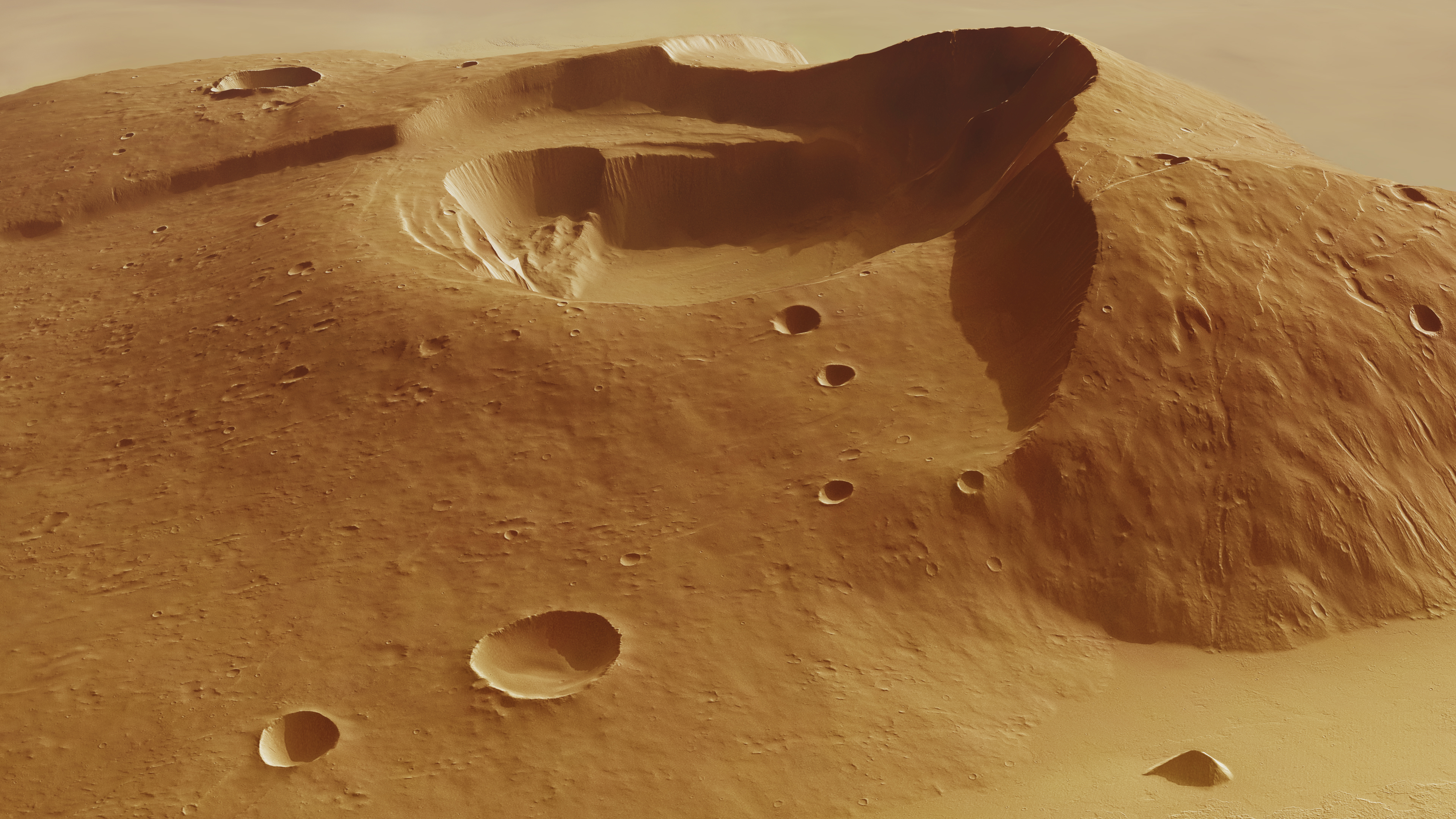
Tharsis Tholus shield volcano seen by the German HRSC Mars camera
November 18, 2026 | Mars Express mission
Tharsis Tholus shield volcano seen by the German HRSC Mars camera
The summit caldera of Tharsis Tholus on Mars
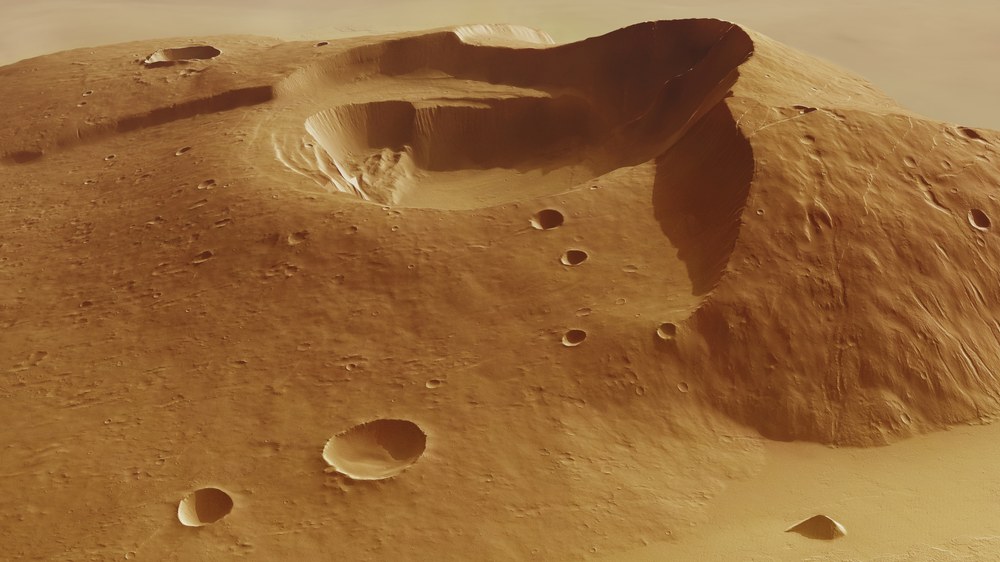
The summit of the Tharsis Tholus volcano is dominated by an irregularly shaped depression (known in technical terms as a 'caldera'). After several eruptions of the volcano and the associated emptying of the magma chamber, there were apparently at least two massive collapses. These created two overlapping calderas: an older (outer) one and a younger (inner) one. Their steep walls are criss-crossed by numerous gullies.
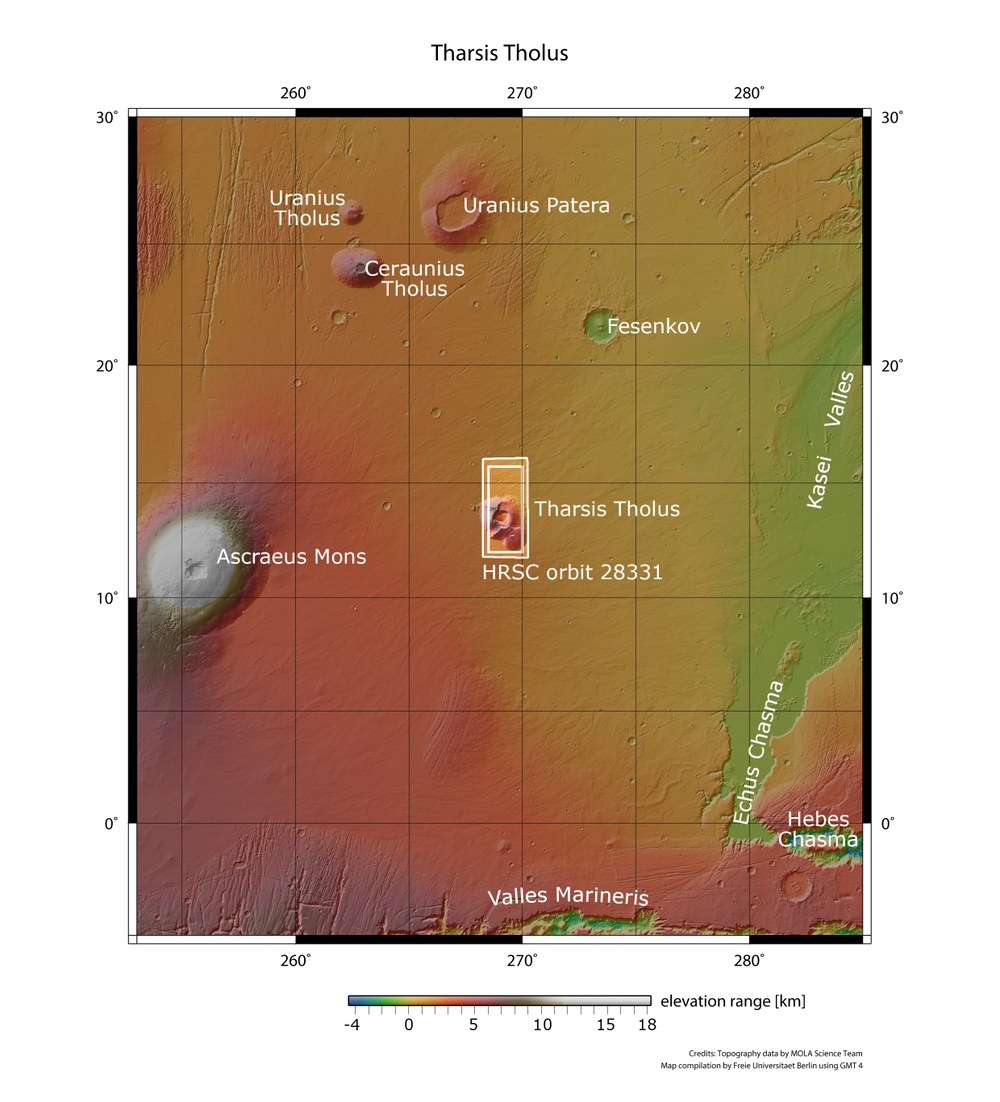
Here, in the north-eastern part of the Tharsis province, are the smaller dome-shaped volcanoes Uranius Tholus and Ceraunius Tholus, among others, as well as Uranius Patera (top of the image) with its prominent summit crater structure. Tharsis Tholus, approximately eight kilometres high (centre of the image), lies more than 800 kilometres from the 18-kilometre-high Ascraeus Mons (left of the image). Ascraeus Mons is one of the larger Tharsis volcanoes.
Image: 2/5, Credit:
NASA/JPL/USGS/MOLA; FU Berlin
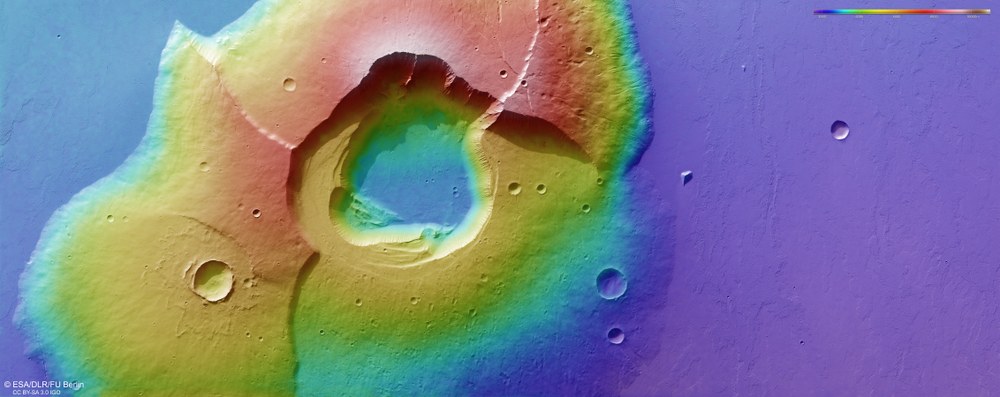
Colour-coded terrain model of the Tharsis Tholus region on Mars
The model was created using data from the nadir channel and the colour channels of DLR's HRSC camera. The scale at the top right shows the differences in elevation. The distance between the floor of the depression inside the volcanic edifice and the highest point of the crater rim is approximately three kilometres.
New images from the German HRSC camera show impressive close-ups of the eight-kilometre-high Tharsis Tholus volcano.
Characteristic features include impact craters, large scarps and faults on its flanks, as well as an almost three-kilometre-deep 'double depression'.
With the help of the DLR-developed camera, the Martian surface is visualised in 3D with high precision.
Focus: Exploration, Mars Express, HRSC camera
It is more than twice as high as Mount Etna, yet by Martian standards it is only average. What makes the shield volcano Tharsis Tholus so striking is its external appearance, with its distinctive double caldera – or collapse crater – which can be seen in new images captured by the German High Resolution Stereo Camera (HRSC) orbiting Mars.
What does the future hold for Mars exploration? How will today's missions, instruments and international collaborations help prepare for the first human on Mars? Ulrich Köhler from DLR paints a fascinating picture, spanning current rover missions, planned sample return missions and the big questions about life on the Red Planet. It becomes clear why Mars, as the planet most like Earth, holds such a special fascination – while presenting enormous technical and societal challenges.
The future of Mars: Missions & Visions • Setting out into the next century? | Lecture by Ulrich Köhler at the DLR Astroseminar 2025
Your consent to the storage of data ('cookies') is required for the playback of this video on Youtube.com. You can view and change your current data storage settings at any time under privacy.
The future of Mars: Missions & Visions • Setting out into the next century? | Lecture by Ulrich Köhler at the DLR Astroseminar 2025
What does the future hold for Mars exploration? How will today's missions, instruments and international collaborations help prepare for the first human on Mars? Ulrich Köhler from DLR paints a fascinating picture, spanning current rover missions, planned sample return missions and the big questions about life on the Red Planet. It becomes clear why Mars, as the planet most like Earth, holds such a special fascination – while presenting enormous technical and societal challenges.
The HRSC is an experiment developed by the German Aerospace Center (Deutsches Zentrum für Luft- und Raumfahrt; DLR) for the European Mars Express mission, which has been orbiting Mars since 2003. Because the robust camera is still reliably sending image data to Earth in its 23rd year of operation, the Red Planet has now been mapped topographically almost in its entirety. In addition, researchers can visualise its surface in three dimensions, gaining insights into geological processes from the early period of Mars and, hence, the formation of our planetary system.
The Tharsis region is the largest volcanic province on the planet. It rises up to nine kilometres above the Martian reference level – analogous to sea level on Earth. Tharsis highlights include the three stratovolcanoes Ascraeus Mons, Pavonis Mons and Arsia Mons, as well as Olympus Mons, at the edge of the province – the largest volcano in the Solar System.
The region is also home to numerous smaller volcanoes whose names include 'Paterae' (irregularly shaped depressions) or 'Tholi' (dome-shaped mountains) – such as Tharsis Tholus. It is situated in the eastern part of the province, more than 800 kilometres from Ascraeus Mons. Rising up to eight kilometres above the surrounding lava fields, it may seem small by Martian standards. Compared with Earth’s volcanoes, however, it would be a giant – more than twice as high as Mount Etna in Sicily.
Complex formation history
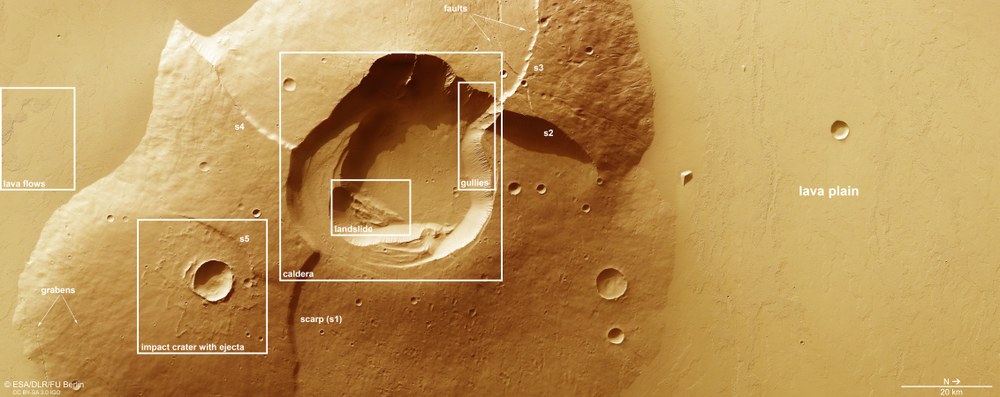
Tharsis Tholus is surrounded by younger lava fields. Its original dimensions are difficult to determine, as today only the upper part of the volcano is exposed. The flanks of the volcano are marked by impact craters, large scarps (steep escarpments) and faults. Four of these scarps run radially, in pairs, from the centre outwards (see annotated image, labelled s1 and s2, and s3 and s4). They bound two 'sector collapses', in which parts of the flanks sank into the subsurface owing to the volcano's increasing weight, leading to the deformations visible today. The grabens (rift valleys) and faults on the flanks can also be explained by these settling processes.
The varied landforms of Tharsis Tholus and its surroundings
The characteristic features in the summit crater (caldera) of the volcano Tharsis Tholus are a landslide and erosion gullies along the inner crater rim. Immediately outside the caldera are several scarps (steep escarpments) that radiate outwards in pairs from the centre of the volcano (s1 and s2, and s3 and s4). They were formed by settling processes on the volcano’s flanks. Scarp s5, by contrast, belongs to an impact crater whose ejecta are still clearly visible. The faults and grabens can also be traced back to the sinking of the huge volcanic edifice into the subsurface. At the edges of the image, narrow lava flows and extensive plains completely covered by lava can be seen.
The summit of Tharsis Tholus is dominated by a large, irregularly shaped depression. Such calderas form when a magma chamber beneath a volcano is largely emptied during eruptions. This causes the overlying rock to become unstable and collapse under its own weight. At Tharsis Tholus, there appear to have been at least two massive collapses, resulting in two overlapping calderas: one older (outer) and one younger (inner). The depression is almost three kilometres deep and, relative to the size of the volcano, exceptionally large. Its steep walls are criss-crossed by numerous gullies. In one place, part of the inner caldera wall has also collapsed, triggering a landslide. Calderas are also widespread geological formations on Earth. Some fill with water over time and develop into lakes. A well-known example of this is Lake Laach in Germany’s Eifel mountain range.
Volcanoes on Mars compared with Earth
Earth's crust is divided into tectonic plates that interact with one another through lateral movement, collision or subduction. Geologists use the term subduction when one tectonic plate is pushed beneath another. Many volcanoes on Earth form in subduction zones, including those around the 'Pacific Ring of Fire', or above hotspots such as in Hawaii. As these tectonic plates move, volcanic activity can occur in different locations over millions of years.
On Mars, there are no plate tectonics or Earth-like subduction zones – it is a 'single-plate planet'. Its volcanoes therefore always remain above the same magma source and, as a result, can grow much larger than most volcanoes on Earth. The planet's lower gravity and extremely low erosion also favour their growth. Volcanic activity on our neighbouring planet was particularly widespread during the Noachian and early Hesperian periods, approximately 4.2 to 3.6 billion years ago. To this day, Tharsis Tholus and its surrounding lava fields, among others, bear witness to this eruptive phase – impressively documented in this HRSC image.
Background info – image processing
The images were taken by the High Resolution Stereo Camera (HRSC) on 15 June 2026 during Mars Express orbit 28,331. The ground resolution is approximately 18 metres per pixel, and the image centre is located at approximately 13 degrees North and 269 degrees East.
The colour image was created from data from the nadir channel, whose field of view is directed perpendicular to the Martian surface, and from the colour channels of the HRSC images from orbits 17,050 and 17,444, because no colour data was captured for the image shown here. The oblique perspective view was generated from the digital terrain model, the nadir channel and the respective colour channels of the HRSC. The anaglyph image, which gives a three-dimensional impression of the landscape when viewed with red-blue or red-green glasses, was derived from the nadir channel and a stereo channel. The colour-coded topographic view is based on a digital terrain model of the region, from which the topography of the landscape can be derived.
The High Resolution Stereo Camera was developed at the German Aerospace Center (DLR) and built in cooperation with industry collaborators EADS Astrium (now Airbus), Lewicki Microelectronic and Jena-Optronik. The research team, led by Principal Investigator Daniela Tirsch, comprises 50 co-investigators from 35 institutions in 11 countries. The camera is operated by the DLR Institute of Space Research (formerly the DLR Institute of Planetary Research) in Berlin-Adlershof.