
Freight transport in Germany – a comparison of transport modes
Focus: Mobility in Germany
The second instalment in the 'Facts and Figures' series examines mobility in Germany, with a particular focus on freight transport. The series looks at trends in transport performance across road, rail and inland waterways, as well as the resulting carbon dioxide equivalents.
Freight transport performance in Germany
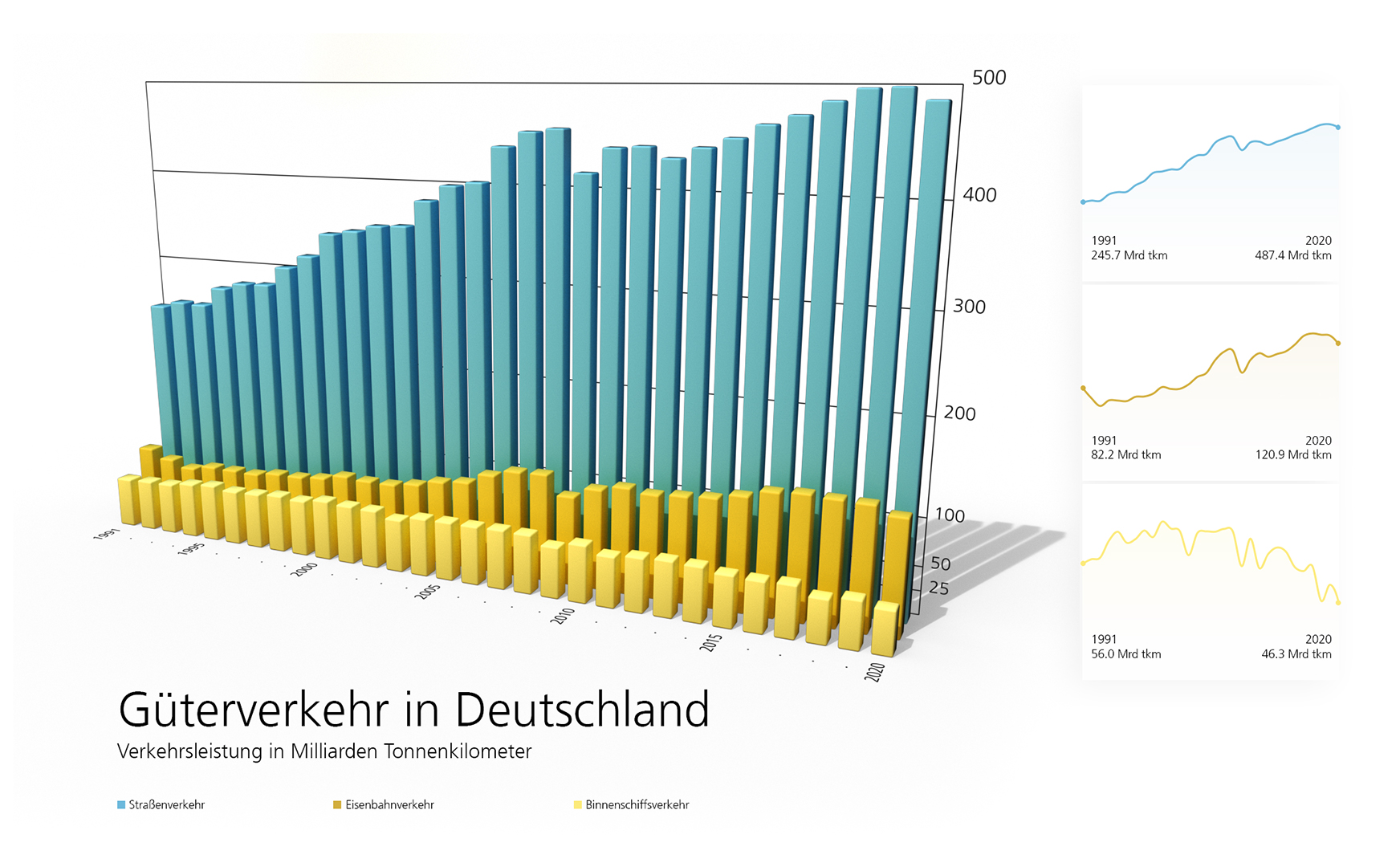

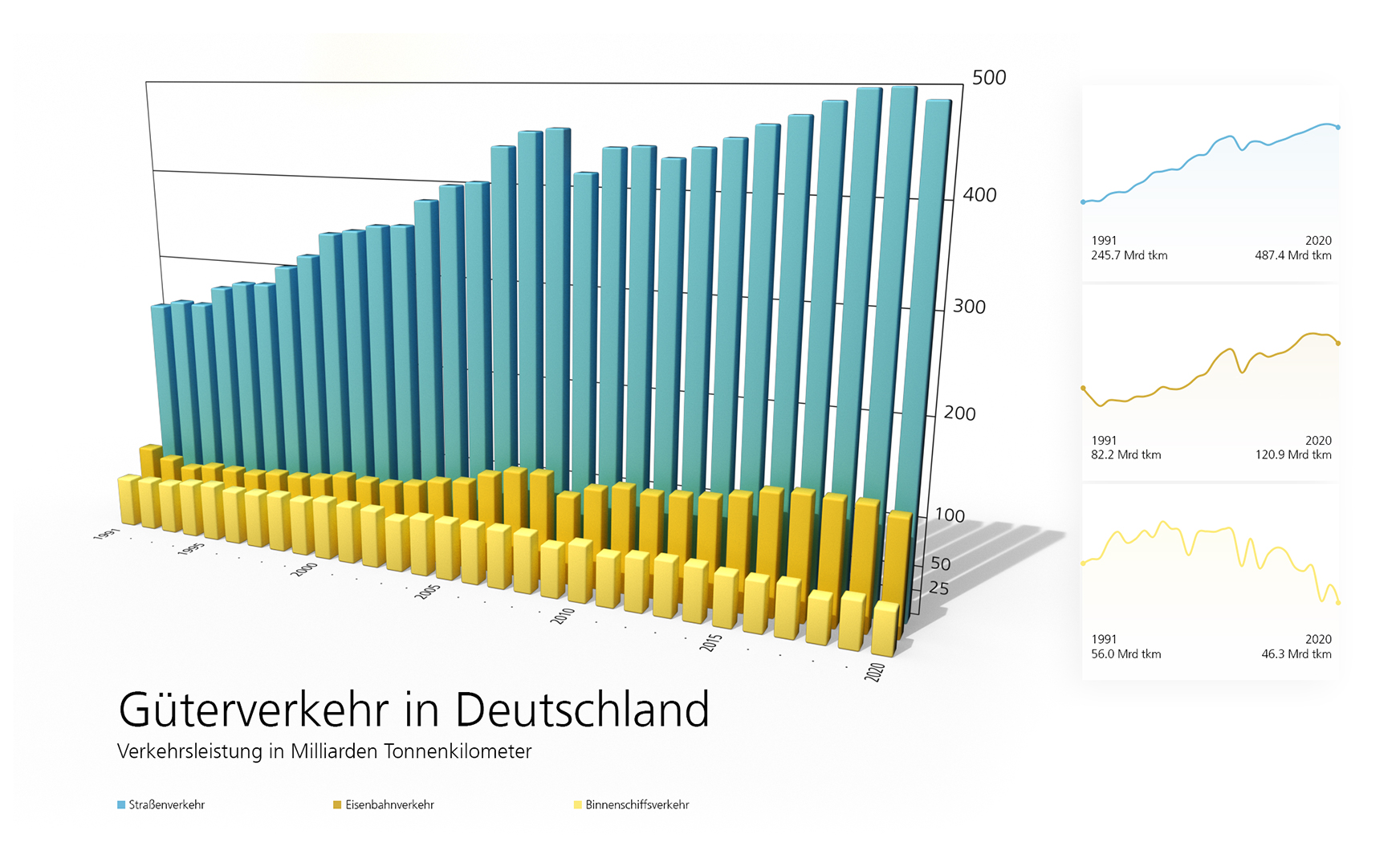
- Tonne-kilometres are a unit of measurement for freight transport performance. Freight transport performance describes the distance travelled by goods within a given period. The data presented here is taken from the Federal Ministry of Transport (BMV) – Transport in Figures (Verkehr in Zahlen).
- Methodology: The transport performance figures presented here are based on data collections and mandatory economic reports submitted to the Federal Motor Transport Authority and the Federal Statistical Office (destatis).
- Freight transport via pipelines, maritime shipping and air is not included here.
Sustained, strong growth
- In 2020, a total of 654.6 billion tonne-kilometres was recorded. This figure is lower than the 678.7 billion tonne-kilometres recorded in 2019, due to the COVID-19 pandemic.
- Over the past 30 years, freight transport has grown continuously at a strong level – starting from 383.9 billion tonne-kilometres in 1991. Overall, this represents an increase of approximately 70 percent.
- Background: The increase in freight transport performance reflects the growing international division of labour and the resulting supply chains, as well as the overall development of the German economy (growth in Gross Domestic Product). The overall growth in freight performance is primarily driven by the increase in road transport. One reason for this is the development of the German economy and its logistical requirements. These include, for example, smaller shipment sizes and more flexible and timely delivery of intermediate goods and raw materials, combined with generally lower logistics and transport costs. Rail freight has also increased by more than 50 percent. Over the past two decades, intermodal transport between several European seaports and German transshipment terminals has seen the most significant growth. Inland waterway transport has also increased in this sector, while the transport of bulk goods – especially raw materials, chemical intermediates, cement and petroleum products – has declined in both rail and inland waterway transport.
- The slightly lower figures between 2009 to 2014 can be attributed to the global financial and economic crisis.
-
Road freight is by far the dominant mode of transport in Germany. In 2020, it accounted for 74 percent of total freight transport. In round figures, rail transport accounts for approximately 18 percent and inland waterways for 7 percent.
Road freight transport:
- Definition: This refers to domestic freight transport by German and foreign lorries in domestic traffic (start and destination in Germany), import and export traffic (start or destination abroad, with only the section on German roads counted here) as well as transit transport (origin and destination abroad, with only the section on German roads counted here).
- In 2020, a total of 487.4 billion tonne-kilometres were recorded on German roads.
- Over the last three decades, German road freight transport has doubled: from 245.7 billion tonne-kilometres in 1991 to 498.6 billion in 2019 (2020, the year of the COVID-19 pandemic: 487.4 billion).
Rail freight transport:
- Definition: This refers to domestic freight transport carried out by all railway companies licensed in Germany, comprising domestic transport (start and destination within Germany), import and export transport (origin or destination abroad, with only the section on the German rail network included here), and transit transport (origin and destination abroad, with only the section on the German rail network included here). Not included is transport within industrial rail networks, such as railways in open-cast mines, ports and large industrial sites.
- In 2020, approximately 120.9 billion tonne-kilometres were transported by rail. Before the pandemic in 2019, the figure stood at 129.2 billion.
- Over the last 30 years, rail transport performance has increased by just over 50 percent, though not as strongly as road freight transport. In 1991, the figure stood at 82.2 billion tonne-kilometres.
Inland waterway freight transport:
- Definition: This refers to domestic transport on German inland waterways carried out by German and foreign private operators (independent vessel owners who also operate their vessels and generally own one or two vessels) and shipping companies in domestic traffic (start and destination in Germany), import and export traffic (origin or destination abroad, with only the section on German waterways included here) and transit traffic (origin and destination abroad, with only the section on German waterways included here).
- In 2019, more than 50 billion tonne-kilometres were covered by inland waterway vessels. This figure fell to 46.3 billion in 2020 due to the COVID-19 pandemic.
- Over the last 30 years, transport performance in inland waterway transport increased slightly until the global financial and economic crisis, followed by a slight decline. In 1991, the figure was 56 billion tonne-kilometres.
- Background: Inland waterway transport is primarily sensitive to fluctuations caused by high or low water levels. Ninety percent of transport takes place on the Rhine and its tributaries, and on canals. Despite comparatively low transport performance, inland waterway transport is particularly important for the chemical and steel industries as well as the mineral oil industry, due to the high masses that can be transported at low transport costs.
Carbon dioxide equivalents of freight transport in Germany
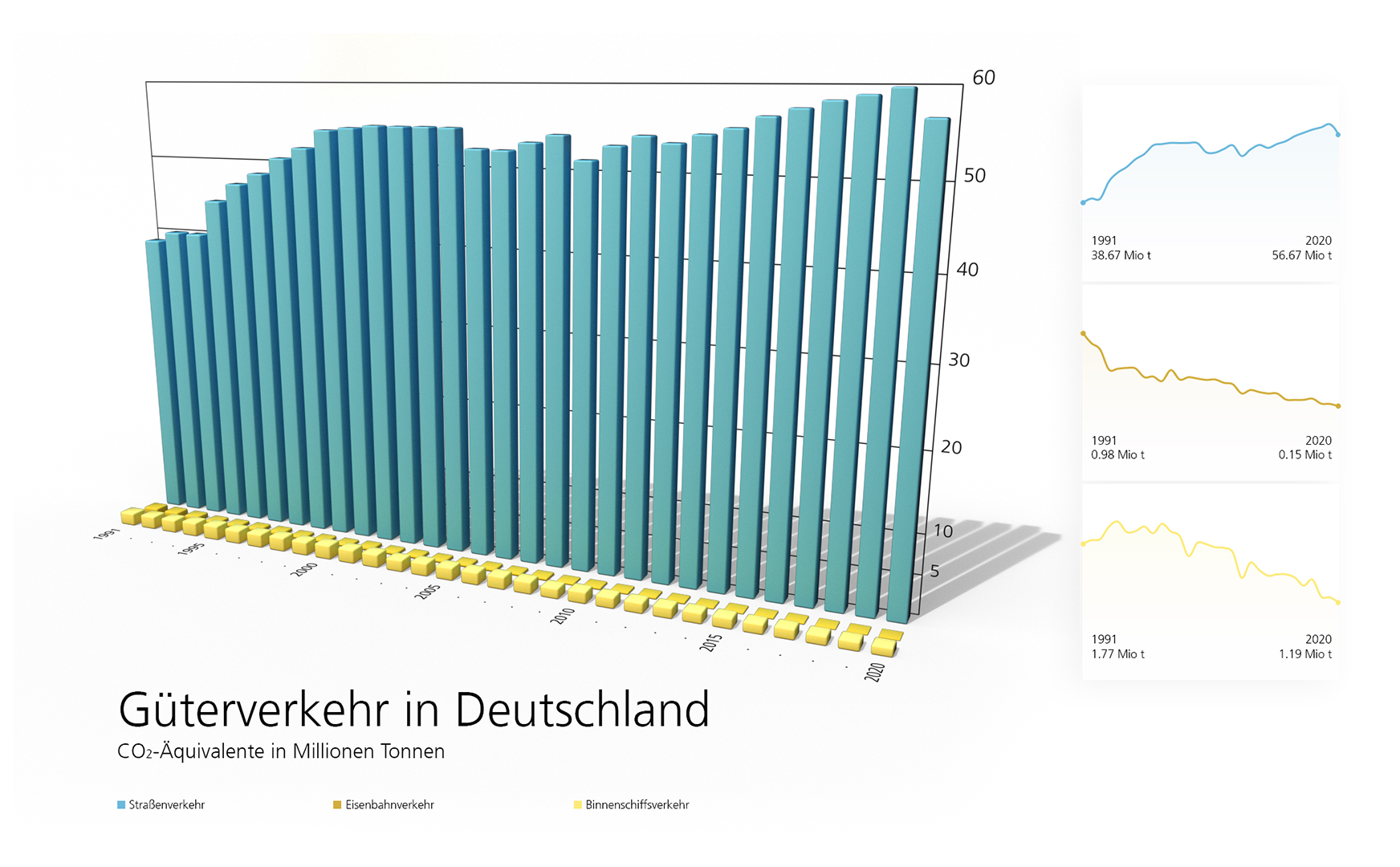
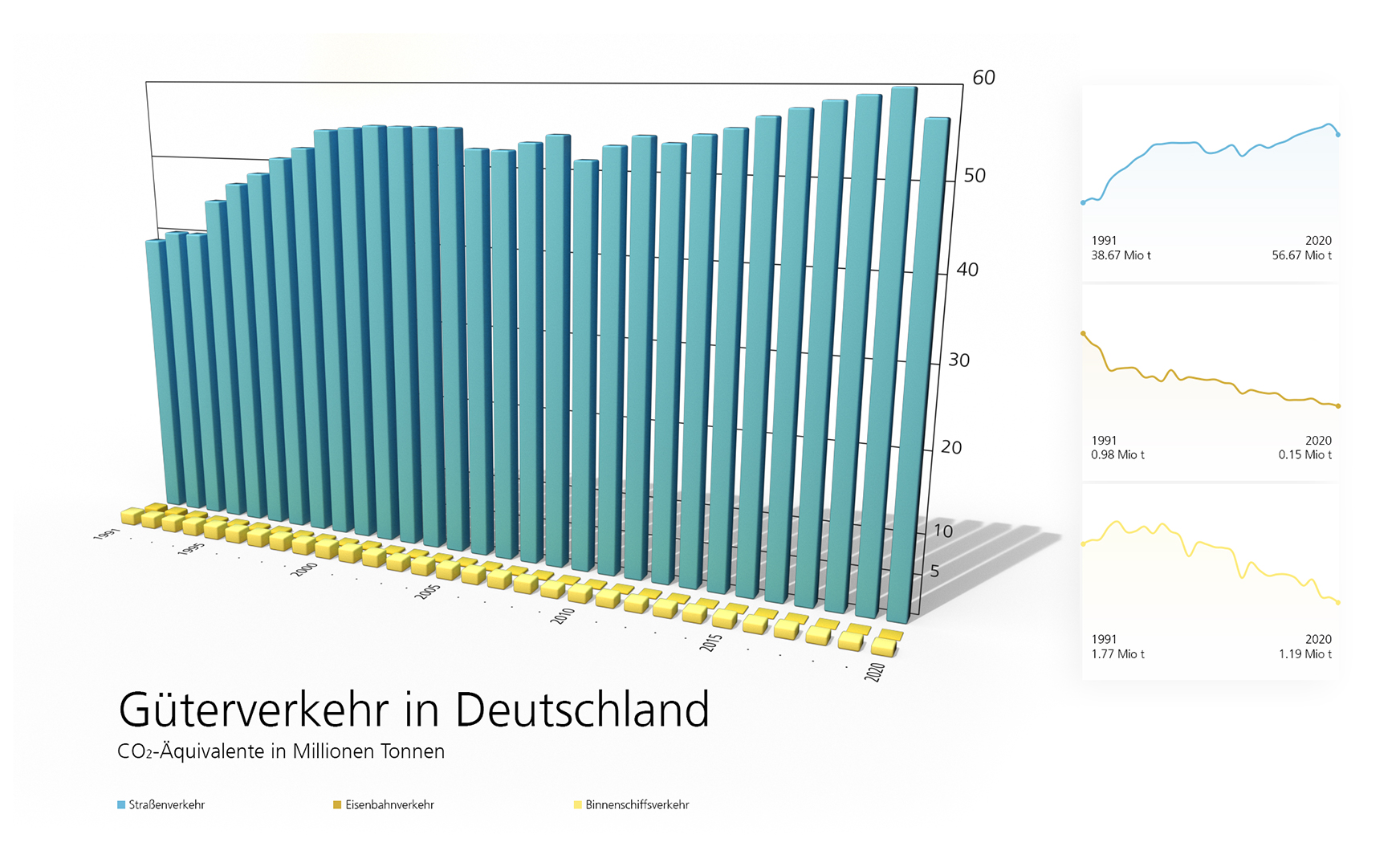
The graph shows carbon dioxide equivalents (CO2e), a unit of measurement used to standardise the climate impact of different greenhouse gases. The greenhouse gases considered are carbon dioxide (CO2), methane (CH4) and nitrous oxide (N2O). CO2e emissions are calculated based on vehicle-specific emission factors and the corresponding transport performance. The model used for this is the Transport Emission Model (TREMOD 6.21: Development of CO2e emissions for domestic transport) from the Institute for Energy and Environmental Research (Institut für Energie- und Umweltforschung; ifeu), which performs these calculations on behalf of the German Environment Agency (Umweltbundesamt; UBA).
A steady rise in emissions corresponding to the increase in traffic volume, with few efficiency gains
- In 2020, CO2e emissions from freight transport totalled 58.10 million tonnes.
- Over the last 30 years, CO2e emissions have risen steadily by a total of nearly 60 percent. In 1991, the figure stood at 41.42 million tonnes.
-
Road freight transport dominates CO2e emissions by a very wide margin. In 2020, it accounted for 97.5 percent of total CO2e emissions from freight transport. Rail transport accounted for 0.26 percent and inland waterway transport for nearly 2 percent (rounded figures).
Road freight transport:
- In 2020, road freight transport generated 56.67 million tonnes of CO2e emissions, a decline from the previous year's figure of 59.78 million tonnes, attributed to the COVID-19 pandemic.
- Over the last 30 years, emissions have increased by almost 50 percent, from 38.67 million tonnes in 1991 to approximately 56.67 million tonnes of CO2e. Transport performance has doubled over the same period.
This trend is driven by improvements in the average fuel consumption of goods vehicles and more efficient transport logistics. The latter is primarily due to rising average load factors and fewer empty runs. In addition, there is a statistical effect resulting from the very strong growth in the long-distance road freight transport segment. This segment is served by large articulated lorries with a gross vehicle weight of 40 tonnes which, combined with the average load factor, exhibit a lower specific CO2e value per tonne-kilometre than smaller vehicles. As a result, the rise in CO2e has been lower than the growth in road freight transport, which also includes smaller vehicles. Almost 100 percent of long-distance road freight transport is still diesel-powered. To significantly reduce CO2e emissions, a change in drive technology is therefore required. A rapid transition to electrically powered lorries, such as with batteries or green hydrogen and fuel cells, would be realistic options.
Rail:
- In 2020, rail freight transport generated 0.15 million tonnes of CO2e. In 2019, the pre-pandemic year, the figure stood at 0.18 million tonnes.
- Over the last 30 years, emissions from rail freight transport have fallen by almost 85 percent – from 0.98 million tonnes of CO2e emissions in 1991 to 0.15 million tonnes in 2020. Transport performance, by contrast, increased by more than 50 percent.
Background: Rail freight transport is already over 90 percent electrified today on the electrified section of the network, which is already operating at high capacity. This means that this share can only be increased marginally through the electrification of further routes. The remaining CO2e emissions stem from traffic on non-electrified lines, shunting operations and journeys on non-electrified industrial and connecting railways. Further reductions will require alternative drives and renewable fuels.
Note: The CO2e emissions of rail freight transport are calculated at the vehicle level ('tank-to-wheel') and do not include emissions from electricity generation. These are accounted for in the energy sector because they are generated in power plants. However, 60 percent of the electricity used for all rail transport (passenger and freight) comes from renewable sources, according to the interest group Allianz pro Schiene.
Inland waterway freight transport:
- In 2020, freight transport by inland waterway emitted 1.19 million tonnes of CO2e. In 2019, the figure was 1.25 million tonnes.
- In 1991, the figure was 1.77 million tonnes. CO2e emissions have fallen by just under one third overall, while transport performance has changed only slightly.
- Background: This is primarily due to improved efficiency gains from newer and larger inland waterway vessels. These have lower CO2e emissions per tonne-kilometre. Compared to other modes of transport, inland waterway vessels have the lowest specific primary energy demand per tonne-kilometre. This efficiency is due to the fact that the bulk goods, which make up most cargoes, are suitable for carriage on large vessel. Although these vessels are comparatively slow, they travel on waterways with low energy consumption.