
DLR research on vertiports, passenger decisions and airline planning at EWGT 2026

- Vertiports and their integration into the existing transport network
- Passenger decision-making and digital planning processes
- Barriers to innovation on the path towards sustainable mobility
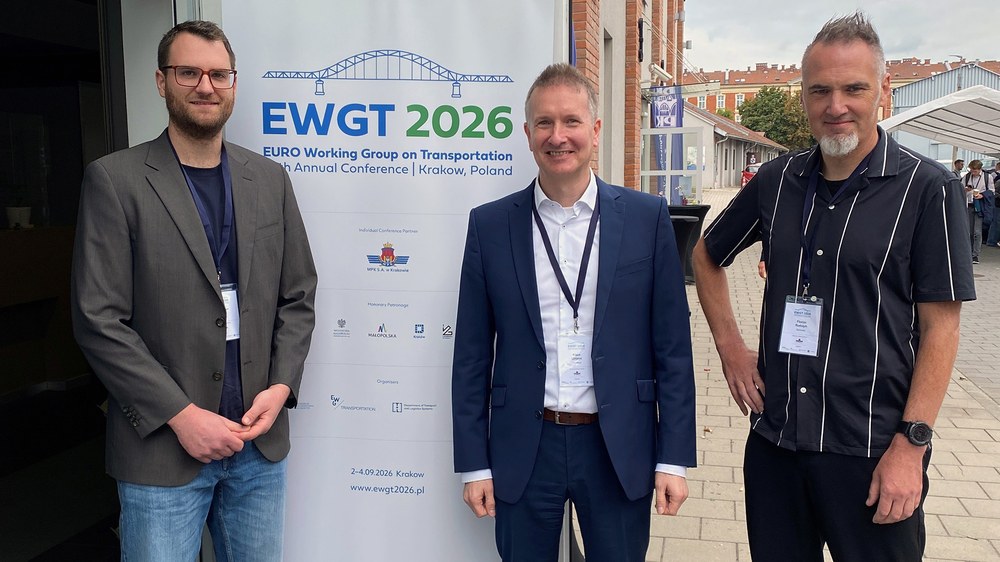
From 2 to 4 September 2026, the international transport research community met in Kraków, Poland, for the 28th Annual Conference of the EURO Working Group on Transportation (EWGT 2026). The conference focused on the challenges facing modern transport systems: they need to be efficient, sustainable and accessible to all, while also responding to global developments such as climate change, technological transformation and new requirements for safety and resilience.
The DLR Institute of Air Transport was represented at EWGT 2026 with several scientific contributions. The papers demonstrate the breadth of the institute’s research into air transport and its interfaces with other modes of transport – from the integration of new forms of mobility and the modelling of passenger processes to the optimisation of airline planning and the framework conditions for introducing innovations in the transport sector.
Innovative Air Mobility: vertiports as part of the mobility chain
How well Innovative Air Mobility (IAM), that is, the use of electric air taxis and drones, for example in urban areas, can be integrated into existing transport systems depends on the location of potential vertiports and their connections to the ground-based transport network. A comparison of the Campania region in Italy and the Hamburg metropolitan region examines the choice of transport modes for journeys to and from modelled vertiport locations.
The comparison reveals differences: in Hamburg, public transport plays a greater role in connecting purposefully located new vertiport sites. In Campania, by contrast, the use of existing airfields with poorer transport connections means that the car is the dominant mode. The findings show that the choice of suitable vertiport locations and the existing transport infrastructure are crucial in determining whether IAM can deliver its expected mobility and sustainability benefits.1 The study was carried out in collaboration with the University of Naples Federico II, Department of Civil, Building and Environmental Engineering, and the Italian Aerospace Research Centre (CIRA).
The passenger perspective: considering time and cost together
Individual passenger decisions in time-critical situations during a journey can be investigated using an extended passenger trajectory model. In addition to the timing of a journey, the approach takes economic factors into account and can, for example, model paid priority services for airport security screening. The results for this example show that, with moderate uptake, offering paid priority access at security screening can provide users with significant time savings. However, as utilisation increases, the benefits decrease again due to additional waiting times. 2
Digital Airline Twin: fleet assignment and maintenance planning
In airline planning, decisions made at an early planning stage can affect subsequent processes. Additional requirements in later stages may render the original plan infeasible, making replanning necessary. As part of the Digital Airline Twin, the DLR Institute of Air Transport has therefore developed a method that automatically identifies problems in subsequent maintenance planning and incorporates the corresponding feedback into fleet assignment. By linking the models, the approach ensures, for example, that a particular aircraft type is not over-utilised. The method can also optimise complex flight schedules in such a way that the required maintenance of the aircraft in operation can be accommodated. 3
Transport innovations: what prevents implementation?
Promising innovations do not automatically make their way into practice in the transport sector. A systematic review of the literature on 16 innovations – including, for example, intermodal innovations such as coach hubs at airports – therefore examines the barriers that arise during their introduction and the challenges shared by different types of innovation. The results reveal both innovation-specific and cross-cutting barriers to the implementation of sustainable transport solutions. The study was carried out as part of the DLR ViMiTrans project, which develops models and tools for designing and evaluating transformation pathways in cities and regions.4
Further information
1 Cosenza, V., Pertz, J., Villani, V., Pariota, L., Travascio, L., Vozzella, A., Lütjens, K., Bifulco, G. N. “Adoption of access mode to air transport: a comparison of Italian and German study cases”, 28th EURO Working Group on Transportation Annual Meeting 2026 – EWGT2026, Kraków, Poland.
2 Rudolph, F., Ennen, D., Milbredt, O., Timmer, M. “Extension of the passenger-trajectory for individual economic decision-making at airports”, 28th EURO Working Group on Transportation Annual Meeting 2026 – EWGT2026, Kraków, Poland.
3 Röhrs, M., Albrecht, S., Ehlers, T., Lütjens, K. “Automatic generation and integration of maintenance feasibility feedback into the fleet assignment model”, 28th EURO Working Group on Transportation Annual Meeting 2026 – EWGT2026, Kraków, Poland.
4 Engel, M. “Barriers to innovation in the transport sector: a structured literature review across innovation types (in ViMiTrans)”, 28th EURO Working Group on Transportation Annual Meeting 2026 – EWGT2026, Kraków, Poland.