
Fully automated business consultant


Getty Images – Oscar Wong
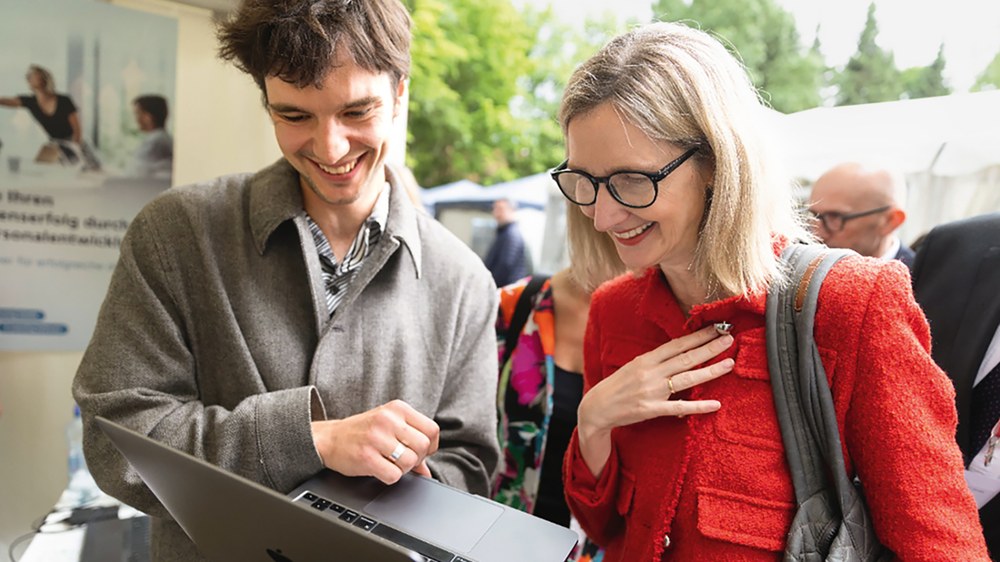
At this year's SME Innovation Day for small and medium-sized enterprises (SMEs) in Berlin, Lukas Beckenbauer's stand certainly drew in the crowds. The young researcher presented the result of nearly two years of work carried out together with a team from the Technical University of Munich and TU Bergakademie Freiberg: Rosie, a chatbot that advises SMEs on how to make profitable use of artificial intelligence (AI). Rosie is the result of an Industrial Collective Research (IGF) project, one of many funded by the Federal Ministry for Economic Affairs and Energy (BMWE). Acting on behalf of ministries, DLR Projektträger implements programmes for SMEs that help bring innovative solutions into practice. As a consultant and link between government and research, DLR Projektträger drives innovation forward for the benefit of the economy and wider society.
Returning now to the event in Berlin, a young bookseller chats with Rosie and asks how she can increase her bookshop's sales. Rosie raises queries and, over the course of their chat, devises the initial steps of a strategy: build a community around the bookshop, use social media channels to this end and optimise the shop's web presence for search engines. The bookseller is surprised – the responses are precise and easy to action. That's what Rosie, the fully automated business consultant, is all about. This chatbot was developed by Beckenbauer and Tim Kanis, along with Isabell Welpe and Jutta Stumpf-Wollersheim.
How Industrial Collective Research works
What makes the IGF funding programme unique is that companies join forces in research consortia to define the research requirements in their sector. "Competitors come together to set out the topics and objectives of IGF research projects," says Judith Hellhake, DLR Projektträger's Head of Department for Innovations in SMEs. "That is a defining feature and a huge benefit of this funding programme, because every company – whether they're an industry giant or small SME, whether they have an in-house research department or not – brings their own expertise to the table." Research topics are chosen together, and the risks of research are spread across many shoulders. IGF findings are published and made openly accessible to all, so any one company won't gain an exclusive competitive edge. Through a network of more than 100 research associations, IGF offers a number of leads for businesses to follow – across multiple industries and for any subject.
AiF Project GmbH
In 2024, the BMWE tasked DLR Projektträger with the implementation of the IGF programme. As Hellhake explains: "We create opportunities for the diverse IGF community, with a range of focus areas, to exchange their ideas. At the 2025 IGF Congress, hosted by the Federal Ministry for Economic Affairs and Energy in Berlin, more than 130 IGF stakeholders from business, research and politics came together to network and inspire one another."
As an interface with research associations and by engaging with researchers, experts at DLR Projektträger gather experience from the IGF on behalf of the ministry, ensuring the programme's continued evolution. In their day-to-day work, they also ensure processes run smoothly within the IGF: "We review applications, issue funding decisions and advise the research associations on matters including the submission of applications," says Hellhake. Her team organises and oversees review panels where external experts assess funding applications and make their recommendations.
Only pre-approved research consortia can benefit from IGF funding – and this comes with conditions, such as having non-profit status. DLR Projektträger checks whether all criteria have been met and ultimately authorises research associations to participate.
The IGF researchers behind Rosie
The team of developers behind Rosie have also benefited from the IGF. Rosie, the fully automated business consultant, is based on the Mistral language model from France – but she can do a whole lot more than most other chatbots. "In the day-today use of applications like ChatGPT, many users only scratch the surface of the potential held by large language models," says Beckenbauer. Kanis adds: "SMEs are very keen to use AI to enhance their efficiency and strengthen their capacity for innovation – yet they often lack resources and AI expertise." Rosie fills this gap.
Multiple companies have already tried out Rosie, including the Munich-based communications agency Platzer Kommunikation. Having tested Rosie and compared his own specialist knowledge with the chatbot's responses, the agency's managing director, Karl Platzer, concludes that Rosie delivers sound recommendations: “This gives me great confidence that even in still uncharted territory for me, the quality will be consistently high." The IT infrastructure and security specialists at KoSytec Systemhaus also tested Rosie, with the company's managing director, Eberhard Vogel, commenting: "Rosie is a real help for SMEs looking into AI. The chatbot provides ideas and suggestions for planning specific use cases in business." In Vogel's assessment, these ideas are practical, understandable and close to real-world needs.
Myriad possibilities
With their Rosie chatbot, Lukas Beckenbauer and his colleagues have created an approach for bringing the benefits of AI to many entrepreneurs working with a tight budget. But Rosie is just one of many projects seeking to shape AI into a market-ready technology.
DLR Projektträger oversees a string of projects across various federal programmes – for example with AI trainers in the BMWE's digital infrastructure and increased digital competence in SMEs programme (Mittelstand-Digital) and with the 'AI Innovation Competition – Generative AI for SMEs' funding programme, run on behalf of the Federal Ministry of Research, Technology and Space. The competition supports practical projects that facilitate the adoption of generative AI and is explicitly tailored to the needs of SMEs. In this respect, DLR Projektträger serves as a funding manager and strategic partner, driving forward cutting-edge AI research in Germany and Europe whilst ensuring that this new technology is put to practical use. The underlying goal is for German and European business and research to remain on equal footing with international competitors.
An article from the DLRmagazine 178. Evelyn Stahl is a communications officer for matters concerning society, innovation and technology at DLR Projektträger and is always pleased to find the quickest route to her destination thanks to AI. Lovis Krüger works in corporate communications at DLR Projektträger and enlists AI to write up training plans.