Innovation for medicine
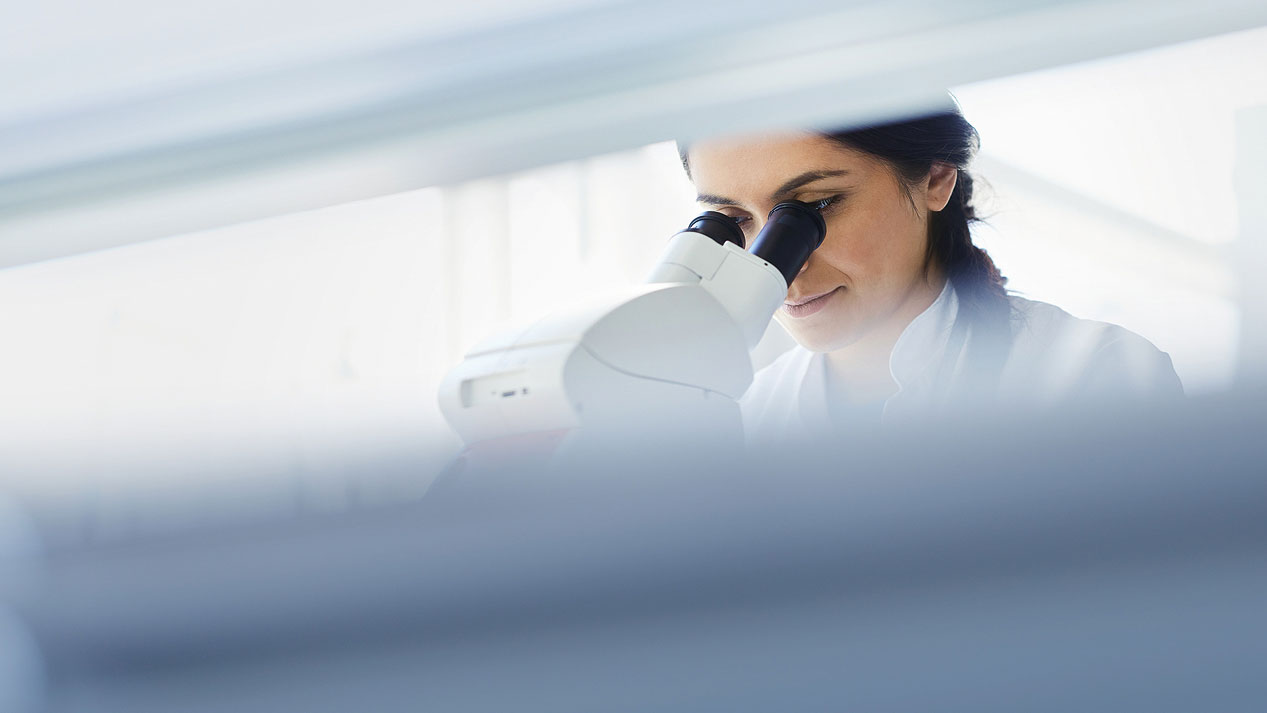

Getty Images/Solskin
Could people breathe through their intestines if their lungs fail? A biomedical start-up in Aachen is researching precisely this question. Meanwhile, in Duisburg, chemists are developing metal nanoparticles that could help proton lasers combat tumours more effectively. And in Wuppertal, an interdisciplinary team from policy and medical Research is investigating how local authorities can best address health risks caused by climate change.
Around universities and leading research institutes in North Rhine-Westphalia, numerous start-ups, small and medium-sized enterprises, research-intensive clinics and large international corporations from the medical Technology and pharmaceutical industries have established themselves. Innovative medicine is taught, researched and developed at nine medical faculties and university hospitals, approximately 80 teaching hospitals, 30 higher education institutions and more than 50 non-University research and development institutions. With the Medizin.NRW cluster, DLR Projektträger has established a central competence platform that connects all of these players – ensuring their ideas and research results reach practical application more quickly.
Cutting-edge medicine for tomorrow
There are few current trends in medical science and practice that are not being researched, tested or reimagined in Germany's most populous federal state. "Nanotubes, biosensors, neuroimplants − some research topics still sound like science fiction, but they have the potential to revolutionise medical practice as breakthrough innovations," says Patrick Guidato, manager of the Medizin.NRW cluster at DLR Projektträger.
Wherever cutting-edge research is conducted, the question arises as to how patients can benefit from it in everyday medical practice. Interdisciplinary collaboration is essential to ensure that innovations actually make it into healthcare provision – and quickly. This is where the Medizin.NRW cluster comes in, promoting strategic networking in North Rhine-Westphalia as a hub for innovation and medicine. DLR Projektträger manages the cluster on behalf of the North Rhine-Westphalia Ministry of Culture and Science. "Our most important task is to create analogue and digital networks that bring together key players in the world of cutting-edge medicine," says Patrick.
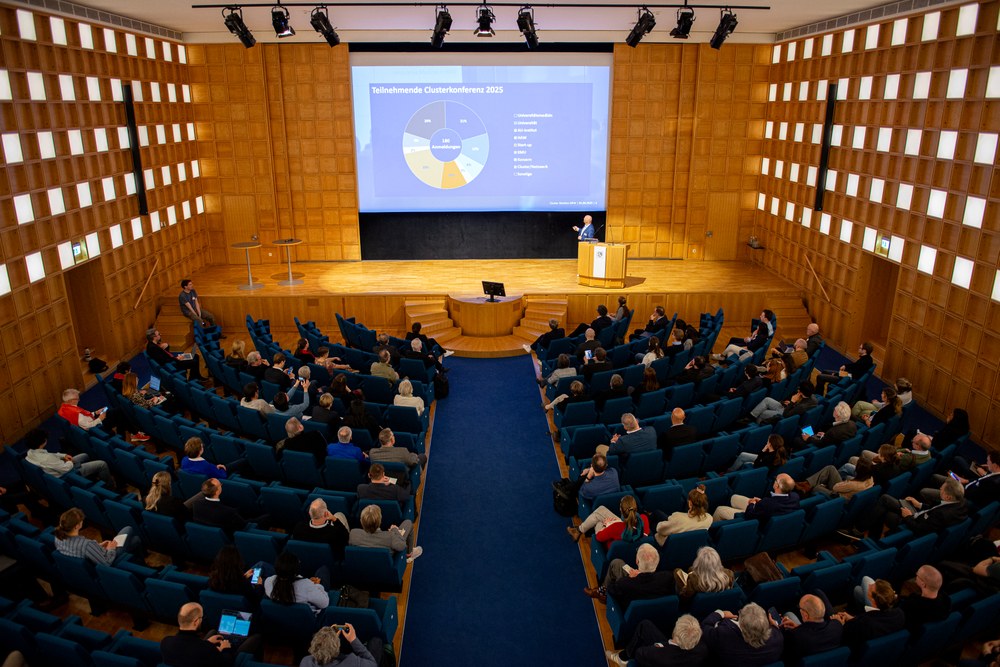
Vogelheim TV/Jens Koch
Improving medical care
Since its establishment in 2019, the four-person cluster management team at DLR Projektträger has already set up six such networks, with more than 300 experts at various career stages in science, industry and healthcare actively involved. "We identified strategic cross-cutting issues that bring together stakeholders from as many different disciplines as possible – and then developed a range of offerings and events around these topics to facilitate the exchange of knowledge and experience," explains Patrick. What all these lighthouse projects have in common is their focus on the perspectives and needs of patients and civil society. Because the fundamental question for the 'translation' of research results from the laboratory into clinical practice is: what is actually needed?
Finding clinical trials more quickly
One of the cluster's most recent projects also emerged from this question: an information platform for clinical trials. "Clinical trials are the linchpin of every medical and medical-technology innovation," says Patrick. Only once a medical innovation has been proven in a study to be safe and effective, and to provide a measurable improvement in healthcare, can it actually be used in clinical practice.
For many stakeholders in this process – such as medical practices, companies and other researchers – it is often a challenge to identify relevant studies and trial locations, suitable partner companies and appropriate patients. "There are various national and international databases available to search for suitable trials," explains Cluster Manager Patrick, "but they are so complex that even experts find them difficult to use." This led to the idea of creating a platform that provides an overview of clinical studies in North Rhine-Westphalia.
DLR start-up analyses data
The digital platform klinische-studien.nrw has been live in a test version since October 2025, for the first time bringing together structured information on clinical trials in North Rhine-Westphalia. The platform is based on an AI-supported tool developed by the DLR spinoff Kwintely Intelligence, which was originally designed to evaluate patent and publication databases. "We then asked: can you also extract and process data from medical registers?" reports Patrick.
The challenge is that the data in the existing trial registers is not recorded in standardised formats, which makes them difficult to interpret. The Kwintely AI solves this problem by collecting publicly available trial data from various international registers, standardising it and linking it to scientific publications. A team from DLR Projektträger has also developed an interactive web interface allowing users to search and analyse studies conducted in North Rhine-Westphalia by keyword, start year and end year.
Even during the test phase, feedback from as many different stakeholders as possible – from science, industry and clinical practice – is now being sought, emphasises Patrick: "We want to gather diverse feedback – and also use the new trial platform strategically to better connect North Rhine-Westphalia's healthcare industry and improve patient care."
"We make the possible visible"
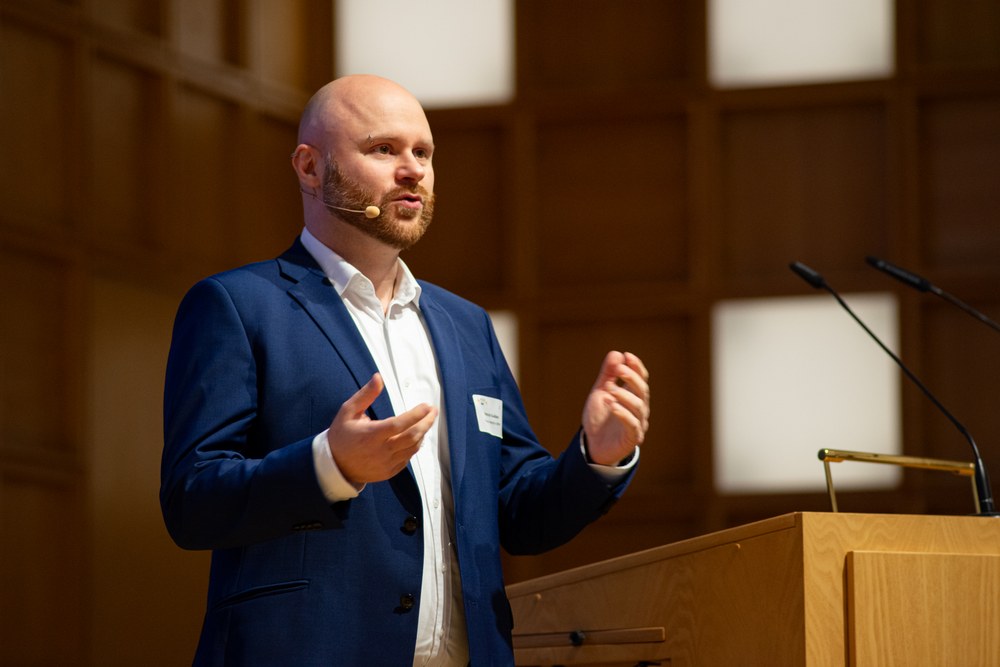
The framework conditions in the healthcare sector are complex. Patrick Guidato, Cluster Manager at Medizin.NRW, explains how innovation can still succeed.
Mr Guidato, why do innovations fail in the healthcare sector?
The framework conditions are challenging: anyone seeking to implement a medical or medtech innovation into routine care has to deal with complex approval procedures, questions of cost reimbursement and patent law. At an early stage, they must demonstrate that the innovation delivers tangible benefits – under challenging organisational and technological conditions. But that doesn't mean you should let this discourage you.
How can these obstacles be overcome?
By recognising that there is always someone who has succeeded before and from whom you can learn something. All players in the healthcare sector operate within these challenging conditions and can learn from one another how to successfully implement innovationsin this environment. But first, they need to know about each other – to meet and start talking. This is where we see a key role for our cluster: we make the possible visible.
Which topics are currently particularly relevant for the development of the healthcare sector?
There is a wide variety of topics and trends that we are addressing. In today's tense geopolitical and international environment, many researchers and companies are concerned with issues such as the availability of raw materials and skilled personnel – and we are in close exchange with other healthcare clusters across Germany and Europe. Innovative solutions are also needed, especially when it comes to the impacts of climate change on health. Age-related medicine is another topic that concerns many professionals in the industry: how can we pool medical expertise – from paediatricians to geriatric specialists – to better address the consequences of demographic change for the healthcare system and patient care? Of course, advances in biohybrid medicine are also equally fascinating: breakthroughs in this field could completely transform medicine as we know it. In short, it remains exciting! In all of these areas, the Medizin.NRW cluster will be called upon in the coming years to bring innovators together.
An article by Sarah Sommer from the DLRmagazine 179. She writes for DLR Projektträger and is fascinated by advances in modern medicine.