Licence to post
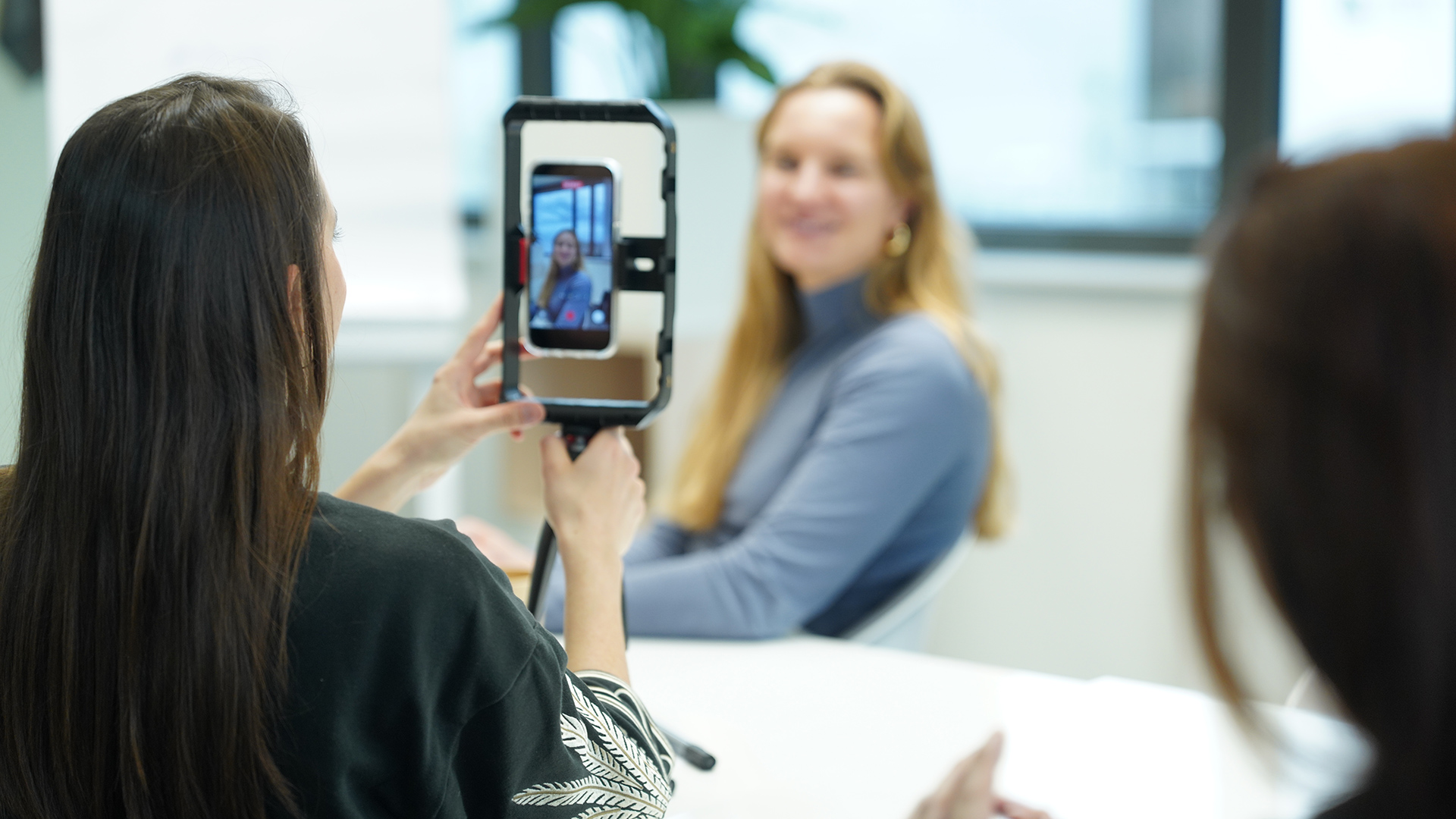

Robert Schültzky seems like someone who isn't easily flustered. In fact, he sounds like a career as a radio presenter or voice actor might once have been on the cards for him. Nevertheless, he works at DLR's Flight Experiments facility where he installs measurement equipment in helicopters, supports flight test campaigns and evaluates the resulting data. His enthusiasm is not purely professional – Robert is also working towards getting his private pilot's licence. He speaks with such energy about their flexibility, manoeuvrability and panoramic views that even I – an airline passenger prone to travel sickness and a fear of heights – feel a flicker of euphoria. It is precisely this enthusiasm that Robert wants to share on LinkedIn.
On LinkedIn: Robert Schültzky
"Tinkerers welcome!"
Daniela Heine wasn't particularly interested in social media before becoming a DLR Ambassador. Together with her team, she investigates the aerodynamic behaviour of trains as they enter tunnels. The tunnel simulation facility she works with is a 60-metre-long test track on which 1:25-scale models travel at speeds of up to 100 metres per second. Daniela and her team build both the models and the technology to measure them. "Tinkerers are always very welcome here," she explains, because test campaigns often require creative solutions. These are precisely the kinds of tinkerers she hopes to inspire in her work via LinkedIn.
On LinkedIn: Daniela Heine
At home in uncharted territory
Carina Kanitz likes to get her hands dirty at work. The experimental physicist screws, drills and solders in the lab – and is currently building an experiment at the DLR Institute of Quantum Technologies in which matter waves are diffracted. With her work in the field of quantum sensing, she is breaking new scientific ground. Carina approaches her role as a DLR Ambassador with the same pioneering spirit that led her to give up her work as a nuclear physicist at CERN and switch to quantum technologies for her doctorate at DLR. "People should know what happens in science and how it is done."
On LinkedIn: Carina Kanitz
Steampunk in the workshop
Nick Evers is also someone who enjoys tinkering and working with his hands. His training as an industrial mechanic focuses on manufacturing extremely precise components for equipment and experimental set-ups. He has already completed his apprenticeship piece – a steam engine. At first glance, this may seem somewhat anachronistic, but the skills he has learnt are now used to carry out commissioned work and his own projects. He is particularly attracted by the fact that, in his role, no two parts are ever the same: "Every job is unique."
On LinkedIn: Nick Evers
Connecting and inspiring
Carolin Altmann also came to DLR to try something new. A few years ago, she was tasked with establishing the DLR_School_Lab in Jena. Carolin is eager to inspire children and young people to take an interest in science – especially those who do not come from academic backgrounds. "I always take pleasure in interacting with others," she says. "I love adapting to each class and thinking about how best to engage the children." As a DLR Ambassador, connecting and inspiring is also her approach online – for the researchers of the future.
On LinkedIn: Carolin Altmann
"People trust people"
Direct interaction with people is a crucial factor in Arti Kalra’s everyday research. She develops control systems for helicopters that support pilots during maritime operations, such as rescue missions at sea. "It's not about replacing people," she emphasises, "but taking the pressure off them. People trust people, not machines." It was professional curiosity that drove her to join the DLR Ambassadors Programme, hoping that she can reach other researchers on social media as well as scientific and political decision-makers.
On LinkedIn: Arti Kalra
Background information: The DLR Ambassador Programme |
|---|
Showcasing DLR in all ist diversity, highlighting Team members' achievements, sparking fascination for research and perhaps even inspiring a career at DLR – these are the goals of the Ambassadors Programme. "Research doesn't happen in an ivory tower," explains Simon Mechenbier from the social media team, who leads the programme. On LinkedIn: Simon Mechenbier |
"Everyone has an opinion on it"
Julia Jarass knows what it means to engage in dialogue. The geography graduate, whose research focuses on mobility and sustainability, has organised, conducted and evaluated several real-world experiments at the DLR Institute of Transport Research. She sees social media as an opportunity to draw attention to successful transport projects. If she could choose one thing, it would be for people to take centre stage in road planning – with lots of greenery and creative approaches to rethinking how space is used.
On LinkedIn: Julia Jarass
Where food isn't found, but grown
Green is Jess Bunchek's keyword. The American astrobotanist works at DLR on the question of how to grow food in hostile conditions. For fourteen months, she grew vegetables in Antarctica as part of DLR's Eden ISS project. Originally, the agricultural scientist had farmers in mind. Now, she is thinking more in terms of spaceflight, as the experiments she is conducting aim to enable the cultivation of fresh food on future missions to the Moon and Mars. Jess now looks forward to reporting directly on social media and connecting with fellow DLR Ambassadors.
Eden ISS project. Originally, the agricultural scientist had farmers in mind. Now, she is thinking more in terms of spaceflight, as the experiments she is conducting aim to enable the cultivation of fresh food on future missions to the Moon and Mars. Jess now looks forward to reporting directly on social media and connecting with fellow DLR Ambassadors.
On LinkedIn: Jess Bunchek
The Moon on Earth
Maria Hallinger is responsible for Moon missions – at least, for those taking place on Earth. For nearly two years, she has worked for DLR on the LUNA project – a joint undertaking with ESA. LUNA is a unique test facility where researchers can simulate Moon missions under realistic conditions. Maria is part of the team that oversees these test campaigns and ensures conditions in the facility are always right. She is happy to now officially share her insights as part of the Ambassadors Programme: "You could say I now have the licence to post!"
On LinkedIn: Maria Hallinger
Satellites made of wood?
For Isil Sakraker Özmen, the Moon is not the priority. This aerospace engineer is more interested in what’s going on down in Earth's orbit. She works on making satellite structures more sustainable – so that they completely burn up at the end of their operational life and don’t leave behind any space debris. This concept is known as Design for Demise. Together with colleagues, Isil experiments with new materials, even including wood, and examines their effect on the environment and atmosphere. As a DLR Ambassador, she hopes to raise awareness for sustainable spaceflight: "I like the idea that I can be a role model," she says. "I’m happy to take the time for that."
On LinkedIn: Isil Sakraker Özmen
Feeling the breeze
Closer to the ground, between the sky and Earth, you’ll find Lukas Firmhofer – at least whenever he’s at DLR's 'WiValdi' research wind farm. Lukas is project lead for the OPUS 3 project – an experimental turbine designed primarily as a test platform for aerodynamic and aeroelastic research. The facility can be modified in a near limitless number of ways as individual components can be swapped to suit requirements. Lukas was himself involved in building the nacelle – "That's where the mechanical engineer in me comes in," he says. As a DLR Ambassador, Lukas wants to achieve one thing above all else: to raise awareness for the project – and thereby gain new collaborations with the worlds of research and industry.
On LinkedIn: Lukas Firmhofer
Breathing new life into PhD ideas
Anika Weber's research also sits at this interface between science and industry. As part of her doctorate, she is developing a novel reactor concept that produces synthesis gas using concentrated solar radiation. Anika almost became a maths and physics teacher, but the appeal of going into research was ultimately stronger. "I don't want to look towards a retirement spent reading about one disaster after the other," she says, explaining her decision to choose energy research. In her view, solar energy has massive societal and economic potential. That is precisely why she is now a DLR Ambassador. Good research must not remain trapped in the laboratory, she stresses: "It's of no use if we develop something great but nobody knows about it."
On LinkedIn: Anika Weber
An article by Melanie Dorweiler from the DLRmagazine 179. She works at DLR Projektträger and is looking forward to getting to know her employer from a new perspective thanks to the Ambassadors Programme.