In January 1927, the Aerodynamics Research Institute (AVA) in Göttingen – one of the predecessor organisations of today's German Aerospace Center – received an unusual request. The enquiry came from Swiss engineer Reinhard Straumann (1892–1967), who wanted to know whether the aerodynamic conditions of ski jumping could be studied under laboratory conditions to determine the optimal posture for a ski jumper and the ideal flight trajectory. The AVA responded promptly, confirming that such investigations could indeed be carried out in the wind tunnel – provided he supplied a suitable model.
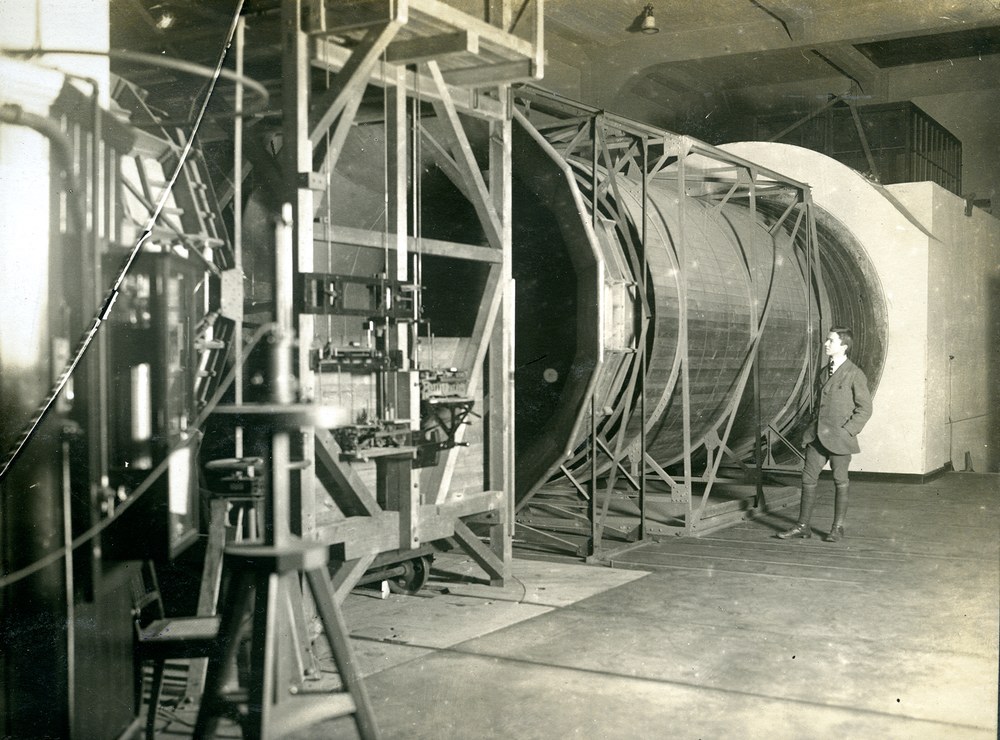
Wind Tunnel l, Aerodynamics Research Institute (AVA)
Wind Tunnel I of the AVA went into operation in 1917 and could reach speeds of up to 58 metres per second
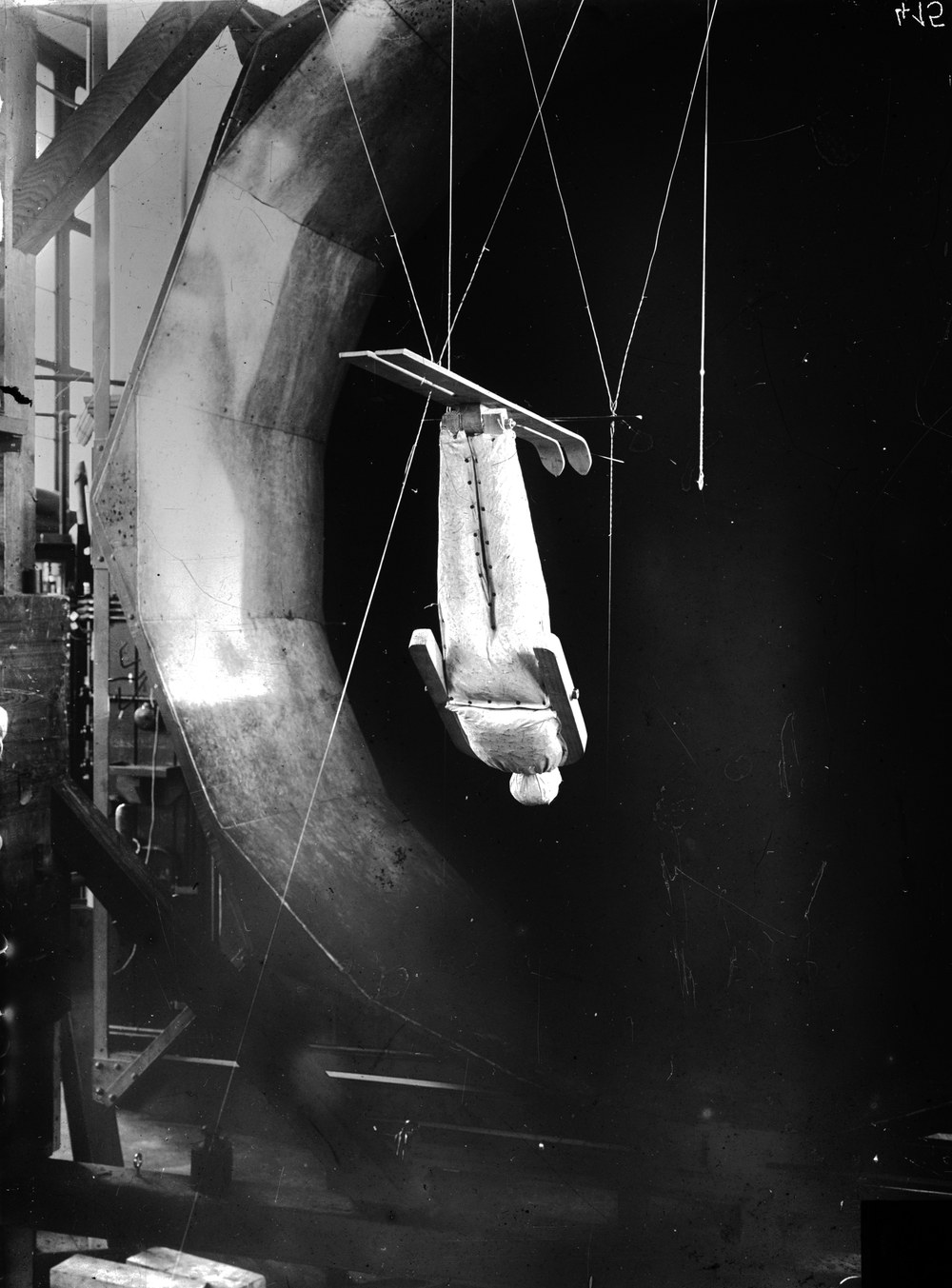
Just a few weeks later, the Göttingen researchers received a package containing a wooden mannequin measuring approximately 50 centimetres in height, along with a pair of scaled model skis. The mannequin was equipped with a joint at hip level that allowed the upper body to be adjusted into various postures. To give the model the most realistic appearance possible, it was carefully padded with fabric in Göttingen – and it was ready for use.
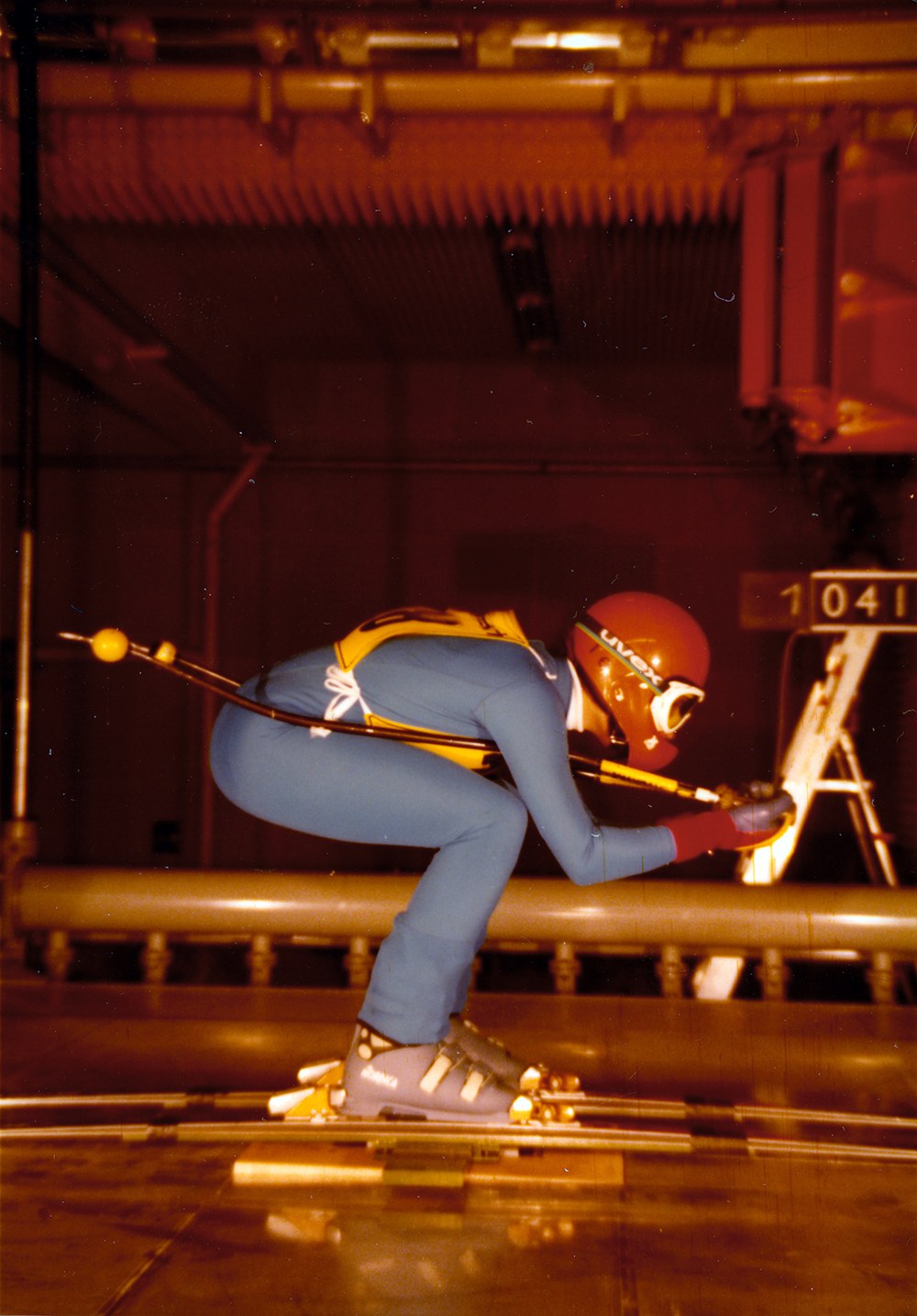
Investigation of a downhill skier in the three-metre wind tunnel in Göttingen
Examining a downhill skier in the three-metre wind tunnel in Göttingen in preparation for the 1976 Winter Olympic Games
In Wind Tunnel I – normally used to test models of aircraft, automobiles, rail vehicles and ships – the wooden mannequin was now suspended, hanging upside down for reasons of stability. Over several experiments, the Göttingen researchers meticulously measured lift and drag in different body positions and sent the results to Straumann.
The engineer carefully studied the data and published an article entitled 'Vom Skiweitsprung und seiner Mechanik' (On ski jumping and its mechanics) in the Swiss Ski Association's magazine that same year. In it, he recommended that ski jumpers crouch as low as possible during the 'inrun' – the steep track at the top of a ski jump hill where jumpers gain crucial speed. During take-off, the upper body should then be thrust quickly forwards, adopting a slightly rounded shape in flight – similar to the cross-section of an aircraft wing.
In fact, the research conducted in the Göttingen wind tunnel helped to gradually increase jump distances, and to this day the optimal upper body posture for ski jumpers identified in 1927 is still clearly recognisable.
Designing better ski jumps
Straumann's interest in ski jumping went even further. Based on the data collected in Göttingen, he subsequently developed recommendations for the construction of ski jump hills and was appointed as a technical member of the International Ski Federation. The 'Trampolino Olimpico Italia' ski jump in Cortina d'Ampezzo, built for the 1955 Winter Olympics, is based on one of Straumann's designs.
The ski jump is no longer used for competitions, as Italy now has two more modern facilities. Nevertheless, it remains a popular tourist destination – thanks in part to its appearance in several scenes from the well-known James Bond film 'For Your Eyes Only' (1981).
The search for the ideal posture and aerodynamic equipment to give ambitious athletes an edge over their competitors continued even after Straumann left the International Ski Federation. In 1975, the German Ski Association approached the then 'German Research and Test Institute for Aviation and Space Flight' (DFVLR) – now DLR – for assistance.
On the way to gold
In preparation for the 1976 Winter Olympic Games, the German Ski Association wanted its athletes and their equipment to undergo wind tunnel tests. The three-metre low-speed wind tunnel in Göttingen was ideal for this purpose, so the German athletes nominated for the Games travelled there for a series of intensive tests in the pre-Olympic year. The investigations paid off: the downhill skier Rosi Mittermaier won two gold medals and one silver medal in various disciplines the following year.
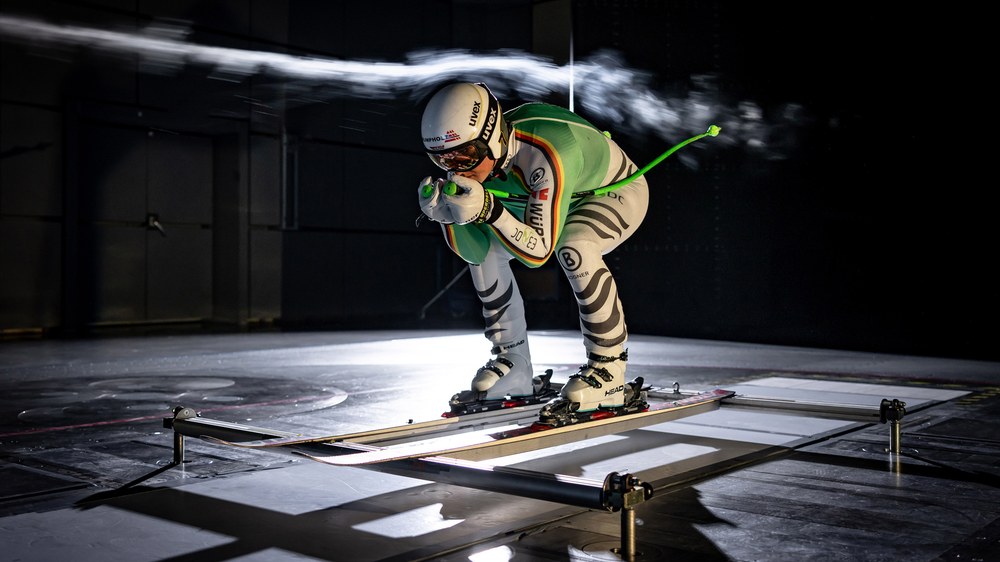
Athlete in the Audi wind tunnel
Today, the German Ski Association uses the Audi Wind Tunnel Center in Ingolstadt to prepare its athletes for competitions
Credit:
Audi AG
To this day, elite athletes use wind tunnels to optimise their posture and test new equipment for its aerodynamic performance. However, the three-metre wind tunnel in Göttingen is no longer available for this purpose. It was decommissioned many years ago to make way for a more modern low-speed wind tunnel at the DLR site in Braunschweig. Where winter sports athletes once endured the blast of air, school classes now bustle around, visiting the School_Lab Göttingen and learning how such experimental facilities work in the decommissioned wind tunnel.
An article by Jessika Wichner from the DLRmagazin 179. She prefers gliding through the roller racks of DLR's Central Archive to being on skis, and in doing so regularly uncovers surprising historical documents that remain relevant to this day.