Article from the DLRmagazine 179: DLR spin-off TerraLens uses AI to analyse satellite data
Searching for a needle in a haystack
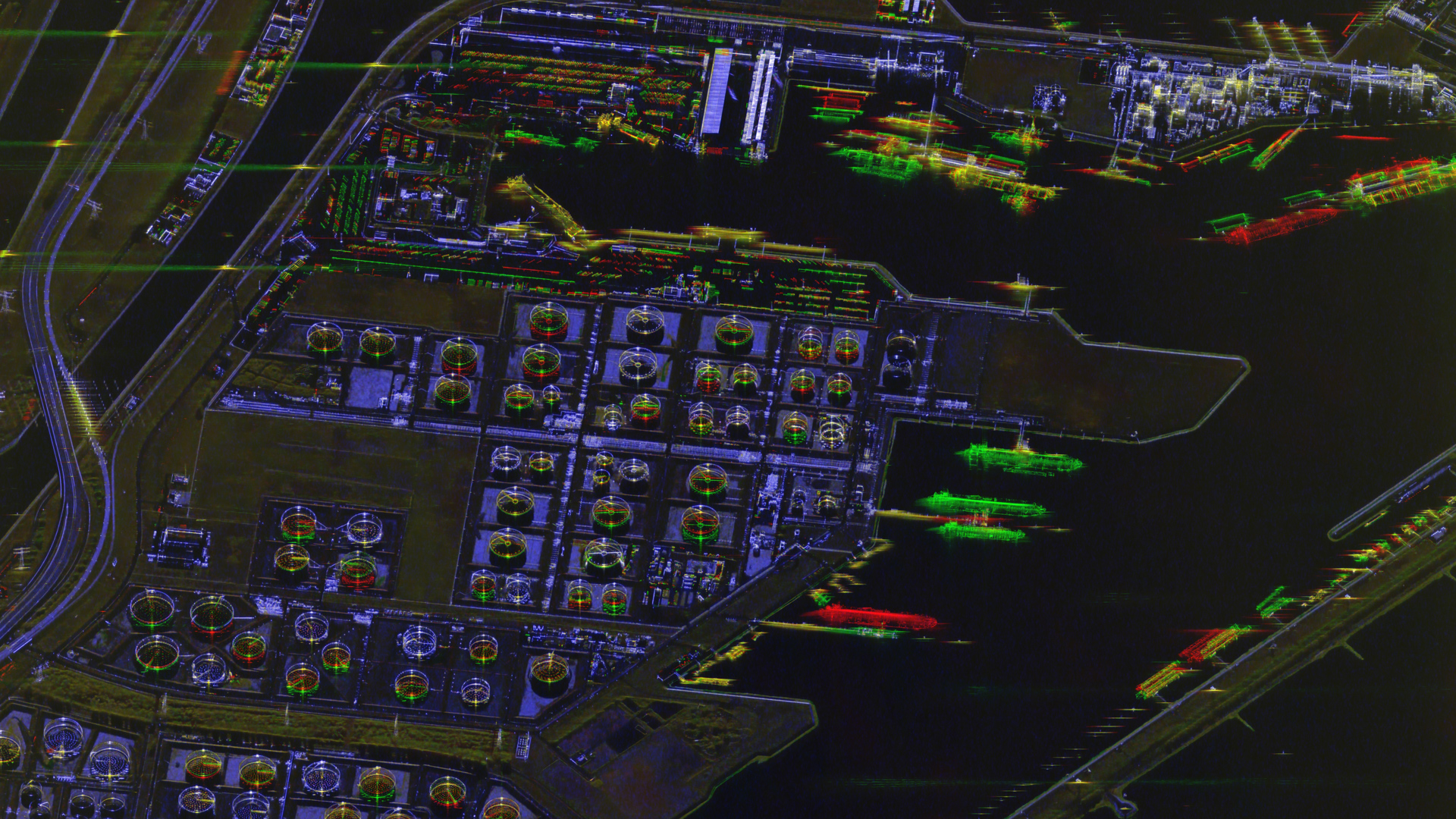
This SAR satellite image shows the port of Rotterdam
Detected changes are highlighted with different colours: objects marked in red have appeared since the previous image was taken, green indicates what has disappeared, blue represents stationary structures and yellow reveals small positional changes.
Credit:
DLR, Airbus Defence & Space GmbH, TerraLens GmbH
TerraLens founders
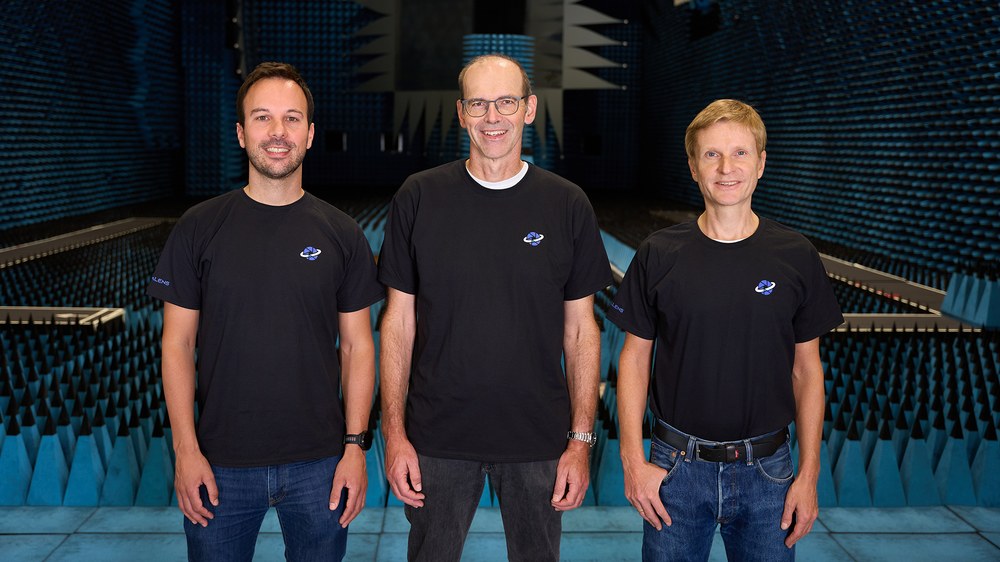
The three TerraLens founders set up their business four years ago based on their idea that AI could help assess SAR satellite data. From left: Carlos Villamil Lopez, Manfred Hager, Harald Anglberger)
Founding a company," says Manfred Hager, "was a challenge that appealed to me." With a degree in electrical engineering, he has been part of DLR since 1997. Together with his colleagues Carlos Villamil Lopez and Harald Anglberger, Manfred co-founded the start-up TerraLens in 2022. Until then, the three had worked at the DLR Microwaves and Radar Institute. Their work had long been focused on the analysis of satellite data, yet their interest in Earth observation developed in a roundabout way: Manfred and Carlos studied electrical engineering, while Harald is a technical mathematician. Eventually they ended up in the same research group and worked on analysing SAR satellite data – a technology that fascinated them from the very start.
Earth observation, day or night
Satellites carrying Synthetic Aperture Radar (SAR) sensors typically operate in low Earth orbit. As Harald puts it, these satellites "essentially bring their own torch". They send radar waves towards Earth's surface, enabling them to generate images independent of light conditions. The radar waves even penetrate clouds, providing images whatever the weather. Radar images generated in this way can achieve levels of detail similar to images captured with visible light.
Germany has been operating its own SAR satellite missions since 2006. Most recently, the European Space Agency (ESA) launched the Biomass mission, with a satellite of the same name using SAR to precisely determine forest biomass – the mass of living things (see page 32, 'Flying in sync over the jungle').
The rising number of satellites is also leading to an increase in available SAR data – which is both a blessing and a curse. While swathes of data ensure a more comprehensive image of the Earth, human analysts are no longer able to process the flood of data. Picking out relevant information is akin to the proverbial search for a needle in a haystack.
AI helps trawl through the data
This is where the idea behind TerraLens comes in. The start-up markets software that, with the help of artificial intelligence, supports the analysis of SAR satellite data. This is a real technical challenge as radar images are subject to a variety of disruptive effects, including strong noise and 'layover' effects – areas with ambiguous information in the pixels. The TerraLens software helps to visually process the images so that they are easier to interpret. What's more, it enables the automated detection of changes over time, ranging from alterations to infrastructure or buildings through to the identification of previously unknown objects.
Suddenly, an entrepreneur
Making the switch from scientist to entrepreneur isn't easy. Besides keeping up with scientific and commercial developments impacting their business, entrepreneurs must also deal with personnel responsibility, project funding and attracting investors.
"It is important to us that our research results provide added value for people. They can do so if they are transferred into the commercial world, for example in the form of start-ups," says Karsten Lemmer, DLR Executive Board Member for Innovation, Transfer and Research Infrastructure. Of the 94 spin-offs that have emerged from DLR since 1993, approximately 90 percent are still in business.
In 2023, to support DLR researchers through the spin-off process, the DLR_Startup Factory was established – a company-building programme that guides DLR employees step by step as they realise their founding aspirations. Start-up coaches support teams in developing a business idea based on their research and assess its market potential – above all, they help strengthen entrepreneurial skills. The aim is to form the basis for a start-up's long-term success.
Business idea driven by geopolitical developments
TerraLens is now almost four years old. Since its founding, the European market has changed. "The defence technology market is currently being shaken up," says Harald. "New fields of business are constantly emerging, and competition is fierce." Manfred adds: "Our time at DLR means we have many years of experience in the security sector. As a small, agile company, we offer another key advantage – we're fast!"
Three questions for…
Georg Seydel, Departmental Head at DLR and Director of the DLR_Startup Factory
Georg Seydel
Departmental Head at DLR and Director of the DLR_Startup Factory
We support employees who want to start their own business based on DLR research. The programme is open to all colleagues – from scientific staff to institute directors. Those interested in founding a company can even come to us without a concrete idea, and we will explore together whether a viable business concept can be developed.
How is the programme structured?
The programme consists of five successive stages, starting with idea generation and followed by the development of a business model. This model is then validated through a market study involving customer interviews. If the study findings are positive, the teams start to build their entrepreneurial skills and prepare for the formal establishment of the company. In the final stage, funding models are devised for the start-up and the opportunities for DLR to get involved are examined. Every team of founders is accompanied by one of our DLR_Startup Factory coaches, who remain on hand for support.
What’s in it for DLR?
DLR benefits in many ways from spin-offs. They bring our research into real-life application, benefiting both society and the German economy. Numerous examples show that start-ups continue to cooperate with DLR after being founded, further developing technologies together. As a result, hands-on insights flow back to DLR. Last but not least, DLR's various institutes also benefit from licensing revenue – every start-up whose operations build on DLR patents licenses the relevant technology under standard commercial terms.
DLR_Startup Factory
Since 2023, DLR has offered a comprehensive and systematic framework programme through the DLR_Startup Factory to get successful, research-based start-ups off the ground. These businesses put research insights into practice, bringing them to market. They generate new ideas to drive innovation. Through products and services, they create value and help solve society's challenges.
An article by Jonas Daniels from the DLRmagazine 179. He is an editor for the DLR Executive Board department for Innovation, Transfer and Research Infrastructure.