
Brochure: Mission InSight (2018)
1013.9 KB | PDF
View into the Interior of Mars

Last updated: 1 October 2026
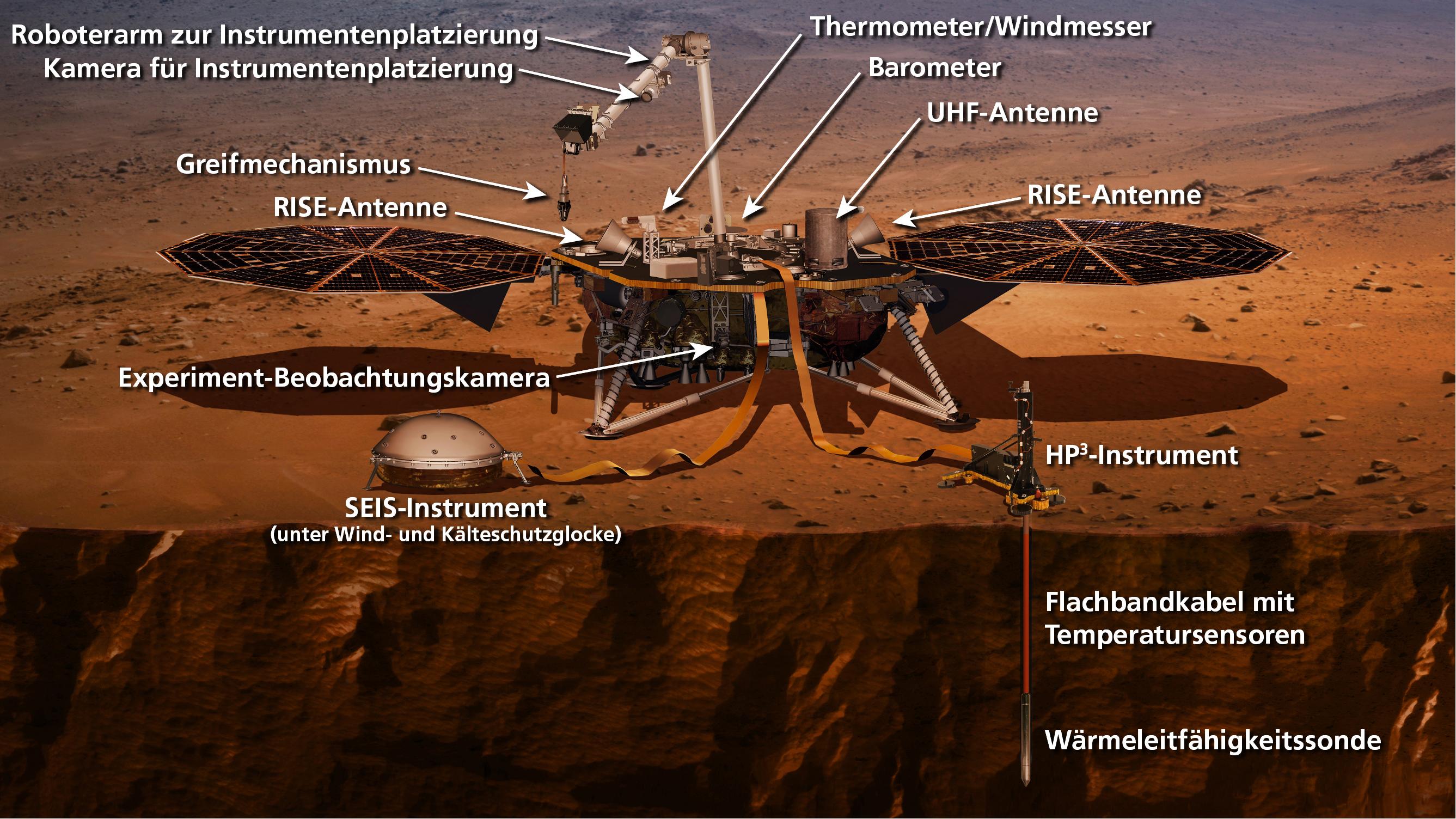
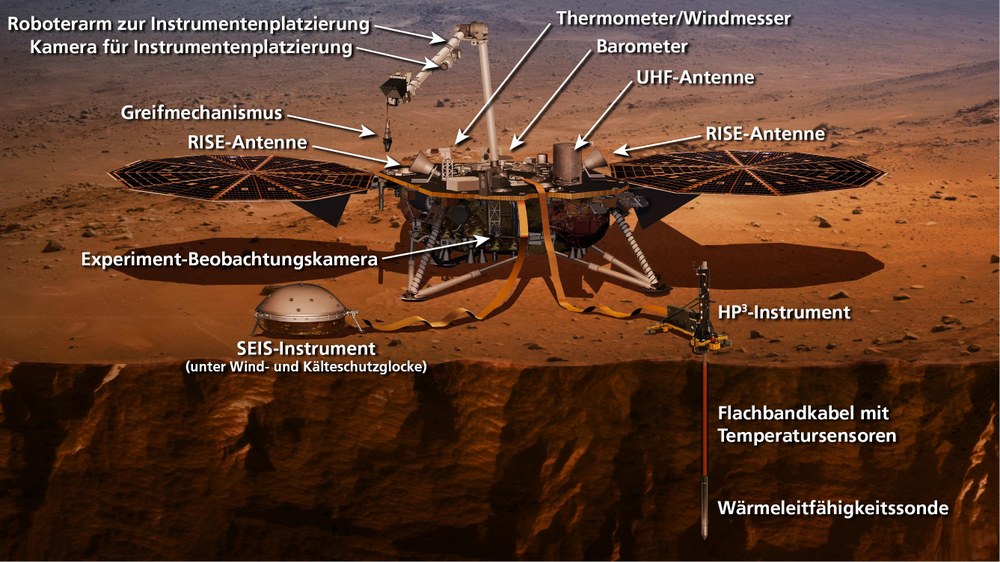
The InSight lander will carried two major experiments, the Heat Flow and Physical Properties Probe (HP3) and the Seismic Experiment for Interior Structure (SEIS), to Mars, where a robotic arm placed them beside the spacecraft after landing. Further experimental components remained attached to the lander itself to assist with the tasks involved in the experiments. There was also the Rotation and Interior Structure Experiment (RISE), which recorded shifts in the frequencies of radio signals (Doppler effect) in order to measure tiny variations in the inclination of Mars’ rotational axis.
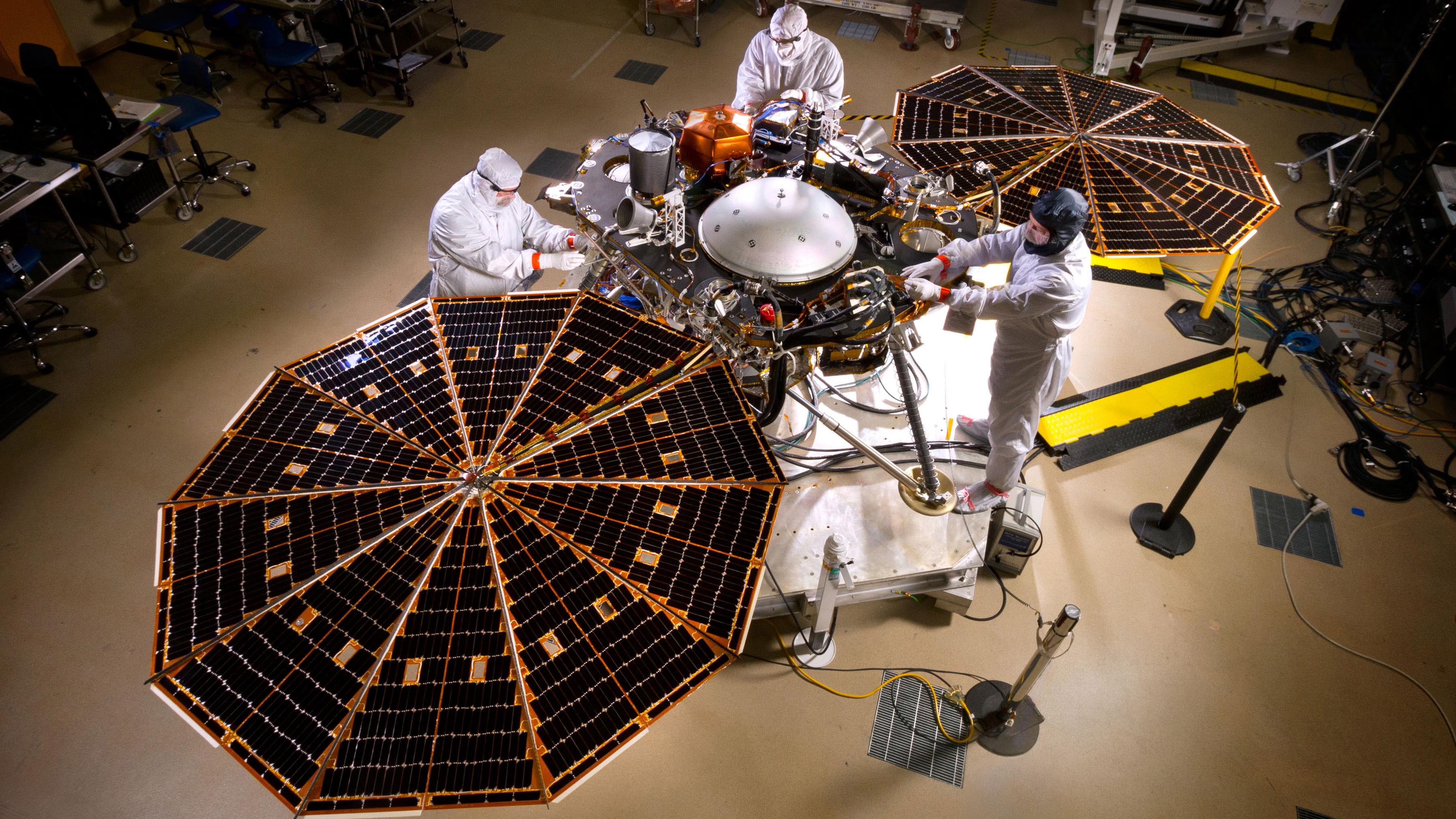
In many respects, the design of the lander was structurally similar to that of NASA's successful Phoenix lander , which touched down on 25 May 2008 near the Martian north pole and carried out experiments over a six-month period, using a scoop for the first time to detect water ice in the form of hoar frost. The aerospace company Lockheed Martin Space Systems began constructing the InSight lander on behalf of NASA in May 2014. The launch of InSight was originally planned for 2016, but NASA postponed it to 2018 due to a leak in a vacuum component of the SEIS seismometer. The main component of the lander was a platform measuring two metres across, to which most of the system components – the experiments in ‘travelling mode’, the antennas, the on-board computer, the thrusters, the propellant tanks and three telescopic legs – were attached. After landing, a robotic arm unfolded and lowered the apparatus for the HP³ and SEIS experiments onto the Martian surface. Two solar panels were attached to the side of the platform. When these were deployed, InSight had a span of 6.1 metres. The spacecraft had a total mass of 360 kilograms.
One new feature of this mission was Mars Cube One (MarCO) – two small satellites. These were based on the CubeSat concept, in which cube-shaped modules with 10-centimetre-long sides were combined to form bigger satellites. Each of the two MarCOs consisted of six CubeSat units. After leaving Earth orbit, they detached from the InSight spacecraft and accompanied the lander on its way to Mars, but following their own trajectories. On arrival, they entered orbit around Mars. Their task was to maintain communications between InSight and NASA’s Mars Reconnaissance Orbiter (MRO) during InSight's arrival and landing – including the most critical phase of the mission (Entry, Descent and Landing; EDL) – while orbiting over the entry zone. This was the first time for small satellites to be used around another celestial body. The project had technology demonstrator status and was not critical to the success of InSight.
The HP3 experiment, which was developed at DLR, consisted of an instrument casing that housed the measuring cable and data cable for connection to the ground probe. A 'drilling rig' was mounted on the front of this housing, which contained the percussion hammer. At 40 centimetres long and 27 millimetres across, the 'Mole' penetrometer used the hammer mechanism to bore. The centrepiece of the experiment was a measuring cable equipped with temperature sensors that were pulled behind the penetrometer, while remaining connected to the casing on the surface, which served as the Support System Assembly (SSA) or 'Sphinx'. The platinum temperature sensors took readings every hour. The sensors on the measuring cable provided measurements that are accurate to a few thousandths of a kelvin. Model calculations had shown that measurements had to be taken for at least a few months to determine the heat flow from the interior of Mars. The 'brain' of the experiment – an electronics box – was located on the InSight lander, where it was protected from large temperature variations. This electronics box was used to operate the experiment from the ground control centre at the DLR site in Cologne.
Ideally, the impact mechanism would have reached a depth of five metres after around two months, so that it could record the heat flux there, which is unaffected by the fluctuating surface temperatures. The minimum depth required for this is three metres. Unfortunately, the ‘Mole' probe of DLR’s HP3 did not fully deliver the expected measurements, because the heat flow probe could not successfully penetrate to the required depths beneath the Martian surface. The self-hammering probe, capable of penetrating through the familiar loose, sandy soil of other missions, was unable to find a foothold in the unexpectedly hard soil around InSight’s surroundings. The instrument was eventually able to bury its 40-centimetre probe just below the surface, collecting some valuable data on the mechanical and thermal properties of the Martian soil. The fact that the Mole was finally able to burrow in is thanks to a team effort by engineers from JPL and DLR. They used the InSight lander's robotic arm in a creative way to give the Mole additional support.
From the Sphinx, a second data cable maintained contact with the computer on board InSight, from which measurement data were transmitted to an orbiter travelling around Mars, and from there to Earth. The experiment also included an infrared radiometer that measured the daily temperature trend. DLR's Microgravity User Support Centre (MUSC) in Cologne operated HP³. The DLR Institute of Planetary Research (today DLR Institute of Space Research), which was responsible for developing the experiment in collaboration with the DLR Institutes of Space Systems (Bremen), Optical Sensor Systems (today DLR Institute of Space Research, Berlin), Space Operations and Astronaut Training (Cologne facility), Composite Structures and Adaptive Systems (Braunschweig), System Dynamics and Control (Oberpfaffenhofen), and Robotics and Mechatronics (Oberpfaffenhofen), was directing the experiment. The industry partners were Astronika (Warsaw), Magson (Berlin) and Sonaca (Berlin).
SEIS was a seismometer that measured ground movements on Mars at different frequencies using six sensors, three short period sensors (SP) and three very broadband sensors (VBB). The instrument was developed by a consortium led by the French space agency (CNES). Germany provided the levelling system (LVL) for SEIS, which was developed and built at the Max Planck Institute for Solar System Research in Göttingen.
A seismometer records ground vibrations. On Earth, massive vibrations can be triggered by earthquakes or explosions. The quake waves then travel across the planet and, if the source is strong enough, may be detected all over the world. Minor vibrations are familiar in everyday life, caused by passing trains or, more rarely, underground cavities collapsing, as occasionally happens with abandoned mines. Their measurement uses the principle of the inertia of masses – every mass endeavours to maintain its current state of motion. Only when a force acts on the mass does it change its state of movement, for instance by accelerating or decelerating. If the suspension point of a pendulum is suddenly moved to the side, the pendulum mass will initially remain where it is, and then follow the movement.
The centrepieces of the SEIS experiment were two sets of three extremely sensitive suspended masses that registered even the smallest movements of the Martian surface. The movement of the masses was recorded electronically. A feedback mechanism attempted to keep the mass stationary, and the power required to do so served as the measured variable. Such devices, referred to as null instruments, allow highly sensitive measurements. Motors that were able to tilt the system in all directions by small increments ensured that SEIS was perfectly levelled. The biggest challenge to performing consistently reliable seismic measurements on Mars came in the form of the large differences in temperature between night and day, and from summer to winter. Due to the fact that materials expand when heated and contract when cooled, SEIS was equipped with a sophisticated thermal control system that comprised several insulating layers, like a Matryoshka doll. These layers compensated for external temperature differences, so that stable measurement conditions prevailed within the instrument. A hemispherical dome consisting of several individual layers protected SEIS against the effects of the Martian wind and the dust transported by it.
The SEIS Experiment recorded seismic waves from more than 1300 tremors in the Martian soil between early 2019 and the end of the mission. These include mostly waves generated by quakes that occurred at different locations in the Martian crust during the discharge of tectonic stresses, but some of these waves were triggered by asteroid impacts. In these cases, even the location of the impacts could be reconstructed. Caused by tectonic activity, these marsquakes provided important clues about the structure of the Red Planet. The reflection of these seismic waves at the boundaries between the solid rock mantle and the liquid core finally allowed the size of the Martian core to be determined precisely. Its diameter is between 3600 and 3700 kilometres. The complementary auxiliary instruments on board also provided data, such as the DLR RAD radiometer, which is part of HP3. RAD recorded the daily change in the surface temperature by measuring infrared radiation. This is important data for characterising the thermal properties of the Martian soil.
The RISE experiment, devised by the NASA Jet Propulsion Laboratory, recorded shifts in the X-band radio frequencies (microwaves, 7–11 gigahertz) in order to measure tiny changes in the inclination of Mars’ rotational axis, which in turn indicated variations in homogeneity within the planet. The experiment complemented data recorded by the Viking lander in the 1970s and the Mars Pathfinder mission (1997), which had provided important indications of the size of the Martian core. The third dataset provided by InSight helps characterise the nutation of Mars’ axis of rotation. Nutation is a ‘wobble’ of the planet’s rotational axis caused by the inhomogeneous distribution of mass within the planet. It is a deviation from the circle that the Mars’ axis ‘traces’ in the sky. The orientation of this axis changes over long periods due to the influence of massive celestial bodies such as the Sun and neighbouring Jupiter. The circular motion of the orientation of the axis of rotation is referred to as precession. Nutation adds a small sinuous variation to the precession.
A camera attached to the telescopic arm took 3D colour images of the area immediately around the landing site, in particular the sites for the deployment of HP3 and SEIS, and was used to monitor the activities involved in the experiments.